How to Find Immigrant Ancestors When Their Name Was Anglicized
Learn how to find immigrant ancestors whose names were anglicized or changed. Tips for searching name variants and spelling differences in historical newspapers.
Historical newspapers are one of the most reliable tools for finding immigrant ancestors whose names were anglicized or changed in official records. Community papers, ethnic church notices, obituaries, and small-town columns often used original or partially anglicized spellings, creating a bridge between the name an ancestor arrived with and the name that appeared in later American records. A single obituary can contain both forms of a name, name a foreign birthplace, and list multiple family lines under different surnames. NewspaperArchive includes extensive small-town and community newspaper coverage, making it possible to search name variants across the papers where immigrant families actually lived and were known.
You find a family in American records with a surname that looks perfectly ordinary. But when you try to trace them back to their country of origin, the connection disappears. The name does not appear in ship records, church registers, or foreign documents because it was not the name they arrived with.
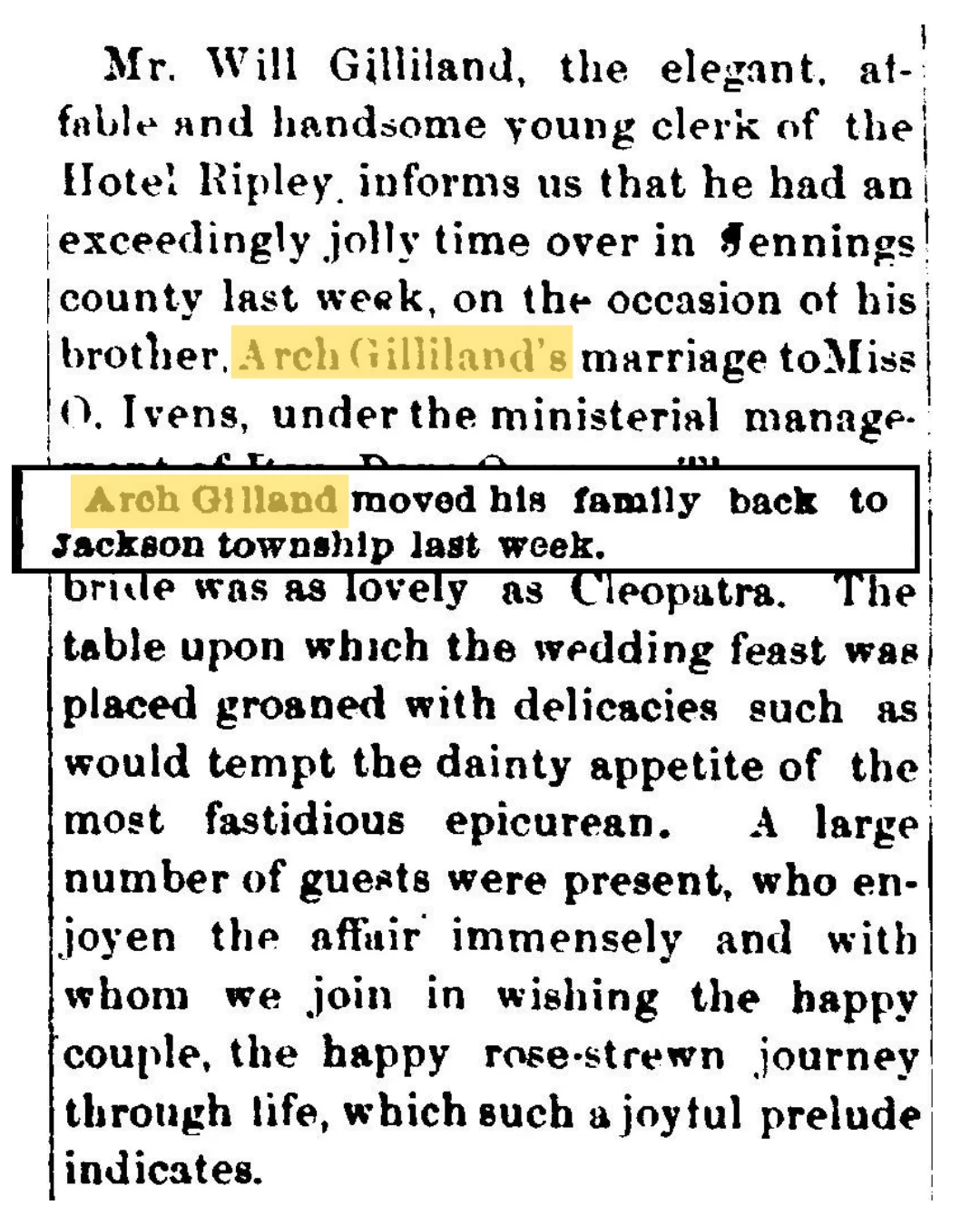
My husband's family ran into this exact problem on his maternal line. In 1886, a local Indiana paper covered the wedding of Arch Gilliland, describing the groom as handsome as a young Apollo and the feast table groaning with delicacies. Six years later, another paper noted that Arch Gilland had moved his family back to Jackson township. Same man, same family, two different spellings across two clippings. No single document made the change official. The name just drifted, the way names often do when spelling was inconsistent and nobody was checking. If you searched only one version, you would miss half the family.
Anglicized names are one of the most common walls in immigrant genealogy research. A name might have been simplified at the port of entry, translated into its English equivalent, or gradually changed over years of living in an English-speaking community. Sometimes the immigrant chose to change it. Sometimes a clerk made the decision for them.
What official records often miss, newspapers frequently preserve. Community papers, ethnic church notices, and small-town columns used the names people actually went by in their daily lives, and those names were not always the same ones that ended up on certificates and court documents. If you are still building the case for why newspapers belong in your research routine, this breakdown of what newspapers reveal that census records don't is a practical place to start.
Quick Answer: When an immigrant ancestor's name was anglicized, the original spelling often still appears in newspapers from their home community, church, or ethnic neighborhood. Searching name variants, phonetic spellings, and both the original and anglicized forms in NewspaperArchive can help you find clippings that connect the old name to the new one. A single obituary or community notice may use both versions in the same article, which is one of the most useful clues a researcher can find.
If you are ready to test some of these name variations now, this guide to searching NewspaperArchive and finding people faster can help you get better results from the start. Or go straight to NewspaperArchive search and try both versions of the name side by side.
Why Names Changed and What That Means for Your Search
Name changes happened for many reasons, and understanding the reason can help you figure out what to search.
Some names were translated directly into their English equivalent. Heinrich became Henry. Wilhelm became William. Mueller became Miller. Schmidt became Smith. If you know the original language, a quick look at common translation equivalents can give you a list of names to try.
Other names were anglicized phonetically. A clerk or immigration officer wrote down what they heard, which might be close to the original or quite far from it, depending on the accent, the noise in the room, and how carefully anyone was paying attention. These phonetic versions can be harder to reverse-engineer, but they often cluster around a few common patterns.
Some immigrants changed their names deliberately, either to fit in more easily or to leave something behind. In those cases, the original name may only appear in the earliest records from their community or in documents that predate the change.
Knowing which type of change you are dealing with helps you decide where to search and what spelling variations to try.
How Newspapers Preserved Names That Official Records Changed
Official records tend to reflect the anglicized name because that is what was recorded at the time of the transaction. Newspapers, especially community papers, often worked differently.
Local reporters and typesetters knew the people they were writing about. They used the names those people used at home, at church, and in their neighborhoods. That is why the same person might appear in a death certificate as Henry and in a newspaper obituary as Heinrich.
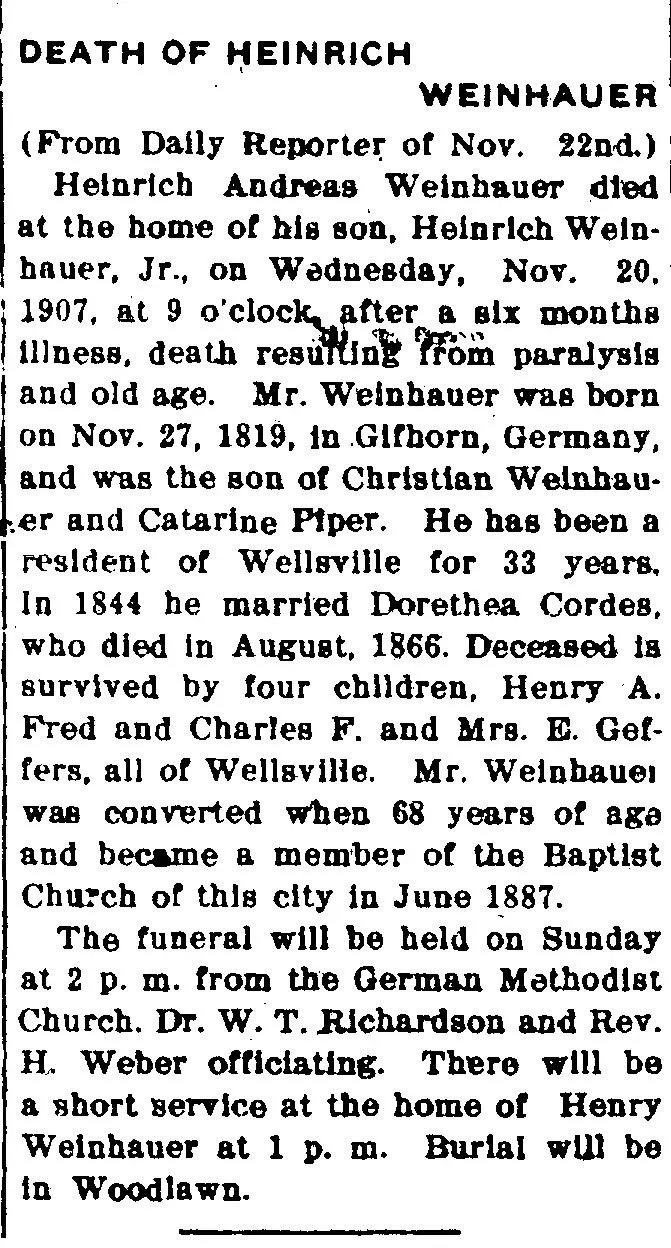
This clipping from a New York paper is a clear example. The headline reads "Death of Heinrich Weinhauer." The article identifies his son as "Heinrich Weinhauer, Jr." and later refers to the same son as "Henry A." Both names appear in the same article, written about the same person.
For a researcher, that inconsistency is actually useful. It shows exactly where the name shifted. A search for "Henry Weinhauer" and a search for "Heinrich Weinhauer" could easily look like two different people in a database. But here, in one newspaper clipping, both versions appear together. The article also notes that Heinrich Sr. was born in Gifhorn, Germany, in 1819, and that his funeral was held from the German Methodist Church, details that point directly back to his origin and his community.
If you found only the anglicized "Henry" in American records and never searched the German form, you might never make that connection.
The Immigrant Community and Why It Matters for Name Research
Immigrants often settled near others from the same country or region. They formed churches, social clubs, and mutual aid societies. They read community newspapers, sometimes printed in their home language. Those institutions used the names their members actually went by, which were frequently closer to the original than what appeared in civic records.
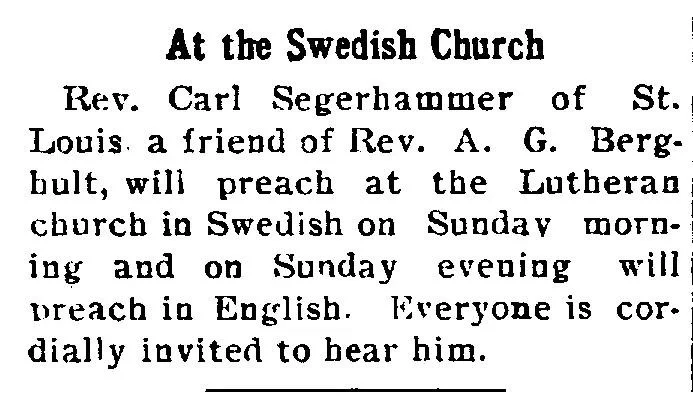
This notice from an Indiana paper announces that Rev. Carl Segerhammer of St. Louis would be preaching at the Lutheran church in Swedish on Sunday morning. The Swedish surname is used without alteration, and the notice specifically identifies the language of the service. This is exactly the kind of community record that can preserve original names long after a family has otherwise blended into American records.
When you are searching for an immigrant ancestor, look for the ethnic or religious institutions they would have belonged to. Then search for those institutions alongside the family name. You may find records that use the original spelling even when everything else has already shifted to the anglicized version.
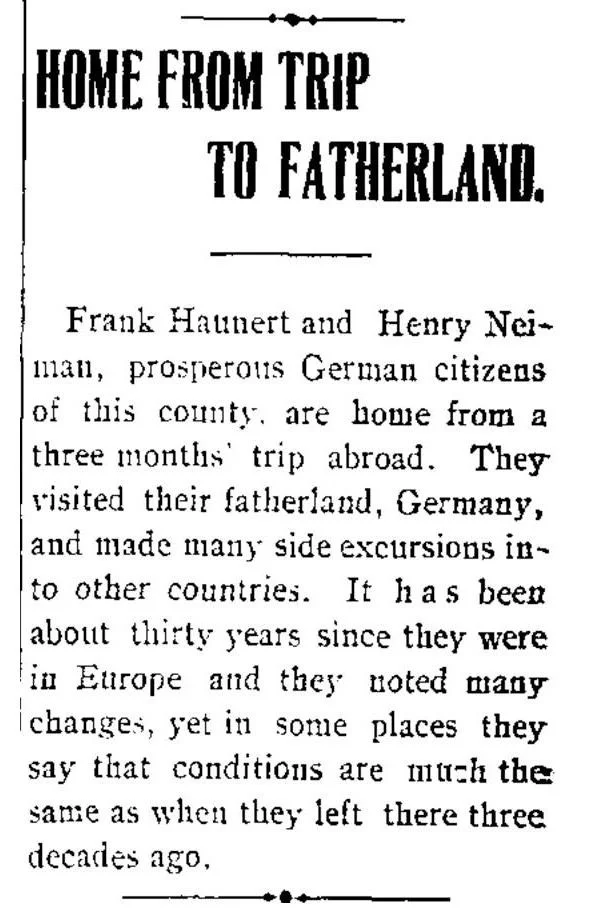
This Indiana clipping identifies Frank Haunert and Henry Neiman as "prosperous German citizens of this county" returning from a trip to their fatherland. Both surnames survived without significant anglicization, but the paper's identification of them as German citizens is itself a useful clue. When a newspaper labels someone as German, Swedish, Irish, or from any other country, it signals the ethnic community they belonged to and points toward the records that community would have generated.
How One Obituary Can Reveal Multiple Surname Lines
Obituaries are among the most genealogically useful newspaper records for immigrant research because they often name the entire family, including children who married and took different surnames.
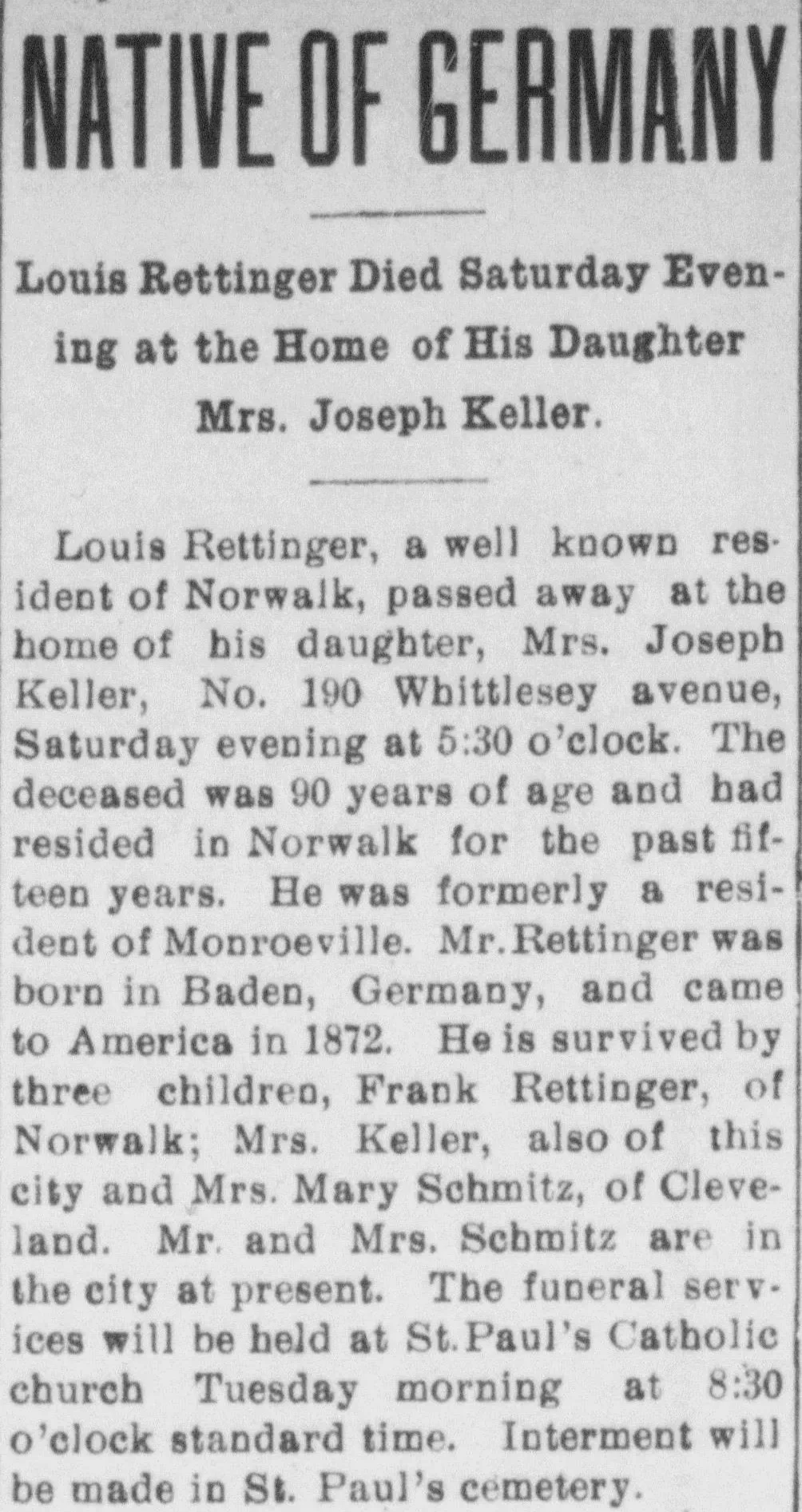
This obituary for Louis Rettinger, a resident of Norwalk, Ohio, identifies him as a native of Baden, Germany, who came to America in 1872. His surviving children are listed as Frank Rettinger of Norwalk, Mrs. Keller of the same city, and Mrs. Mary Schmitz of Cleveland. Three children, three different surnames, all from one German-born father.
A researcher who only knew the Keller or Schmitz line would have no obvious German connection from those surnames alone. But this obituary provides it. The birthplace, the arrival year, and the family relationships are all in one clipping. Any of those three children's lines could be traced back to Baden, Germany, using the information in this single notice.
When you find an obituary for an immigrant ancestor, read it carefully for married children's surnames, church affiliations, birthplaces, and arrival years. Each detail is a potential search path.
Why Small-Town Newspapers Matter Most for Immigrant Research
Large city newspapers covered major events. Small-town papers covered people. They named who visited whom, which families attended church, who was ill, and who had recently arrived from abroad. For immigrant communities that settled in smaller towns and rural areas, the local paper is often the most detailed record of daily life that survives.
NewspaperArchive is especially strong in small-town newspaper coverage, which makes it particularly useful for this kind of research. Immigrants who settled in rural Indiana, upstate New York, or small Ohio towns are far more likely to appear in local community papers than in major metropolitan coverage.
When searching for anglicized names, try the small-town papers from the area where the family settled. Those papers often used names the way the community used them, not the way a government clerk recorded them.
Search Strategies for Anglicized Names in Newspaper Archives
A few approaches that tend to work well:
Search the anglicized name first to establish what you already know. Then search the most likely original form. For German names, common translations include Heinrich to Henry, Wilhelm to William, Johann to John, and Mueller, Müller, or Moeller to Miller. For Scandinavian names, common anglicizations follow similar phonetic patterns.
Try partial name searches when the full name is uncertain. Searching a distinctive surname with a location and date range can surface results even when the first name varies.
Search for the ethnic church or community organization alongside the family name. A Swedish Lutheran church notice or a German Methodist funeral announcement may be the record that uses the original spelling.
Look at the names of neighbors and witnesses in clippings. Immigrants often settled near people from the same region. If you find a cluster of German surnames in one small town, that community likely generated additional records worth searching.
For a deeper look at how to work through spelling variations, NewspaperArchive's guide to searching name variants in historical newspapers walks through fifteen specific approaches worth trying.
If your searches are coming up empty, OCR may also be part of the reason. When a newspaper page is digitized, the text is converted by a process called optical character recognition, and older or faded type does not always convert cleanly. A foreign-language name with unusual letter combinations can be especially vulnerable to OCR errors, which means it may be indexed differently than you expect. NewspaperArchive's explainer on what OCR is and how it works in newspaper archives is worth reading before you give up on a name.

This article identifies George Paul as a German native who stowed away on a steamer from Buenos Aires. The surname Paul is simple and anglicized enough that a researcher would have little reason to connect it to a German origin without the article's explicit statement. The clipping is a reminder that a short name in American records is not always evidence of American origins. Sometimes the simplest-looking names are the ones that have traveled the farthest from their source.
Frequently Asked Questions
How do I find an ancestor whose name was changed or anglicized? Start by searching the anglicized form in records from the area where the family settled. Then search the most likely original spelling and common phonetic variations. Historical newspapers, especially community and ethnic papers, often preserved original spellings longer than official records.
Can newspapers help me find an original foreign surname? Yes. Community papers, church notices, and obituaries frequently used the names people went by at home, which were sometimes closer to the original than names that appear in civic records. A single obituary can contain both the anglicized and original forms of a name.
What if I only know the anglicized name? Work backward from what you know. Look for the ethnic or religious community the family belonged to, the small town where they settled, and any obituaries or community notices that name the broader family. Those records may use the original surname even when individual records have already shifted to the anglicized version.
Why would a church notice have a different spelling than the death record? Church records and community newspapers used the names people used within their own communities. Official records reflected whatever spelling a clerk recorded at the time of the transaction. Those two versions did not always match, which is why searching both is worth the effort.
Are small-town newspapers useful for immigrant genealogy? They are often the most useful source available. Small-town papers named ordinary people in ways that larger city papers did not. For immigrant families who settled outside major cities, local community papers may be the only place where the original name appears in a searchable record.
Key Takeaways
When an immigrant ancestor's name was anglicized, the change rarely happened all at once. Newspapers, church records, and community notices often preserved the original spelling for years or even decades after official records had moved on. Searching both forms of the name, looking for ethnic community institutions, and reading obituaries carefully for family connections can help you find the clipping that bridges the gap.
A single newspaper article sometimes does all of that work at once. The Weinhauer obituary from Wellsville uses Heinrich and Henry in the same paragraph. The Rettinger obituary from Norwalk names a German birthplace and three different surviving surnames. Those kinds of clippings do not just answer one question. They open the next several searches.
When your family tree hits a wall at the immigration line, old newspapers are worth searching on both sides of it.
Use the names, towns, and dates from your family tree as starting points in NewspaperArchive, then widen your search from there. For twenty-one research strategies that go beyond the basics, this guide to finding ancestors in newspaper archives is a practical next step.