How to Find Your Ancestors in Old Fourth of July Newspapers
Old Fourth of July newspapers named real people: parade marshals, speakers, picnic hosts, and visiting family. Here's how to find your ancestor in holiday coverage.
Fourth of July newspapers from the 1800s through the mid-1900s named specific people in their coverage of local Independence Day celebrations. The categories of people most likely to appear include parade organizers and marshals, community speakers and readers of the Declaration of Independence, contest winners, veterans honored at celebrations, visiting family members listed in social columns, and picnic or barbecue hosts. Because small-town papers covered local celebrations in detail, a single July 4th edition could name dozens of residents. NewspaperArchive holds Fourth of July editions spanning from the late 1700s through the twentieth century and allows researchers to search by location and date range to target the communities where their ancestors lived.
Most people know the big names from the Fourth of July. Washington. Jefferson. The Declaration of Independence. The famous ones are easy to find.
But what about the people who showed up?
The parade marshal who organized the procession in your county seat in 1887. The neighbor who read the Declaration aloud in the town square. The family who started roasting a pig at five in the morning for the neighborhood barbecue. The woman who won the pie contest and got her name in the paper.
Those people are in the newspapers too.
For as long as America has been celebrating its independence, local papers have been writing it all down. The Fourth of July was one of the biggest news events of the year in small-town America, and editors named names. That is the whole point. The coverage was for the community, about the community. Your ancestors were part of that community.
Here is what to look for and how to find it.
What Fourth of July Newspapers Actually Covered
The Procession: A Directory of Community Leaders
If your ancestor held any kind of civic role, the July 4th procession coverage may be the single most likely place their name appears in a newspaper outside of a birth or death notice.
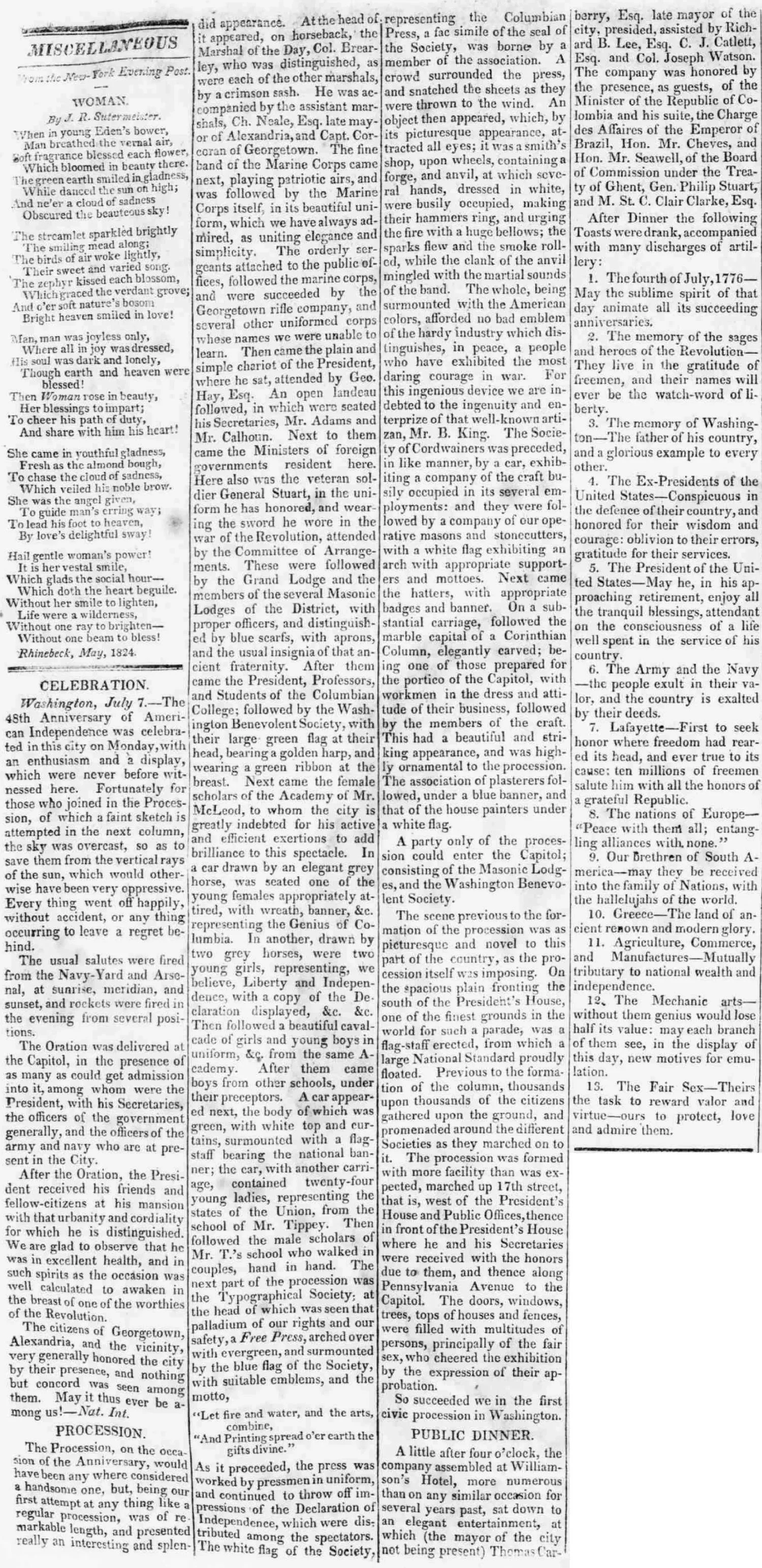
The 1824 Washington, D.C. celebration reported in the Tarboro Free Press gives you a sense of the scope. The procession that day included President Monroe, several cabinet secretaries, the officers of the Columbian College, the Marine Corps band, multiple Masonic lodges with their officers listed, the Georgetown Rifle Company, the Washington Benevolent Society, the Columbian Benevolent Society, the Typographical Society, and several trade groups, including shoemakers, plasterers, and house painters, with representatives named and described. The report runs the better part of a full newspaper column.
That kind of coverage was not limited to the nation's capital. Small-town papers replicated the format for their own communities. The local parade committee, the grand marshal, the subcommittee members, the band, the school children marching in formation, the veterans given a place of honor near the front: all of them named, all of them on record.
If your ancestor served as a committee chairman, a marshal, a marshal's aide, or even as one of many committee members, their name is likely in print. Procession coverage reads like a census of local civic life.
The Speaking Program: Who Read the Declaration
Every July 4th celebration had a formal program. Someone was invited to read the Declaration of Independence. Someone delivered the oration. A local pastor offered a prayer. A poet might read a commissioned verse.
These were positions of honor. The invitation meant your ancestor was recognized as a community leader, a respected voice, a person worth hearing. Newspapers covered the program in advance with notices announcing who had been selected, and then covered it again afterward with summaries of what was said.
Searching for an ancestor in a speaker's role turns up two bites at the same apple: the advance notice and the retrospective coverage.
The Dinner Toasts: A Who's Who of the Banquet Table
After the formal program came the dinner, and after the dinner came the toasts. This is one of the most overlooked categories of Fourth of July newspaper content, and it is loaded with names.
The 1824 Tarboro Free Press account includes thirteen numbered toasts from the public dinner at Williamson's Hotel. The company was presided over by Thomas Carbery, described as the late mayor of the city. The toasts begin with "The Fourth of July, 1776" and proceed through the memory of the Founding generation, the current president, the army and navy, Lafayette, the nations of Europe, South America, and Greece. Each toast was followed by artillery discharges.
The names embedded in that coverage (Carbery, the presiding officer; Col. Brearley, the Marshal of the Day; Ch. Neale and Capt. Corcoran named as assistant marshals) are all findable today because a newspaper in Tarboro, North Carolina reprinted the account from the New York Evening Post.
This is a good reminder: Fourth of July coverage traveled. A celebration in Washington might be reprinted in a paper three states away. An account of a local celebration might surface in a paper from a neighboring county. Searching broadly is worth the effort.
Veteran Honorees: The Living Link to the Revolution
Through most of the 1800s, Fourth of July celebrations included a deliberate honoring of veterans still living from previous wars. In the earlier decades, this meant Revolutionary War veterans seated near the front of the procession and introduced by name at the dinner. By the 1840s and 1850s, these were elderly men in their eighties and nineties. The newspaper coverage of these moments is among the most detailed veteran documentation in the archive outside of obituaries.
If you have a Revolutionary War ancestor you have not been able to locate in other records, try searching the Fourth of July coverage from communities where they lived between 1800 and 1860. They may have been named as a surviving veteran at a local celebration. This type of coverage was more personal than a pension list and more specific than a death notice.
For a full guide to finding Revolutionary War veterans in newspaper records from across their lifetimes, see the companion post After the War: How Newspapers Covered Revolutionary War Veterans for Decades.
Who Appeared in Fourth of July Newspapers: A Quick Reference
If Your Ancestor Was... | Look For This Coverage Type | Typical Date Range |
|---|---|---|
A parade organizer or marshal | Procession committee notices, grand marshal listings | 1820s through 1920s |
A civic or fraternal leader | Masonic lodge listings, benevolent society rosters, named marching groups | 1820s through early 1900s |
A tradesperson or craftsman | Trade guild contingents in procession coverage | 1820s through 1880s |
A community speaker or pastor | Advance notices naming the orator or reader of the Declaration | 1800s through early 1900s |
A Revolutionary War veteran | Veteran honoree sections, named survivors given places of honor | 1800 through 1860s |
A family member visiting for the holiday | Social notes, personal columns, visiting relatives listings | 1870s through mid-1900s |
A contest or games participant | Prize winner lists, games results | 1880s through mid-1900s |
A picnic or barbecue host | Social columns, neighborhood event coverage | 1880s through mid-1900s |
A neighborhood event organizer | Community celebration coverage, named committee members | 1870s through mid-1900s |
The Neighborhood and Family Coverage: The Part That Surprises Researchers
Here is where most researchers underestimate old newspapers.
Small-town Fourth of July coverage did not stop at the formal celebration. In the late nineteenth century and well into the twentieth, social columns in local papers captured exactly what individual families were doing on the holiday. Who hosted, who visited, who traveled in from out of town, who made the food. The coverage was genuinely granular.
The Neighborhood Parade: More Names Than You Expect
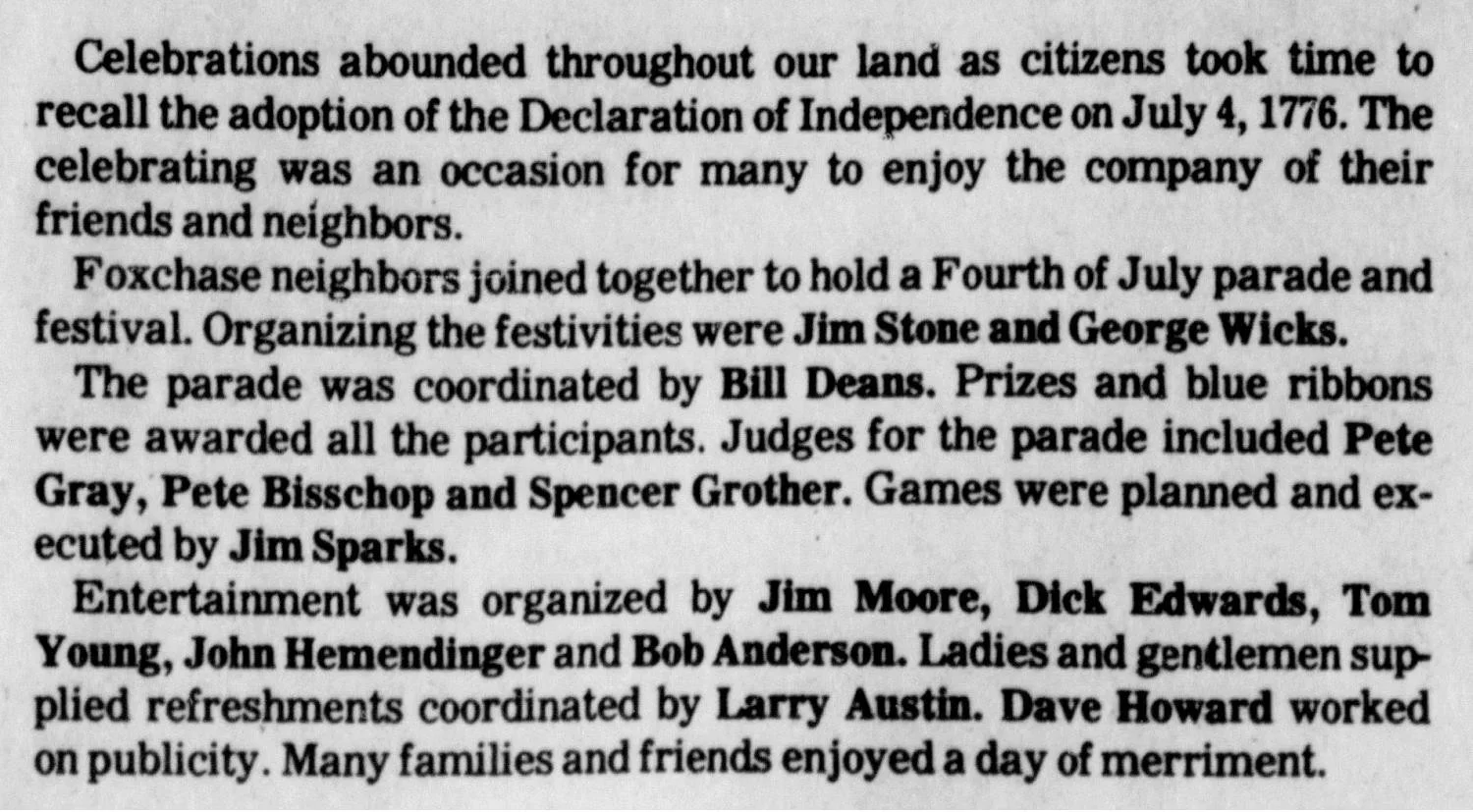
The Foxchase neighborhood parade, reported in the Aiken Standard in 1980, is a perfect example of how a modest community event can generate a surprising amount of genealogical data. A neighborhood parade. A one-day festival. And the paper named eleven people by role: organizers, the parade coordinator, three judges, the games organizer, five entertainment organizers, a refreshments coordinator, and a publicity person.
That is eleven searchable names from a neighborhood event most people would assume never made it into the newspaper at all.
If your ancestor was a civic-minded person in any community from roughly the 1870s through the mid-twentieth century, they were probably involved in something like this at some point. Their name may be in a paper you have never thought to search.
The Family Barbecue: An Accidental Census
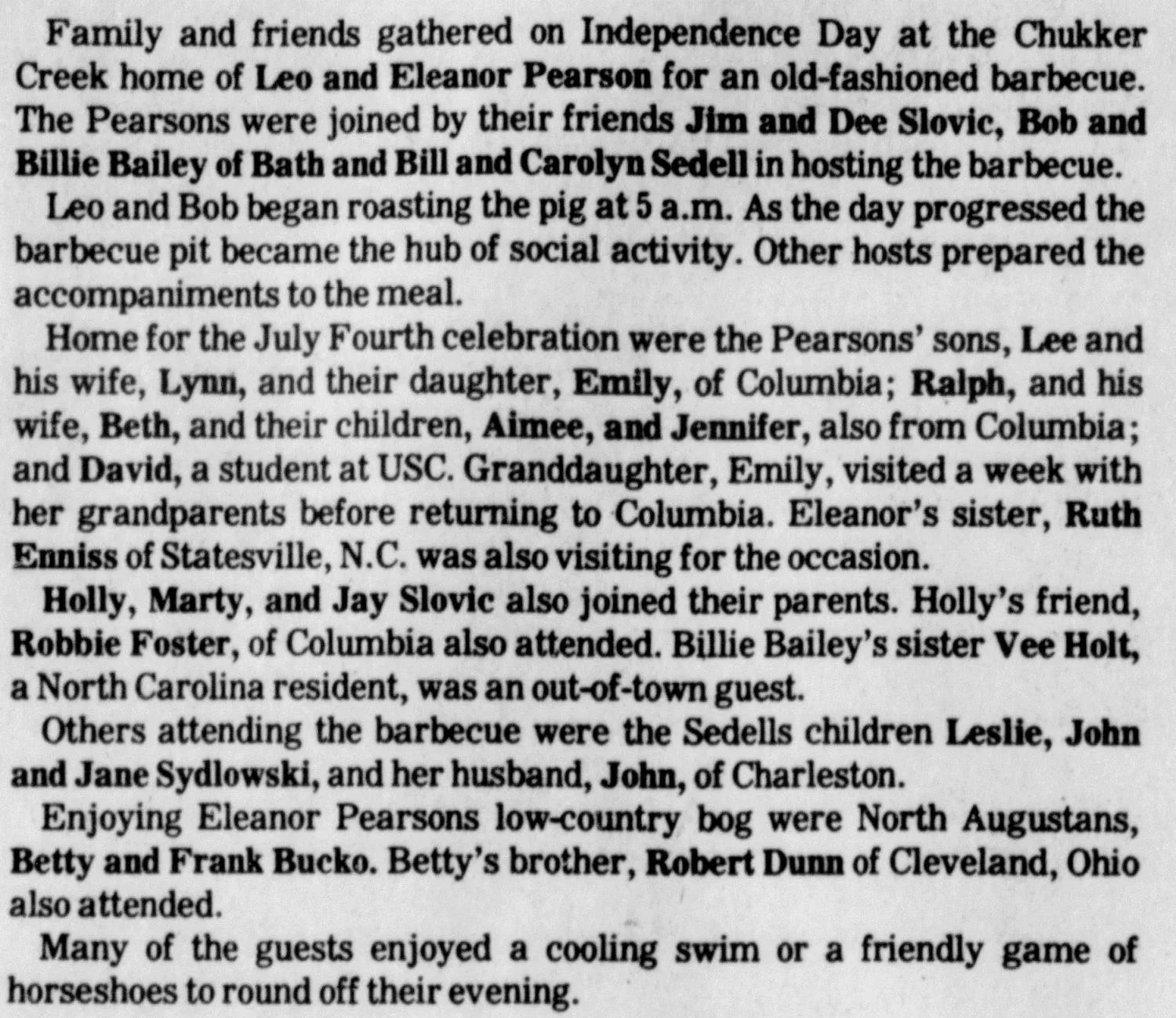
The Pearson family barbecue coverage from the same Aiken Standard edition in 1980 reads less like a newspaper article and more like an annotated guest list. It names Leo and Eleanor Pearson as hosts. It names their co-hosting families. It names the Pearsons' sons, their wives, their grandchildren, their daughter-in-law's children. It names Eleanor's sister and her town of residence in North Carolina. It names out-of-town guests from North Augusta and Cleveland, Ohio.
If this were a genealogy database entry rather than a newspaper clipping, a researcher would be thrilled to find it. It contains family relationships, locations, married names, and a specific date. The fact that it appeared in a social column about a backyard barbecue does not make the information any less useful.
This type of coverage is common. Papers in communities large and small ran social notes like these for decades. They are among the least-searched newspaper record types in genealogy and among the most likely to contain exactly the kind of family detail that a vital record would never include.
How to Search for Fourth of July Ancestors in Newspaper Archives
Search by Date First, Then Location
The most direct approach is to narrow by date before you narrow by name. Fourth of July coverage appeared on July 4th itself or, more often, in the edition immediately following. Weekly papers typically published on July 7th or 8th with their Independence Day coverage. Daily papers ran it on the 5th.
Search NewspaperArchive with a date window of July 1 through July 15 in any given year, filtered to the state or county where your ancestor lived. Then browse the results for your ancestor's name.
Search for Roles, Not Just Names
If you are not finding your ancestor by name, try searching for the kinds of roles they might have held. "Grand Marshal" and a state filter will surface procession coverage. "Committee of Arrangements" with a county name will find planning coverage. "Orator of the day" with a location will pull up speaker coverage.
Don't Overlook the Social Notes
The social column was usually not on the front page. It appeared on pages two, three, or four in most small-town papers. If you are browsing a paper rather than searching by name, scan the interior pages for the social column. It may be labeled "Local Notes," "Personal," "Among Our Citizens," or simply "Locals."
Search Across Multiple Decades
A person named in a Fourth of July parade committee in 1892 might have appeared in that role for a decade or more. Organizations elected the same people to the same roles repeatedly. Searching one year may only be the beginning.
What These Records Tell You That Others Cannot
A Fourth of July record is not a vital record. It will not tell you a birth date or confirm a death. But it tells you things no birth or death record can.
It puts your ancestor in a specific place on a specific date. It shows their standing in the community. It names the people they worked alongside and gathered with. It captures a moment in their ordinary life, not a crisis. And when it names visiting relatives from out of town, it can open research paths you would never have found otherwise: a sister in North Carolina, a son at a university, an in-law from Cleveland.
The Fourth of July was not just a holiday. It was one of the most densely documented days of the year in small-town American newspaper culture. The people who showed up are still on record.
Frequently Asked Questions
What years of Fourth of July newspaper coverage does NewspaperArchive hold?
NewspaperArchive holds newspapers spanning from the colonial era through the twentieth century, including Fourth of July editions from across that full range. Coverage from the 1800s through the early 1900s tends to be the most detailed for genealogical purposes, as that era of small-town journalism produced the most granular community naming. Coverage does not thin out until newspapers shifted away from social column reporting in the mid-twentieth century.
What if my ancestor lived in a small town with a small paper?
Small-town papers are often better for this kind of search than large-city papers. Large city papers covered large city celebrations and rarely named individuals outside of prominent civic roles. Small-town papers covered the community they served, which meant naming everyone involved. A neighborhood parade in a town of two thousand people was front-page news. The Foxchase parade and the Pearson family barbecue both appeared in a small regional daily, not a major metropolitan newspaper.
Can I find my ancestor in Fourth of July coverage if they weren't an organizer?
Yes. Social columns named guests at private gatherings, picnic attendees, out-of-town visitors, and family members present for holiday dinners. Your ancestor did not need a formal role to appear in Fourth of July newspaper coverage. They simply needed to have been present in a community that had an active newspaper covering local social life.
What if the July 4th edition isn't in the archive for my target year?
Try adjacent years. A person who appeared in Fourth of July coverage in one year was often present in neighboring years as well. Try a five-year window centered on the year you are targeting. Also, check whether the paper published weekly or daily: a weekly paper published mid-week may have run its Fourth of July coverage in the July 7th or 8th edition rather than the July 4th date.
Are there other holidays where ancestors appear in newspaper coverage this way?
Yes. Thanksgiving was another major occasion for social notes naming family gatherings, particularly from the 1880s through the mid-twentieth century. Christmas coverage followed a similar pattern. Memorial Day coverage often named veterans. New Year's coverage named callers and guests. The Fourth of July is the most reliably documented because it was tied to both civic ceremony and community celebration, but it is not the only holiday that generated this kind of record.
Is there a broader guide to finding newspaper records for Revolutionary War ancestors?
Yes. For a full guide to the range of newspaper record types available for Revolutionary War veterans and their families, see our America250 series on Revolutionary War newspaper research.
Closing
America's birthday is the oldest running story in the newspaper archive. Every year, in every town, editors sent reporters out to cover it. They wrote down who organized the parade, who read the Declaration, who gave the speech, who hosted the barbecue, and who came in from three states away to celebrate with family.
If your ancestors were there, they may be in those pages.
NewspaperArchive holds decades of Fourth of July editions from communities across the country. Go find your family's holiday.