How to Build an Ancestor Timeline Using Old Newspapers
Learn how to build a newspaper timeline for any ancestor using obituaries, civic records, social columns, and more. Real clippings from one Indiana family show how it works.
Old newspapers can help family historians build a complete life timeline for any ancestor by searching beyond obituaries to include social columns, letters to the editor, civic appointment notices, business advertisements, legal notices, and family gathering mentions. A single county's small-town papers can reveal an ancestor's occupation, religious affiliation, political views, family relationships, and personal character in ways that census records and vital records cannot. NewspaperArchive provides searchable access to millions of digitized newspaper pages from small-town and rural papers across all 50 states, making it especially useful for tracing ancestors in county communities where local papers named ordinary people consistently across decades. To build a newspaper timeline, researchers should start with the death year, work backward through clippings, search all family members separately, and treat each clipping as a pointer toward the next search.
How Old Newspapers Built My 3rd Great-Grandfather's Complete Life Story
Vital records give you the outline of a life. A birth date. A marriage. A death. But they rarely tell you who a person actually was, what they did, what they believed, or how their community knew them.
Old newspapers do that work. And when you search systematically, clipping by clipping, year by year, you can build something that feels less like a research file and more like a portrait.
I did this recently with my husband's 3rd great-grandfather, William Warder Hamilton of Decatur County, Indiana. I went in knowing his name, his birth year, and that he had two sons with unusually strong names. I came out knowing his voice, his politics, his tobacco habit, his mule business, his grief, and the exact words his neighbors used when he died.
Eight clippings. Fifty-four years. One complete life.
Quick Answer
To build an ancestor timeline using old newspapers, start with the year of death and work backward through local and county papers. Search for obituaries, social columns, legal notices, civic appointments, and business mentions. Each clipping will name family members, places, and events that point you toward the next search. The result is a layered picture of your ancestor's life that vital records alone cannot provide.
Download the free Ancestor Timeline Worksheet: 📄 Ancestor_Timeline_Worksheet.pdf
A printable worksheet to log every clipping, in order, the same way Warder Hamilton's story came together.
What an Ancestor Newspaper Timeline Is and Why It Works
A newspaper timeline is exactly what it sounds like: a collection of clippings arranged in chronological order that documents a person's life as it was recorded by their community.
It is different from a research timeline you might keep in a genealogy program. Those track what you have found and where. A newspaper timeline tracks what the newspapers actually said, which means it captures details no census or vital record would ever include.
When Warder W. Hamilton's neighbors wrote about him, they described his business practices, his political opinions, his religious convictions, and the way he treated the people around him. They noted when his wife died after four years of illness. They mentioned that he entertained four generations at his dinner table. They called him "Uncle Warder" in the social column, which tells you something about how his community saw him that no official record ever could.
That is what a newspaper timeline gives you. Not just dates. A person.
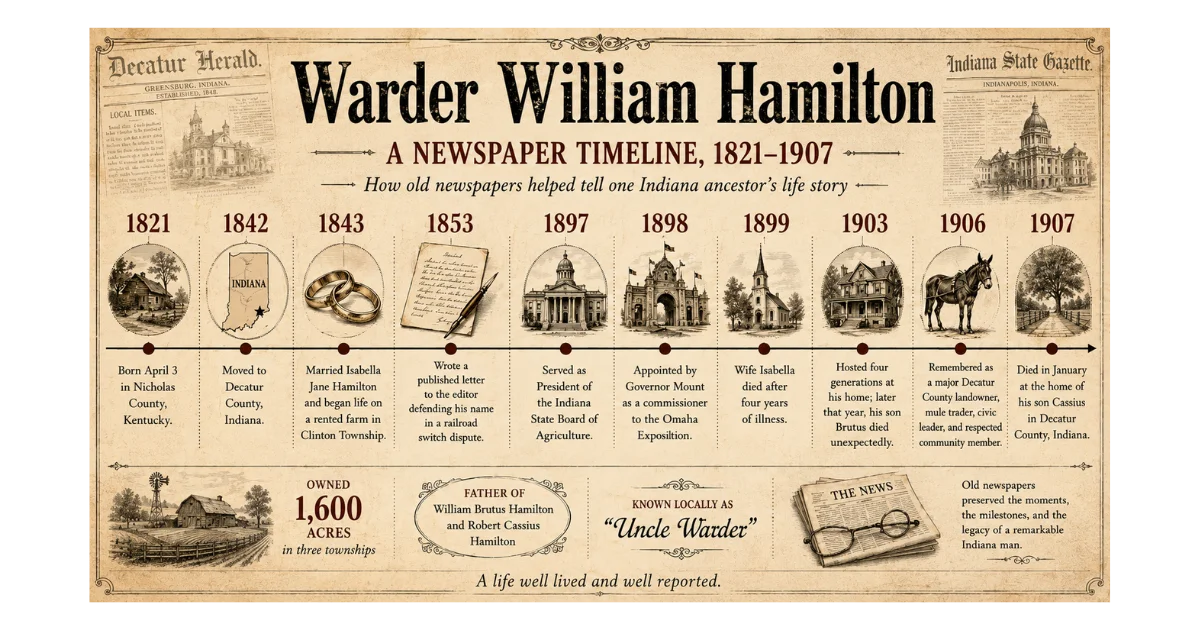
Meet William Warder Hamilton, Born 1821 in Kentucky, Lived in Decatur County, Indiana
William Warder Hamilton was born April 3, 1821, in Nicholas County, Kentucky, into a family of prominent slave-holders. He came to Indiana in the fall of 1842, just after reaching his majority, drawn by a cousin named Robert A. Hamilton whose enthusiastic descriptions of Indiana's free-labor system made Kentucky look different in comparison.
Within a year of arriving, Warder married his cousin Isabella Jane Hamilton, a daughter of Robert and Mary (Henry) Hamilton, the very family whose glowing accounts had brought him north. They set up housekeeping in a log cabin on a rented farm in Clinton Township, Decatur County, and started a life that would stretch across eight decades and leave a paper trail that still speaks clearly today.
To this marriage were born two sons: William Brutus Hamilton and Robert Cassius Hamilton. Both names carry the weight of Roman history and the men who stood against Caesar, which tells you something about this family's reading habits and perhaps their politics.
Over the course of his life, Warder Hamilton went from tenant farmer to one of the largest landowners in Decatur County, holding sixteen hundred acres in three townships. He traded mules across the American South and into Cuba. He served as president of the Indiana State Board of Agriculture and as a director of the State Fair Association for six years. The governor himself appointed him as a commissioner to the Omaha Exposition. His acquaintance, as his neighbors noted, extended throughout the state.
He was also, by all accounts, a man his community trusted. When he died in January 1907, the Greensburg Standard wrote that the news of his death "was on every tongue, as neighbors and friends greeted each other."
He was eighty-five years old. He had outlived his wife, his son Brutus, and his granddaughter Florine. He died at the home of his surviving son, Cassius.
All of that is in the newspapers. None of it is in a census record.
The Newspaper Timeline: 54 Years of One Man's Life in Eight Clippings
The clippings below were found in the NewspaperArchive collection, primarily in Decatur County papers. They span from 1853, when Warder was thirty-two years old and already engaged enough in local life to write a letter to the editor, to 1907, when his obituary ran under the headline "Called Home."
Read the table first, then the clippings. The table shows what each item revealed and where it pointed next. The clippings show what actually appeared on the page.
Year | Publication | What It Revealed | What to Search Next |
|---|---|---|---|
1853 | Greensburg Decatur Press | Warder's own voice defending his name in a railroad switch dispute | Other local political items, Kingston area land records, early Decatur County court notices |
1879 | Greensburg Standard | R. Cassius Hamilton and Miss Stella Fenton announced for marriage | Cassius and Stella in later social columns, Fenton family records in Decatur County |
1897 | Greensburg News | President of the Indiana State Board of Agriculture, recommending $35,000 in state funding | Indianapolis papers, state agricultural records, Indiana State Fair coverage |
1898 | Greensburg New Era | Appointed commissioner to the Omaha Exposition by Governor Mount | Omaha Exposition records, Indiana delegation coverage, regional papers |
June 1899 | Greensburg Review | Isabella Jane's death after four years of illness, beloved by all, Presbyterian church member | Funeral notices, probate records, her parents Robert and Mary Hamilton |
Dec. 1899 | Greensburg Standard | "Uncle Warder" attends Brutus's 29th anniversary gathering six months after Isabella's death | Brutus's children by name, Roland family connection, Adams community papers |
1903 | Greensburg News | Warder entertains four generations at his palatial home north of town | Grandchildren's names, great-grandchildren's birth announcements, Brutus's family |
Sept. 1903 | Greensburg Standard | Brutus dies unexpectedly of kidney complications, father and brother survive him | Catherine Cunningham Hamilton's later records, grandchildren Will C., Ray, Harry Warder |
Oct. 1904 | Greensburg Standard | Florine Roland dies young, daughter of Mrs. Brutus Hamilton, leaves a four-year-old child | Elmer Roland records, Florine's daughter in later census and vital records |
1906 | Greensburg Standard | Full life profile: mule trading, farm history, family, character, civic roles | E.B. Bishop and Sons mule company, Cuba export records, Terre Haute and Cincinnati Railroad |
Jan. 1907 | Greensburg Standard | Death at Cassius's home, full survivors list, 1,600 acres in three townships | Cassius's probate records, land transfers, grandchildren Will C., Ray, and Harry Warder |
1853: His Own Voice, Age Thirty-Two
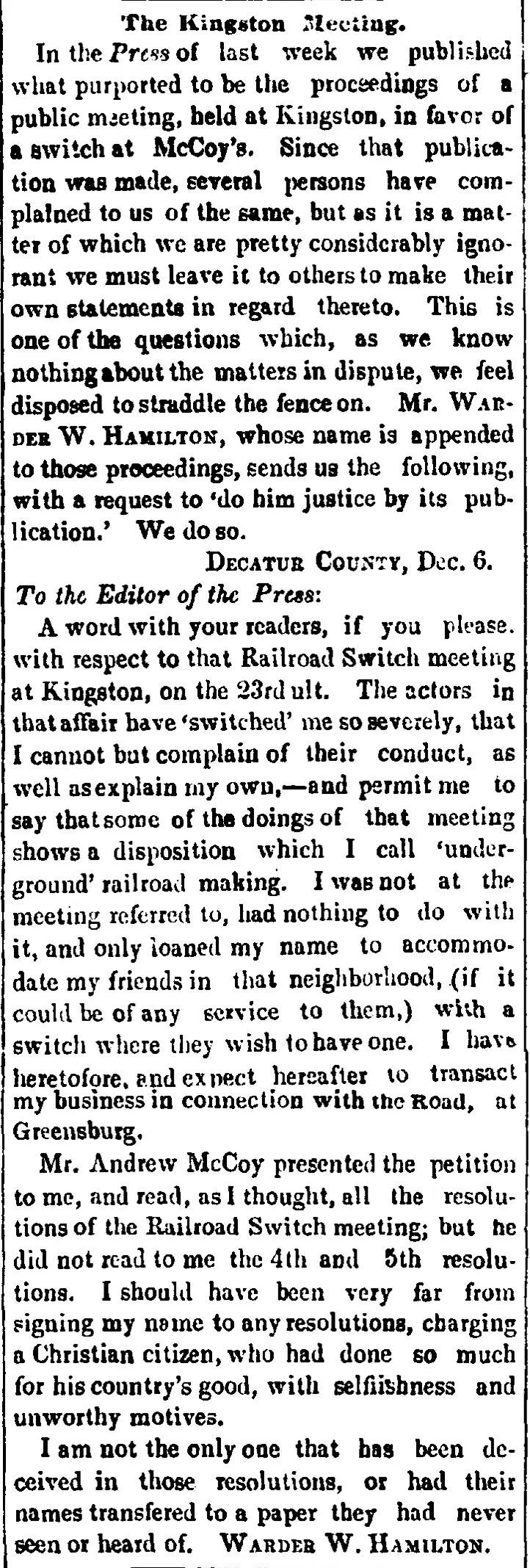
Most researchers never think to search for letters to the editor. This one is worth finding.
In December 1853, Warder wrote to the Greensburg Decatur Press to distance himself from a public meeting in Kingston about a railroad switch he had never attended and a set of resolutions he had never agreed to. His name had been attached to the petition without his knowledge.
He wrote, in part:
"I was not at the meeting referred to, had nothing to do with it, and only loaned my name to accommodate my friends in that neighborhood, if it could be of any service to them, with a switch where they wish to have one."
He closed by saying:
"I am not the only one that has been deceived in those resolutions, or had their names transferred to a paper they had never seen or heard of."
That is the voice of a man who took his reputation seriously and was not shy about defending it in print. He was thirty-two years old. He had been in Indiana for eleven years. He was already someone whose name carried enough weight that the paper published his full letter.
Letters to the editor are one of the most overlooked clipping types in genealogy research. When you find one signed by your ancestor, you are reading their actual words.
1879: One Line That Tells You Everything

Some clippings are a paragraph long. Some are one sentence. This one is one sentence, and it does exactly what a social column is supposed to do.
"R. Cassius Hamilton and Miss Stella Fenton are recorded for hymen's altar."
That is all. But it tells you his full name as it appeared in print, the name of his future wife, and the approximate date of their marriage. From one line, you have three new search terms: R. Cassius Hamilton, Stella Fenton, and the Fenton family of Decatur County.
This is why social columns matter. They named ordinary people in ordinary moments, and those names are search threads you can follow for years.
1897 and 1898: The Man Beyond the Farm
By the late 1890s, Warder Hamilton was in his mid-seventies and still active in state-level civic life.
In January 1897, the Greensburg News reported that:
"President Warder W. Hamilton, of the state board of agriculture, will, in his annual address before the meeting of the board, next week, recommend that the legislature appropriate $35,000 annually to the board, and that the gates of the state fair be thrown open."
The following year, the Greensburg New Era reported that he had been appointed commissioner from the Fourth Congressional District to the Omaha Exposition by Governor Mount, adding that the governor "has made a good selection" and that Hamilton "will make an excellent member of the committee and he will see that the Fourth district has a good showing."
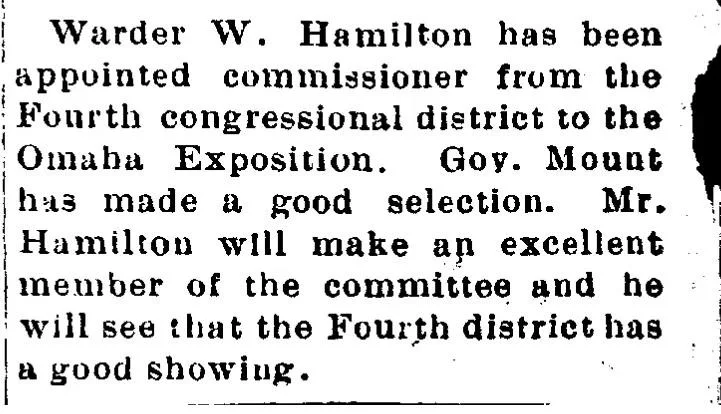
Neither of these items would appear in a census record or a vital record. Both of them change the picture of who this man was considerably. He was not just a farmer. He was a civic figure operating at the state level in his seventies, known to the governor by name.
When you find clippings like these, search the Indianapolis papers next. State-level appointments and board meetings often got regional coverage that local papers missed or summarized briefly.
June 1899: Isabella Jane
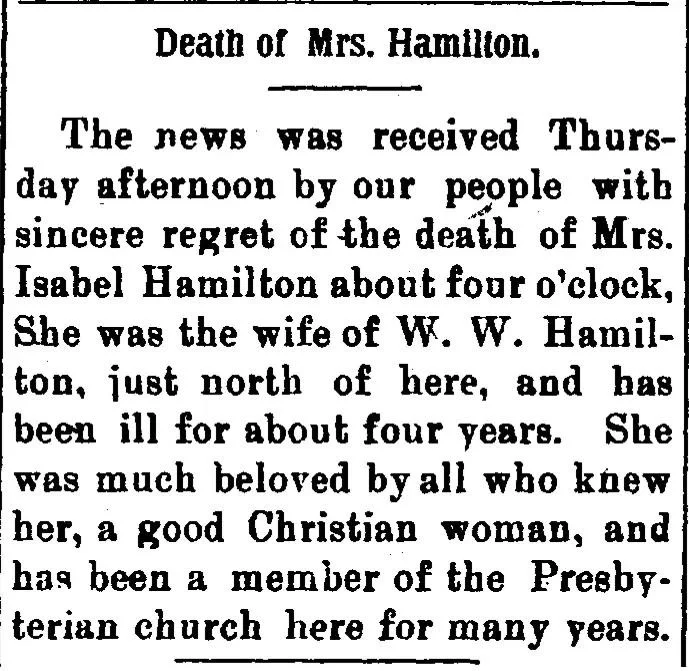
On June 29, 1899, the Greensburg Review published a brief notice under the heading "Death of Mrs. Hamilton."
"The news was received Thursday afternoon by our people with sincere regret of the death of Mrs. Isabel Hamilton about four o'clock. She was the wife of W. W. Hamilton, just north of here, and has been ill for about four years. She was much beloved by all who knew her, a good Christian woman, and has been a member of the Presbyterian church here for many years."
That is the entirety of what the newspaper said about Isabella Jane Hamilton. It does not name her parents. It does not name her children. It gives no birth date and no age.
But notice what it does give you. It tells you she had been ill for four years, which means her decline began around 1895. It tells you she was well known and well loved. It tells you she was Presbyterian, which matches what the later sources say about Warder and Brutus. And it places the family specifically north of Greensburg.
For a researcher, a brief notice like this is not a dead end. It is a starting point. Run her parents' names, Robert and Mary (Henry) Hamilton, through the same county papers, and you will find an entirely separate thread to follow.
Warder was seventy-eight years old when Isabella Jane died. They had been married for roughly fifty-seven years.
December 1899: The Family Still Gathers
Six months after burying his wife, Warder Hamilton was at a family celebration.
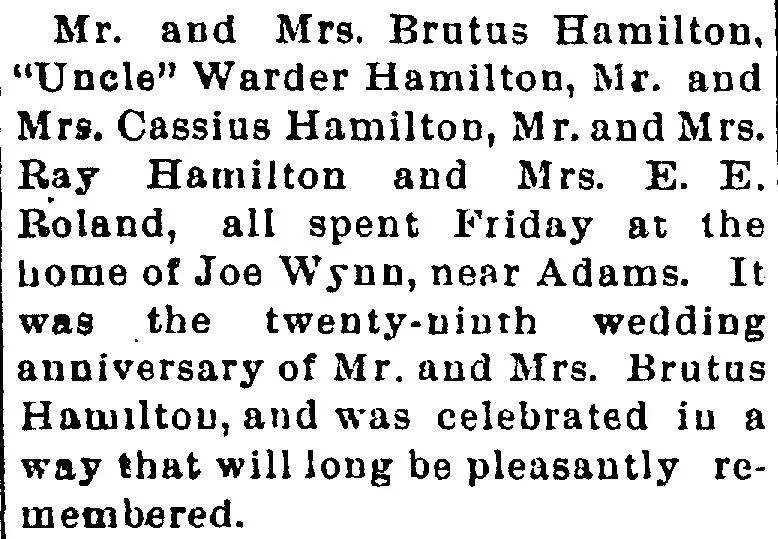
The Greensburg Standard reported in December 1899:
"Mr. and Mrs. Brutus Hamilton, 'Uncle' Warder Hamilton, Mr. and Mrs. Cassius Hamilton, Mr. and Mrs. Ray Hamilton and Mrs. E.E. Roland, all spent Friday at the home of Joe Wynn, near Adams. It was the twenty-ninth wedding anniversary of Mr. and Mrs. Brutus Hamilton, and was celebrated in a way that will long be pleasantly remembered."
Read that list of names carefully. It is a complete family snapshot. Warder, both sons, a daughter-in-law, a grandson's wife, and a granddaughter. From one short item, you have confirmed that Brutus and Cassius are both living, that Ray Hamilton is old enough to be married, and that the Roland connection runs through a granddaughter named Mrs. E.E. Roland, who is Florine.
This clipping also tells you that Warder was known to this community as "Uncle Warder," which is how neighbors and extended family referred to him, a title that suggests warmth and broad family connection rather than formal distance.
He had just lost his wife. He was at his son's anniversary party. Life went on, and the newspaper recorded that it did.
January 1903: Four Generations at His Table
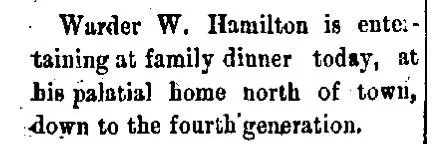
This is one of my favorite clippings in the entire collection, and it is exactly one sentence long.
"Warder W. Hamilton is entertaining at family dinner today, at his palatial home north of town, down to the fourth generation."
That is all the paper said. No names. No guest list. Just the image of an eighty-one-year-old man at the head of a table that holds four generations of his family.
The fourth generation would have been Brutus's grandchildren, the children of Will, Ray, Harry, and Florine. Brutus himself would have been there, likely with Catherine. Cassius and Stella would have been present. Warder at the top of it all, in the house he had built north of Greensburg, the one that had replaced the log cabin in Clinton Township where he and Isabella Jane had started.
Nine months later, Brutus was dead.
This is what weaving clippings into a timeline does. When you know what came before and what came after, a single sentence carries far more weight than it would on its own.
September 1903: The Death of Brutus
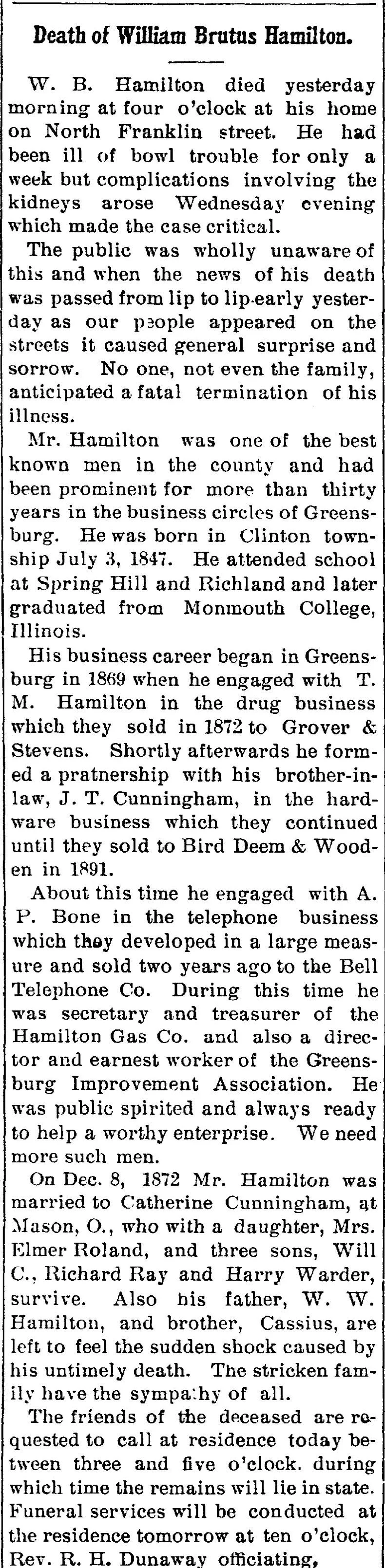
The Greensburg Standard's obituary for William Brutus Hamilton opens with this:
"The public was wholly unaware of this, and when the news of his death was passed from lip to lip early yesterday as our people appeared on the streets, it caused general surprise and sorrow. No one, not even the family, anticipated a fatal termination of his illness."
He had been ill with kidney trouble for only a week.
Brutus Hamilton was born July 3, 1847, in Clinton Township, exactly where the Pioneers article says Warder and Isabella Jane set up their first home. He attended school at Spring Hill and Richland and later graduated from Monmouth College in Illinois. He built a business career in Greensburg spanning drug sales, hardware, telephone infrastructure, and natural gas. He sold his telephone business to Bell Telephone. He was secretary and treasurer of the Hamilton Gas Company. He was a director of the Greensburg Improvement Association.
His survivors were named as: his wife Catherine, daughter Mrs. Elmer Roland, sons Will C., Richard Ray, and Harry Warder Hamilton. Also his father, W.W. Hamilton, and his brother Cassius.
That youngest son's name is worth pausing on. Harry Warder Hamilton. Brutus named his son after his father. That is a detail no vital record would have told you clearly, but the obituary makes it plain.
Warder Hamilton was eighty-two years old when he buried his son.
October 1904: Florine
One year after Brutus died, the Greensburg Standard published another obituary for the Hamilton family.
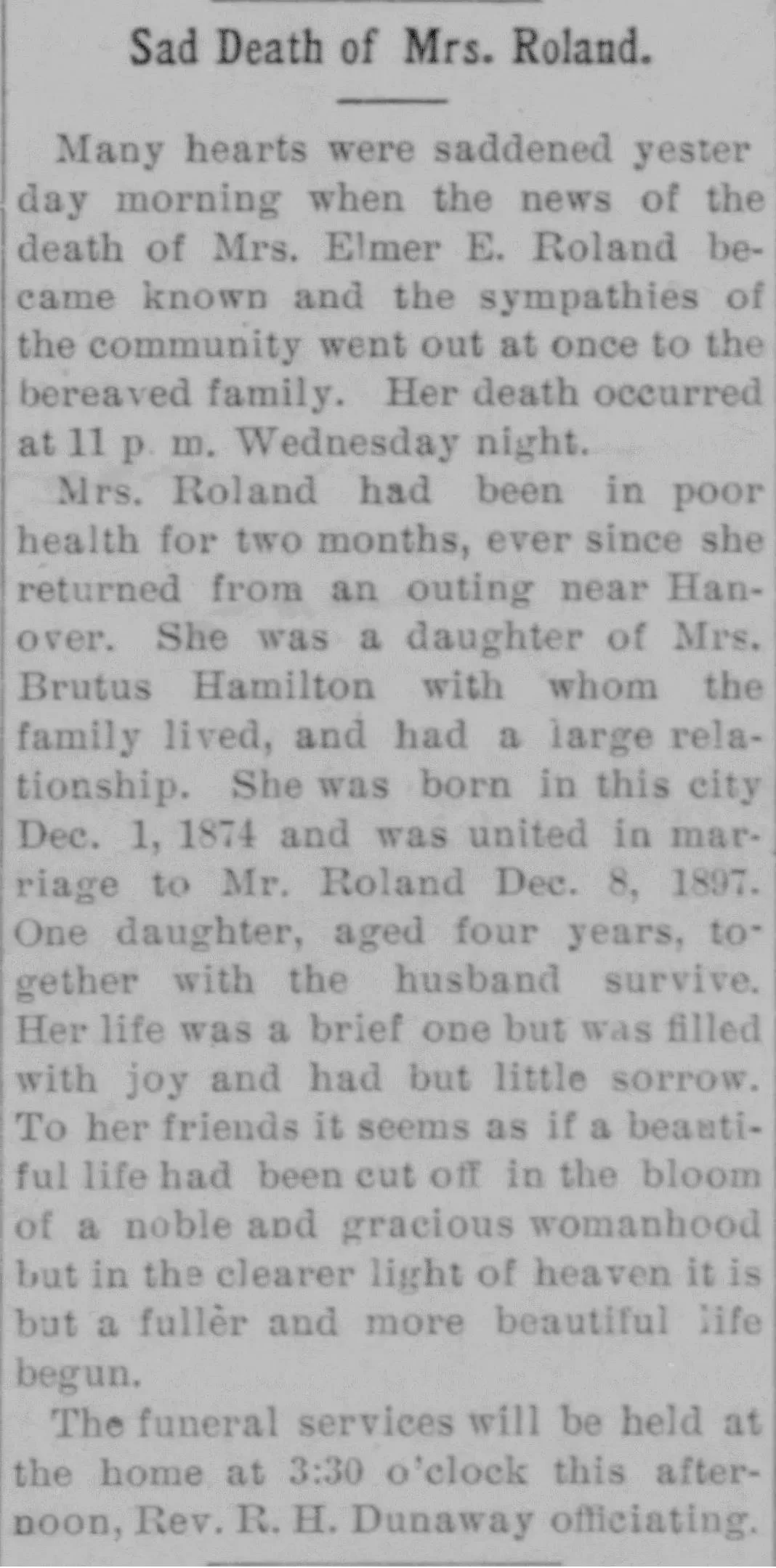
"Many hearts were saddened yesterday morning when the news of the death of Mrs. Elmer E. Roland became known and the sympathies of the community went out at once to the bereaved family."
Florine Roland was thirty years old. She had been ill for two months, ever since returning from an outing near Hanover. She was a daughter of Mrs. Brutus Hamilton, living with her mother after Brutus died. She had married Elmer Roland on December 8, 1897, and left behind a husband and a four-year-old daughter.
The paper wrote:
"Her life was a brief one but was filled with joy and had but little sorrow. To her friends it seems as if a beautiful life had been cut off in the bloom of a noble and gracious womanhood."
Warder Hamilton was eighty-three years old. In five years, he had lost his wife, his son, and his granddaughter.
The same Reverend R.H. Dunaway who would officiate Warder's funeral in 1907 presided over Florine's in 1904.
1906: The Pioneers Feature
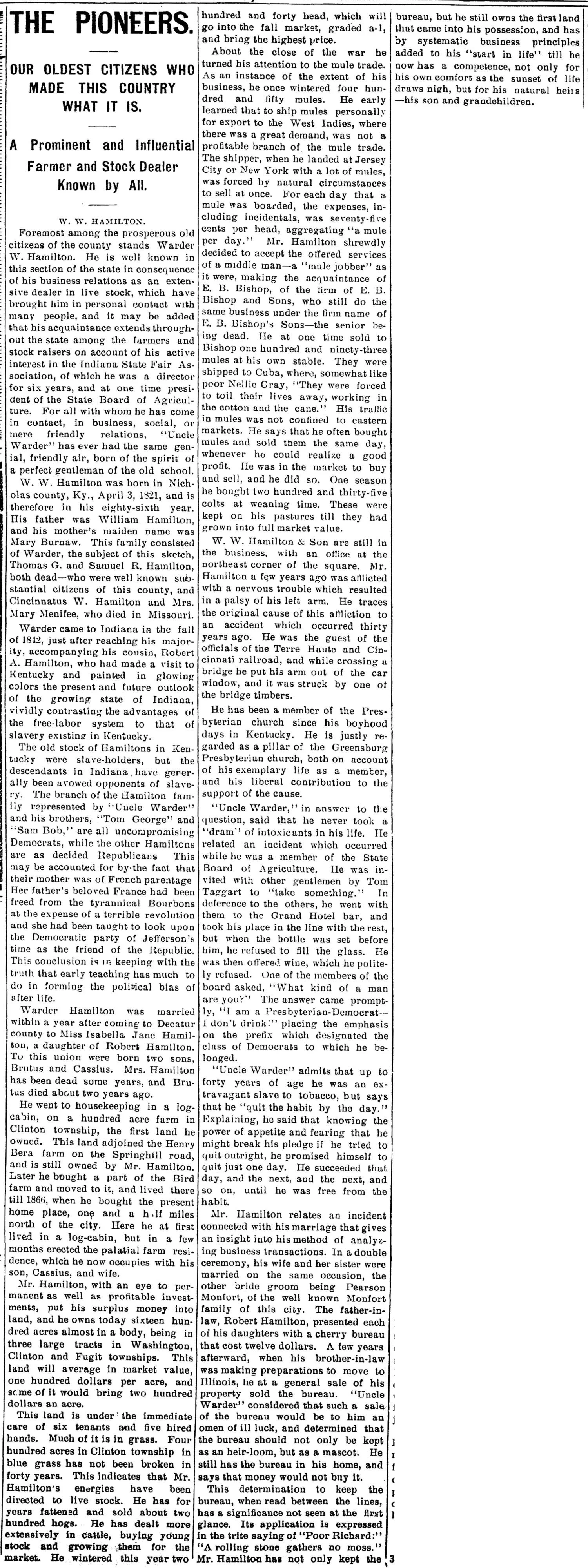
In August 1906, the Greensburg Standard published a long profile of Warder Hamilton as part of a series called "The Pioneers: Our Oldest Citizens Who Made This Country What It Is."
He was eighty-five years old. Cassius was the only one of his immediate family still living.
The article covers his entire life in detail, which no other source matches. Here is a fraction of what it contains:
On his origins: He was born in Nicholas County, Kentucky, into a family his neighbors described as prominent slave-holders. His mother's maiden name was Mary Burnaw, of French descent. He came to Indiana in 1842 after his cousin Robert A. Hamilton painted "in glowing colors the present and future outlook of the growing state of Indiana, civilly contrasting the advantages of the free-labor system to that of slavery existing in Kentucky."
On his business: "About the close of the war he turned his attention to the mule trade. As an instance of the extent of his business he once wintered four hundred and fifty mules." He became the acquaintance of a "mule jobber" at the firm of E.B. Bishop and Sons, and sold through them to buyers as far as Cuba. The article notes that he often bought and sold mules on the same day.
On his character: The article reports that in his forty years of age, he gave up tobacco "by the day," promising himself to quit just one day, and then the next, and the next, until he was free. It also recounts that when he was a member of the State Board of Agriculture, he was invited by Tom Taggart to "take something" at the Grand Hotel bar. He went with the group but refused to fill his glass when the bottle was set before him. When asked what kind of man he was, he answered: "I am a Presbyterian Democrat, I don't drink," placing the emphasis, as the article notes, on the class of Democrats to which he belonged.
On his land: He owned sixteen hundred acres in Washington, Fugit, and Clinton townships, land averaging one hundred dollars per acre with some worth two hundred.
On the cherry bureau: When he and Isabella Jane married, they attended a double ceremony. The other groom's father-in-law, at a general sale of his goods afterward, sold Isabella Jane's cherry bureau for twelve dollars. Warder decided this was an omen of ill luck and that the bureau should never leave the family. He kept it. The article ends with the note that "Mr. Hamilton has not only kept the bureau in his home, and says that money would not buy it."
That bureau detail is the kind of thing that appears in exactly one place in the historical record: a long newspaper profile written while a man was still alive to tell the story himself.
January 1907: Called Home

Warder W. Hamilton died Sunday morning, January 1907, at the home of his son Cassius, just north of Greensburg. He was eighty-five years, nine months, and seventeen days old.
The Greensburg Standard ran his obituary under the headline "Called Home: Death of One of Decatur County's Prominent and Most Influential Citizens."
The paper wrote:
"His almost eighty-six years of activity of both mind and body had consumed his vitality, and his life came to a peaceful end."
His survivors included his son Cassius, three grandsons (the sons of Brutus: William, Ray, and Harry), a great-granddaughter named Kathryn Florine Roland, and three great-grandsons, including two children of Ray and one of Harry.
The obituary named the same Reverend R.H. Dunaway who had buried Florine three years earlier and who had presided over other Hamilton family services throughout the decade.
"The death of this truly good man calls out an expression of sorrow and sympathy wherever mentioned, and the sad news of his death though expected was on every tongue, as neighbors and friends greeted each other."
What Small-Town Indiana Newspapers Captured That Census Records Never Could
Every clipping above came from Decatur County, Indiana, papers. Most came from Greensburg, the county seat. A few came from papers covering the townships where Warder farmed and lived.
Small-town papers like the Greensburg Standard, the Greensburg Review, and the Greensburg New Era operated on a simple principle: local people were news. Not just prominent people. Anyone who hosted a dinner, attended an anniversary party, received a business appointment, or wrote a letter to the editor was worth a line or two.
That naming habit is what makes small-town papers so valuable for genealogy research. Here is a short list of what the Hamilton family clippings revealed that no other record type would have provided:
That Warder described himself as "a Presbyterian Democrat" and placed the emphasis on the Democrat
That he gave up tobacco one day at a time over the course of many years
That he kept a cherry bureau his whole life because he considered its near-loss on his wedding day a bad omen
That his community called him "Uncle Warder" in social columns
That he entertained four generations at his table in January 1903
That his son, Brutus, named his youngest son Harry Warder Hamilton
That Florine Roland had been ill ever since an outing near Hanover
That the same minister buried multiple members of this family across a decade
None of those details appear in census records, birth certificates, death certificates, or marriage licenses. All of them appeared in newspapers.
20 Types of Newspaper Clippings to Look for When Building an Ancestor Timeline
Not every ancestor will have a Pioneers profile or a letter to the editor. But most ancestors who lived in a community for any length of time will have left traces across several of these clipping types.
Search beyond obituaries. Some of the most useful clippings in Warder Hamilton's file are one sentence long.
Life Events
Birth announcements and birth notices, which sometimes include parents' names, home address, and birth weight
Marriage notices, ranging from a single line to a full column depending on the family's prominence
Anniversary mentions, especially for milestone years, which often name adult children and their spouses
Death notices, which are brief but often confirm the spouse, location, and church affiliation
Obituaries, which at their best are biographical summaries naming survivors, birthplace, career, and community standing
Funeral reports, sometimes published separately, which name pallbearers and attendees and can reveal extended family
Civic and Community Life
Letters to the editor, which give you your ancestor's actual voice and their position on local issues
Political appointments, which can show civic standing at the county or state level
Board and committee memberships, including agricultural boards, school boards, and improvement associations
Fair and exposition coverage, especially in agricultural communities where families participated regularly
Church news, including officer lists, building campaigns, and special services
Business and Property
Business advertisements, which name the business, its location, and its offerings
Partnership and dissolution notices, which name business partners and dates
Land transaction notices, which can appear in legal columns and name buyer, seller, acreage, and location
Probate notices, which name the deceased, the executor, and sometimes the heirs
Legal notices, including tax sales, sheriff's sales, and quiet title actions, which often name extended family
Family and Social
Social columns and visiting notices, which place your ancestor in a specific location on a specific date and often name who they were with
Family gathering mentions, which can list multiple generations in one item
School and graduation notices, which name students and sometimes their parents
Travel items, noting departures and returns that confirm location at a specific time
"Years Ago" columns, reprinted from earlier issues, which can surface clippings from decades you have not yet searched
How to Start Building Your Own Ancestor Timeline in Old Newspapers
The process is more straightforward than it looks. Here is where to begin.
Step 1: Start with the death year and work backward. The obituary is usually the richest single source. It names survivors, gives a birthplace, and sometimes summarizes an entire career. Start there, then search backward through the decades.
Step 2: Search name variations and initials. Warder Hamilton appears as "Warder W. Hamilton," "W.W. Hamilton," and "Uncle Warder" across different clippings. Search all reasonable variations, including initials only, nicknames, and misspellings.
Step 3: Search family members separately. Isabella Jane's death notice revealed details about her that Warder's clippings never mentioned. Brutus's obituary named a son after his grandfather. Florine's obituary confirmed the Roland family connection. Every family member is a separate search thread.
Step 4: Widen to county and regional papers. Warder's state-level civic work showed up in the Greensburg New Era and the Greensburg News, not just one paper. If your ancestor had any prominence beyond their immediate neighborhood, search multiple county papers and, when relevant, nearby city papers and state capitals.
Step 5: Let each clipping tell you what to search next. The Brutus obituary named E.B. Bishop and Sons, the mule company Warder worked with. The Pioneers article mentioned the Terre Haute and Cincinnati Railroad. The Florine obituary placed her near Hanover before her illness. Each of those details is a new search thread. Follow them.
Ready to start your own? 📄 Ancestor_Timeline_Worksheet.pdf
Use the worksheet to log each clipping as you find it, the same five steps, one page to fill in.
Frequently Asked Questions
What is the best type of newspaper clipping to start with when building an ancestor timeline? Start with the obituary if one exists. It is usually the most detailed single source and will name survivors, give a birthplace, and summarize the major events of a person's life. From the obituary, work backward through the decades using the names, places, and dates it provides.
What if my ancestor only appears in small-town papers? That is often an advantage. Small-town papers named ordinary people far more consistently than large city papers did. A county seat paper from the late 1800s might mention your ancestor attending a church social, visiting a relative, or selling a piece of land. Those items are exactly what you need to build a timeline.
How do I find newspapers from a specific city or township? Search by city name and state in NewspaperArchive to see which papers are available and what date ranges are covered. Try the county seat name first, then search smaller township communities. Warder Hamilton's clippings came from multiple Greensburg papers covering the same county, each with different content.
Can I build a meaningful timeline with only a few clippings? Yes. Even three or four clippings spanning different decades can reveal an ancestor's occupation, family relationships, civic standing, and community connections. A single social column item from 1899 placed Warder Hamilton, both his sons, a daughter-in-law, and a granddaughter in the same room on the same day. That is a complete family snapshot from one paragraph.
What should I record from each newspaper clipping I find? For each clipping, note the following:
Publication name and date
Every personal name mentioned
Every place name mentioned
The type of record it is (obituary, social column, legal notice, etc.)
What it reveals that you did not already know
What new search terms it suggests
That last item is the one most researchers skip. Every clipping should point you somewhere new.
Your Ancestor's Whole Story Is Waiting
Warder Hamilton was born in Kentucky in 1821 and died in Indiana in 1907. He was a mule trader, a farmer, a civic leader, a Presbyterian, a Democrat who did not drink, and a man who kept a cherry bureau his whole life because it mattered.
I know all of that because his community wrote it down, and because those words survived in the pages of small-town Indiana newspapers that have been digitized and made searchable.
Your ancestor's community wrote things down, too. The social columns, the legal notices, the long profiles in the local paper, the one-line marriage announcements that name a woman's maiden name and nothing else. Those details are waiting.
Start with a name and a county. Search the death year first, then work backward. Follow every name the clippings give you. The person you are looking for is in there.
If you are ready to start, NewspaperArchive.com is a good place to begin.
P.S. I don't have the cherry bureau. I'm not even sure it still exists. But somewhere out there, there may be a piece of furniture with a very good story attached to it.