
21 Smart Ways to Find Your Ancestors in Newspaper Archives
Find ancestors in newspaper archives with 21 smart search tips using names, towns, relatives, churches, cemeteries, legal notices, and local news.
To find ancestors in newspaper archives, search beyond a full name and date. Use surnames with towns, nearby communities, maiden and married names, initials, spelling variations, relatives, addresses, churches, cemeteries, funeral homes, occupations, schools, military lists, legal notices, accident reports, wedding announcements, and social columns. Small-town newspapers are especially valuable because they often recorded everyday details such as visits, funerals, illnesses, club meetings, school events, and community news. NewspaperArchive can help researchers find these records through local and regional newspapers, including many small-town titles and unique content not found in competing archives.
Most people search newspaper archives the same way at first.
They type in a full name.
Maybe they add a town.
Maybe they add a year.
Then they wait for the perfect article to appear.
Sometimes it does.
But a lot of the time, the best family history clues are not sitting under the exact name you typed into the search box. They are hiding in draft lists, wedding columns, funeral notices, accident reports, legal notices, social columns, and tiny local items that look ordinary until you realize what they prove.
That is why searching newspapers takes a little creativity.
NewspaperArchive is a good place to try these searches because its collection includes many local and small-town newspapers, where everyday mentions often appear. Those small notices can be the difference between knowing a name and actually understanding a life.
Quick answer: how do you find ancestors in newspaper archives?
To find ancestors in newspaper archives, search beyond the full name. Try surnames with towns, nearby locations, maiden and married names, relatives, addresses, churches, cemeteries, occupations, schools, military lists, legal notices, social columns, and accident reports. Small-town newspapers are especially useful because they often recorded everyday details larger papers skipped.
1. Search the surname with a town
The simplest search is often the best place to begin.
Instead of starting with every detail you know, try a surname and location first.
For example:
Siebert + Osgood
Haunert + Indiana
Brown + county name
Richey + town name
VonPhul + Cincinnati
This works because old newspaper articles did not always use full names. Someone might appear as “Mr. Brown,” “Mrs. Siebert,” “R. P. Hamilton,” or simply as part of a local column.
A surname and town can bring up results you would miss if you searched too narrowly.
2. Search nearby towns, not just the hometown
Your ancestor may not appear only in the paper from the town where they lived.
People visited relatives. They married in nearby communities. They attended funerals in other towns. They moved, worked, shopped, served in court cases, went to school, and showed up in newspapers outside their home base.
Try searching:
the town where they lived
the county seat
nearby towns
the town where relatives lived
the place where they were buried
the place where they worked
This is especially true in small-town newspapers. One community paper might mention several nearby places every week.
3. Search military lists and draft registrations
Military-related newspaper items can be surprisingly useful, even when they do not look personal at first.
A draft list, enlistment notice, casualty list, homecoming article, reunion notice, or veterans organization mention may place your ancestor in a very specific time and place.
This clipping titled “Serial Numbers and Names of 923 Local Youths Made Public” is a good example.
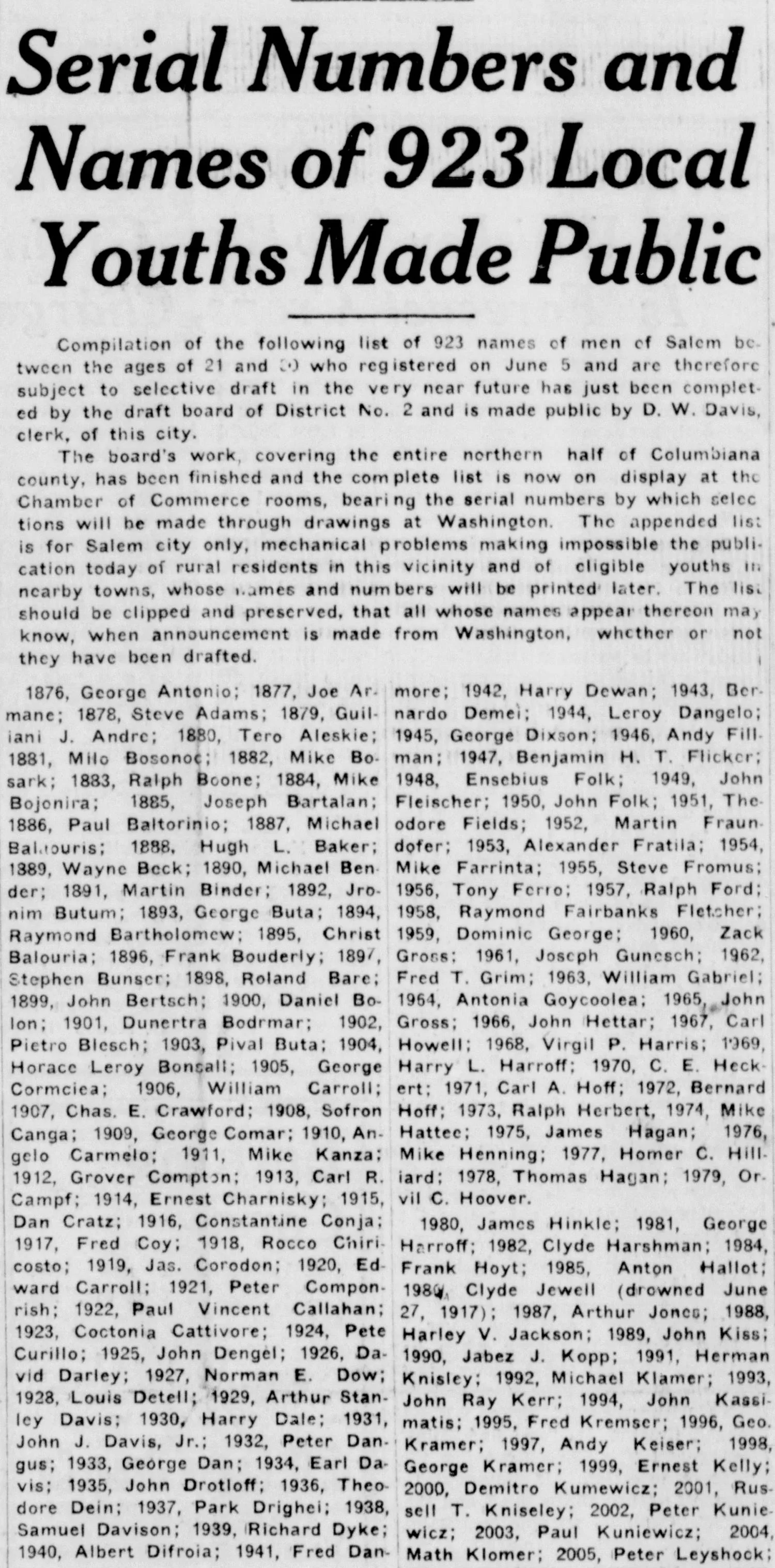
It is not a story about one person. It is a list. But a list like this can confirm that a man was living in a particular community at the time of registration.
Draft lists and military notices may place an ancestor in a specific town, year, and age group, even when the article is not a personal profile.
Search for:
surname + draft
surname + serial number
surname + regiment
surname + enlisted
surname + veteran
surname + GAR
surname + military
4. Search women by married names and family relationships
Women can be harder to find in old newspapers because they were often identified through relationships.
A woman might appear as:
Mrs. Nathaniel Brown
Mrs. Asbury Richey
Mrs. Johnson Brown
wife of William Brown
widow of John Melton
mother of Mrs. Charles Smith
daughter of Nathaniel Brown
That does not mean she is not in the newspaper.
It means she may not be under the name you expected.
Try searching:
her given name
her married name
her maiden name
Mrs. + husband’s full name
Mrs. + husband’s initials
her children’s names
her father’s name
her spouse’s surname and town
This is one of the biggest shifts in newspaper searching. Sometimes the best way to find a woman is to search the people around her.
5. Search maiden names and former names
Maiden names, former married names, and “formerly known as” references can show up in unexpected places.
You may find them in:
marriage announcements
obituaries
death notices
anniversary articles
legal notices
probate notices
divorce cases
land disputes
Try searches like:
Bessie Melton + Brown
Bessie Brown + Melton
Louisa Walters + Ralston
Elizabeth Cooper + Ralston
maiden name + married town
married name + father’s surname
This is especially helpful when a woman disappears from records after marriage. Newspapers can reconnect the names.
6. Search accident, injury, and illness notices
Newspapers loved accident and injury items.
Sometimes these are only a few lines long, but they can place someone in a specific location and tell you what happened to them in daily life.
This “Accident and Injury” clipping is a great example.
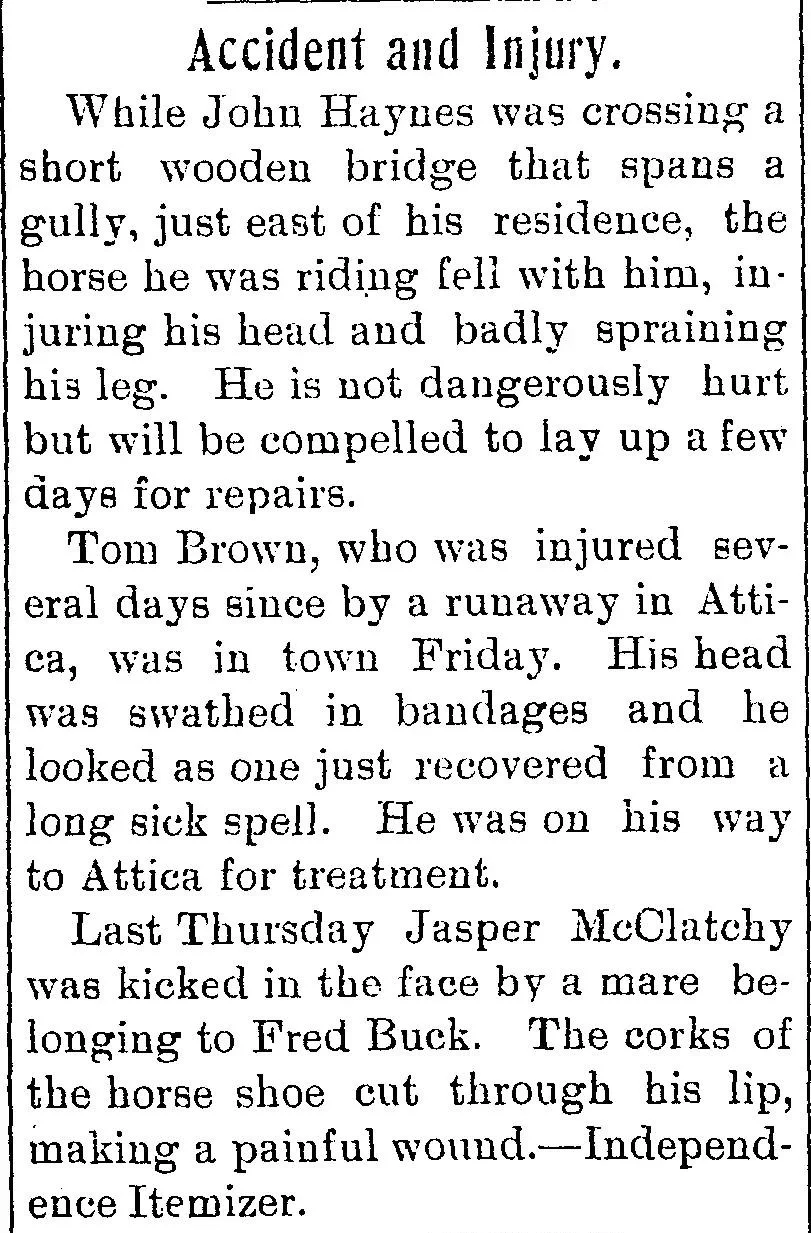
It mentions John Haynes crossing a wooden bridge, Tom Brown recovering from a runaway accident, and Jasper McClatchy being kicked by a horse belonging to Fred Buck.
That is a lot of people in one small article.
Search for:
surname + accident
surname + injury
surname + injured
surname + illness
surname + hospital
surname + operation
surname + treatment
surname + runaway
surname + horse
These notices can lead to follow-up articles, death notices, court records, or family stories.
Accident and injury notices can mention several local people at once and may reveal events that never appear in formal records.
7. Search addresses and residences
An address can be just as useful as a name.
Newspaper notices often include:
street addresses
residence descriptions
neighborhoods
farms
“north of town”
“near the schoolhouse”
“formerly of this city”
“at the home of her daughter”
Try searching:
surname + street name
surname + residence
surname + “formerly of”
surname + neighborhood
address + surname
street name + town
This can help you confirm you have the right person, especially when the surname is common.
It can also lead to more articles. Once you know the address, you can search the address itself and see who else appears there.
8. Search death notices and funeral notices
Obituaries are not the only death-related newspaper records.
Death notices and funeral notices may be shorter, but they often include exactly the clues you need.
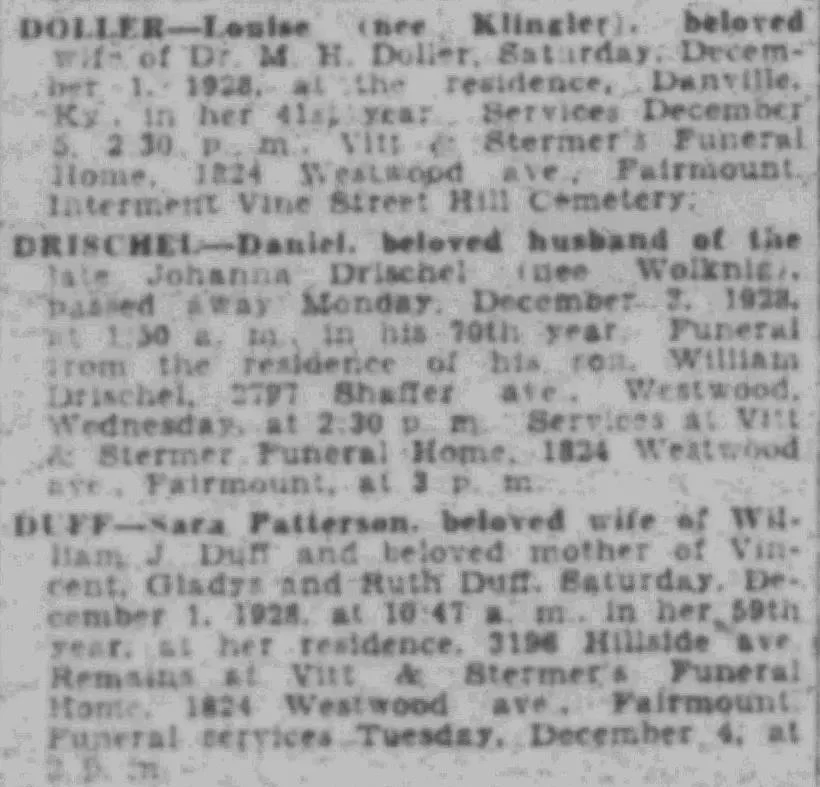
The death notice clipping with names like Leslie Doller, Daniel Drischel, and Sara Patterson Duff shows how much information can appear in a compact column. You may find names, maiden names, spouses, residences, funeral homes, funeral times, and cemeteries.
Search for:
surname + death
surname + died
surname + funeral
surname + services
surname + interment
surname + cemetery
surname + burial
surname + funeral home
A short notice still counts.
9. Search churches and ministers
Churches show up everywhere in old newspapers.
They appear in:
obituaries
weddings
funerals
anniversary articles
church socials
revivals
membership events
Sunday school programs
community dinners
Try searching:
surname + church
surname + Methodist
surname + Baptist
surname + Lutheran
surname + Catholic
surname + minister’s name
church name + surname
church name + town
If you know an ancestor’s denomination or church, use it as a search term. It may bring up articles that a name-only search misses.
10. Search cemeteries and burial places
Cemetery names are some of the best newspaper search terms.
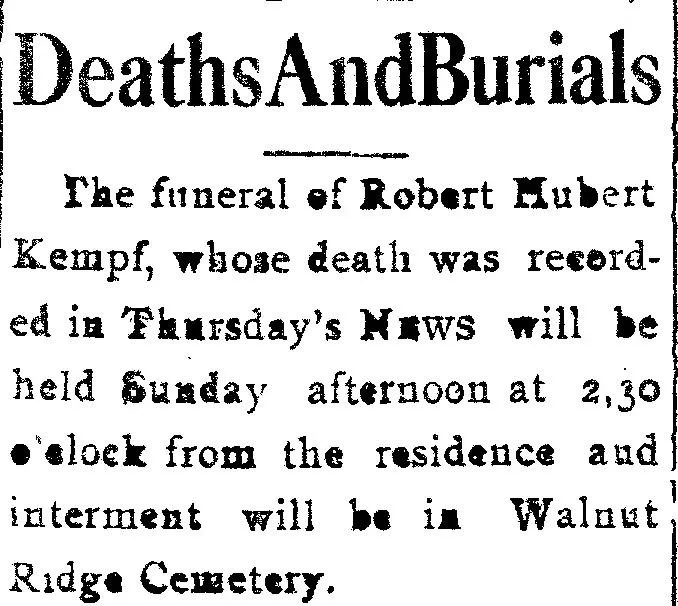
This “Deaths and Burials” clipping for Robert Hubert Kempf says his funeral would be held from the residence and that interment would be in Walnut Ridge Cemetery. Even a short item like that gives you a burial place, a date clue, and a location to search next.
Try:
surname + cemetery
surname + burial
surname + interment
surname + “laid to rest”
cemetery name + surname
cemetery name + town
If you already know the cemetery from Find a Grave, a death certificate, or family notes, take that clue back to NewspaperArchive and search with it.
11. Search funeral homes and undertakers
Funeral homes, morticians, and undertakers can also lead you to newspaper notices.
Older newspapers often named the person or business handling the arrangements.
Search for:
surname + funeral home
surname + undertaker
surname + mortician
surname + chapel
surname + “in charge”
funeral home name + surname
This is helpful when the obituary itself is hard to find. A funeral notice may be easier to catch because it names the funeral home, chapel, or undertaker.
12. Search weddings and society news
Wedding articles can be packed with family history details.
This Schafstall-Pine wedding clipping does more than announce a marriage. It gives the bride and groom, the bride’s parents’ address, the church connection, the minister, attendants, clothing, reception details, and where the couple planned to live.
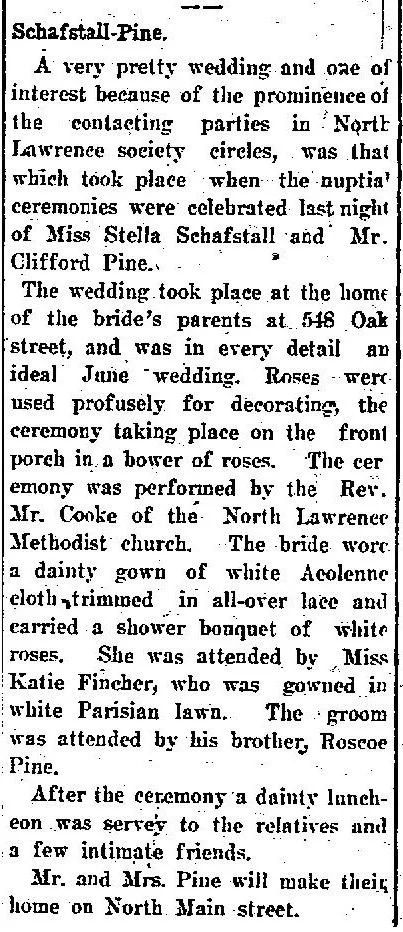
That is exactly the kind of article that can help you build context around a family.
Search for:
surname + wedding
surname + marriage
bride’s surname + groom’s surname
surname + society
surname + reception
surname + honeymoon
surname + “will make their home”
Wedding and society news can also connect families who do not appear together in census or vital records.
13. Search social columns and personals
This is one of the best reasons to use small-town newspapers.
Social columns and personals can mention everyday things like:
visits
dinners
relatives arriving
people returning home
illness
school breaks
out-of-town guests
funeral attendance
moves
club meetings
These items can seem tiny, but they can prove relationships and movement.
Try searching:
surname + visited
surname + guests
surname + returned home
surname + called on
surname + attended funeral
surname + relatives
surname + Sunday dinner
Small-town newspapers are especially good for these mentions. NewspaperArchive’s strength in local and regional papers makes this kind of searching worth trying, especially when bigger papers do not have much on ordinary families.
14. Search occupations, titles, and employers
Sometimes a person is easier to find through what they did than through their name.
This clipping “Captain McDonald Marries Daughter of Robert Chabot” is a good example. It identifies Captain N. C. McDonald, his bride Emily L. Chabot, her father Robert Chabot, his real estate work, her education, and McDonald’s command of the Apex Co. fishery fleet.
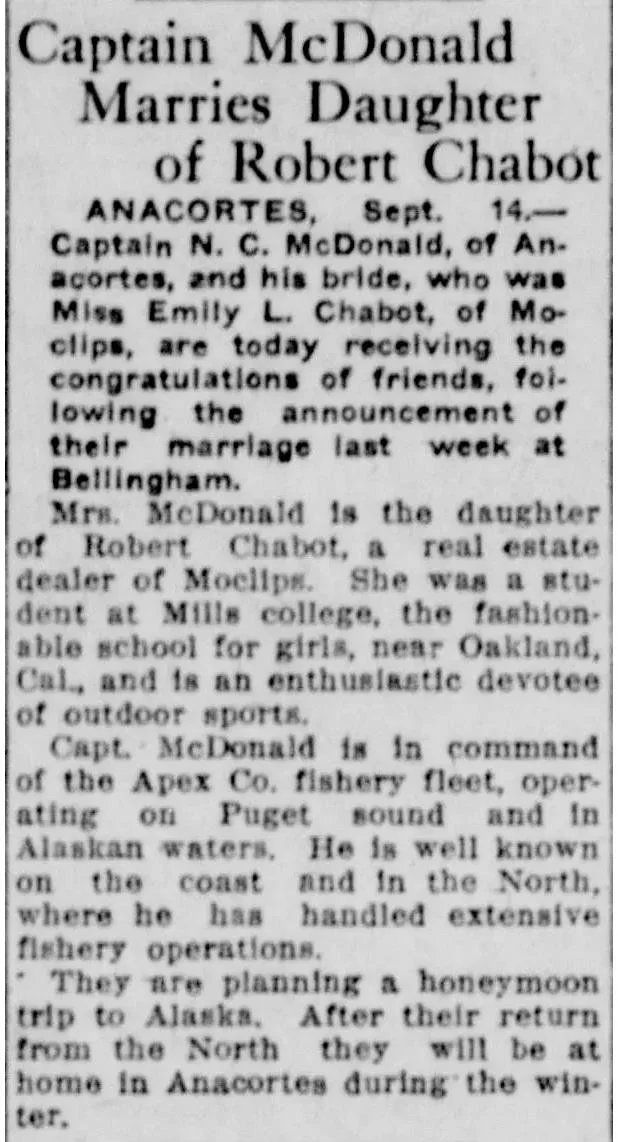
That gives several search paths:
Captain McDonald
N. C. McDonald
Robert Chabot real estate
Apex Co. fishery fleet
Emily Chabot
Mills College
Anacortes
Try searching:
surname + occupation
surname + employer
surname + captain
surname + teacher
surname + merchant
surname + farmer
surname + railroad
surname + real estate
employer name + surname
Titles and occupations can separate people with the same name.
15. Search schools, colleges, and student news
Schools and colleges can show up in newspapers more often than people expect.
Look for:
honor rolls
graduation lists
class plays
alumni notes
teacher assignments
school programs
college visits
sports teams
scholarship mentions
Try searching:
surname + school
surname + college
surname + student
surname + graduation
surname + teacher
school name + surname
college name + surname
If a wedding, obituary, or local article mentions a school, use that school name in your next search.
16. Search clubs, lodges, and organizations
Clubs and organizations created a lot of newspaper mentions.
Search for:
Masons
Knights of Pythias
Odd Fellows
Eastern Star
GAR
women’s clubs
literary societies
church societies
fraternal groups
local clubs
professional organizations
Try:
surname + lodge
surname + club
surname + society
surname + chapter
surname + post
organization name + surname
These articles can help explain who your ancestor knew, what they cared about, and how they fit into their community.
17. Search initials and abbreviations
Newspapers used initials constantly.
The R. P. Hamilton obituary is a good example.
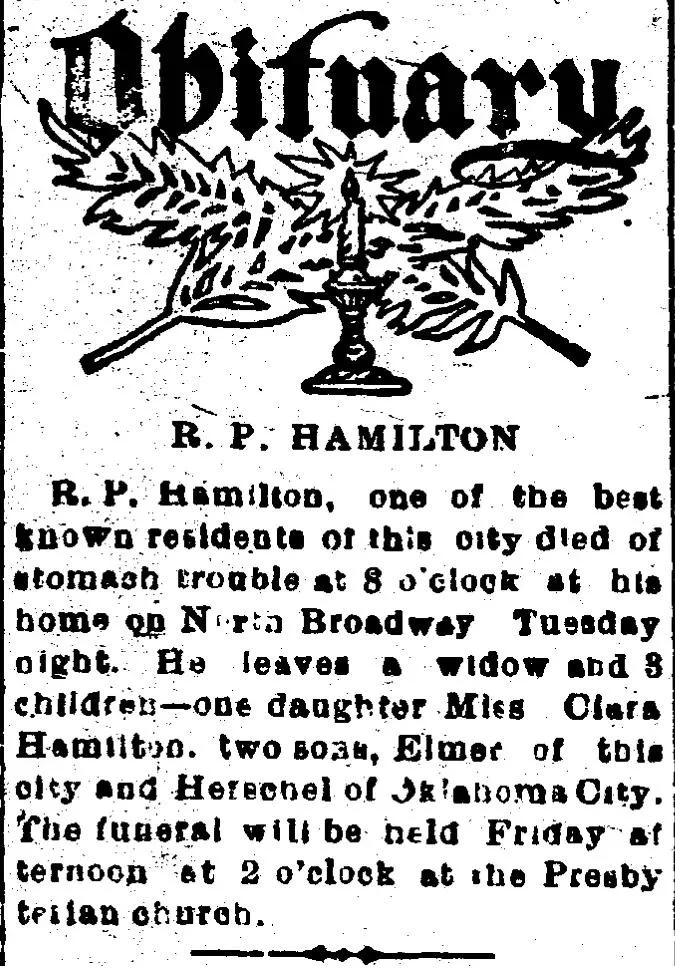
If you searched only for the full first name, you might miss it. But the obituary itself gives a lot: residence, cause of death, widow, children, funeral time, church, and the places where children lived.
Search:
first initial + middle initial + surname
first initial + surname
initials + town
surname + spouse
surname + children
surname + church
For example:
R. P. Hamilton
R P Hamilton
Hamilton + North Broadway
Hamilton + Presbyterian church
This is especially useful when you know an ancestor often used initials in records.
Initials and abbreviations can hide strong family history clues, especially in obituaries and death notices.
18. Search spelling variations and OCR mistakes
Old newspapers are full of spelling variation.
Search engines are also working with OCR, which means the text was read from scanned newspaper pages. If the page is faded, crooked, smudged, or printed in an unusual font, names can be misread.
Try variations like:
Siebert / Seibert / Sibert
Haunert / Hawnert / Hounert
VonPhul / Von Phul / Vonphul
Richey / Ritchey / Richie
Melton / Milton
Brown / Browne
You can also search fewer letters or pair the surname with a location.
If the name is being misread, the place or keyword may do more work than the full name.
For a deeper look at this, read The Name Game: 15 Smart Ways to Search Name Variants in Historical Newspapers. It walks through practical ways to search spelling changes, initials, nicknames, married names, and other name surprises that can keep ancestors hidden in old newspapers.
19. Search relatives instead of the ancestor
If your ancestor does not appear, search the people around them.
Try:
spouse
parents
children
siblings
married daughters
sons-in-law
daughters-in-law
neighbors
business partners
witnesses
funeral attendees
This works because newspapers often named people through relationships.
Your ancestor may appear as:
father of Mrs. Johnson Brown
brother of Nathaniel Brown
daughter of Bessie Melton
uncle of Asbury Richey
guest of Mrs. Hamilton
You may not find the person directly, but you may find the family network around them.
20. Search legal notices, aliases, and former names
Legal notices are not always fun to read, but they can be incredibly useful.
This Alias Summons clipping is dense, but look at what it includes: James N. Ralston also known as Jas. Ralston, Louisa Walters formerly Louisa Ralston, Elizabeth Cooper formerly Elizabeth Ralston, A. D. Cooper also known as A. J. Cooper, Mary P. Foster formerly Mary P. Ralston, and many other named people.
That is a lot of name evidence in one legal notice.
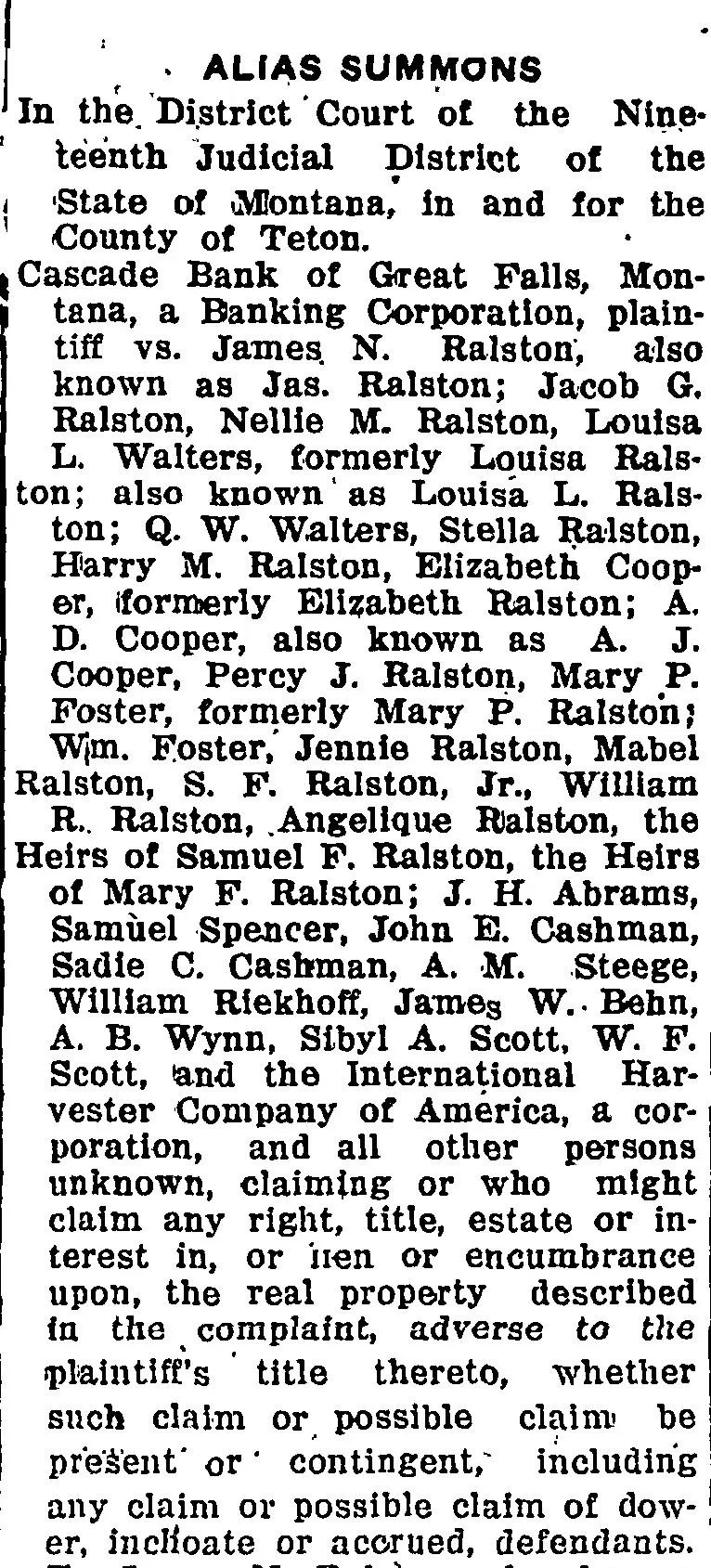
Legal notices can include:
aliases
former names
married names
heirs
banks
property disputes
estate claims
guardianships
probate matters
land descriptions
unknown heirs
Try searching:
surname + estate
surname + heirs
surname + alias
surname + summons
surname + probate
surname + administrator
surname + executor
surname + formerly
surname + “also known as”
This is one of the best ways to find name changes and family groups.
21. Save each clue and search again
This is the step that makes all the other steps work.
A newspaper article is not just something to save. It is something to use.
If an article gives you:
a new town
an address
a cemetery
a church
a maiden name
an occupation
an employer
a school
a lodge
a relative
a minister
a funeral home
search again with that clue.
If one of these ideas reminds you of an ancestor you’ve already searched for, try that name again in NewspaperArchive with one new detail: a church, address, occupation, or nearby town.
Sometimes the next article appears only after you stop repeating the same search.
FAQs About Finding Ancestors in Newspaper Archives
What is the best way to start searching for an ancestor in newspapers?
Start with the surname and location. Then add one detail at a time, such as a first name, date range, church, cemetery, occupation, or relative.
Why can’t I find my ancestor by full name?
The newspaper may have used initials, a nickname, a married name, a misspelling, or a relationship instead of the full name. OCR errors can also make names harder to find.
Are small-town newspapers useful for genealogy?
Yes. Small-town newspapers often included visits, funerals, illnesses, weddings, club meetings, school news, and community items that larger newspapers skipped.
Should I search for relatives too?
Absolutely. Relatives can lead you to the ancestor you are trying to find. Search spouses, children, siblings, parents, in-laws, and married daughters.
What should I do if search results are too broad?
Add a location, date range, keyword, church, cemetery, occupation, or newspaper title. Narrow slowly so you do not accidentally filter out useful results.
What should I do if nothing comes up?
Use fewer words, try spelling variations, search nearby towns, browse the newspaper, and search for relatives or related clues instead of only the person’s full name.
Final thoughts
Finding ancestors in newspaper archives is not only about typing in a name and waiting for the perfect result.
It is about trying the words newspapers actually used.
Names.
Places.
Churches.
Cemeteries.
Addresses.
Occupations.
Legal notices.
Wedding columns.
Social items.
Accidents.
Schools.
Relatives.
That is where the stories start to open up.
NewspaperArchive includes a wide range of local newspapers, including many small-town titles, and that matters because family history is often hiding in the everyday columns. With 85% unique content compared to competitors, it is worth trying searches that go beyond the obvious name-and-date approach.
Pick one ancestor and one strategy from this list. Run a fresh NewspaperArchive search with that clue and see whether a different kind of newspaper mention appears.
Key takeaways
Search beyond the full name.
Try surnames with towns and nearby locations.
Look for military lists, legal notices, school news, and social columns.
Search married women by husband, maiden name, and family relationships.
Use churches, cemeteries, funeral homes, addresses, and occupations as search terms.
Try initials, abbreviations, spelling variations, and OCR-friendly searches.
Small-town newspapers often include everyday details that larger papers skip.
Save each clue and use it to search again.