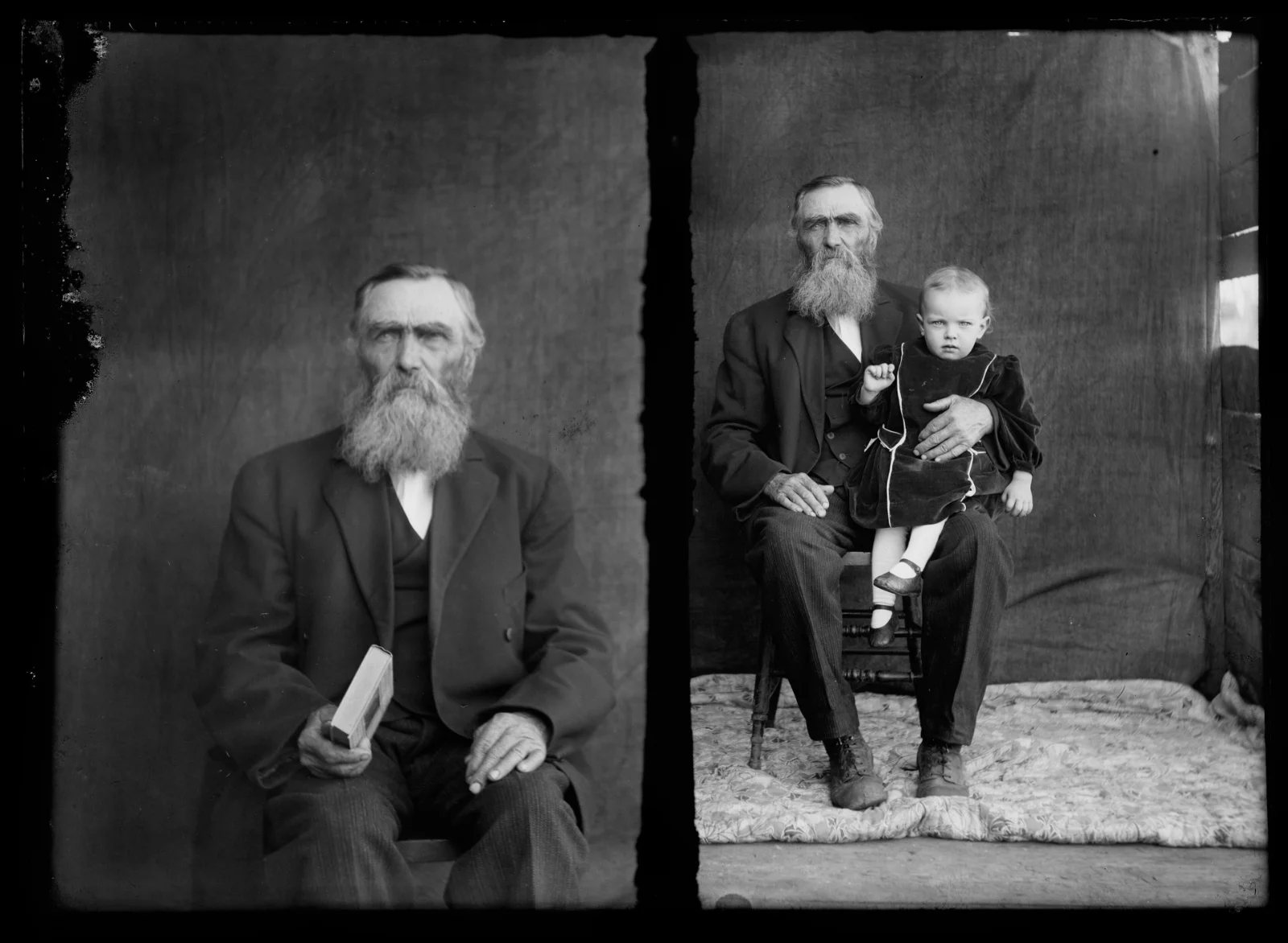
How Old Newspapers Tell Your Grandfather's Story
Heather Haunert searched NewspaperArchive for one man in Indiana and found a saloon keeper, a billiard parlor, a buggy accident, and a death that stopped her cold. Here's how to find the same kind of story about your own grandfather.
A Fine Girl Baby, a Billiard Parlor, and a Train: How Old Newspapers Told My Husband's Grandfather's Whole Story
I wasn't expecting much.
I knew his name: Archibald Gilland. The newspapers would call him Archie, and later just Arch. I knew he was from Indiana. I knew he had lived and died somewhere in Ripley County, in the kind of small town where everybody knew everybody and the local paper recorded everything.
What I didn't know was that those papers had been quietly keeping his story for over a hundred years, waiting for someone to look.
Here's what I found, and how you can find the same kind of thing about your own grandfather.
Start with a name, a place, and whatever else you've got
When you search for a grandfather in old newspapers, you don't need much to get started. A name and a state can be enough, especially if he lived in a small town, where the local paper was the community's memory.
Archie Gilland lived in Versailles, Indiana, in Ripley County. That's where I started. And almost immediately, the Versailles Republican handed me something I wasn't expecting: a legal notice from November 1891, formally announcing that Archie Gilland intended to apply to the Board of Commissioners for a license to sell "spirituous, vinous and malt liquors" at his place of business on Lot No. 12 in the town of Versailles.
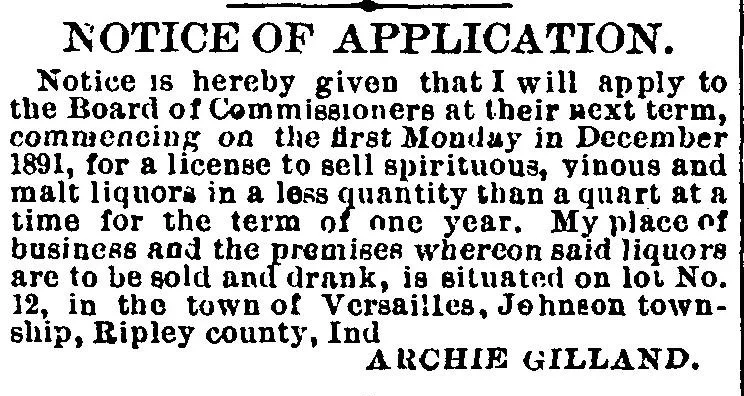
He was applying for a liquor license. My husband's grandfather ran a saloon.
I called my husband immediately.
One of the most useful things to know before you start searching is that your grandfather may have gone by more than one name in print. Archibald became Archie in casual local coverage, and Arch in the more formal notices later in his life. Searching all three variations, and any nicknames you know of, will help you find records you'd otherwise miss. If name variations trip you up, the post on searching name variants in historical newspapers goes deep on exactly this problem.
The life you didn't expect to find
This is the thing about old newspapers: you search for facts and you find a person.
By February of 1892, Archie wasn't just applying for a license. He was advertising. A bold, block-letter ad in the Osgood Ripley Journal announced his business to all of Ripley County:
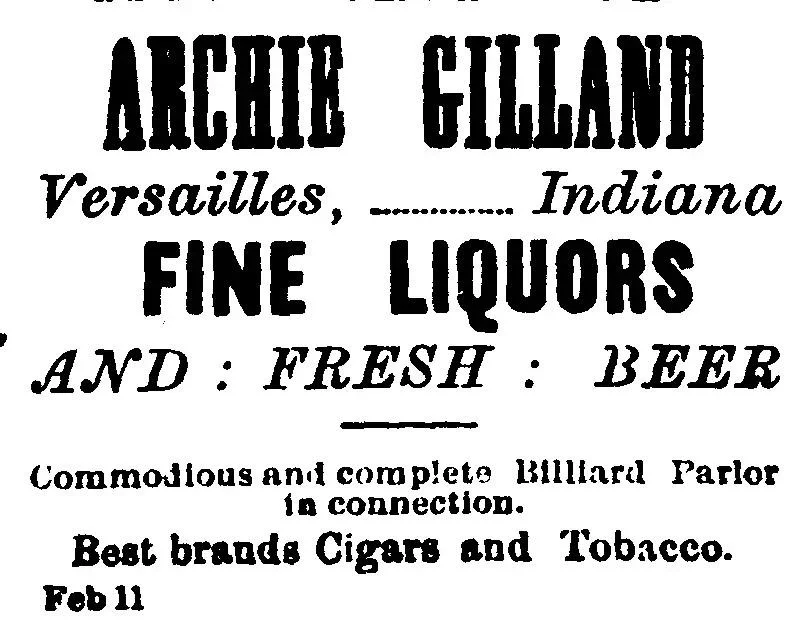
ARCHIE GILLAND Versailles, Indiana FINE LIQUORS AND FRESH BEER Commodious and complete Billiard Parlor in connection. Best brands Cigars and Tobacco.
He had a billiard parlor. He sold cigars. He was, by any measure, a man about town.
This is exactly the kind of record that gets overlooked in traditional genealogy research: a newspaper advertisement that tells you not just that someone existed, but how they made their living, what kind of establishment they ran, and how they wanted to be seen in their community. Archie Gilland wanted Ripley County to know he ran a fine operation. And a hundred and thirty years later, it worked.
The small, human moments that make history feel real
The big events in a life (births, marriages, deaths) are what most people search for first. But some of the most moving finds are the small ones. The ordinary Tuesday moments that somehow made it into print.
In November of 1892, the Versailles Republican ran this item:
"Archie Gilland was quite severely hurt one day last week while leading a horse behind his buggy. The horse pulled him out of the buggy and bruised him up considerably. It was at first thought his ribs were broken, but fortunately this was a mistake."
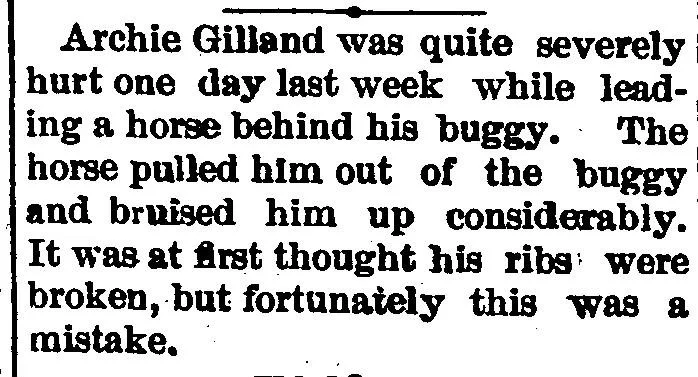
That's it. That's the whole item. A man got thrown from a buggy, and the town paper noted it because the town cared. His ribs weren't broken, thank goodness. He was fine.
And the following December, a quiet line in the Osgood Ripley Journal: Arch Gilland, proprietor of the West End saloon, was confined to his bed with la grippe.

The flu. He had the flu. This man who had been dead for nearly ninety years had the flu, and a newspaper reported it, and now I know.
Small-town newspapers were the social media of their era. If something happened to you, whether you were hurt, sick, hosting a dinner, or traveling to visit relatives, there was a decent chance it made the paper. These items aren't just color. They're proof of a life being lived. Millions of exactly these kinds of small-town records have been digitized and are fully searchable by name and location. If your grandfather lived anywhere near a local paper, chances are he's in there somewhere.
For Indiana researchers specifically, Indiana Newspaper Archives: Discover Local Stories, Records, and Hidden Family History is worth bookmarking before you start.
The clipping that opens ten new searches
In January of 1907, a legal notice appeared in the Osgood Ripley Journal under the heading "Non-Residents." It was a quiet title action, a real estate dispute, filed in the Circuit Court of Ripley County.
Mary A. Gilland, plaintiff. Archie Gilland, George Gilland, Dan Gilland, and others, defendants.
The notice went on to name the unknown heirs of Jane Gilland Pink, deceased. The unknown heirs of Daniel Gilland, deceased. The unknown heirs of Margaret Gilland Rice, deceased.
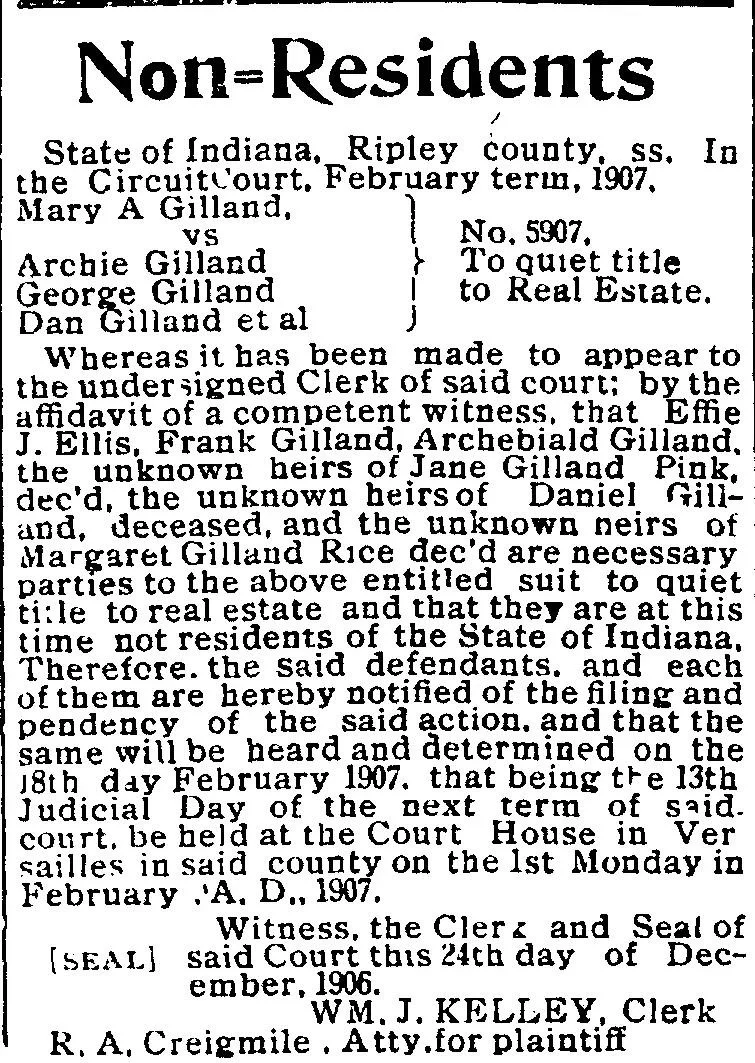
Suddenly I had siblings. I had deceased relatives I hadn't known to look for. I had maiden names, Rice and Pink, that opened entirely new branches of the family tree. A single legal notice, three column inches long, had given me a map I didn't have before.
This is one of the most underappreciated aspects of newspaper research: court notices, property records, and legal announcements routinely name extended family members, including people who had already died. If you find a notice like this one, follow every name in it. Each one is a thread worth pulling. How to Turn One Newspaper Article Into a Family Tree Research Plan walks through exactly how to do that.
The clipping that stops you cold
I found the death notice last.
That's often how it works. You build a life forward through the records, and then you find the end of it. But nothing quite prepares you for the moment you do.
Cincinnati Times-Star, March 3, 1937:
RETIRED INDIANA FARMER KILLED Father of Three Cincinnatians Is Victim
Arch Gilland, 68, retired farmer, Osgood, Ind., and father of Mrs. Milton Wieman, Mrs. Andrew Schoenebaum and Miss Elba Gilland, all of Cincinnati, was killed instantly when struck by a westbound B. & O. passenger train in Osgood, Tuesday night.
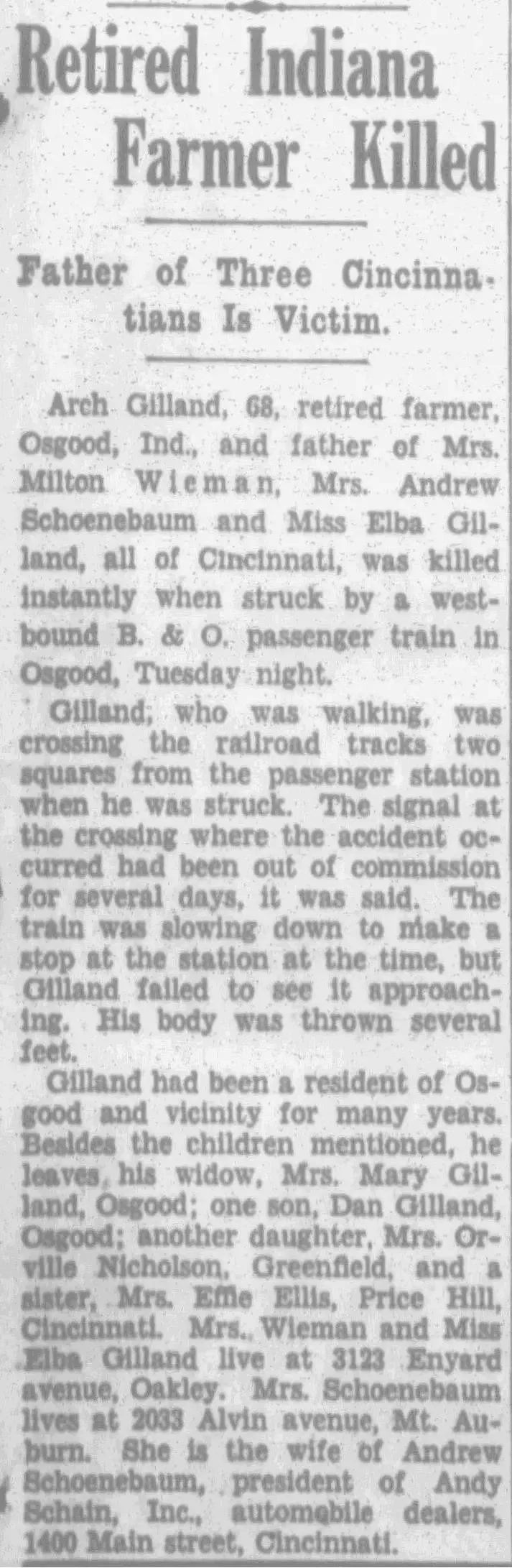
He was crossing the railroad tracks, two squares from the passenger station. The signal at the crossing had been out of commission for several days. The train was slowing down to make a stop. He didn't see it coming.
By 1937, Archie Gilland, the saloon keeper, the billiard parlor owner, the man the newspaper once noted was bruised up from a horse incident, the man who had the flu in the winter of 1891, had become a retired farmer. His children had moved to Cincinnati. His wife, Mary, was still in Osgood.
He was 68 years old.
I sat with that clipping for a long time. The man who had advertised fine liquors and fresh beer in block letters died crossing the railroad tracks on a Tuesday night in a small Indiana town. The signal was broken. It wasn't supposed to happen that way.
That's the gift of newspaper research, and the ache of it: you find out who people really were. Not just names on a family tree, but people who ran businesses and got thrown from buggies and had the flu and died too soon in ways that weren't supposed to happen.
Your grandfather's story is in those pages. Someone recorded it, year by year, in real time, because that's what local newspapers did. They kept the community's memory so that, a hundred years later, people like you and me could find it.
Not sure what to do once you start finding things? The post on turning one newspaper article into a family tree research plan is a great next step.
How to start your own search
You don't need much to begin. Here's what helps:
Use every name variation. If his name was Robert, search Bob and Rob too. If he had a formal name and a nickname, search both. Names shift across decades of newspaper coverage. The Name Game: 15 Smart Ways to Search Name Variants in Historical Newspapers has every trick you need.
Narrow by geography first. State and county searches will return far more useful results than national searches, especially for small-town coverage.
Search in time clusters. If you know a birth year, search around it. Birth announcements in old newspapers often name parents even when the child isn't named, which can confirm family connections you suspected but couldn't prove. If you know a marriage year, search around that too. Build outward from what you already know.

Follow every name you find. A legal notice, an obituary, a church announcement: any record that names your grandfather also names the people around him. Those names are your next searches. And when you find a death notice, pay attention to the difference between an obituary, a funeral notice, and a death notice. The differences matter more than you'd think.
Don't overlook the unexpected. Liquor license applications. Buggy accidents. Letters to the editor. Classified ads. The society pages. Small towns put everything in the paper, and sometimes the most human moments are the ones nobody thought to archive anywhere else.
Frequently asked questions
Can I really find my grandfather in old newspapers? Very likely, yes, especially if he lived in a small town or city with an active local paper. NewspaperArchive holds billions of pages from thousands of papers across the United States and beyond, covering everything from birth announcements to legal notices to obituaries. If your grandfather lived between the mid-1800s and the late 1900s, there's a good chance he appears somewhere in those pages.
What's the best way to start searching for a grandfather in old newspaper archives? Start with his full name and the state where he lived. Then try nickname variations and nearby counties. Narrow by decade if you know approximate dates. The more specific you can be with location and time frame, the faster you'll find results. How to Search NewspaperArchive and Find People Faster has a full walkthrough.
What kinds of records will I find besides obituaries? Birth announcements, marriage and divorce notices, legal notices, court records, business advertisements, church announcements, school honor rolls, sports rosters, letters to the editor, society columns, and local news items are all common. Archie Gilland showed up in a liquor license application, a newspaper ad, a buggy accident item, a flu notice, a real estate dispute, and a death notice. That's a whole life, found in six clippings.
What if I can't find anything at first? Try name variations first. Then broaden your geography. Your grandfather may have appeared in a neighboring county's paper, or in a city paper if he had family who moved away. If you're still stuck, try broadening your search to neighboring counties or papers from cities where family members later moved.
Your grandfather's story is waiting
I started this search not expecting much. A name, a county, a hunch that something might turn up.
What I found was a man. A saloon keeper who advertised fine liquors and fresh beer in block letters. A businessman thrown from a buggy who was fine, thank goodness. A husband sick in bed with the flu on a December night in 1891. A father whose children grew up and moved to Cincinnati. An old man crossing railroad tracks on a Tuesday night when the signal wasn't working.
Archibald Gilland lived and died in small Indiana towns that most people have never heard of. But the newspapers there were paying attention. They recorded his liquor license and his advertisement and his accident and his illness and his family dispute and his death. They kept all of it, in ink, on paper, for over a hundred years, until someone thought to look.
That someone was me. And now I know him.
Your grandfather's story is in those pages too. Maybe it's a birth announcement, a sports roster, a letter to the editor, or a business ad. Maybe it's something you'd never think to search for. Maybe it's a death notice that stops you cold and makes you sit quietly for a while.
You won't know until you start looking. If you're ready, NewspaperArchive.com is a good place to begin.