What the Papers Said: Reading Pearl Harbor Through the Newspapers of December 7 and 8, 1941
Newspapers told Americans what happened at Pearl Harbor in real time. See how local and national papers covered December 7, 1941, and what those pages mean for family history research.
Newspapers published on December 7 and 8, 1941 covered the Pearl Harbor attack through wire service dispatches, strategic maps, international war bulletins, and local lists naming community members stationed in Hawaii and the Pacific. These pages are primary historical sources and valuable genealogical records, because local papers named ordinary servicemen by name, address, ship, and unit in the days following the attack. NewspaperArchive holds a large searchable collection of these papers from across the United States, including small-town and county papers that published local soldier lists throughout the war. Searching a hometown paper from December 1941 through the end of World War II is one of the most direct methods for finding a military ancestor in newspaper records.
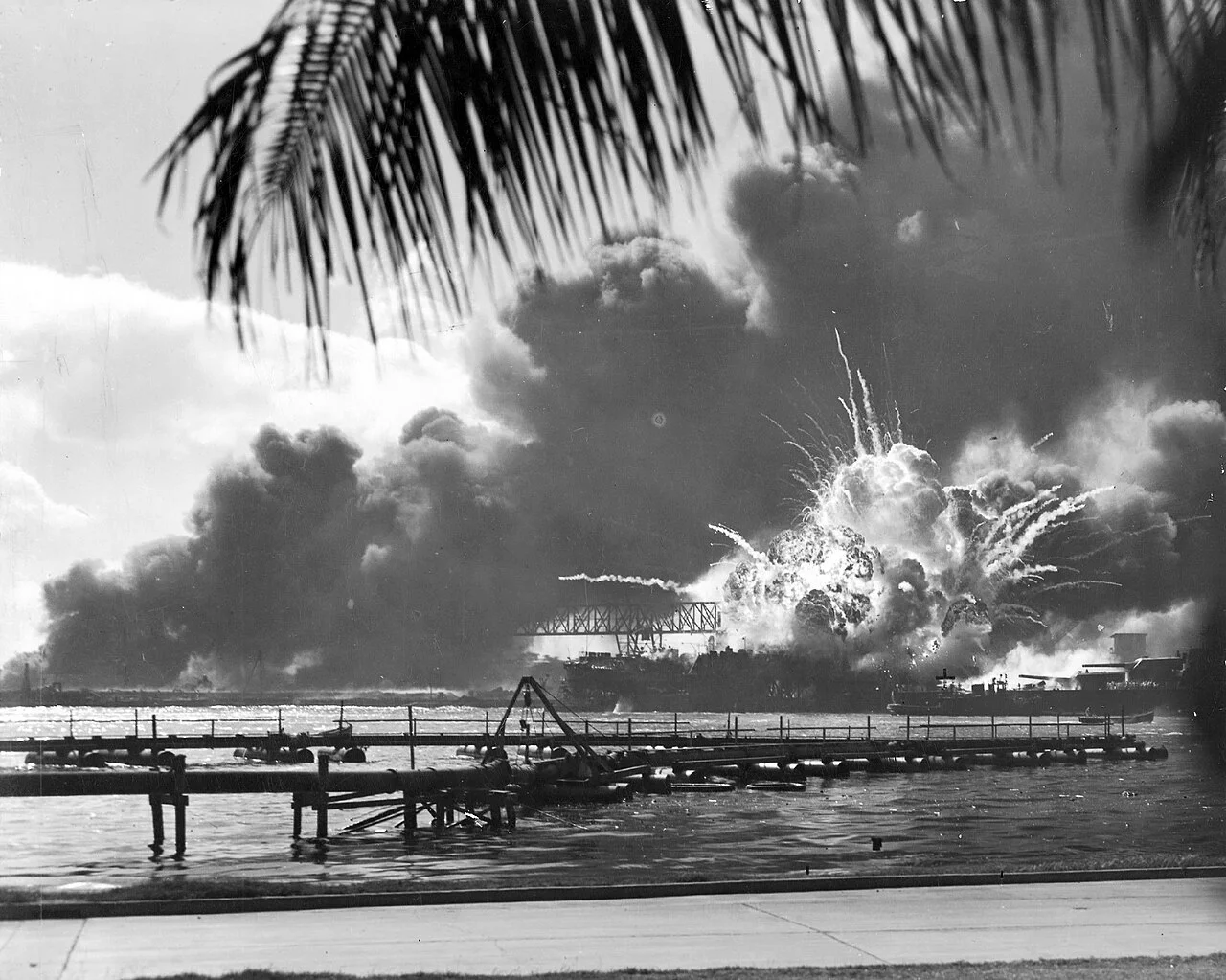
On the morning of December 7, 1941, the Empire of Japan launched a surprise attack on the United States Pacific Fleet at its naval base at Pearl Harbor on Oahu, Hawaii. The first Japanese aircraft appeared over Pearl Harbor at 7:55 AM local time. Over the next hour, airfields and ships were subjected to a merciless assault with bombs and torpedoes. A second wave struck at 8:50 AM. At 8:10, a 1,800-pound bomb smashed through the deck of the battleship USS Arizona and landed in her forward ammunition magazine. The ship exploded and sank, killing 1,177 sailors, officers, and Marines.
The attack prompted the United States to declare war on Japan the next day. By the time the smoke cleared, more than 2,400 U.S. military members and civilians were killed, and nearly 190 aircraft were destroyed or damaged.
Americans learned what happened through their newspapers. Editors worked through the night. Presses ran before dawn. By Monday morning, front pages across the country carried the story in headlines as large as any in living memory. Those pages still exist. Many are searchable today, and they tell the story of December 7th in a way no history book quite replicates.
Quick Answer
Newspapers from December 7 and 8, 1941, captured the Pearl Harbor attack in real time through eyewitness dispatches, front-page maps, war bulletins, local soldier lists, and draft notices. These pages are valuable both as historical records and as family history research tools, because local papers named the men from each community who were stationed in the Pacific. NewspaperArchive holds a large collection of these papers from across the country.
If you have an ancestor who served in the Pacific in 1941, searching their hometown paper from December 7 through the end of that month is one of the most direct ways to find their name in print.
What the First Dispatches Looked Like
Not every paper had a reporter in Honolulu. Much of what American readers saw on December 7th came through wire services, primarily the Associated Press and United Press, transmitted from Hawaii in real time as the attack was still unfolding.
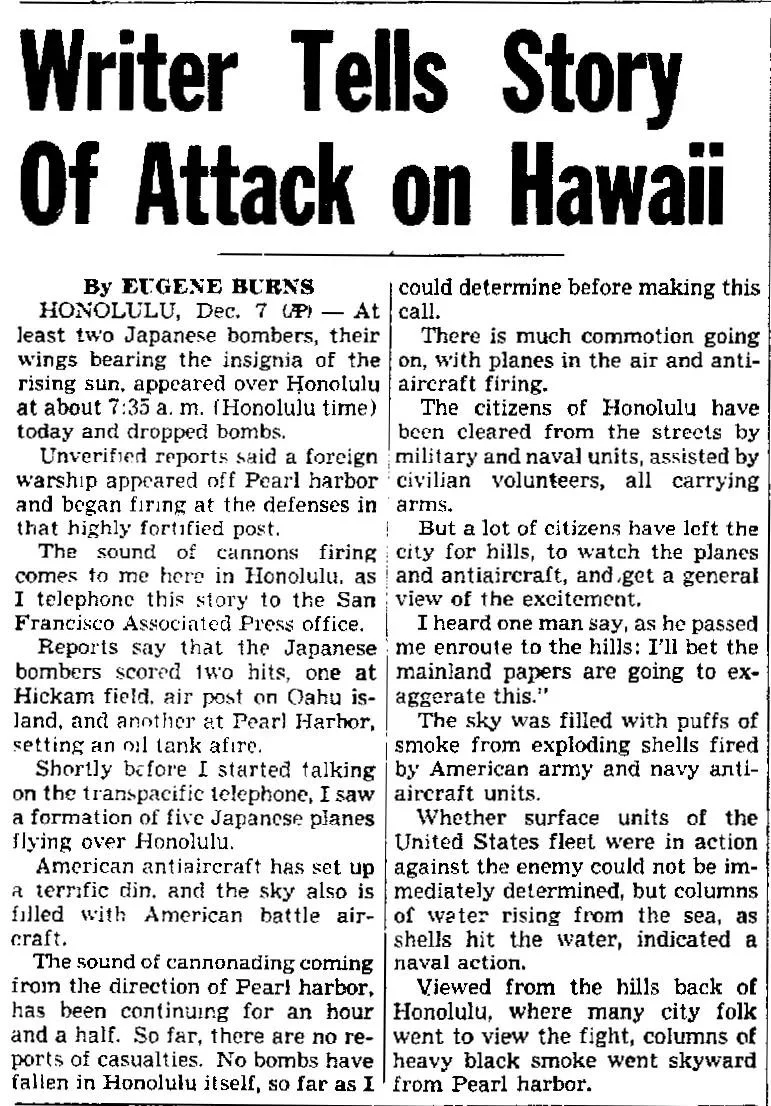
The Reno Evening Gazette ran a first-person AP dispatch filed from Honolulu by correspondent Eugene Burns while the attack was still in progress. Burns described Japanese bombers bearing the insignia of the rising sun appearing over Honolulu at approximately 7:35 AM. He wrote of cannon fire audible from the direction of Pearl Harbor, of American antiaircraft units setting up a din across the sky, of civilians being cleared from the streets by military and naval units. He was telephoning his account to the San Francisco AP bureau as the sound of cannonading continued around him. One line stands out: he quoted a man passing him on the street, heading to the hills to watch, saying
"I'll bet the mainland papers are going to exaggerate this."
They did not exaggerate. Burns described columns of heavy black smoke rising from Pearl Harbor, visible from the hills above Honolulu. His account conveyed the chaos and uncertainty of those first hours, when reports were still unverified, and the full scale of the damage was not yet known.
That dispatch, filed and transmitted while the attack was still unfolding, was how much of America first came to understand what had happened.
How Newspapers Explained the Strategic Picture
American readers in December 1941 had been following the deteriorating situation in the Pacific for months. Japan had been at war with China since 1937. Tensions over Japanese expansion into Southeast Asia had led the United States to cut off oil exports to Japan in mid-1941. Most military analysts expected a confrontation. A Gallup poll taken just before the attack found that 52 percent of Americans expected war with Japan. Few expected it to begin at Pearl Harbor.
Once it did, newspapers moved quickly to help readers understand what the attack meant strategically. Some papers ran detailed maps and graphics alongside their news coverage.
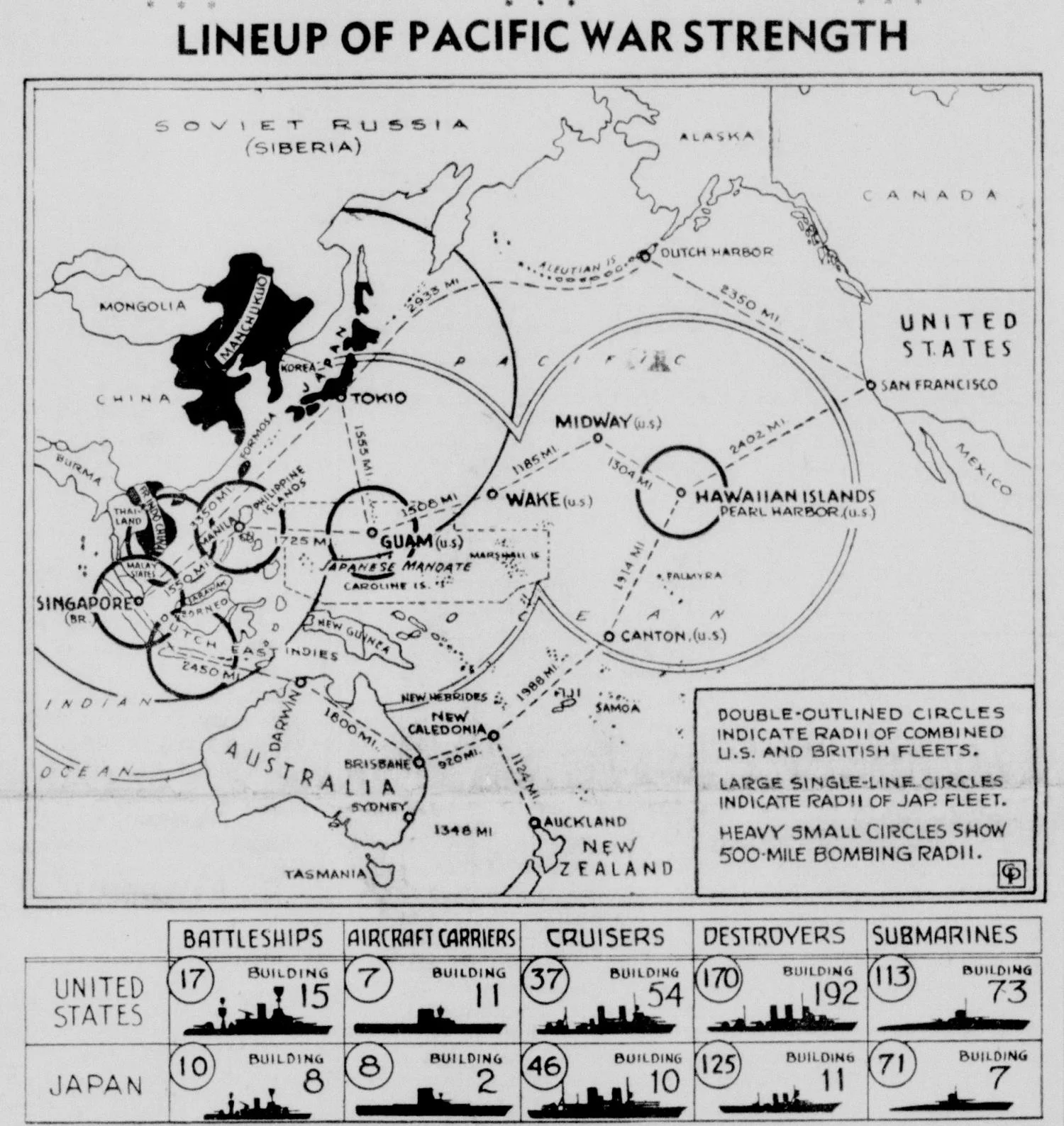
The Washington C.H. Record Herald published a graphic titled "Lineup of Pacific War Strength" showing a map of the entire Pacific theater alongside a comparative table of U.S. and Japanese fleet strength. The table broke down battleships, aircraft carriers, cruisers, destroyers, and submarines for both nations, listing both active ships and vessels then under construction. It was the kind of visual that told readers: here is the scale of what we are entering.
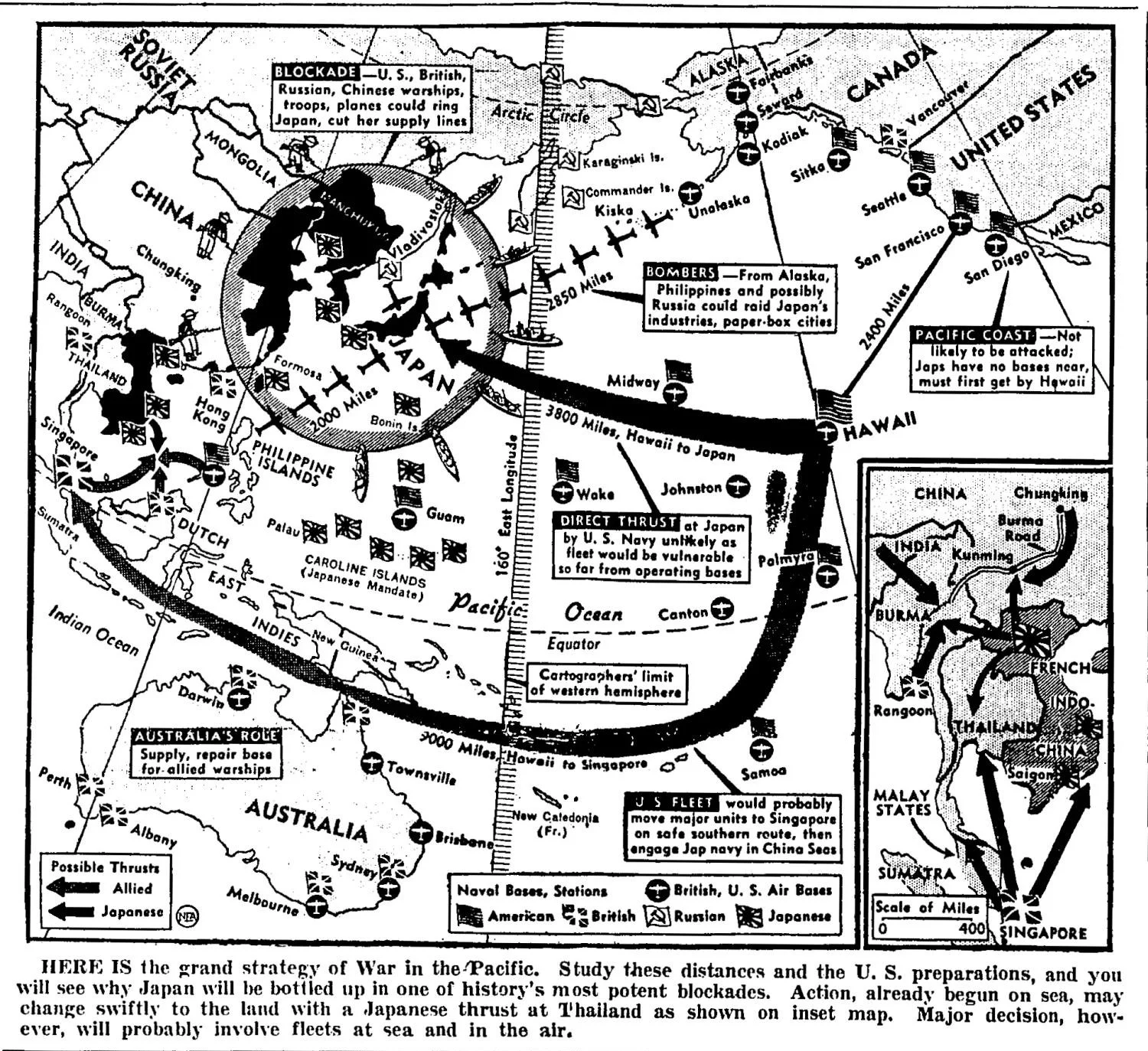
The Hutchinson Herald ran a full-page war strategy map showing the distances, naval base positions, and possible lines of attack and counterattack across the Pacific. The caption read in part:
"HERE IS the grand strategy of War in the Pacific. Study these distances and the U.S. preparations, and you will see why Japan will be bottled up in one of history's most potent blockades."
It was confident language for a morning when the Pacific Fleet was still burning.
From a research perspective, these graphics reveal how seriously local editors took their responsibility to explain the war to ordinary readers. These were not metropolitan papers. They were small and mid-sized papers serving communities across the country, and they treated their readers as people who deserved to understand what was happening.
How the World Responded: The War Bulletins of December 8
By the morning of December 8th, the story had expanded far beyond Hawaii. The attack on Pearl Harbor had triggered a cascade of declarations and military movements across multiple theaters.
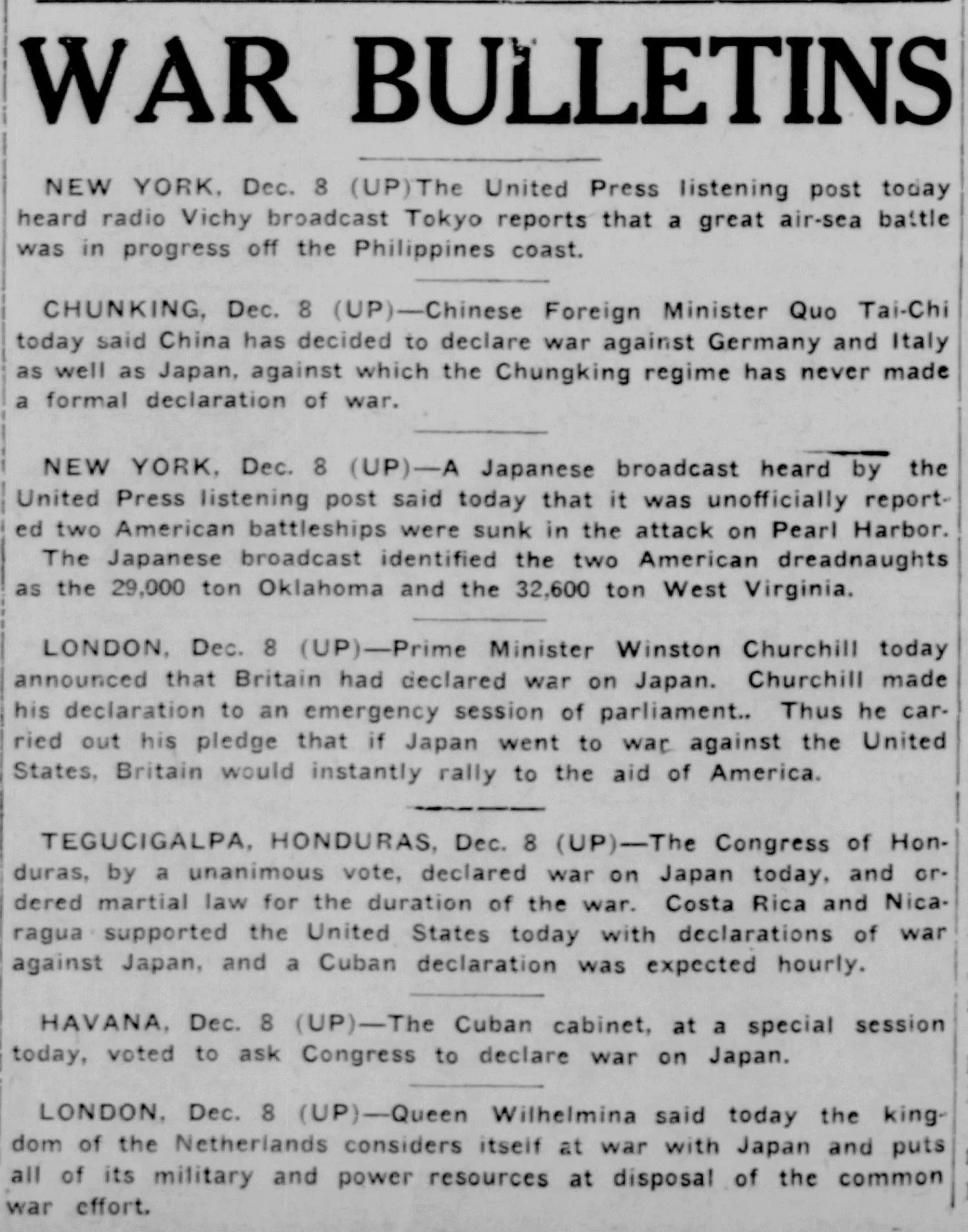
The Murphysboro Daily Independent ran a front page dominated by a "War Bulletins" column carrying dispatches from around the world, all dated December 8. From Chungking, China's Foreign Minister announced that China had decided to declare war on Germany, Italy, and Japan. From London, Prime Minister Winston Churchill announced that Britain had declared war on Japan, honoring his pledge that if Japan attacked the United States, Britain would instantly ally itself with America. Honduras declared war on Japan by unanimous congressional vote. Costa Rica and Nicaragua followed. Cuba's cabinet voted to ask Congress to declare war. From London again, Queen Wilhelmina announced that the Netherlands considered itself at war with Japan.
In a single newspaper column, readers could see the shape of a world war forming in real time. That is something you cannot fully appreciate from a history book. The bulletins have no retrospective calm. They read like what they were: a world reacting to sudden catastrophe, one dispatch at a time.
The Pages That Named Your Ancestor
For family historians, the most significant Pearl Harbor coverage often appeared not in the dramatic front-page dispatches but in the quieter local stories that followed. When news of the attack reached American communities, editors and reporters immediately began asking: who from here was there?

The Lawrence Journal World published an article headlined "Many Men From Here in the Pacific" naming more than fifteen Lawrence, Kansas men then serving in the Army or Navy in the Pacific. The article named them individually, with their parents' names and home addresses, their ships, and their units. Among those named was Ensign Robert J. Rowlands, son of Mr. and Mrs. R. J. Rowlands of 620 Ohio Street, listed as stationed aboard the battleship USS Nevada at Pearl Harbor. Also named was Charles Martin, a former local messenger boy, listed as a radio operator assigned to the Nevada.
The USS Nevada's story that morning was one of the few things that lifted spirits during the attack. She was the only battleship to get underway during the assault. Hit by a torpedo and taking on water, she backed clear of her berth and began steaming down the channel toward the open sea. Japanese dive bombers immediately shifted their attention to the moving ship and hit her repeatedly. With fires burning and the ship in danger of sinking and blocking the harbor entrance, her officers beached her at Hospital Point, keeping the channel open for other vessels. Her antiaircraft batteries were still firing as she grounded. She was later salvaged and rebuilt, and she went on to fire her guns in support of Allied troops at Normandy and Iwo Jima.
The men named in the Lawrence paper were assigned to that ship. Whether any individual crew member was aboard or ashore when the attack began on that Sunday morning cannot be confirmed from the newspaper account alone. But their families, reading that article on December 7th, would not yet know either way.
That is what a local newspaper clipping can do that a casualty list cannot. It places a real person, with a name and an address, in the middle of a historical moment.
What Came Next: The Draft, the Names, and the Papers That Kept Printing Them
In the weeks after the attack, newspapers shifted to covering the national response. Draft boards prepared for massive inductions. Congress authorized the declaration of war. Military planners began mobilizing an industrial economy for total war.
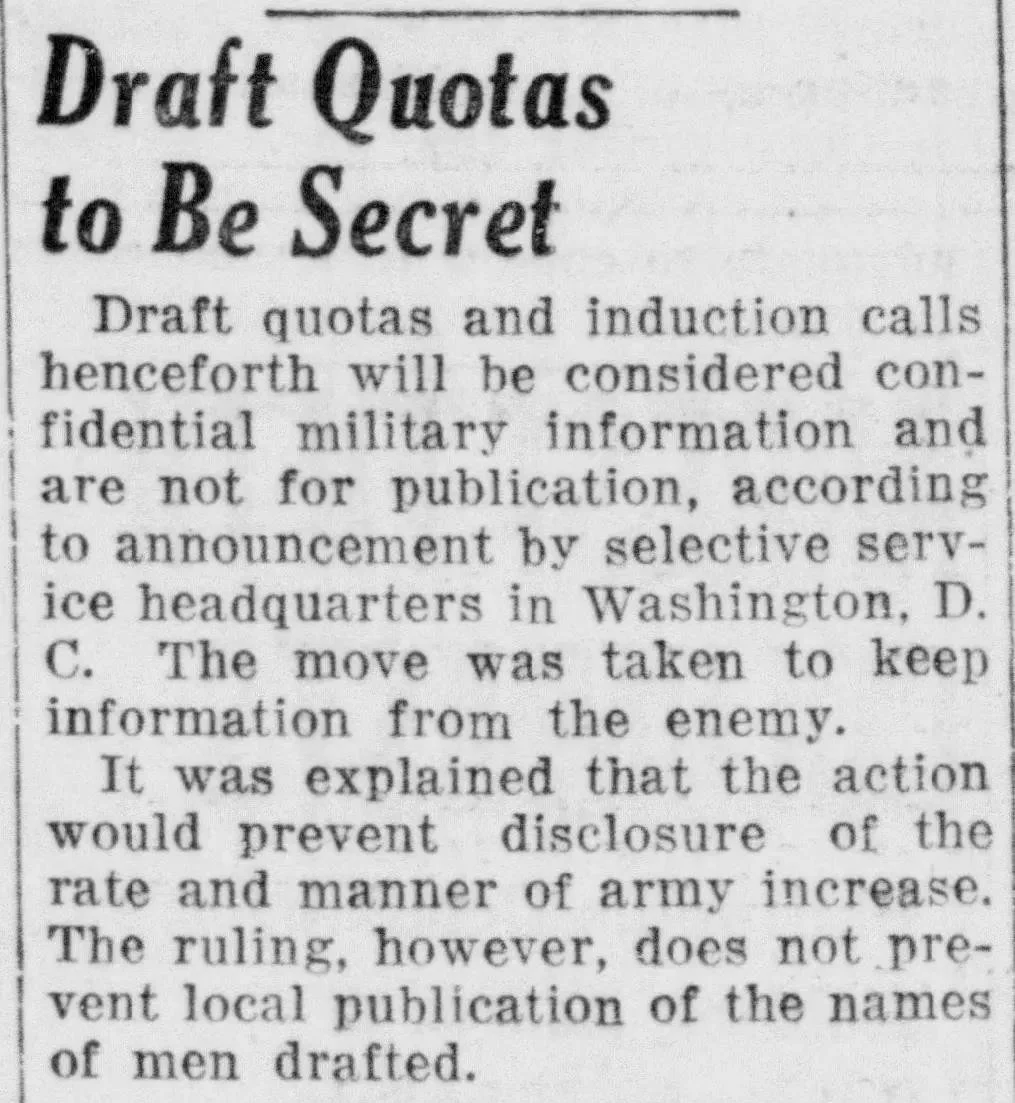
The Burlington Daily Hawk-Eye Gazette ran a short item on December 15th under the headline "Draft Quotas to Be Secret." The article reported that draft quotas and induction calls would henceforth be considered confidential military information, not for publication, to prevent disclosure of the rate and manner of army increase. But the ruling included a critical exception: it did not prevent local publication of the names of men drafted.
That exception matters enormously for family historians. Throughout the war, many local papers continued to publish the names of men called up, inducted, shipped out, promoted, wounded, and killed. The national numbers went dark. The local names, in many communities, stayed in print.
If your ancestor served in World War II, his name may well have appeared in his hometown paper at multiple points, from induction to deployment to the notice of his return. Those names are searchable today in NewspaperArchive.
How to Research Pearl Harbor and World War II Ancestors in Old Newspapers
The clippings above suggest a search strategy that goes well beyond typing a name into a search box.
Start with the hometown paper from December 1941. Search your ancestor's name in their hometown newspaper in the weeks immediately following December 7th. Papers were printing local soldier lists, "men from here" features, and family notices throughout that month.
Search by ship name. If you know the ship your ancestor served on, try searching that ship's name in local papers. Coverage of specific ships, especially after notable actions, often named crew members.
Look for induction and deployment notices. Local papers printed these regularly throughout the war. Search your ancestor's name alongside terms like "inducted," "reported for duty," "leaves for service," or "transferred."
Search for letters home. Some local papers printed excerpts from letters sent home by servicemen. These are rare but remarkable finds when they appear.
Don't stop at December 1941. The war lasted until August 1945. Search across the full arc of the war for promotions, wounds, commendations, and homecomings.
If name spelling creates problems in your searches, searching by unit, ship, or hometown can sometimes surface articles where your ancestor appears without being the named subject. NewspaperArchive's guide to searching name variants in historical newspapers is a useful companion when exact-name searches come up short.
Frequently Asked Questions
Why did local newspapers publish the names of men serving in the Pacific after Pearl Harbor?
Local editors understood that their readers' first concern was for the men from their own communities. Publishing names, addresses, ships, and units served both an informational and a community function. It told families where their sons and husbands were and acknowledged their service publicly.
Were the draft lists published in newspapers accurate?
They were generally reliable but not comprehensive. Local papers reported what draft boards and families shared with them. Errors in name spelling, rank, and unit were not uncommon. Treat newspaper notices as a starting point for confirming information through military service records.
Can I find my World War II ancestor's name in a newspaper even if he didn't do anything notable?
Yes. Ordinary servicemen appeared in induction lists, deployment notices, promotion announcements, letters-home features, and casualty reports. Smaller local papers often covered their community's servicemen in considerable detail precisely because they knew their readers personally.
What is the best date range to search for Pearl Harbor coverage?
December 7 through December 31, 1941, covers the immediate attack and the first wave of local response coverage. January through March 1942 often includes follow-up stories on local men whose fates were confirmed after the initial chaos.
Does NewspaperArchive have papers from small towns that might have covered local soldiers?
Yes. NewspaperArchive is particularly strong in small-town and rural newspaper coverage, which is exactly where most local soldier lists appeared. Searching a county-seat weekly from the weeks after December 7th often yields results that a metropolitan paper search will miss.
The Pages Are Still There
What the newspapers of December 7 and 8, 1941, captured was not just history. It was the moment history arrived at people's doors. The eyewitness dispatches, the strategic maps, the cascading war bulletins from capitals around the world, and the quiet local lists of men from ordinary streets in ordinary towns: all of it is preserved, and much of it is searchable today.
If someone in your family was part of that moment, their name may be in those pages. The hometown paper from December 1941 is a reasonable place to begin.