Why Your Ancestor's Name Looks Different in Every Record (And What to Do About It)
Ancestor names change in historical records for many reasons. Here's why it happens and what each variation can tell you about the person you're searching for.
Ancestor names change in historical records for many reasons: phonetic spelling by clerks and editors who recorded names as they sounded, immigration and deliberate anglicization as families adapted to English-speaking communities, marriage customs that listed women only under their husbands' names, translation of names across languages, personal name changes recorded in court notices and local newspapers, post-emancipation surname choices that may have no visible connection to earlier records, and OCR errors in digitized newspaper pages that affect searchability. Understanding the reason behind a name change helps family historians identify better search terms, find records they would otherwise miss, and connect people across the gaps that name variation creates. NewspaperArchive's collection of small-town and local newspapers is especially useful for finding the informal or transitional version of a name that may not appear in official records.
You found your great-grandmother in the 1900 census, spelled one way. You found her again in a church notice, spelled differently. In the county deed, her husband appears under initials you don't recognize. The names belong to the same people. But every record seems to describe someone else.
This happens in nearly every family history search, and it almost never means the records are wrong. It means names were not fixed, stable things the way we treat them today. They shifted with language, circumstance, geography, and the assumptions of whoever held the pen.
Understanding why a name changed is often the key to finding more records. Once you know what caused the variation, you have a better sense of what else to search, where to look, and which version of a name is most likely to appear in which type of source.
Quick Answer: Ancestor names change in historical records for many reasons: phonetic spelling by clerks and editors, immigration and anglicization, marriage customs that erased women's given names, deliberate name translation across languages, personal name changes, post-emancipation surname choices, and OCR errors in digitized newspapers. Understanding the reason behind a name change helps you decide what to search next.
If a name in your family tree keeps coming up empty, try working through the reasons below. Local and small-town newspapers often recorded the name a person actually used in daily life, not the anglicized or formalized version from official documents. NewspaperArchive's collection is especially strong in those smaller papers, which makes it a useful place to search when official records aren't telling the whole story.
How Names Changed at the Border: Immigration and Anglicization
There is a persistent story in American family history that immigration officials at Ellis Island changed immigrants' names wholesale, giving them new American identities with the stroke of a pen. The reality is more complicated and, for researchers, more useful to understand.
Immigration officials usually did not make up new names. They simply wrote down what they heard. If an immigrant spoke with a strong accent, used a different alphabet, or could not spell the name in English, the written version could end up looking very different from the original. Names written in languages such as Russian, Greek, or Hebrew had to be converted into English letters, and the person doing the writing often had little knowledge of the language. As a result, the spelling was often just their best guess.
Families also anglicized deliberately, and this is worth separating from the port-of-entry story. Many immigrants chose to adapt their names after arrival, sometimes within months, sometimes over a generation. It was a practical decision as much as a cultural one. A name that was difficult for English speakers to pronounce or spell could be a barrier in business, in schools, and in daily community life.
This 1917 estate notice from the Harrisburg Telegraph shows both names for the same man in the same sentence.
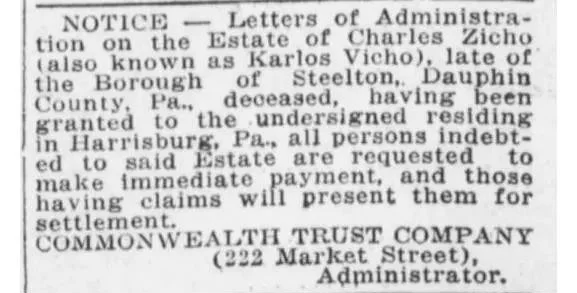
Charles Zicho. Also known as Karlos Vicho. The same person, the same estate, two names that look like they belong to different people. A researcher who knew him only as Charles Zicho would not find records filed under Karlos Vicho. A researcher who knew him only as Karlos Vicho might not recognize Charles Zicho as the same man. The estate notice happens to preserve both, which is exactly the kind of bridge record that can open an otherwise closed search.
When a surname seems to appear and disappear across records, look for both the original form and any anglicized version. Legal notices, probate records, and obituaries sometimes preserve both names the way this one does.
When Clerks and Editors Spelled Phonetically
Even without immigration in the picture, names were regularly written the way they sounded. County clerks, census takers, and small-town newspaper editors worked from what they heard in conversation or across a counter. There was no standardized spelling for most surnames before the twentieth century, and even given names were recorded inconsistently.
If a person had an accent, a quiet voice, or an unusual name for the region, the spelling in the record depended entirely on the judgment of whoever was writing it down. The same person could appear under three different spellings in the same decade, depending on who held the pen that day.
This is especially common in small-town papers, where the editor often knew everyone personally and spelled names the way they sounded in local speech. That informality can work in a researcher's favor. It can also produce results that bear almost no resemblance to how a name appears in official records.
When a search returns nothing, read the results that do come back and look for names that sound like your ancestor's name, even if they don't look like it. A surname with an unusual vowel combination, a silent letter, or a non-English origin is especially likely to show up in phonetic variations across different sources.
What Marriage Did to Women's Names in Records
A woman named Clara Schmidt, who married a man named John Hoover, did not become Clara Hoover in the newspapers of her era. In most cases, she became Mrs. John Hoover, and that was the end of her independent identity in print.
This was not carelessness. It was the convention of the time. A married woman's social identity was understood through her husband's name, and newspapers reflected that without question. Her given name might appear in earlier records, before her marriage, and might reappear in her obituary. In the decades between, she could be almost entirely absent from newspaper searches conducted under her own name.
This clipping from the Ottumwa Tri-Weekly Courier in 1910 is a good example of how complete that erasure could be.
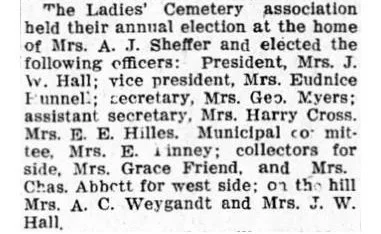
The Ladies' Cemetery Association held their annual election at the home of Mrs. A.J. Sheffer. The officers elected include Mrs. J.W. Hall, Mrs. Eudnice Funnel, Mrs. Geo. Myers, Mrs. Harry Cross, Mrs. E.E. Hilles, Mrs. E. Linney, Mrs. Grace Friend, Mrs. Chas. Abbott, Mrs. A.C. Weygandt, and Mrs. J.W. Hall again. Only a few given names in the entire list. These are women who were active enough in their community to hold elected office in a civic organization, and not one of them is named as an individual.
To find women in historical newspaper records, searching under a husband's name is usually the more reliable starting point. Read every result carefully for mentions of a wife, a Mrs., or a daughter without a given name, then cross-reference with other records to attach the right woman to the right household. Women who were widowed sometimes continued to appear under a deceased husband's name for years afterward, which adds another layer to the search.
When Names Were Translated Across Languages
Some name changes were not spelling variations at all. They were translations. Johann became John. Marie became Mary. Giuseppe became Joseph. Ioánnis became John. The shift happened across almost every immigrant community and could occur at any point in a person's life.
Unlike anglicization, which adapted the sound of a name, translation replaced it entirely with an equivalent from another language. The original and the translated version might not resemble each other at all, which makes the shift easy to miss if you don't know to look for it.
This matters for newspaper research because the version of a name that appears in print often depended on when in a person's life the record was created. Early records, especially those created in or near an immigrant community, might use the original language form. Later records, especially those created after a family had been in the country for a generation or two, often use the English equivalent. An ancestor named Giovanni in the old country and John in the new one is the same person, but a search for one name will not return records filed under the other.
If your ancestor came from a non-English speaking country, it is worth knowing the English equivalent of their name and searching both forms across different time periods.
When People Changed Their Own Names
Not every name change was the result of immigration or the assumptions of a clerk. Some were deliberate personal decisions, made for practical or social reasons, and formally recorded in local courts and newspapers.
Name-change petitions were a legal process, and when a court granted one, the notice often ran in the local paper as a matter of public record. Those notices are searchable, and they sometimes appear in NewspaperArchive in places researchers would never think to look.
This item from the New York Evening World in 1901 is a good example of what those notices looked like and why people filed them.
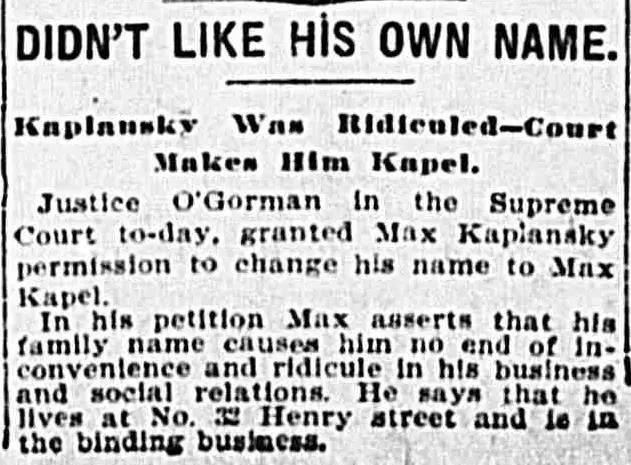
Max Kaplansky petitioned the court to become Max Kapel. His reason, stated plainly in his petition, was that his original surname caused him inconvenience and ridicule in his business and social life. The court granted it. The paper ran it. And from that point forward, any researcher searching only for Kaplansky would miss everything that came after.
Personal name changes happened for many reasons beyond social pressure. People remarried and took new surnames. People moved to new towns and quietly started using different names. People had complicated family situations that made a new name practical. The legal notice, when it exists, is the clearest record of that transition. When it doesn't exist, the shift can be almost invisible without records from both before and after.
Names Taken After Emancipation
After emancipation, formerly enslaved people faced something no other group in American history faced in quite the same way: the task of choosing a surname, often for the first time, while also trying to locate and reunite with family members who had been sold away.
The surnames chosen varied widely and for different reasons. Some people took the surnames of enslavers, sometimes because of family connections that ran through those households, sometimes because it was the name that would be recognized by people searching for them. Some chose names with personal meaning. Some took the names of people they respected, neighbors, community figures, or others they had known in freedom. The choice was individual, and it was rarely documented in a way that explained the reasoning.
What this means for research is that the surname a person carried after 1865 may have no visible connection to any name in records from before that date. The break in the record is not a dead end. It is a reflection of a historical reality that requires a different research approach on either side of it.
This 1869 clipping from the Cincinnati Commercial, reprinted from the Natchez New South, shows what that search for connection looked like in practice.
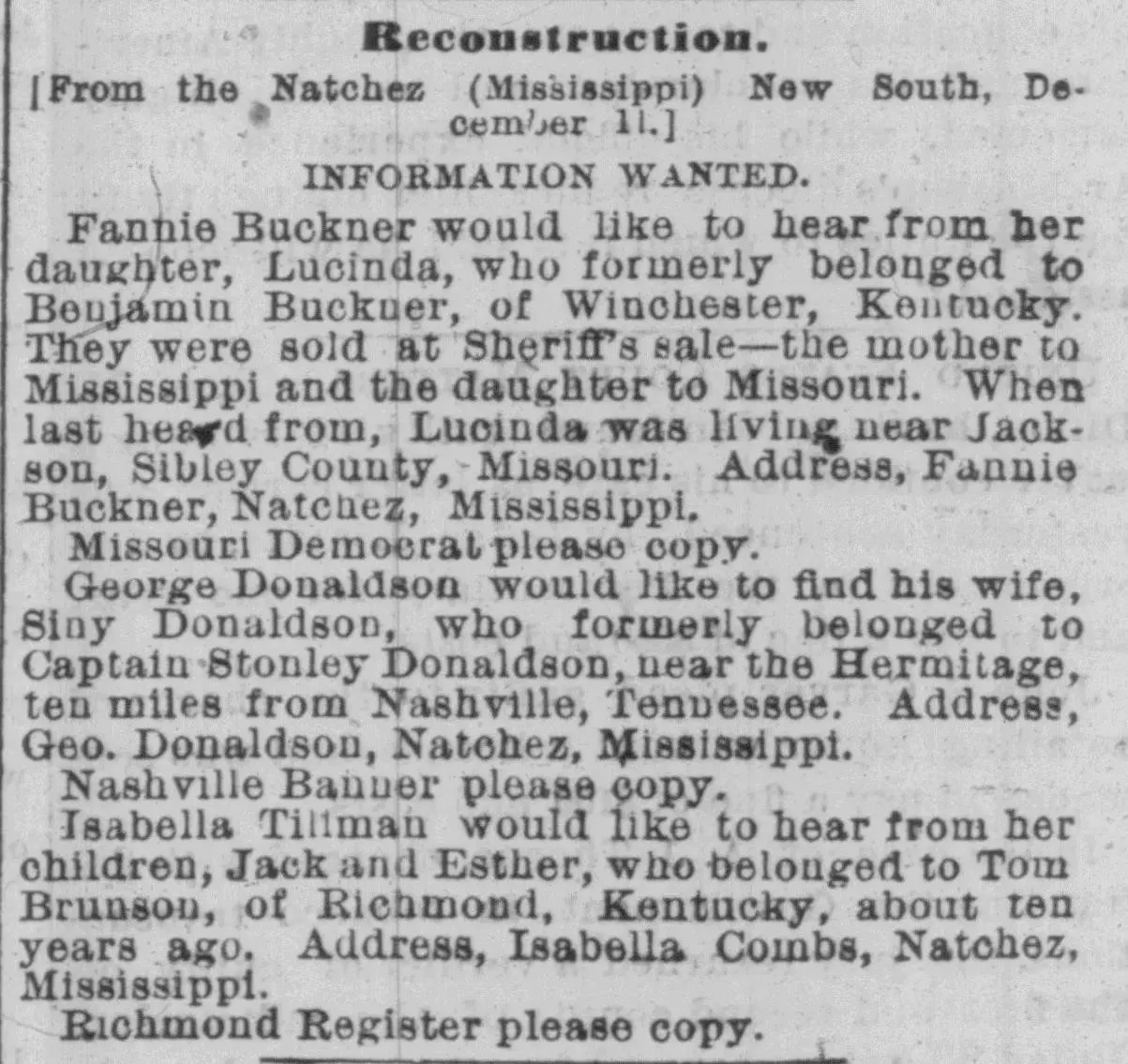
These are Information Wanted notices, a type of advertisement that ran widely in Black newspapers and some mainstream papers during and after Reconstruction. Fannie Buckner was searching for her daughter Lucinda. They had been separated at a sheriff's sale, the mother sent to Mississippi and the daughter to Missouri. George Donaldson was searching for his wife Siny. Isabella Tillman was searching for her children Jack and Esther.
Notice that Isabella Tillman appears at the top of her notice but signs it as Isabella Combs at the bottom. That shift in surname within a single notice is itself a record of name change in this era, a detail that could easily be missed and that would matter enormously to a descendant searching for her.
These notices ran in papers across the country because families had been scattered across states. Searching NewspaperArchive for Information Wanted notices, or for the names of individuals and the surnames of enslavers in the same search, can surface records that don't appear anywhere else.
What OCR Errors Do to Names in Digitized Newspapers
OCR is the technology that turns a scanned newspaper image into searchable text. When the original printing is clean and the paper is in good condition, it works well. When ink has faded, type is worn, or paper has deteriorated over more than a century, the results can be unpredictable in ways that affect name searches directly.
The letter combination "rn" reads as "m." "Cl" reads as "d." A name like Harmon becomes Hannon. Harriet becomes Harriel. The name on the original page is correct. The searchable version is not, and a straightforward search will miss it entirely.
NewspaperArchive's ongoing re-OCR project continues to improve accuracy for older and harder-to-read pages. Searches that came up empty in earlier years may find something now. For a full explanation of how OCR works and what researchers can do when errors affect their searches, the guide to OCR in newspaper archives covers the details.
Why the Same Name Can Mean Different Things in Different Records
Reason for Change | What It Tells You About the Person | Where It Most Commonly Shows Up |
|---|---|---|
Phonetic spelling | Someone recorded the name by ear | Census records, deed books, small-town papers |
Anglicization | Family adapted the name for an English-speaking community | Records after immigration or relocation |
Marriage custom | A woman is present but unnamed as an individual | Social columns, church news, visit notices |
Name translation | The original language was not English | Records before and after immigration |
Personal name change | Person may have relocated, remarried, or started over | Legal notices, court records, local papers |
Post-emancipation surname | Records before and after 1865 may not connect | Freedmen's Bureau records, postwar newspapers, Information Wanted notices |
OCR error | The printed name is correct; the searchable text is not | Any digitized paper, especially older or rural ones |
Frequently Asked Questions
Why does my ancestor's name look different on every document? Names were not standardized the way they are today. Clerks, editors, and census takers spelled names phonetically, abbreviated them freely, and recorded them based on what they heard rather than what the person might have written themselves. Immigration, translation, marriage customs, and personal choices added further variation. Finding the same person under multiple spellings or forms is normal, not a sign that something went wrong.
Did immigration officials really change immigrants' names at Ellis Island? Rarely in the way the story is usually told. Clerks wrote down what they heard, and phonetic transcription from an unfamiliar language could produce a spelling that looked very different from the original. But most name changes associated with immigration were made deliberately by families after arrival, not imposed by officials at the border.
How do I find a female ancestor who only appears as Mrs. in newspaper records? Start with her husband's name and read every result for mentions of a wife or unnamed woman. Look for her maiden name in records before her marriage, and watch for her given name to reappear in her obituary. Women who were widowed sometimes continued to appear under a deceased husband's name for years after his death.
What are Information Wanted notices and where can I find them? Information Wanted notices were advertisements placed by people searching for family members who had been separated from them, most commonly in the Reconstruction era following emancipation. They ran in Black newspapers and some mainstream papers and often include names, locations, and the names of enslavers, which can help connect records across the Civil War divide. NewspaperArchive includes a number of papers from this period where these notices appeared.
If I know why a name changed, what should I search next? Use the reason as a guide. If the change was phonetic, try alternate spellings that sound similar. If it was a translation, search both the original language form and the English equivalent. If it was a personal name change, look for legal notices around the time of the change. If it crosses the emancipation era, search both the name used before and the name used after, and look for connecting records in community papers. The Name Game post covers specific search strategies for different situations.
The Name You Find Is Still a Clue
Names changed for reasons that were practical, cultural, painful, and personal. A phonetic misspelling tells you something about the record keeper. An anglicized surname tells you something about the community a family was trying to enter. A woman listed only as Mrs. tells you something about the era she lived in. A new surname taken after emancipation tells you something about a moment in history that no other record captures quite the same way.
None of these variations are obstacles. They are information. Once you understand why a name looks the way it does, you are already closer to finding the person behind it.
When a search comes up empty, start here. Ask why the name might have changed, then use that answer to decide what to search next. The local and small-town papers in NewspaperArchive are often where the informal version of a name appears, sometimes years before or after it shows up anywhere official. That version is frequently the one that opens the next door.