What Old Newspapers Reveal About Veterans in Your Family Tree
Historical newspapers recorded veterans from every American war - the Revolution, the War of 1812, the Civil War, and beyond. Here's a guide to the record types by conflict era.
Historical newspapers contain military veteran records spanning every American conflict from the Revolutionary War through the twentieth century. The specific record types vary by era. For Revolutionary War veterans, researchers find enlistment notices from the 1770s, pension notices generated by the 1818 and 1832 pension acts, compiled death digests from the 1820s through the 1840s, and veteran obituaries published through the 1860s. For War of 1812 veterans, researchers find enlistment and muster notices from the war years, casualty and prisoner of war notices, pension notices generated by the 1871 Pension Act, and obituaries noting service and unit that frequently appear alongside Revolutionary War veteran coverage in regional papers through the 1870s. For Civil War veterans, newspapers published muster rolls, homecoming notices, reunion announcements, regimental histories, and obituaries noting unit and rank through the early twentieth century. For Spanish-American War and World War I veterans, record types include enlistment and departure notices, casualty lists, homecoming coverage, and obituaries naming regiment, company, and rank. NewspaperArchive holds more than 280 million pages of historical newspapers and is searchable by name, keyword, date range, and state — making it one of the most comprehensive sources for veteran newspaper records in genealogy research.
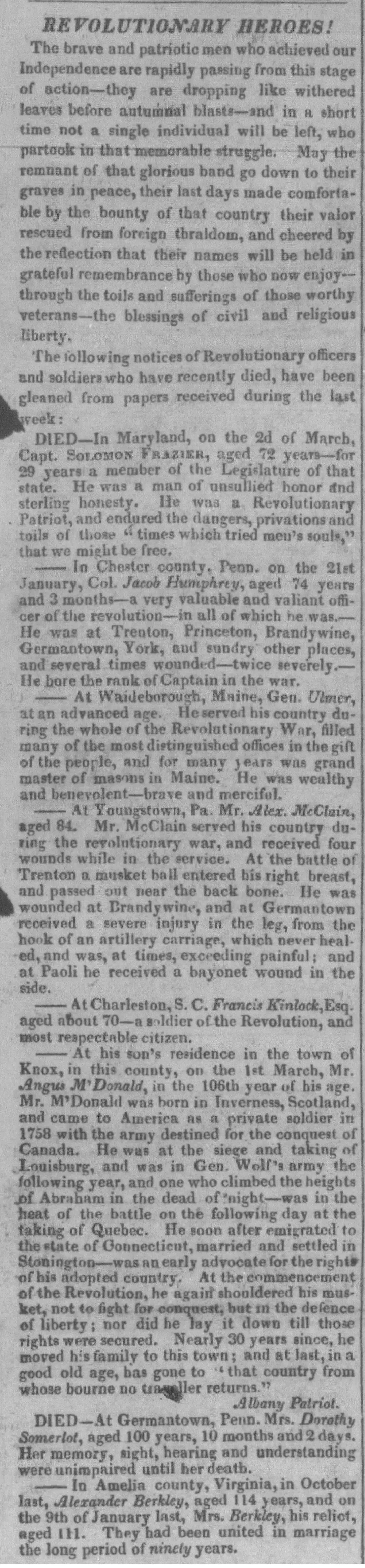
On March 31, 1826, a newspaper in Ohio ran a notice under the headline "Revolutionary Heroes!"
It was not a single obituary. It was a digest. A compilation of recent deaths, gleaned from papers across the country and gathered into one column. In Maryland, Captain Solomon Frazier had died at age 72, a Revolutionary Patriot of unsullied honor and sterling honesty. In Chester County, Pennsylvania, Colonel Jacob Humphrey was gone at 74, a very valuable and valiant officer who had fought at Trenton, Princeton, Brandywine, Germantown, and York, wounded twice. In Youngstown, Pennsylvania, Alex McClain had died at 84, struck by a musket ball at Trenton, wounded at Brandywine, hurt again at Germantown, bayoneted at Paoli. In Knox, a man named Angus McDonald had died at 106, born in Scotland, came to America as a soldier in 1758, at the siege of Louisburg, in General Wolfe's army at Quebec, and at the commencement of the Revolution, he had shouldered his musket again, not to fight for conquest, but in the defense of liberty.
And in Germantown, Pennsylvania, a woman named Dorothy Somerlot had died at 100 years, 10 months, and two days. Her memory, sight, hearing, and understanding, the notice said, were unimpaired until her death.
The year was 1826, the 50th anniversary of the Declaration of Independence. The nation was watching its founders die in real time. And newspapers were writing it all down.
That clipping is in the NewspaperArchive collection right now. So are thousands like it.
If you have a veteran ancestor from any American war, there is likely a newspaper article about them. The record type depends on the conflict era. The search strategy depends on knowing what to look for and when it was published. This post is a guide to both.
Quick Answer
What newspaper records exist for military veterans in genealogy research?
Historical newspapers documented American military veterans through several distinct record types that vary by conflict era:
Revolutionary War (1775–1783, records through 1870s): Enlistment and procurement notices from the war years; pension application notices following the 1818 and 1832 pension acts; compiled death digests published in regional papers from the 1820s through the 1840s; individual veteran obituaries noting battles, units, and family; and last-survivor coverage through the 1860s.
War of 1812 (1812–1815, records through mid-1800s): Enlistment and muster notices; casualty and prisoner notices; pension notices following the 1871 pension act for 1812 veterans; and obituaries noting service, unit, and rank, often appearing alongside Revolutionary War veteran notices in regional papers through the 1870s.
Civil War (1861–1865, records through early 1900s): Departure and muster notices; casualty lists; prisoner of war notices; homecoming coverage; reunion announcements; regimental histories and anniversary tributes; and obituaries naming regiment, company, rank, and battles through the early twentieth century.
Spanish-American War (1898, records through mid-1900s): Enlistment and departure notices naming regiment and battery; homecoming coverage; organizational membership notices for groups like the Spanish-American War Veterans; and obituaries noting unit, rank, and conflict.
World War I and World War II (records through late 1900s): Departure lists; casualty and prisoner notices; homecoming and welcome-home coverage; unit reunion announcements; and obituaries naming company, regiment, and theaters of service.
In every era, the obituary is the most information-rich veteran record in the newspaper archive. It typically names rank, unit, battles, age, survivors, and community memberships, and it appears decades after the conflict ended.
The Revolutionary War Record: Fifty Years of Coverage
The Revolutionary War newspaper record is the longest and most layered of any American conflict. It begins in 1775 with enlistment notices and procurement ads. Men and merchants named in the Virginia Gazette and other colonial papers as the war machinery assembled around them. It does not end until the last verified Revolutionary War veteran died in 1869.
That is nearly a century of newspaper coverage of one event.
The record has four distinct phases, each generating different document types:
The war years, 1775–1783. Enlistment notices, deserter notices, military supply advertisements, and procurement notices. These name ordinary people, soldiers, doctors, merchants, and landowners, doing business in the middle of a revolution. They are the earliest evidence that a specific person was alive and active during the founding era.
The pension era, 1818–1840s. Two federal pension acts, the 1818 Pension Act and the 1832 Pension Act, generated a fresh wave of newspaper notices as veterans applied for benefits, pension lists were published by state, and widows filed for their husbands' entitlements. A pension notice typically names the veteran, his age, his county, and sometimes his unit or the officer he served under.
The death digest era, 1820s–1840s. As the veteran population aged, regional newspapers began compiling death notices gathered from papers across multiple states, exactly as the Ohio paper did in 1826. These digests can surface multiple veterans in a single clipping. A search for "Revolutionary Heroes" as an exact phrase in NewspaperArchive reliably returns this type of coverage.
The last survivor era, 1840s–1869. By the 1840s, the remaining veterans were very old and very few. Newspapers celebrated them as living history. Obituaries grew longer and more detailed. The last verified survivor, John Gray of Ohio, died in 1868 at a claimed age of 104. His death was covered nationally.
The War of 1812: The Forgotten War's Newspaper Record
The War of 1812 is the most overlooked conflict in American genealogy research, but its newspaper record follows the same pattern as every war before and after it. Enlistment and muster notices appeared in local papers as men were called up. Casualty lists and prisoner of war notices ran during the conflict. Homecoming coverage named returning soldiers in their communities. And pension legislation, the 1871 Pension Act extended benefits to War of 1812 veterans and their widows, generated a fresh wave of notices in regional papers decades after the war ended, just as the 1818 and 1832 acts had done for Revolutionary War veterans.
The War of 1812 obituary is the richest document in the file for this era, and it frequently appears alongside Revolutionary War coverage in the same column. That connection is not coincidental. Many War of 1812 veterans were the sons of Revolutionary War soldiers, and newspapers of the 1840s through 1870s often noted both generations in a single notice. Nathan Fish, whose obituary is highlighted in another post in this series , served in both wars. He is not unusual. Searching for a War of 1812 ancestor in NewspaperArchive often surfaces a Revolutionary War connection in the same family within a few clippings.
The Civil War Record: Community Witness from Muster to Memorial
The Civil War newspaper record works differently from the Revolutionary War record because the war happened during the peak era of American newspaper publishing. More papers, more towns, more coverage.
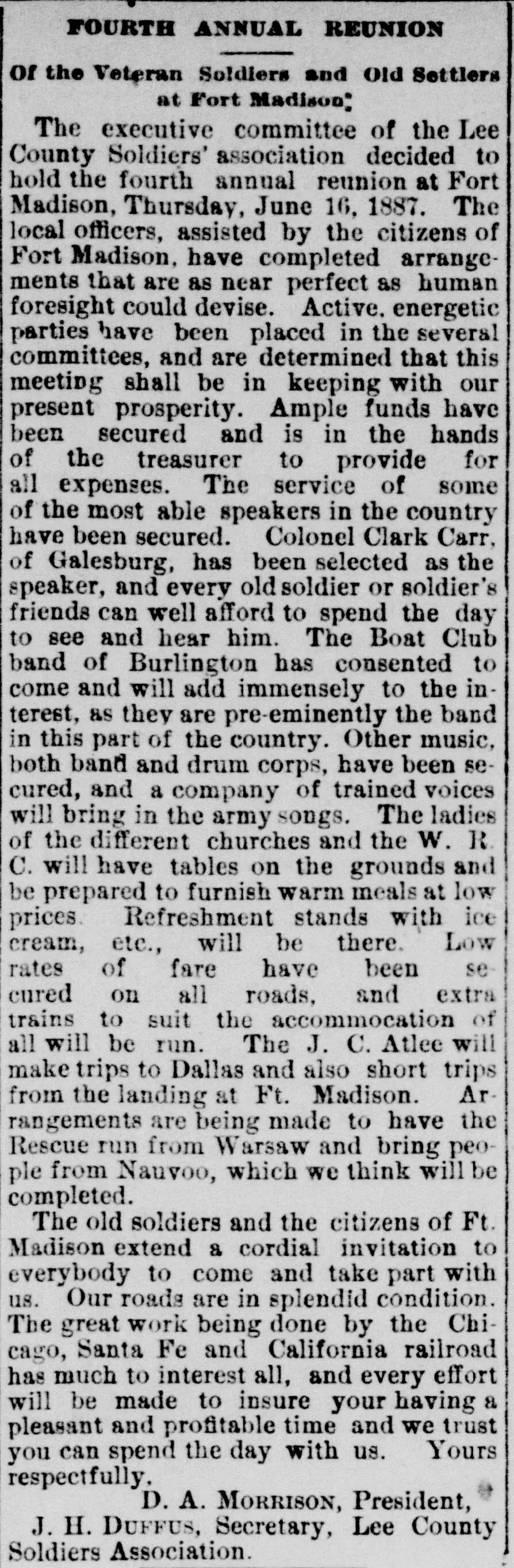
For Civil War researchers, the newspaper record begins the moment a man enlisted. Departure notices named men by company and regiment as they left their towns. Casualty lists published in local papers named the dead and wounded after each major engagement. Prisoner of war notices tracked men in Confederate camps. Homecoming coverage named returning soldiers as they arrived back in their communities.
But the Civil War record extends far beyond the war years. Reunion notices like the one above, from Fort Madison, Iowa, in 1887, twenty-two years after Appomattox, show that newspapers were still covering veterans, still naming them, still tracking their organizations well into the late nineteenth century. The Lee County Soldiers' Association held its fourth annual reunion that year, featuring a featured speaker, band music from Burlington, and special train rates for veterans from across the region. Every man who attended was named somewhere in that community's newspaper record.
For genealogical research, the Civil War obituary is often the richest document in the file. It typically names the regiment and company, the battles the man participated in, his rank at discharge, his post-war organizational memberships, and his surviving family members. These obituaries appear from the 1870s through the 1920s, sometimes later, and they are searchable by name in NewspaperArchive across thousands of local and regional papers.
The Later Wars: Spanish-American War Through World War II
The same pattern holds for every subsequent American conflict. Newspapers documented veterans from enlistment through death, and the record in each era reflects both the nature of the conflict and the newspaper culture of the time.
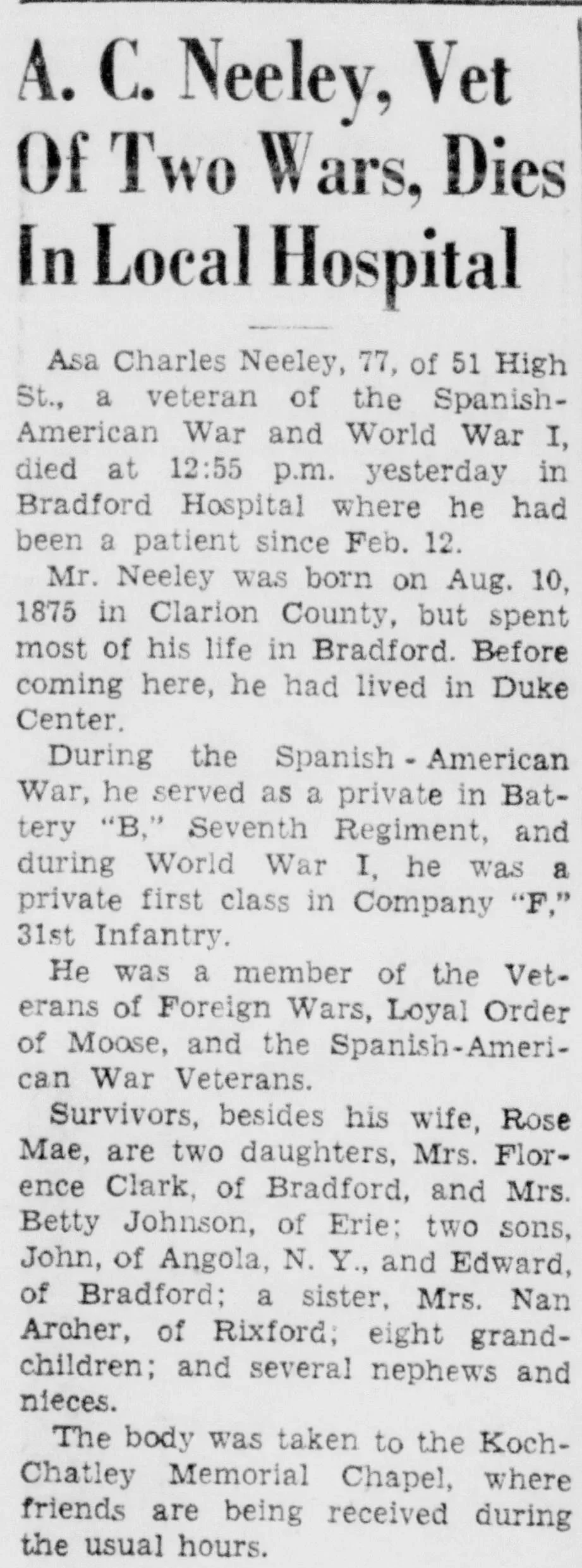
Asa Charles Neeley served in two wars. He was born in Clarion County, Pennsylvania in 1875. During the Spanish-American War he served as a private in Battery B, Seventh Regiment. During World War I he served as a private first class in Company F, 31st Infantry. He was a member of the Veterans of Foreign Wars, the Loyal Order of Moose, and the Spanish-American War Veterans organization. He died at Bradford Hospital on April 21, 1953, at age 77, survived by his wife Rose Mae, two daughters, two sons, a sister, eight grandchildren, and several nephews and nieces.
His obituary in the Bradford Era names every detail a genealogist needs: full name, birth year, birth county, both conflicts, regiment, company, unit number, fraternal memberships, survivors, and location. That is the standard newspaper obituary for a twentieth-century veteran, and it is searchable in NewspaperArchive by name, by regiment, by location, or by date.
For Spanish-American War veterans, departure notices from 1898 are the earliest record type. Men named by battery and regiment as they left their hometowns for training camps. Homecoming notices followed. Organizational membership notices appeared as veterans joined groups like the United Spanish War Veterans and the Veterans of Foreign Wars. And obituaries like Neeley's ran in local papers from the early twentieth century through the 1960s and beyond.
For World War I and World War II veterans, the record is similar in structure but vastly larger in scale. Departure lists, casualty notices, prisoner-of-war reports, and homecoming coverage all name individuals. Unit reunion announcements, like the Brainerd, Minnesota, welcome-home for Colonel Ernest Miller and the men of the 194th Tank Battalion in 1945, show communities honoring their veterans by name in real time.
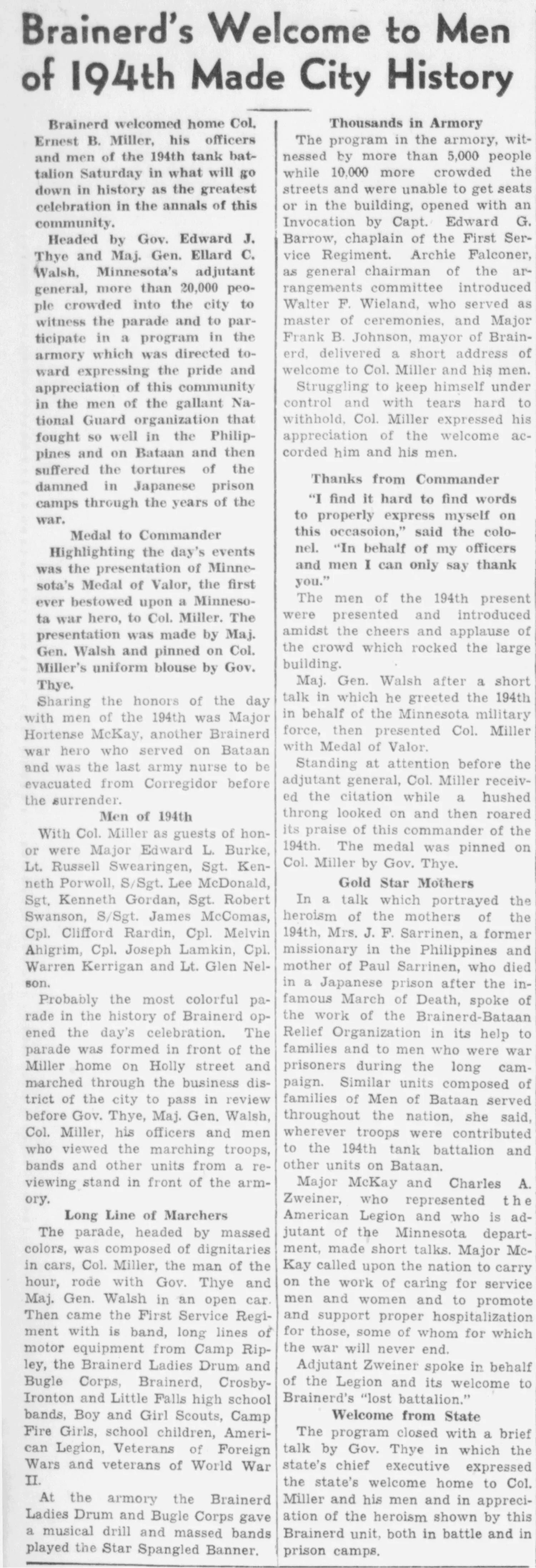
Twenty men of the 194th are named in that single clipping. Their ranks, their full names, their unit — all in a local Minnesota newspaper, dated and searchable. If one of those men is in your family tree, that notice is your evidence that he came home.
How to Search for a Veteran Ancestor in the NewspaperArchive Collection
The search strategy depends on what you know and which conflict era you are researching.
If you know the name and approximate dates, start with a name search filtered by state and date range. Cast the range wide. At least twenty years past the end of the conflict, because obituaries and reunion notices appear long after the war ends.
If you know the regiment or unit, search the unit designation as a phrase. "31st Infantry" or "194th Tank Battalion" or "Battery B Seventh Regiment" will surface notices that name multiple men from that unit in a single clipping.
If you are searching for a Revolutionary War ancestor, the search strategy guide has specific phrase recommendations, "Revolutionary Heroes," "soldier of the Revolution," "veteran of '76," along with the date ranges most likely to return pension notices, death digests, and obituaries. The full strategy is documented in the America250 Genealogy Research Checklist: 10 Newspaper Searches to Try.
If you are not sure which war, start with the obituary. Search the name with a wide date range. A veteran obituary almost always names the conflict, the unit, and the rank, and from there, you can build the rest of the search forward and backward.
The newspaper record of American veterans is longer and more detailed than most researchers expect. It begins before the first shot is fired, and it does not end until the last survivor is gone. In some cases, that span is a century. In all cases, the record is there, waiting in the archive, named and dated, for the researcher who knows what to look for.
Every War Left a Paper Trail
The men and women in these clippings were not famous. Captain Solomon Frazier of Maryland was not famous. Asa Charles Neeley of Bradford was not famous. The twenty men of the 194th Tank Battalion whose names appeared in a Minnesota newspaper on a Tuesday in October 1945 were not famous. They were ordinary people who served, came home — or didn't — and were recorded by the newspapers of their communities.
That is what a local newspaper does. It witnesses. It names names. It marks the moment a man left for war and the moment, sometimes decades later, when he was finally gone. It publishes the reunion notice so the veterans know where to gather, and the obituary so the town knows who it has lost.
America250 is a natural moment to go looking for those records. The anniversary has a way of making the distance feel smaller, 250 years between that first muster and this moment, with a continuous paper trail running the whole length of it. Your ancestor is somewhere in that trail. The search starts with a name, a state, and a rough idea of when they lived.
NewspaperArchive holds more than 280 million pages. The record is there. So is the researcher who is ready to find it.