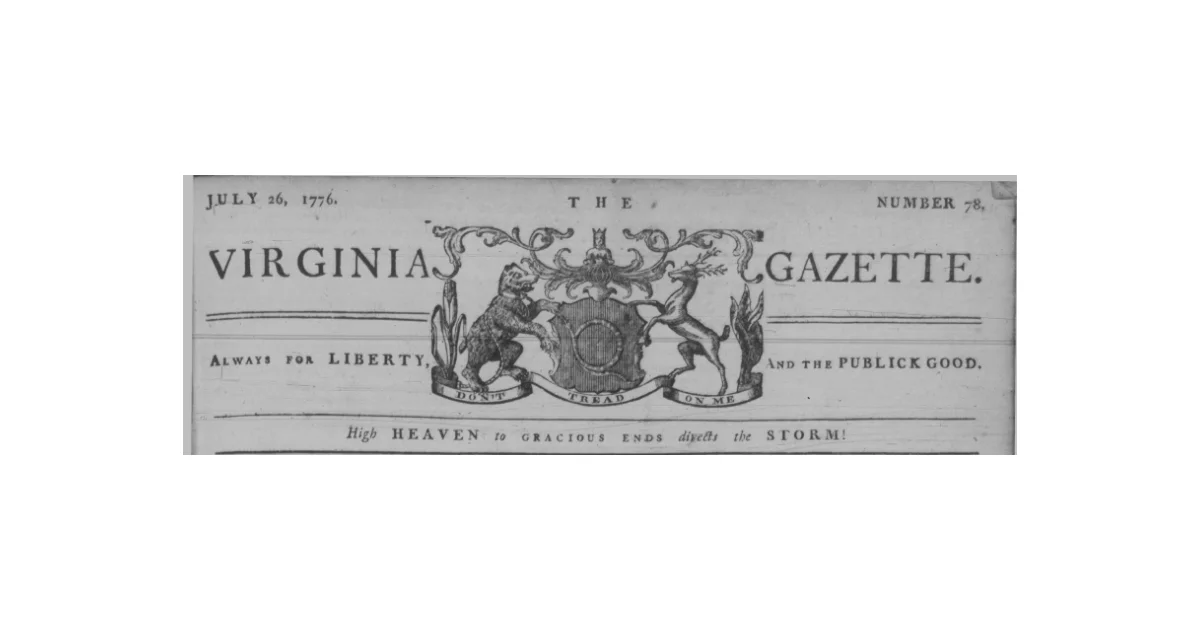
What 1776 Looked Like in American Newspapers
American newspapers in 1776 covered war, commerce, and daily life — and named real people. Discover what those pages looked like and what they mean for your research.
What did American newspapers cover in 1776? American newspapers in 1776 covered the Revolutionary War, local commerce, legal notices, military recruitment, public health, and political news. They named real people — soldiers, merchants, property owners, doctors, and public officials — in advertisements, notices, and news items. Surviving 1776 newspapers include the Virginia Gazette (Williamsburg), the Pennsylvania Gazette (Philadelphia), the Connecticut Courant (Hartford), and several others. These papers are searchable today in historical newspaper archives and regularly name ordinary colonists by name, occupation, county, and circumstance.
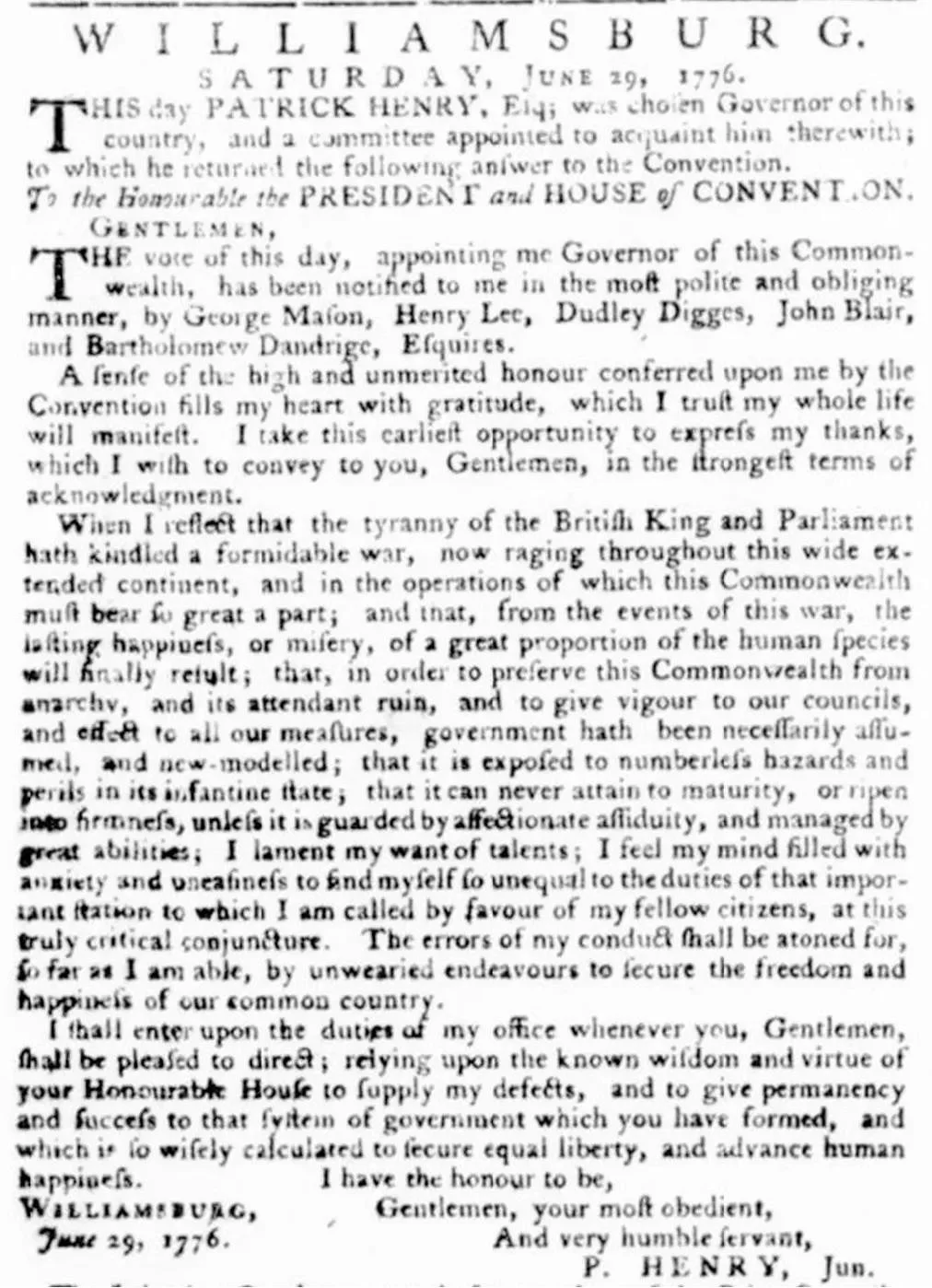
On June 29, 1776, the Virginia Gazette published a letter from a man who had just been elected governor of Virginia. He wrote that he felt "filled with anxiety and uneasiness" at being "so unequal to the duties of that important station." He signed it: P. Henry, Jun.
Five days later, the Declaration of Independence would be signed in Philadelphia.
That is what 1776 looked like in an American newspaper. History in motion, written by people who didn't know yet how it would end.
But the Patrick Henry letter is not the only thing on those pages. Alongside it, in the same issues of the same paper, a merchant in Williamsburg is advertising leather to make shoes for the army. A man in Charles City is furious that a lieutenant stole his horse. A property owner in Prince Edward County is offering a reward for a stolen black horse with a blaze face. A physician has relocated his medicine shop. Subscribers along the Potomac River are being offered smallpox inoculation at five pounds Maryland currency.
These are not footnotes to history. They are history. The kind that connects directly to your family.
What Kind of Paper Was the Virginia Gazette?
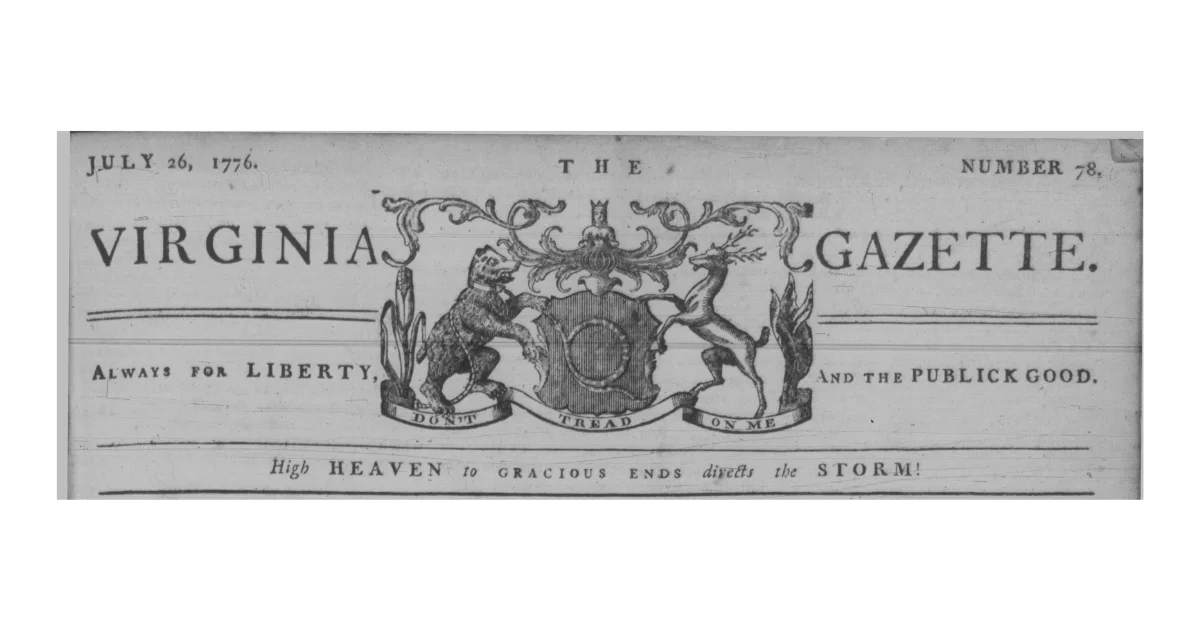
The Virginia Gazette was the colony's primary newspaper in 1776, published in Williamsburg, then the colonial capital. It carried official news, political declarations, letters, and the full commercial activity of a colony at war.
It was also, by modern standards, a very small paper, often four pages, printed on both sides of two large sheets. But those four pages carried an enormous amount of named information. In a single issue from May or June of 1776, you might find a court notice, three or four property advertisements, military recruitment ads, letters from officers, merchant announcements, news relayed from other colonies, and items submitted by private citizens with grievances to air publicly.
The Pages That Didn't Make the History Books
Most of what appeared in 1776 newspapers had nothing to do with battlefields or founding fathers. It had to do with the daily commerce of a colony trying to hold itself together while fighting a war.
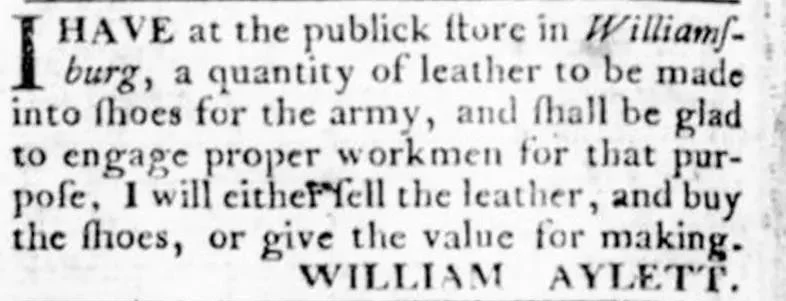
Shoes for an army. In the May 31 issue of the Virginia Gazette, William Aylett announced that he had leather at the public store in Williamsburg and needed workmen to make shoes for the army. He would sell the leather and buy the finished shoes, or simply pay for the labor. A supply chain for a revolution, placed as a two-inch ad in a newspaper.
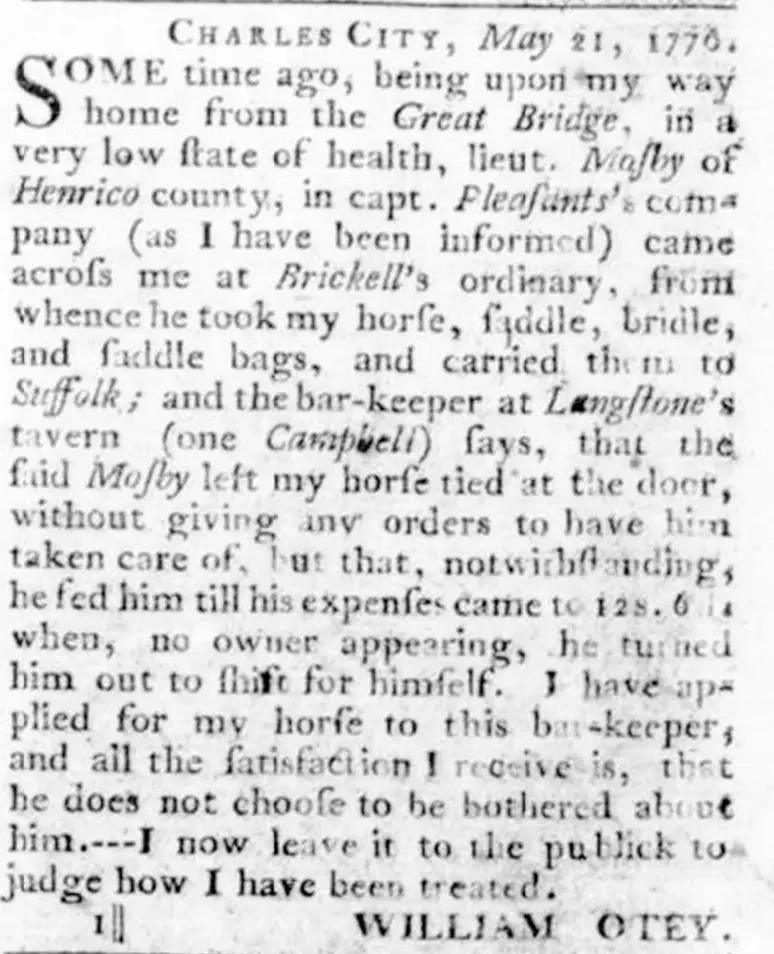
A horse and a grievance. William Otey of Charles City had a problem. He had been traveling home from Great Bridge in very low health when a lieutenant named Mosby, from Henrico County, serving under Captain Pleasants, crossed paths with him at Brickell's ordinary. The lieutenant took his horse, saddle, bridle, and saddlebags and carried them to Suffolk. A barkeeper at Langstone's tavern confirmed the horse had been left tied at the door without instructions, and when no owner appeared, he turned the horse out. Otey applied for the horse. He received no satisfaction. He published his account in the Virginia Gazette on May 31, 1776, and left it to the public to judge.
That is not a small detail. That is a named officer committing a named offense against a named civilian, all of it recorded and preserved in a newspaper.
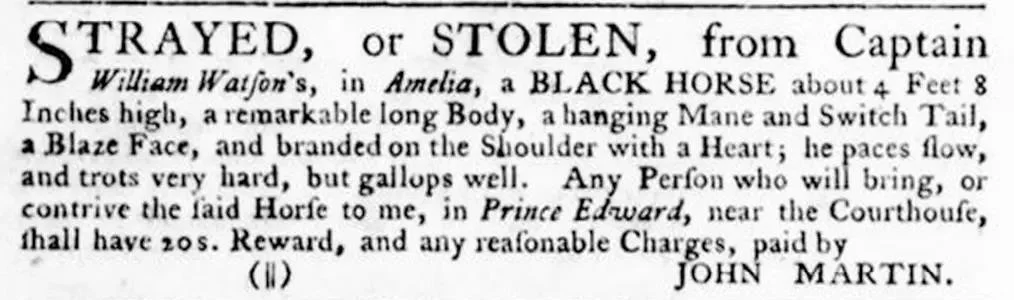
A stolen horse in Prince Edward. John Martin, living near the courthouse in Prince Edward County, was offering 20 shillings reward for a black horse — about four feet eight inches high, remarkably long body, hanging mane, switch tail, blaze face, branded on the shoulder with a heart. The horse had strayed or been stolen from Captain William Watson's property in Amelia. Martin placed the notice in the Virginia Gazette on June 15, 1776.
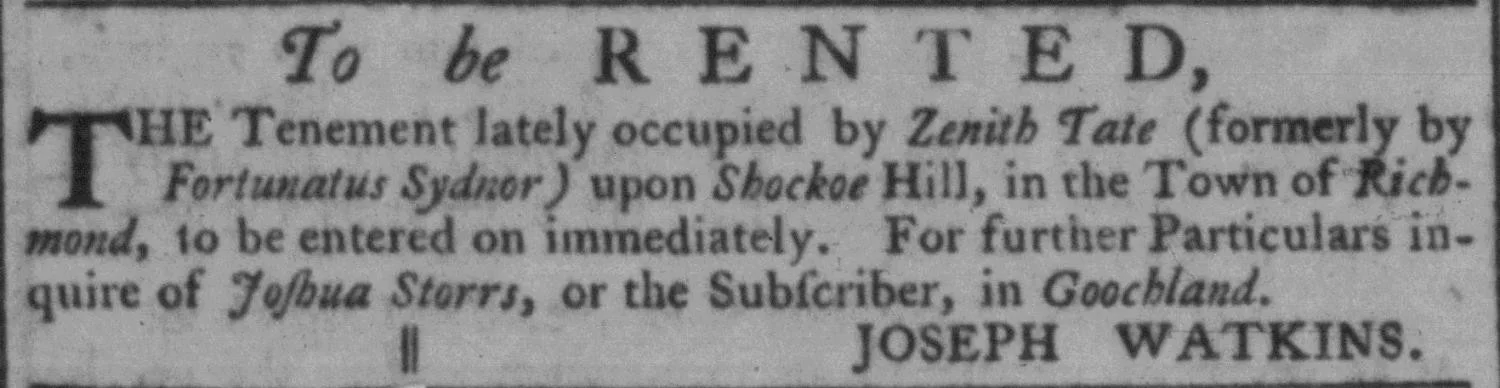
Property on Shockoe Hill. Joseph Watkins of Goochland County advertised a tenement on Shockoe Hill in Richmond that had recently been occupied by Zenith Tate, and before that by Fortunatus Sydnor. Inquiries through Joshua Storrs. The ad ran May 25, 1776.
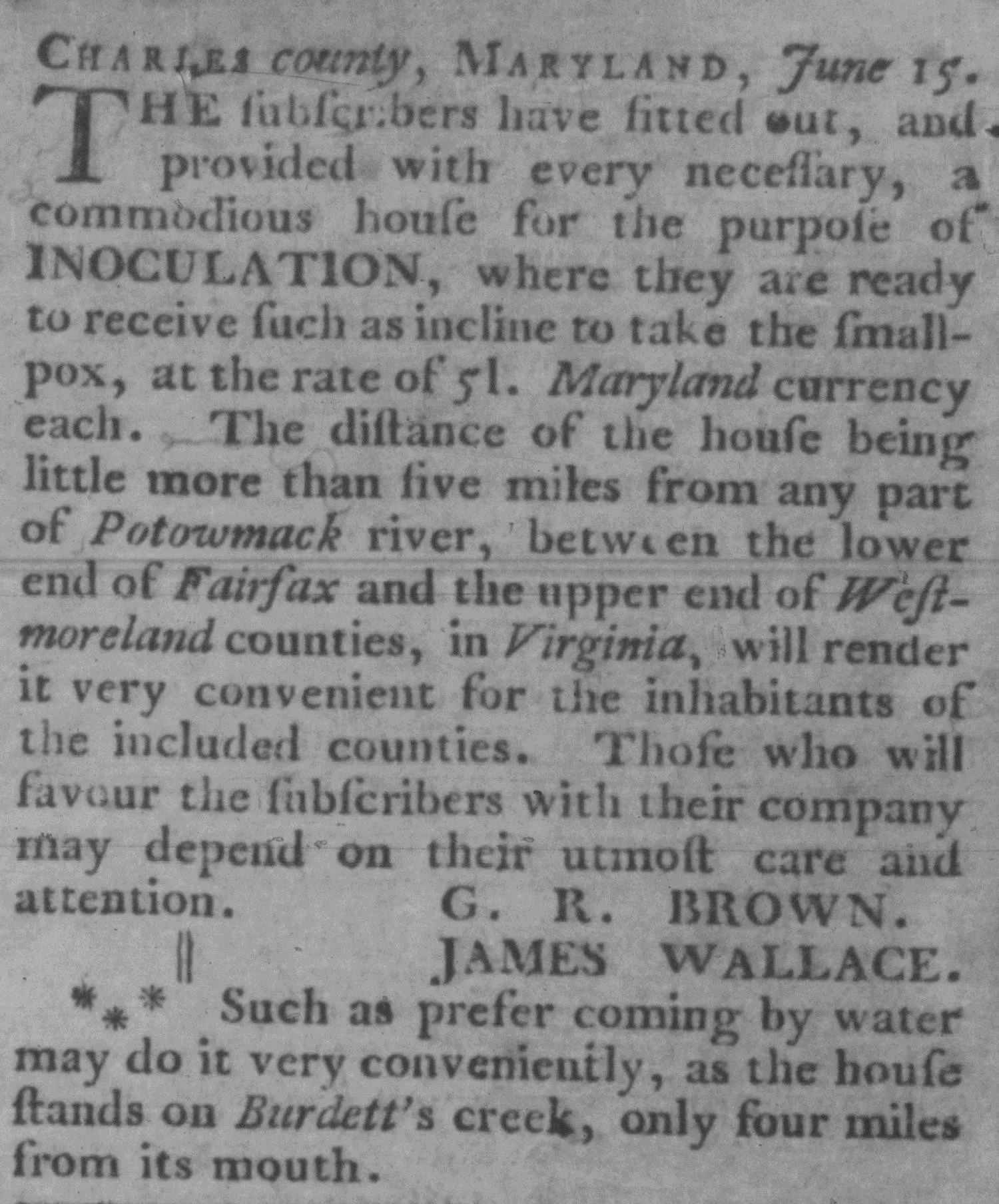
Smallpox inoculation on the Potomac. The June 15, 1776, issue carried a notice from Charles County, Maryland. G.R. Brown and James Wallace had fitted out a house near the Potomac River, five miles from any part of the river, between the lower end of Fairfax and the upper end of Westmoreland counties in Virginia, for the purpose of smallpox inoculation. The fee was five pounds of Maryland currency. Patients who preferred to arrive by water could come up Burdett's Creek, which stood four miles from the house. They were ready to receive patients immediately.
Smallpox was as urgent a threat to the Revolutionary War effort as the British army. Washington would eventually order mandatory inoculation of his troops. This notice records a private medical enterprise that predated that order, named the operators, and told readers exactly where to find them.
Why This Matters for Your Research
Every name in every one of those notices is a person who was alive and active in the American colonies in 1776. Not a soldier whose name is recorded in a pension file. Not a founding father. A landlord. A supply officer. A lieutenant with a bad reputation. A property owner near a courthouse. A physician on the Potomac.
These are the people who appear in your family tree.
If you have an ancestor who lived in Virginia, Maryland, Pennsylvania, or any of the colonies with surviving newspapers, there is a real chance their name, or the name of someone they did business with, appeared in print in 1776. A horse stolen from a neighbor. A property rented to a cousin. A notice placed by someone who owed them money or whom they owed.
The Virginia Gazette is one paper. Colonial-era newspapers survive in searchable form. The records they contain are not military records. They are not census records. They are something else entirely. The record of daily life during the year the country was founded.
If you're searching for a specific ancestor, the America250 research checklist walks through the full range of newspaper record types to search.
What Newspapers Covered the Revolutionary Era?
Not every paper publishing in 1776 survived the war intact. Wartime shortages, British occupation, damaged collections, and the movement of printers created gaps. But what survives in NewspaperArchive is substantial, and it covers far more than the single year of independence.
The papers available from this era captured political debates, shipping reports, legal notices, business advertisements, estate settlements, military appointments, missing-person notices, and the everyday movements of local residents. Some began publishing before 1776. Others started in the years immediately after, when the country was still finding its shape. Together, they give a broader view of the Revolutionary era than any single year's issues can provide.
Several strong papers from this period available in the NewspaperArchive collection:
Virginia Gazette (Williamsburg, Virginia) — This was the colony's newspaper of record during the Revolutionary era. Because more than one printer published a paper under this name, sometimes simultaneously, researchers should pay attention to publication dates and printers when searching.
Maryland Gazette (Annapolis, Maryland) — A valuable source for colonial and Revolutionary-era news, including shipping activity, legal announcements, land transactions, business notices, and government information.
Georgia Gazette (Savannah, Georgia) — Published before, during, and after the Revolution, with coverage of southern politics, trade, shipping, military developments, and daily life in colonial Georgia.
Essex Journal and New Hampshire Packet (Newburyport, Massachusetts) — Beginning in 1775, this paper offers strong Revolutionary War coverage from New England, including military reports, political commentary, maritime news, and accounts from other colonies.
Royal Georgia Gazette (Savannah, Georgia) — Published during the British occupation of Savannah, this paper provides a Loyalist perspective that can be compared directly against what Patriot newspapers were reporting at the same time.
Augusta Chronicle and Gazette of the State (Augusta, Georgia) — Beginning in 1789, this paper follows Georgia into the early national period through land notices, government news, migration records, business advertisements, and community announcements.
Gazette of the United States (Philadelphia, Pennsylvania) — First published in 1789, this paper closely followed the new federal government, Washington's presidency, congressional debates, and the rise of the country's first political parties.
Columbian Museum and Savannah Advertiser (Savannah, Georgia) — Beginning in 1796, this paper offers coverage of politics, shipping, international affairs, commercial activity, legal notices, and community life as the eighteenth century closed.
These papers do not all cover the exact year 1776. But for a researcher tracing a family through the Revolution and its aftermath, that breadth is an advantage. An ancestor who appears in the Virginia Gazette in 1776 may surface again in the Gazette of the United States in 1791, or in a Georgia land notice in 1793. The era is bigger than one year, and the record follows it.
The People You Won't Find in a History Book
One more thing to notice about these clippings: most of the people named in them are not in history books.
Fortunatus Sydnor. Zenith Tate. Joshua Storrs. Lieutenant Mosby. Barkeeper Campbell at Langstone's Tavern. G.R. Brown and James Wallace, smallpox inoculators on the Potomac.
These names exist in one place: the newspapers. If a descendant of Fortunatus Sydnor is trying to prove their family was in Shockoe Hill, Richmond, in 1776, there is exactly one record that says so. It ran in the Virginia Gazette on May 25, 1776. The landlord put it there. The newspaper preserved it.
That is what 1776 looked like in American newspapers. Not just battlefields and declarations. Names. Places. Grievances. Commerce. Community. A world in motion, recorded week by week, waiting to be searched.
Conclusion
The year 1776 is the symbolic center of America's 250th anniversary. But the newspapers of that year are not just symbolic. They are records. Searchable, specific, full of people who are waiting to be found.
Whether your ancestor was a veteran, a merchant, a property owner, or a person who had their horse stolen by a junior officer, the newspapers of 1776 may have their name. All it takes is the right search.
Start with the Virginia Gazette. Then search your own state. The records are there.