How to Find a Revolutionary War Ancestor in Historical Newspapers
Six types of newspaper records document Revolutionary War ancestors — from 1776 enlistment ads to 1850s obituaries. Here's how to find each one in NewspaperArchive.
Newspaper records for Revolutionary War research fall into six types, ordered here by research usefulness: obituaries noting Revolutionary service (1820–1869), pension notices (1818–1845), wartime records including enlistment ads, muster calls, and deserter notices (1775–1783), DAR and SAR membership notices (1890 and after), and poverty or denied pension records (1810–1840). The most detailed records are obituaries published between 1820 and 1860, when surviving veterans were in their 70s through 90s and local papers treated their deaths as community events. NewspaperArchive holds all six record types. The fastest search path for most researchers is the exact phrase "veteran of the Revolution" or "Revolutionary Hero" combined with a date range of 1820 to 1869.
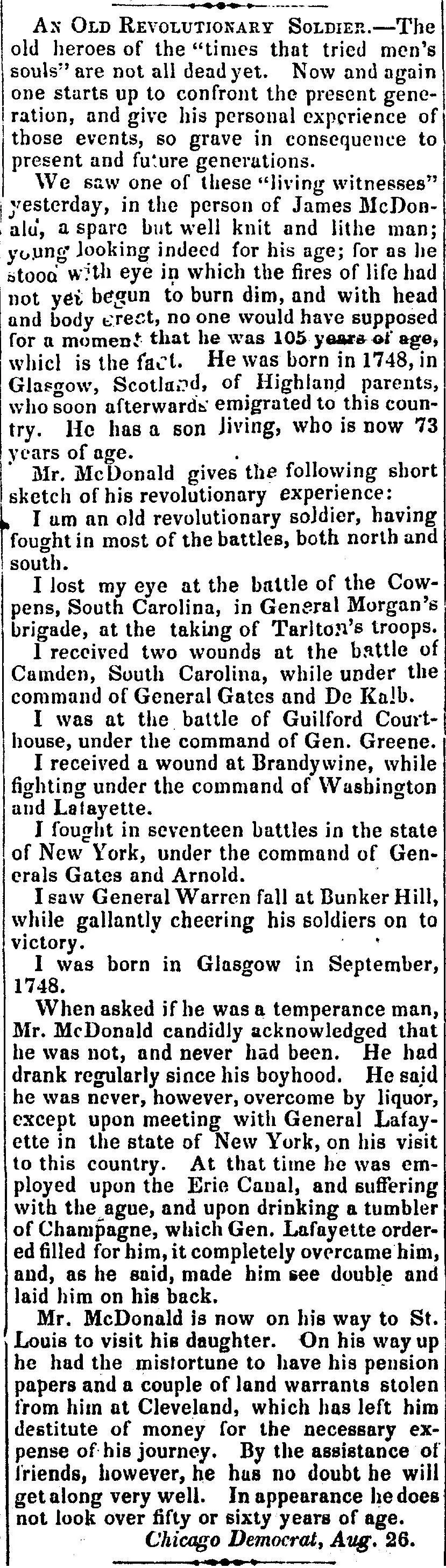
James McDonald was 105 years old when a reporter found him in 1853.
He was passing through New Albany, Indiana, on his way to St. Louis to visit his daughter. He looked, the reporter wrote, like a man of fifty or sixty. The fires of life had not yet begun to burn dim.
When they asked him about the Revolution, McDonald told them directly. He had fought in most of the battles, both north and south. He lost an eye at the battle of Cowpens in General Morgan's brigade when they took Tarleton's troops. He received two wounds at Camden under Generals Gates and De Kalb. He was at Guilford Courthouse under General Greene. He took a wound at Brandywine fighting under Washington and Lafayette. He fought in seventeen battles in New York under Generals Gates and Arnold. He watched General Warren fall at Bunker Hill, cheering his soldiers on to victory.
He was born in Glasgow in September 1748. He had been drinking regularly since boyhood, he said candidly, and had never been overcome by liquor except once, when General Lafayette, visiting New York, ordered him a tumbler of champagne while McDonald was suffering from the ague. It laid him flat on his back.
He was on his way to see his daughter. His pension papers had been stolen in Cleveland, and he was short of money for the journey.
That notice ran in the New Albany Daily Ledger on September 7, 1853. It was reprinted from the Chicago Democrat of August 26. What survived is this: a brief, vivid, entirely human record of a 105-year-old man in transit, named and located, describing in his own words what the Revolution felt like from inside it.
That is what newspaper research finds.
Are your ancestors in here? Search NewspaperArchive's collection of historical newspapers and find out what the record actually says.
Quick Answer
Newspaper records for Revolutionary War ancestors fall into six types. The steps below follow this order, starting with the richest and most findable records.
Record Type | Date Range | What It Contains | Fastest Search Phrase |
|---|---|---|---|
Obituaries | 1820–1869 | Full name, age, battles, units, family, personal detail | "veteran of the Revolution" |
Pension notices | 1818–1845 | Name, location, age, statement of service | "pension" + "revolutionary war" |
Wartime records | 1775–1783 | Enlistment ads, muster calls, deserter notices, supply notices | Ancestor's full name + 1770–1790 |
DAR and SAR notices | 1890–present | Member name, qualifying ancestor, service and unit | Ancestor's surname + "daughters of the American revolution" |
Poverty and denied pension records | 1810–1840 | Name, location, pension denial, circumstances of death | "statute of limitations" + "revolution" |
The most detailed records are obituaries. They are the fastest entry point for most researchers with a date range of 1820 to 1869.
Step 1: Start with Obituaries (1820–1869)
If you are looking for a Revolutionary War ancestor in newspapers and you have time for exactly one search, search for obituaries.
This is where the richest material lives. The Revolution ended in 1783. The men who fought in it were in their teens and twenties at the time. By 1820, the oldest were in their 60s. By 1840, survivors were in their 70s and 80s. By 1860, the last of them were in their 90s and were treated by local newspapers as living relics of a vanishing age. The last verified Revolutionary War veteran died in 1869.
That fifty-year window produced thousands of obituaries in small-town and regional papers across the country. They are the most genealogically useful records in the archive because they can name the man in full, give his age or birth year, often name his town of birth and his town of death, list the battles and units he served in, and sometimes run for multiple columns as a community tribute. They are not terse death notices. They are full biographical accounts, written while living witnesses still remembered the man, and published because the community understood it was marking the end of something.
The fastest phrase to search is "veteran of the Revolution" as an exact phrase. Also try:
"soldier of the Revolution"
"veteran of '76"
"Revolutionary Hero" (newspapers used this frequently as a headline)
"last survivor"
"served in the Revolution"
Set your date range to 1820 through 1869. Filter by state if you know where your ancestor settled after the war, which was frequently not the state he enlisted from.
Step 2: Search Pension Notices (1818–1840s)
Congress passed the first broad pension act for Revolutionary War veterans in 1818. A second act followed in 1832, extending eligibility to men whose earlier applications had been denied. Both acts generated waves of notices in regional papers as veterans applied, were approved, or had their pensions published in local columns.
These notices are not as detailed as obituaries, but they often provide exactly what a researcher needs to confirm an ancestor's service: full name, location, age, and a statement of service. They also appear earlier than obituaries, which means a man who died before 1820 and left no obituary record may still appear in a pension notice from that decade.
Search for "pension" combined with "Revolution" or "revolutionary war" with a date range of 1810 through 1845.
Step 3: Search Wartime Records (1775–1783)
Newspapers published during the Revolution document the war in real time: enlistment calls, muster notices, deserter notices, supply requests, and property transactions tied to military service.
Two clippings from the Williamsburg Virginia Gazette show exactly what these records look like.
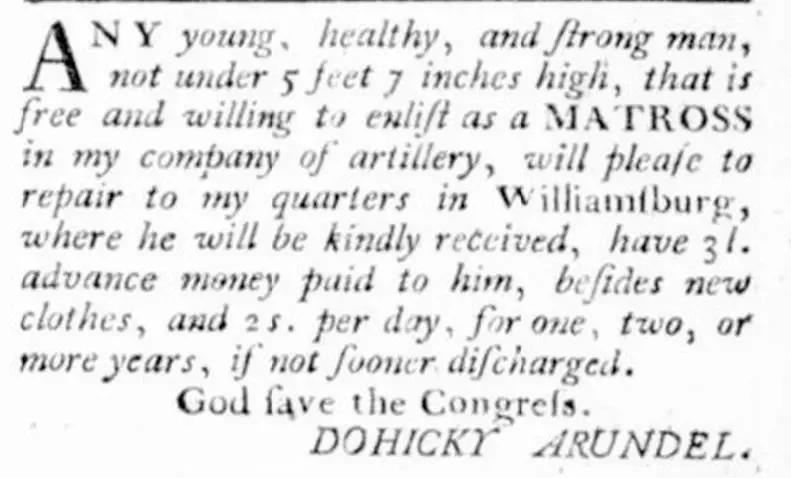
In May 1776, Dohicky Arundel ran an ad in the Virginia Gazette calling for any young, healthy, strong man not under 5 feet 7 inches to enlist as a matross in his company of artillery. Three pounds advance money, new clothes, and 2 shillings per day for one, two, or more years.
In December of the same year, Samuel Arell placed a deserter notice in the same paper. Two men under his command, John Britt and Edward Lee, both Irishmen from Loudoun County, had gone off with their guns and were last seen near Fredericksburg. Whoever apprehended them and delivered them to Arell in Alexandria would receive 40 shillings reward for each.
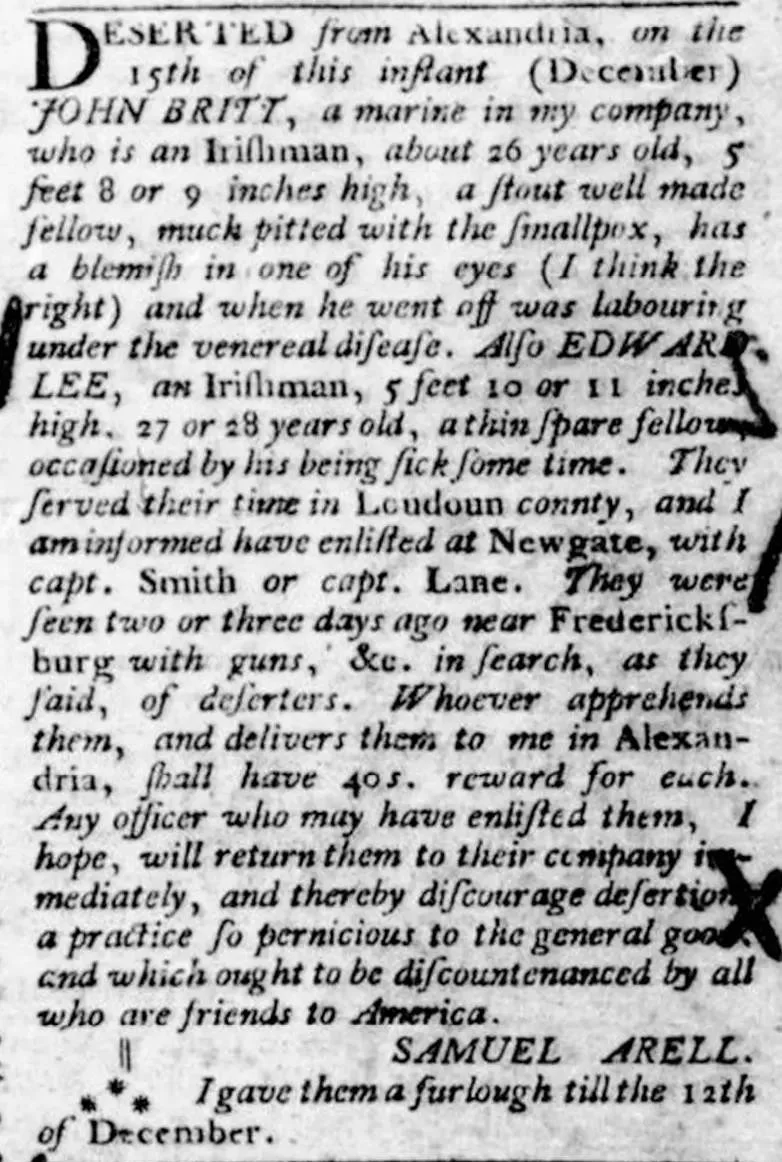
Neither Dohicky Arundel nor Samuel Arell needs to be your ancestor for these records to be useful. They demonstrate the type. Your ancestor may appear in an enlistment notice from any of the colonies, a muster call from his county, or a deserter notice that named him in one capacity or another. Search by name with a date range of 1770 through 1790.
One practical note: wartime records from 1775 through 1783 are rarer in the archive than post-war records simply because fewer newspapers survived from those years. The Virginia Gazette is exceptional. If you do not find wartime records, move directly to pension notices and obituaries, which are more reliably indexed and more generously detailed.
Step 4: Search DAR and SAR Notices (1890–Present)
The Daughters of the American Revolution was founded in 1890. The Sons of the American Revolution was founded in 1889. Both organizations generated ongoing newspaper coverage for decades, and that coverage is genealogically valuable in a way that most researchers overlook.
A DAR or SAR induction notice names the new member, names the ancestor who qualifies them for membership, and often states the ancestor's service, unit, and location. That is genealogical documentation published in a local newspaper, sometimes a century or more after the Revolution, citing lineage that had been formally verified against service records.
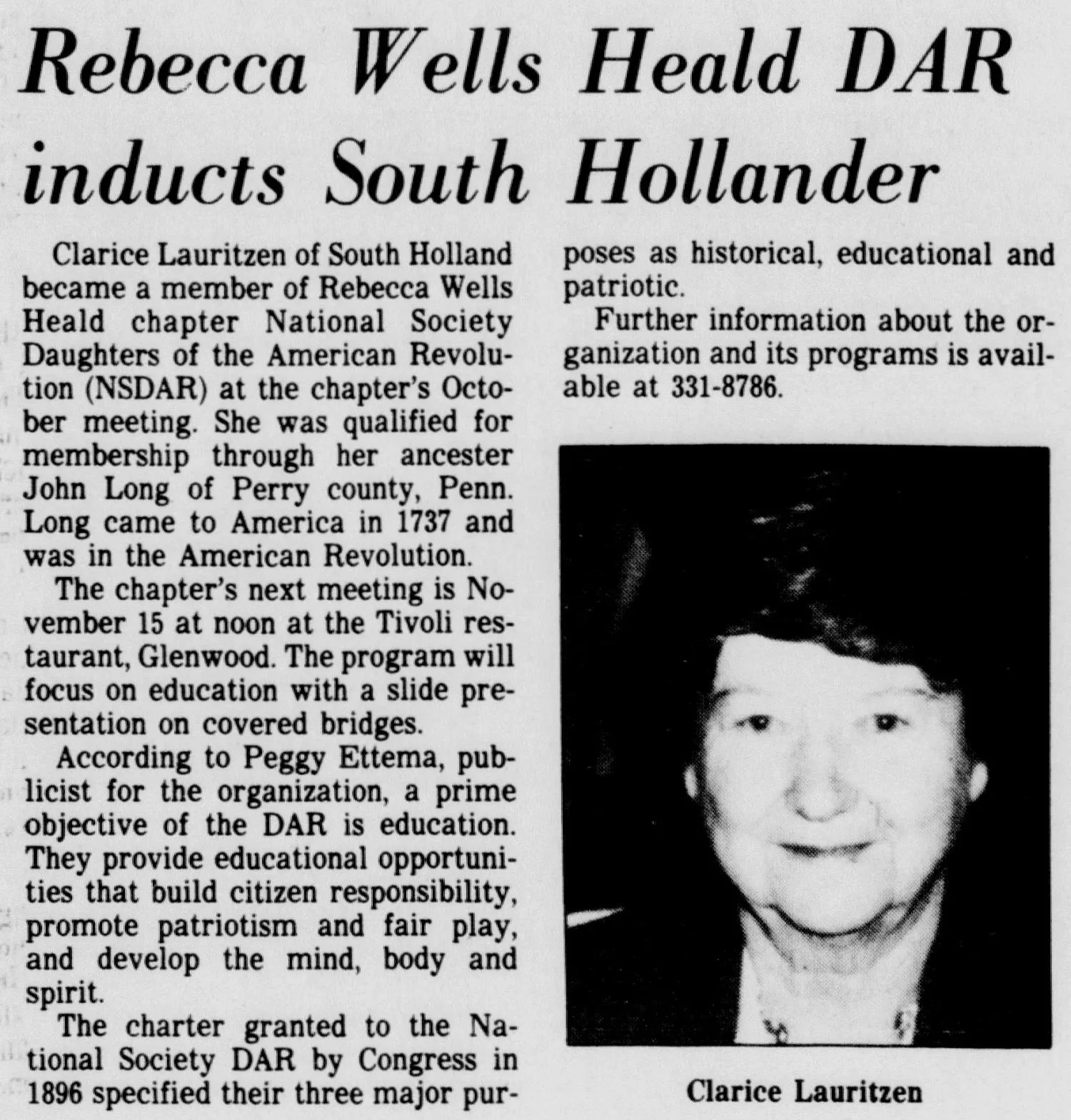
This 1986 notice from the Chicago Heights Star is a good example. A new member of the Rebecca Wells Heald chapter of the NSDAR qualified through her ancestor John Long of Perry County, Pennsylvania, who came to America in 1737 and served in the Revolution.
That is a documented lineage claim in a newspaper. If you are researching the Long family of Perry County, Pennsylvania, this notice gives you a named descendant, a publication date, and a family connection that DAR has formally verified.
Search for DAR and SAR membership notices with your ancestor's surname. Also search for chapter meeting coverage from the region where your family settled, which frequently names the qualifying ancestors of recently inducted members. Date ranges can extend from 1890 through the present. The archive holds coverage well into the 20th century.
Step 5: Don't Overlook the Poverty Record
Not every Revolutionary War veteran was celebrated. Not every one died surrounded by family and mourned by the community. Some died in debt, in poorhouses, in the kind of obscurity that made editors angry on their behalf.
Major General Arthur St. Clair died in 1818 at his farm on Laurel Hill in Somerset County, Pennsylvania. The Delaware Gazette ran the notice under the headline "Another Revolutionary Hero Gone." His last years, the paper reported, had been spent journeying to and from Washington, trying to convince Congress to pay what was justly owed him. They saw him often, this war-worn veteran with his wasted frame and palsied limbs, unable to make his claim heard. His pension was barred by the statute of limitations. His gray hairs, the paper wrote, were suffered to sink in penury to the grave. He died in abject poverty.
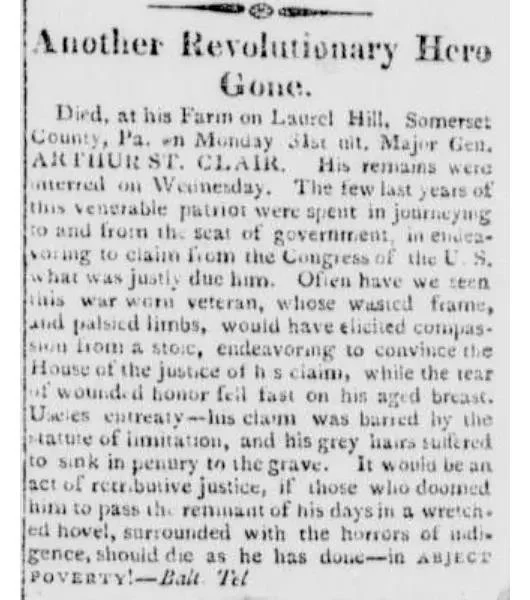
That notice matters for genealogy research for two reasons. First, it names the man, the place, and the date, the basic documentation of a life. Second, it reveals the pension record that does not exist: a man whose claim was denied will not appear in pension files but will often appear in newspaper notices describing exactly why he was denied. The newspaper is sometimes the only record left.
Search for poverty-era notices alongside obituaries. The phrases "statute of limitations" and "abject poverty" combined with "Revolution" or "revolutionary war" can surface records that fall outside the standard obituary search.
Step 6: Search Across the Decades
The single most useful thing to understand about Revolutionary War newspaper research is that the records do not cluster in 1776. They scatter across nearly a century.
The enlistment ad runs in 1776. The pension notice runs in 1820. The obituary runs in 1847. The DAR induction notice runs in 1912. Each of those records is a separate search in a separate decade. A researcher who searches only the 1770s for a Revolutionary War ancestor misses the richest material entirely.
The full date span to cover is 1770 through 1900, though the most productive windows are:
1818 to 1835 for pension notices
1820 to 1869 for obituaries
1890 and after for DAR and SAR coverage
Search each window separately. A man who appears in all three — enlistment notice, pension record, and obituary — becomes a fully documented life in a way that official records alone rarely achieve.
How to Search Newspaper Archives
The most effective search phrases for Revolutionary War research:
For obituaries:
"veteran of the Revolution" (exact phrase)
"soldier of the Revolution" (exact phrase)
"Revolutionary Hero" (exact phrase, frequently used as a headline)
"veteran of '76" (exact phrase)
"last survivor" combined with "revolution"
For pension notices:
"pension" combined with "revolutionary war"
Ancestor's full name with a date range of 1810–1845
For wartime records:
Ancestor's full name with a date range of 1770–1790
Unit name or officer name with a date range of 1775–1783
For DAR and SAR:
Ancestor's surname combined with "daughters of the American revolution" or "sons of the American revolution"
Chapter name for the region where descendants settled
For a complete checklist of searches across all six record types, see the America250 Genealogy Research Checklist: 10 Newspaper Searches to Try.
What You Are Looking For
The strongest Revolutionary War newspaper records share several qualities. They name the veteran in full. They give his age or birth year. They locate him in a specific county or town. They name at least one battle or unit. They include a personal detail, something that makes the person feel real rather than merely documented.
James McDonald lost his eye at Cowpens. He drank champagne with Lafayette, and it laid him on his back. He was robbed of his pension papers in Cleveland at age 105 and was still making his way to St. Louis to see his daughter.
That is not a list of facts. That is a life. Newspapers found it, recorded it, and kept it. NewspaperArchive holds a lot of stories. Go find yours.