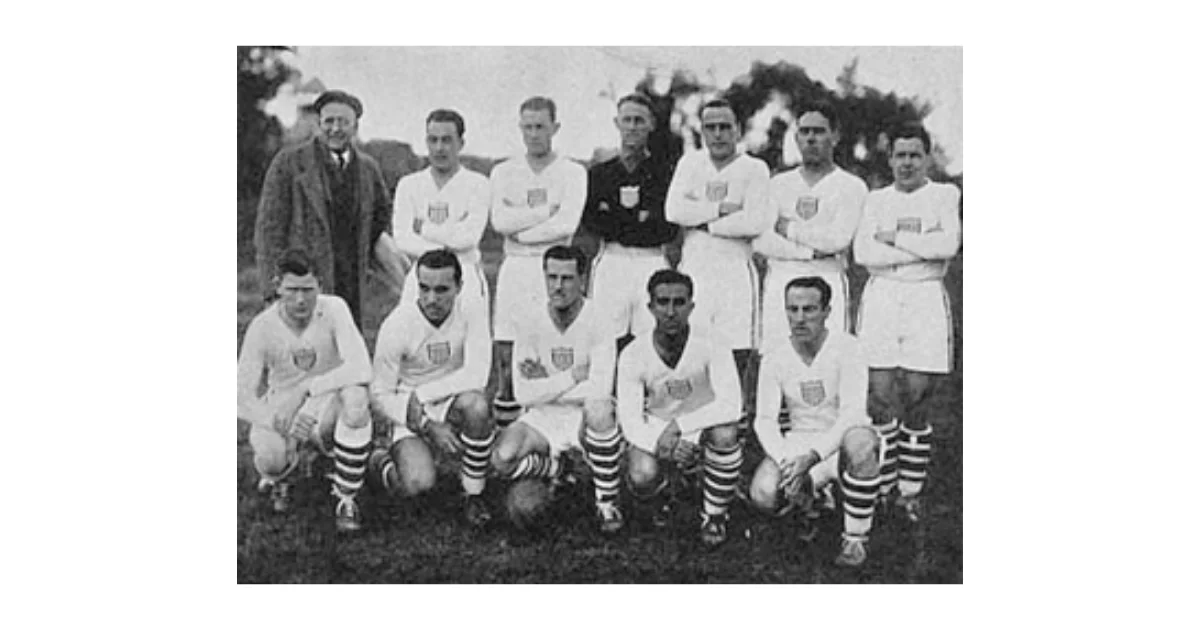
World Cup History in the Headlines: What Old Newspapers Captured Across the Decades
From a stolen trophy to the upset that put Britain in mourning, old newspapers captured the World Cup from 1930 forward. See what the archive holds.
Historical newspapers covered the FIFA World Cup from the first tournament in Uruguay in 1930. Coverage is searchable through NewspaperArchive, which includes papers from all 50 U.S. states and 48 countries. Wire service reports distributed match results to small-town and major papers alike, meaning World Cup coverage appears in local newspapers across the country for every tournament from 1930 onward. Notable moments documented in the archive include the U.S. reaching the 1930 semifinals, the American upset of England in 1950, Brazil's first title in 1958, the theft of the Jules Rimet Trophy in 1966, Argentina's 1986 championship, and the first Women's World Cup in 1991. Search terms, date ranges, and player names can all be used to locate specific match coverage across eras and countries.
The 2026 FIFA World Cup is being played across North America right now. Matches in Dallas, Los Angeles, Miami, Kansas City, Atlanta, and eight other American cities, plus venues in Mexico and Canada. For the first time in the tournament's history, three nations are hosting together, spreading the world's biggest sporting event across 16 cities on one continent.
That kind of scale generates a paper trail. Every four years, it always has. Game reports filed overnight. Wire stories landing in papers from Appleton, Wisconsin, to Fairbanks, Alaska. Local columnists weighing in on matches played thousands of miles away. Small-town editors running the same dispatch that ran in every major city.
That trail goes all the way back to 1930. And a surprising amount of it is searchable right now.
If you want to see how your own corner of the world responded to a World Cup moment, searching NewspaperArchive by date and location is a good place to start. Papers from all 50 U.S. states and 48 countries are included, which means the coverage runs deeper than most people expect.
Quick Answer
Old newspapers covered the World Cup from the very first tournament in Montevideo, Uruguay, in 1930. You can find wire reports, game summaries, player profiles, local reactions, and stories that never made it into any highlight reel. NewspaperArchive includes papers from all 50 U.S. states and 48 countries, making it possible to search coverage from nearly any angle, any era, or any location.
The Tournament Nobody Knew Would Change Everything (1930)
The first FIFA World Cup was held in Uruguay in July 1930. Thirteen nations participated. Most European powers declined to make the trip. The United States sent a team.
On July 23, 1930, the Appleton Post-Crescent ran a short wire report with a headline that would surprise most American sports fans today.
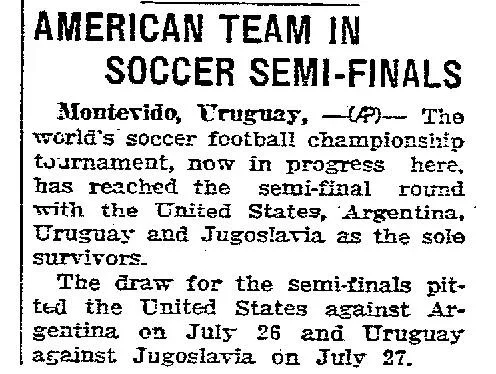
The United States had reached the semifinals. The squad had beaten Paraguay and Belgium in the group stage and advanced alongside Argentina, Uruguay, and Yugoslavia as the final four teams in the competition. They would lose to Argentina in the semis, but the result placed them third in the first World Cup ever played.
Most Americans have no idea that happened.
A week later, the Uniontown Morning Herald in Pennsylvania ran the result of the final.
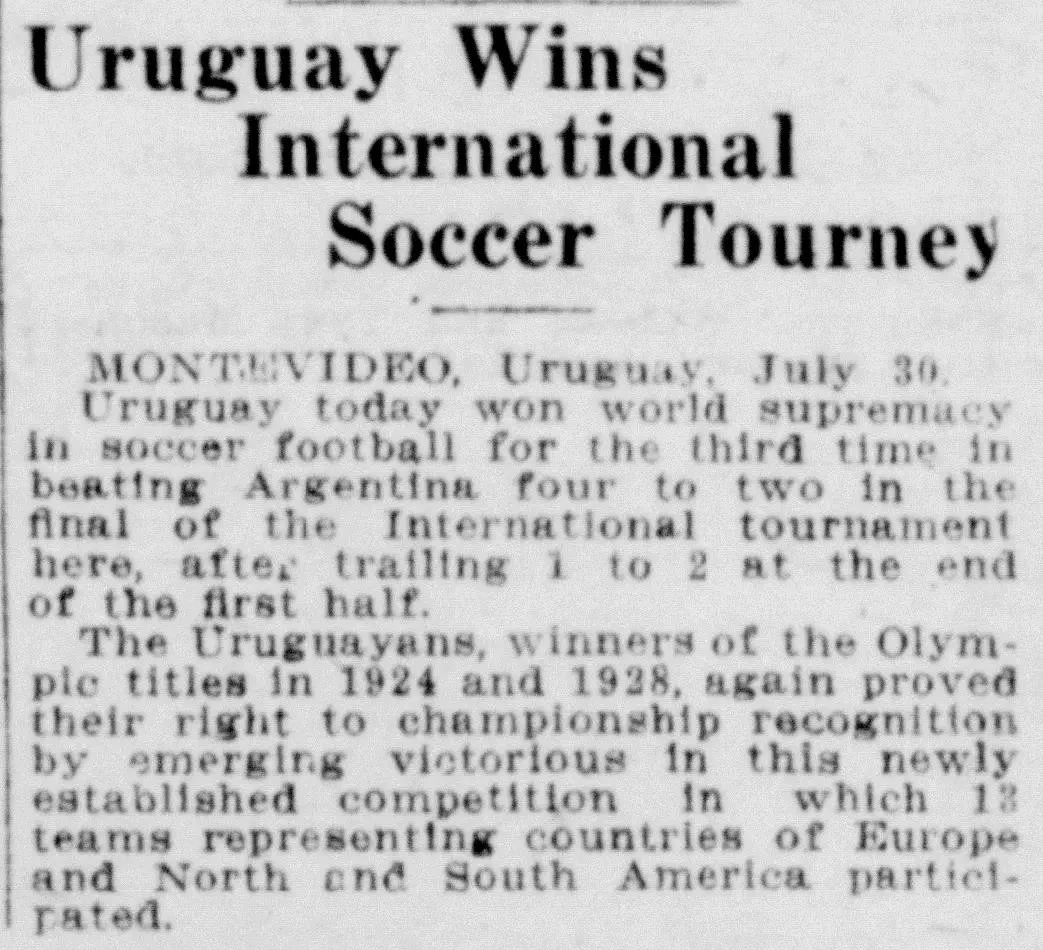
Notice what the headline calls it. Not the World Cup. The "International Soccer Tourney." The language had not settled yet. The competition was so new that papers were still deciding what to name it. Uruguay won 4-2 over Argentina after trailing at halftime, claiming what the paper described as world supremacy in soccer football for the third time, counting their Olympic titles in 1924 and 1928.
These two clippings together tell the whole 1930 story. They ran in small American papers, which means versions of them appeared across dozens of cities and towns.
The Upset That Stopped Britain Cold (1950)
The 1950 World Cup in Brazil produced what many still call the greatest upset in the history of the sport. The United States, a team of part-time amateurs, defeated England 1-0 in Belo Horizonte.
The British could not believe it. Some newspapers in England reportedly printed the story inside a black border, the way they would mark a death.
The Lowell Sun in Massachusetts covered it differently.
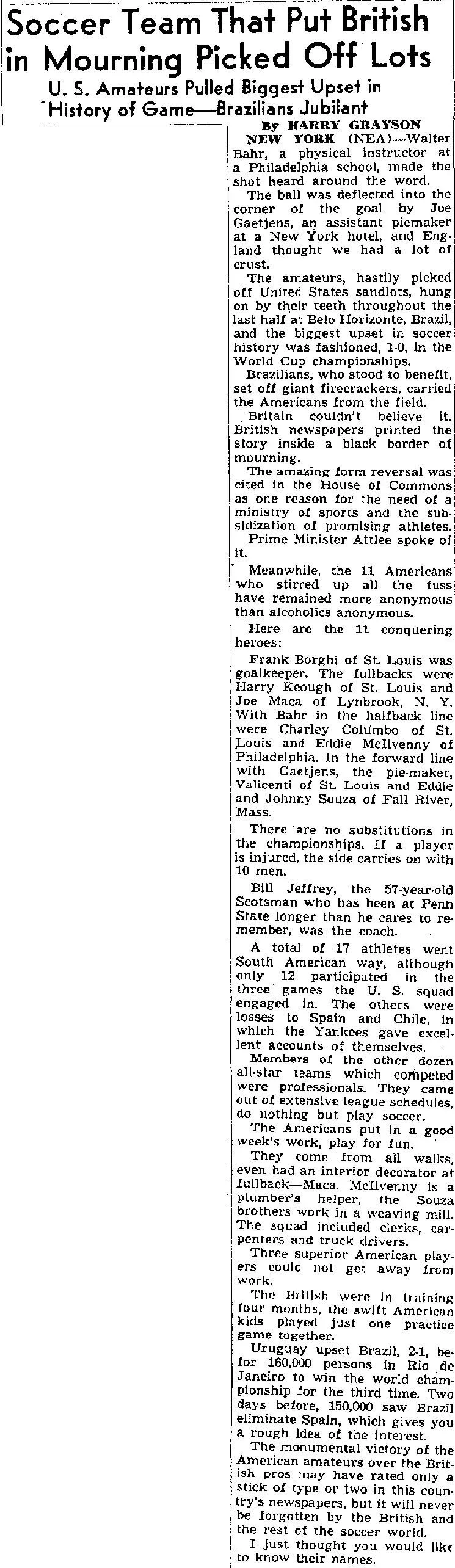
The piece, written by Harry Grayson for the NEA wire service, named every single player on the American squad. Not just their names. Their hometowns. Their jobs.
Frank Borghi of St. Louis was the goalkeeper. Joe Gaetjens, the man whose deflected shot went in for the only goal, was an assistant pie maker at a New York hotel. Harry Keough and Joe Maca played fullback. Eddie McIlvenny was from Philadelphia. The Souza brothers worked in a weaving mill. The squad included clerks, carpenters, and truck drivers.
The coach was a 57-year-old Scotsman who had been at Penn State longer than he cared to remember.
They played England, who had been in training for four months, after just one practice game together.
England thought the Americans were a nuisance. They were not.
This is exactly the kind of detail that makes historical newspaper research worth doing. Not the final score. The people behind it. The pie maker who helped produce the biggest upset in soccer history.
Brazil, Pelé, and the First of Many (1958)
Eight years later, in Stockholm, a 17-year-old scored twice in a World Cup final.
The Bakersfield Californian covered Brazil's 5-2 win over Sweden on June 30, 1958.
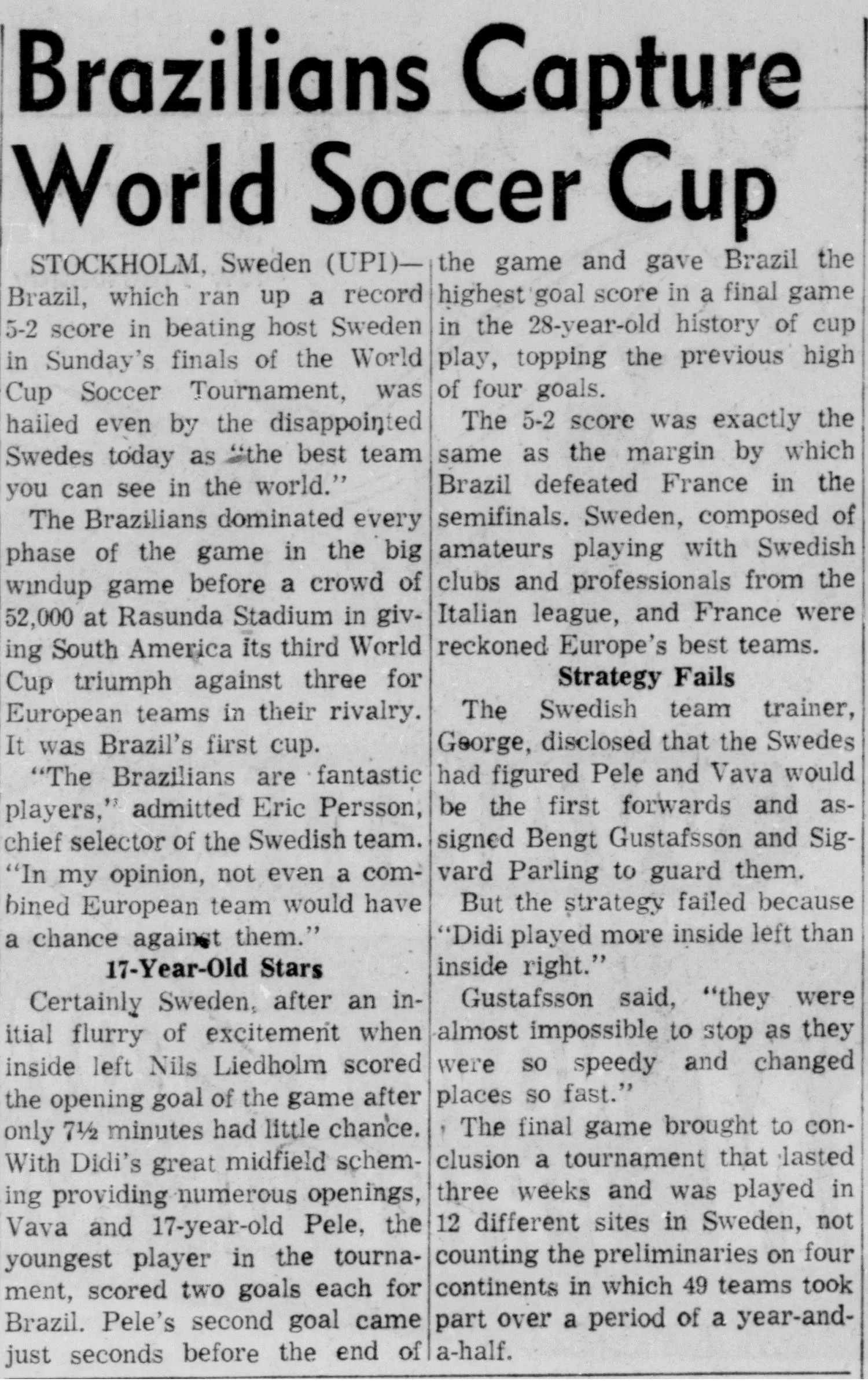
The Swedish chief selector told reporters after the match that in his opinion, not even a combined European team would have had a chance against Brazil. The Brazilians dominated every phase of the game before a crowd of 52,000 at Rasunda Stadium. South America and Europe were now level at three titles each.
It was Brazil's first title. Pelé, the youngest player in the tournament, scored two goals in the final and added another in the semifinal. He was 17 years old.
By 1958, the World Cup was generating real wire coverage in American papers from coast to coast. The Bakersfield Californian ran a full match report with quotes from both sides and a breakdown of how the game unfolded. This was no longer a fringe story buried in the back pages.
Before the 1966 Tournament, Someone Stole the Trophy (1966)
Four months before the World Cup was set to begin in England, the Jules Rimet Trophy disappeared.
The Somerset Daily American in Pennsylvania ran the story on March 21, 1966.
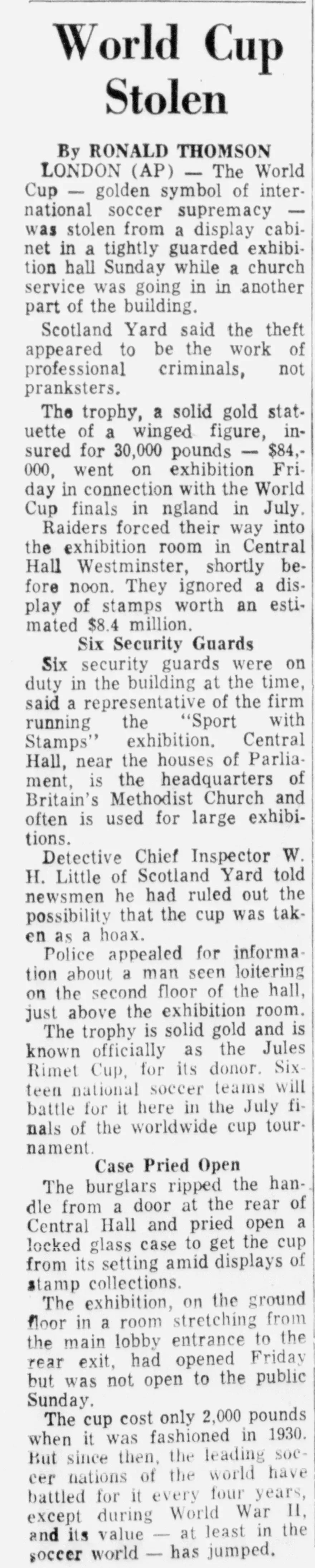
The trophy, a solid gold statuette insured for 30,000 pounds, had been put on display at a stamp exhibition in Central Hall Westminster. Six security guards were on duty. On Sunday morning, while a church service was being held in another part of the building, raiders forced their way in, ignored a display of stamps worth an estimated 8.4 million dollars, and took the cup.
Scotland Yard said the theft appeared to be the work of professional criminals, not pranksters.
The trophy was later found wrapped in newspaper under a hedge in South London by a dog named Pickles, who became briefly famous. A man was eventually arrested. England went on to win the tournament that summer, meaning the host nation lifted a trophy that had been missing just months before.
The Somerset Daily American clipping captures the moment before any of that was known. Scotland Yard had ruled out the possibility that it was a hoax. The cup was simply gone. That is the version the newspaper printed, and it is the version that survives.
This is what old newspapers do that nothing else can. They hold the story as it was understood at the time, before the ending was written.
The Tournament Itself Delivered (1966)
England got the trophy back and hosted the tournament. It did not disappoint.
The Kingston Gleaner in Jamaica covered the group stage on July 17, 1966.
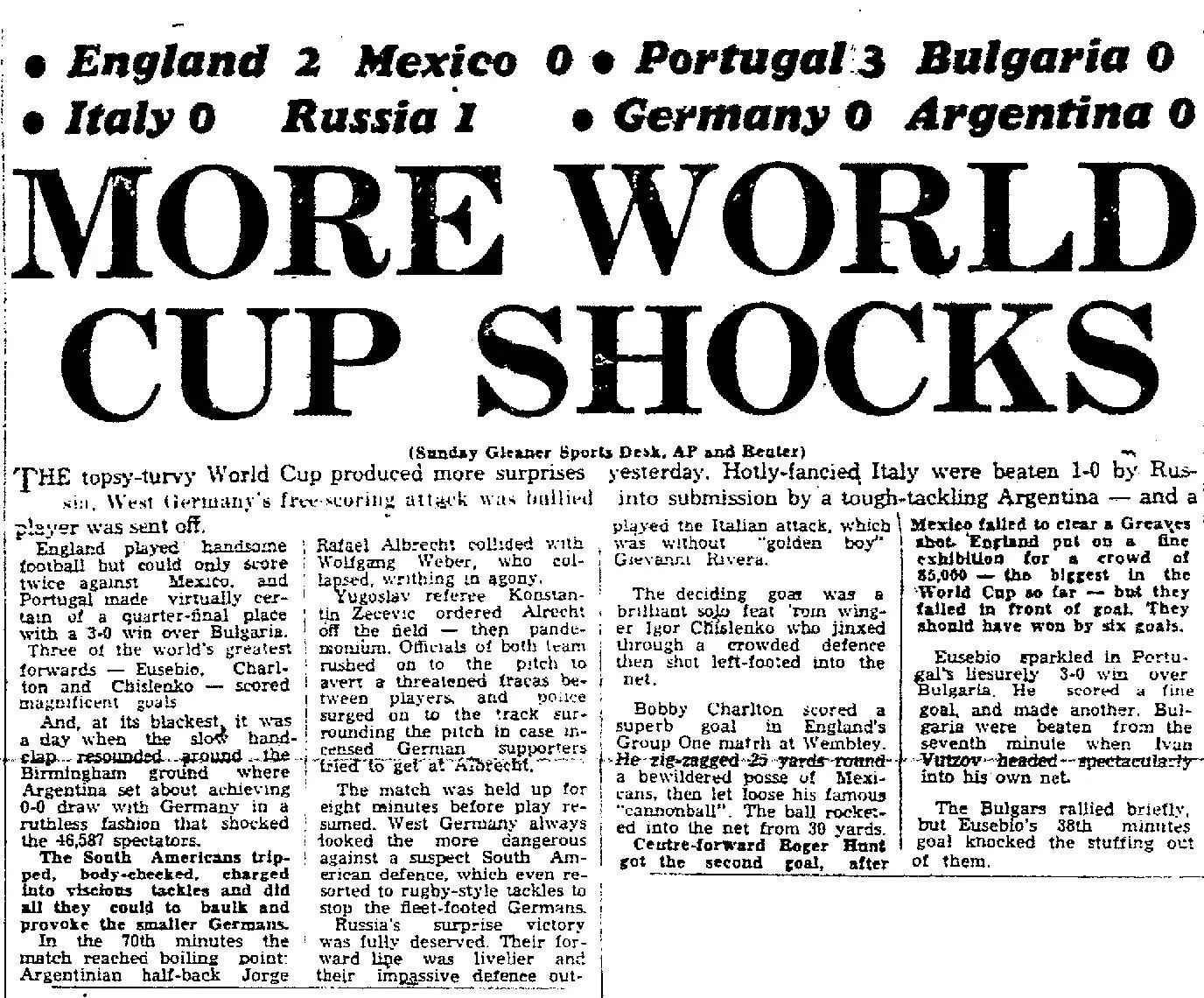
The headline runs three words in enormous type across the page: MORE WORLD CUP SHOCKS. Scores run above it. Italy 0, Russia 1. Germany 0, Argentina 0. England 2, Mexico 0. Portugal 3, Bulgaria 0.
The article describes Bobby Charlton scoring a cannonball from 30 yards that rocketed into the net. It describes Argentina playing rugby-style tackles to stop the fleet-footed Germans. It describes Eusebio sparkled in Portugal's win over Bulgaria with the kind of casual confidence that suggests the writer expected his readers to know exactly who Eusebio was.
The Kingston Gleaner was a Jamaican paper. The World Cup by 1966 was not an American story or a European story. It was a global one, and the newspaper record reflects that. NewspaperArchive's international holdings mean you can search how the same tournament looked from different countries, different editorial perspectives, different angles entirely.
England won the final at Wembley on July 30, 1966.
Maradona's Tournament, Argentina's Title (1986)
By 1986, the World Cup had grown into something else entirely. The final in Mexico City drew 114,000 fans to the Azteca. It was broadcast around the world. And it delivered one of the most dramatic finishes the tournament had seen.
The Dover Times-Reporter in Ohio covered Argentina's 3-2 win over West Germany on June 30, 1986.
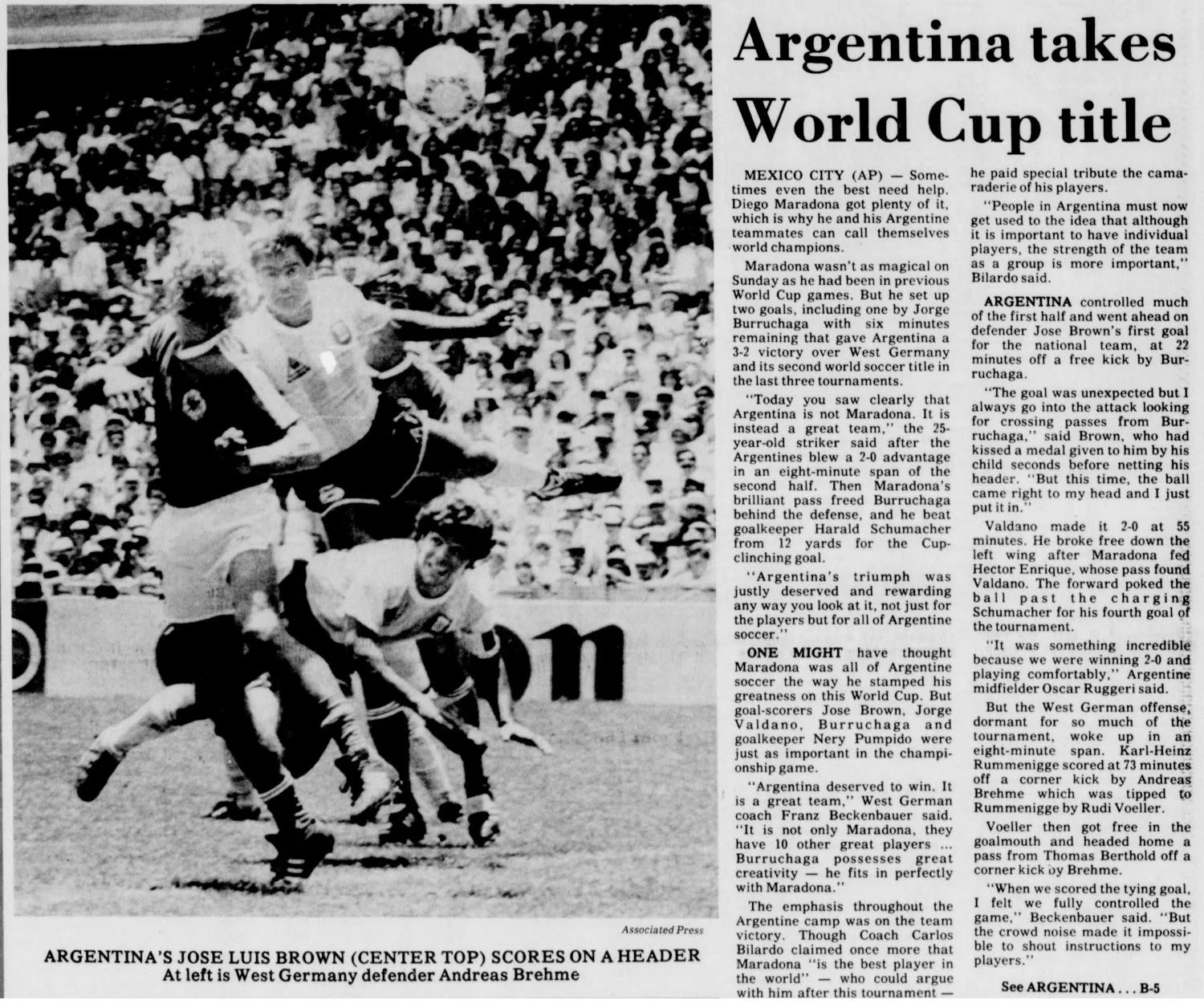
Argentina led 2-0. West Germany scored twice in eight minutes to level it. Then Maradona, who had dominated the entire tournament, set up Jorge Burruchaga with six minutes remaining. Burruchaga beat the goalkeeper from 12 yards. Argentina held on.
The coach pushed back afterward on the idea that the win belonged to Maradona alone.
"Today you saw clearly that Argentina is not Maradona. It is instead a great team," said the 25-year-old striker.
The West German coach Franz Beckenbauer agreed. "It is not only Maradona, they have 10 other great players."
It is worth pausing on where this clipping came from. A small Ohio paper covered a World Cup final played in Mexico City before one of the largest crowds in soccer history. That is what the wire service system did. It carried the story everywhere. Which means it is findable everywhere, from major metro papers to county weeklies.
A Championship Nobody Was Watching (1991)
On November 30, 1991, the United States won the first FIFA Women's World Cup in Canton, China.
The Fairbanks Daily News-Miner in Alaska covered it the next day.
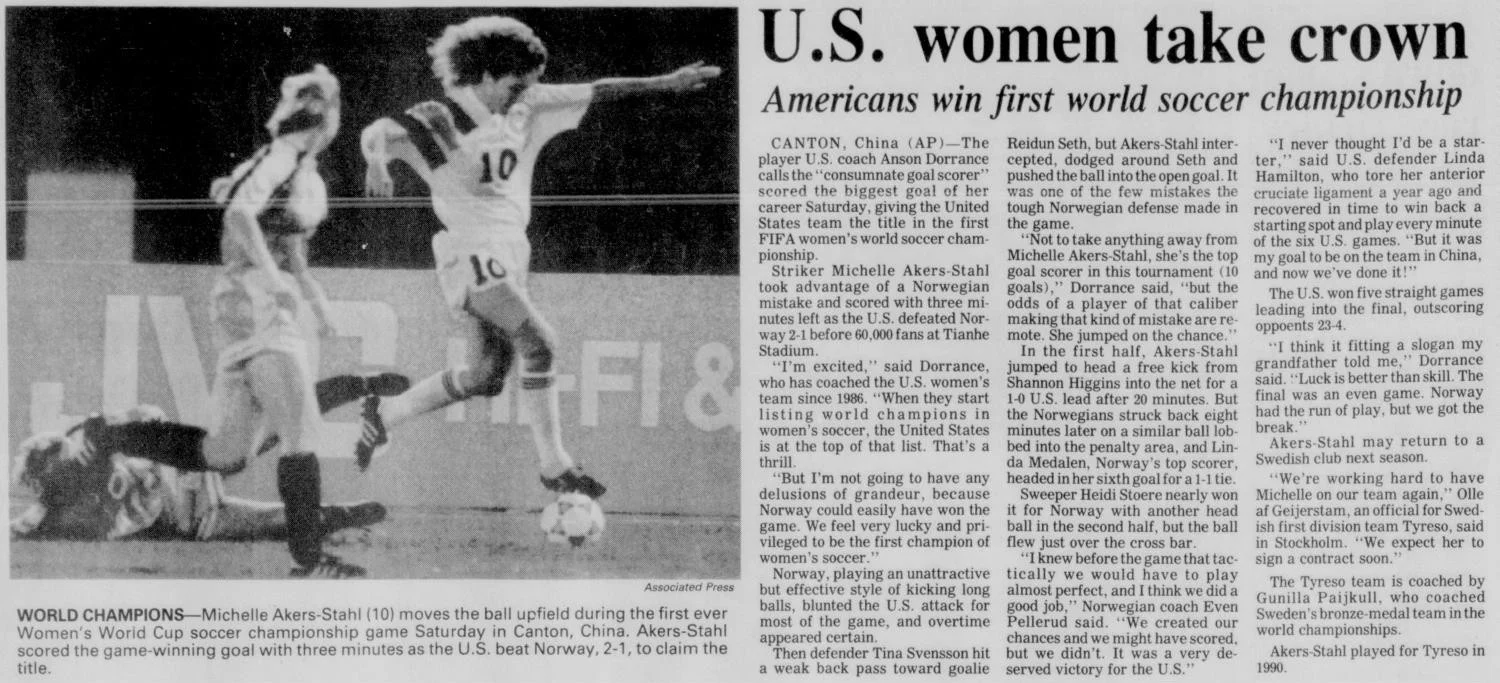
Striker Michelle Akers-Stahl scored the winning goal with three minutes remaining as the U.S. defeated Norway 2-1 before 60,000 fans. The U.S. had outscored opponents 23-4 on the way to the final. Coach Anson Dorrance called Akers-Stahl the consummate goal scorer.
"I never thought I'd be a starter," said defender Linda Hamilton, who had torn her anterior cruciate ligament a year earlier and recovered in time to earn back her spot. "But it was my goal to be on the team in China, and now we've done it."
The coverage was modest compared to what the moment deserved. The women's game was still finding its audience. Eight years later, the 1999 Women's World Cup came to the United States, and Brandi Chastain's penalty kick in the Rose Bowl became one of the most recognizable images in American sports history.
But the 1991 tournament is there, too. In Alaska. In Ohio. In Pennsylvania. In papers that picked up the wire and ran the story the next morning, because the Americans had won something remarkable and the world was barely paying attention.
How to Search World Cup History in Old Newspapers
The World Cup has a long newspaper trail, but the search terms shift depending on the era. Here are a few things worth knowing before you start.
Search "world soccer championship" for early tournaments. The phrase "World Cup" was not standard in American papers until the 1950s. Clippings from 1930 and 1934 may appear under variations like "international soccer tournament" or "world football championship."
Search by date, not just by keyword. If you know a match was played on a specific date, search the two or three days following it. Game reports almost always ran the next morning.
Try multiple papers for the same event. Wire reports were distributed widely, which means dozens of papers may have run versions of the same story. Searching across papers from different cities can surface different details, different headlines, and occasionally different quotes.
Search player names alongside tournament years. Names like Pelé, Maradona, Eusebio, and Beckenbauer appear in papers from the 1950s through the 1990s. Searching a name with a year can pull up profiles, match reports, and opinion pieces you would not find with a general search.
Look beyond American papers. NewspaperArchive includes newspapers from 48 countries. The Kingston Gleaner in Jamaica covered 1966. Canadian and Australian papers covered tournaments their nations did not even qualify for. Searching internationally gives you a completely different picture of how the world received the same event.
Search local angles. If a player on a World Cup squad came from a specific town, local papers often covered it. The 1950 U.S. squad included players from St. Louis, Philadelphia, Fall River, and Lynbrook, New York. Papers from those cities may have additional coverage that the wire service never picked up.
Frequently Asked Questions
Can I find World Cup coverage in old American newspapers? Yes. American papers covered the World Cup through wire services beginning with the first tournament in 1930. Coverage increased significantly through the 1950s and 1960s. By the time the U.S. hosted in 1994, American newspapers were giving the tournament extensive coverage.
When did U.S. newspapers start covering the World Cup regularly? Consistent coverage began with the 1950 tournament in Brazil, partly because the U.S. team's upset of England generated genuine news interest. Before that, coverage existed but was scattered. By the 1958 and 1966 tournaments, wire reports were running in papers from coast to coast.
Are international newspapers available on NewspaperArchive? Yes. NewspaperArchive includes newspapers from 48 countries. This makes it possible to search how the same World Cup tournament was covered in Jamaica, Canada, the United Kingdom, and elsewhere, often giving a very different perspective than American papers provide.
What is the best way to search for a specific World Cup match in historical newspapers? Start with the date of the match and search the following two or three days. Use the names of the teams, the host city, and any player names you know. For tournaments before 1950, try older phrasing like "world soccer championship" or "international football tournament" rather than "World Cup."
Did small-town newspapers cover international soccer? More than you might expect. Wire services like AP and UPI distributed match reports widely, and small papers across the country ran them. A paper in Appleton, Wisconsin, covered the 1930 semifinals. A paper in Somerset, Pennsylvania, covered the stolen trophy story in 1966. A paper in Dover, Ohio, covered the 1986 final. The coverage is there. It just takes some searching to find it.
Your Town Was Paying Attention Too
Ninety-six years ago, a wire dispatch about the United States reaching the semifinals of the first World Cup ever played ran in the Appleton Post-Crescent. Someone read it over breakfast and probably moved on with their day. The game was played thousands of miles away. Most Americans had never seen a soccer match. But the newspaper printed it, and the newspaper kept it.
That is true of every tournament since. The scores, the upsets, the stolen trophy, the overtime goals, the celebrations in the streets. All of it landed in local papers from Alaska to Pennsylvania to Ohio, filed overnight and printed the next morning for readers who may or may not have cared.
The 2026 World Cup will generate its own paper trail. But the one that already exists, stretching back to Montevideo in 1930, is waiting to be searched.