The Other Side of 1776: Finding Loyalist Ancestors in Historical Newspapers
Not every ancestor chose the Patriot side. Historical newspapers documented Loyalists through confiscation notices, proclamations, and postwar return coverage.
Historical newspapers documented Loyalist families throughout the Revolutionary War era through several distinct record types. Confiscation and estate sale notices appeared in colonial papers from 1775 onward, naming individuals whose property was seized by Patriot authorities. Military proclamations issued by British commanders and reprinted in Patriot newspapers named specific individuals who were exempted from pardons or targeted for punishment. Postwar refugee return notices appeared in American papers from 1783 through the 1790s, recording families who had fled to Britain or Canada and were returning. Loyalty oath records and banishment orders appeared in local and colony-wide papers. NewspaperArchive holds records from all of these periods and allows searching by name, date range, and state or colony.
Not Everyone Was a Patriot
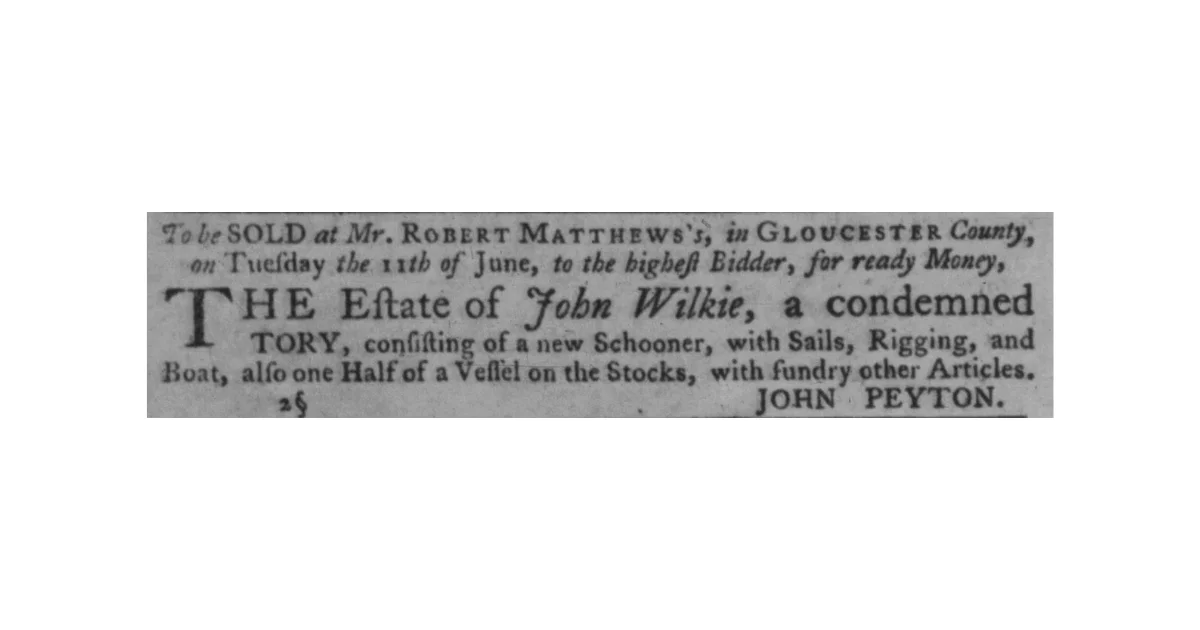
The Virginia Gazette ran the notice in its June 1, 1776, edition, plain as any other advertisement on the page. John Wilkie's estate was to be sold at Mr. Robert Matthews's in Gloucester County, on Tuesday, the 11th of June, to the highest bidder for ready money. A new schooner with sails and rigging. A boat. Half a vessel on the stocks. Sundry other articles.
The notice described Wilkie in two words: condemned TORY.
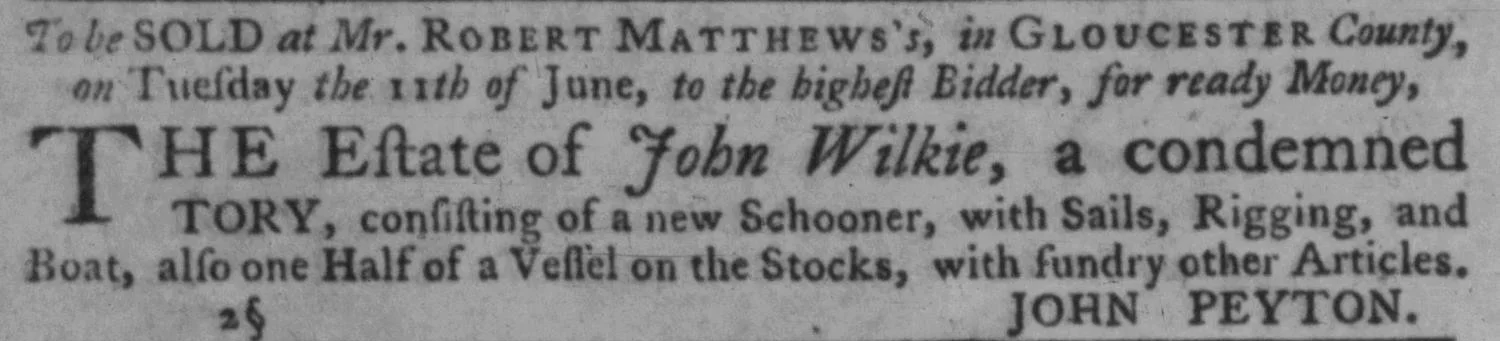
John Wilkie did not get a farewell notice or a community tribute. He got a liquidation sale. Everything he had built in Gloucester County, vessels, rigging, watercraft, was broken apart and sold to the highest bidder. His name appeared in the newspaper once, and it was in the context of losing everything.
That notice is still a genealogical record. It names him, places him, dates him, and tells you exactly what side of 1776 his neighbors thought he was on.
Not every ancestor was a Patriot. Historians estimate that roughly twenty percent of the colonial population remained loyal to the British Crown during the Revolution. Another twenty to forty percent were neutral or tried to stay out of it. The people we tend to find in genealogy research are the ones who signed loyalty oaths, appeared on Patriot muster rolls, and filed pension claims later in life. But the Loyalist ancestor left a different kind of paper trail, and newspapers are one of the richest sources for finding it.
If you are just getting started, the America250 Genealogy Research Checklist lays out the full range of newspaper searches available for the founding era before you dig into any single record type.
What a Loyalist Record Looks Like in a Newspaper
Confiscation and Estate Sale Notices
The most common Loyalist record in colonial newspapers is the confiscation notice. When a Loyalist was identified by local Patriot authorities, a Committee of Safety, a county court, or a colonial assembly, their property could be seized and sold. The notice announcing that sale ran in local papers, sometimes with the word TORY printed in large capitals to make sure no one missed the point.
These notices typically include the full name of the property owner, the county where the property is located, a description of the assets being sold, and the name of the Patriot official overseeing the sale. John Wilkie's notice names the overseer as John Peyton. That name can be searched independently, which may produce additional records about the confiscation process in Gloucester County.
If your ancestor's name appears in a confiscation notice, you have confirmed where they were, when they were there, that local authorities considered them a Loyalist, and roughly what they owned. That is a solid foundation for a much bigger search.
Military Proclamations
The Virginia Gazette printed something unusual in its June 8, 1776, edition. It ran a full copy of a British military proclamation, issued by Major General Clinton from aboard the Pallas transport in Cape Fear River, North Carolina, on May 5th of that year.
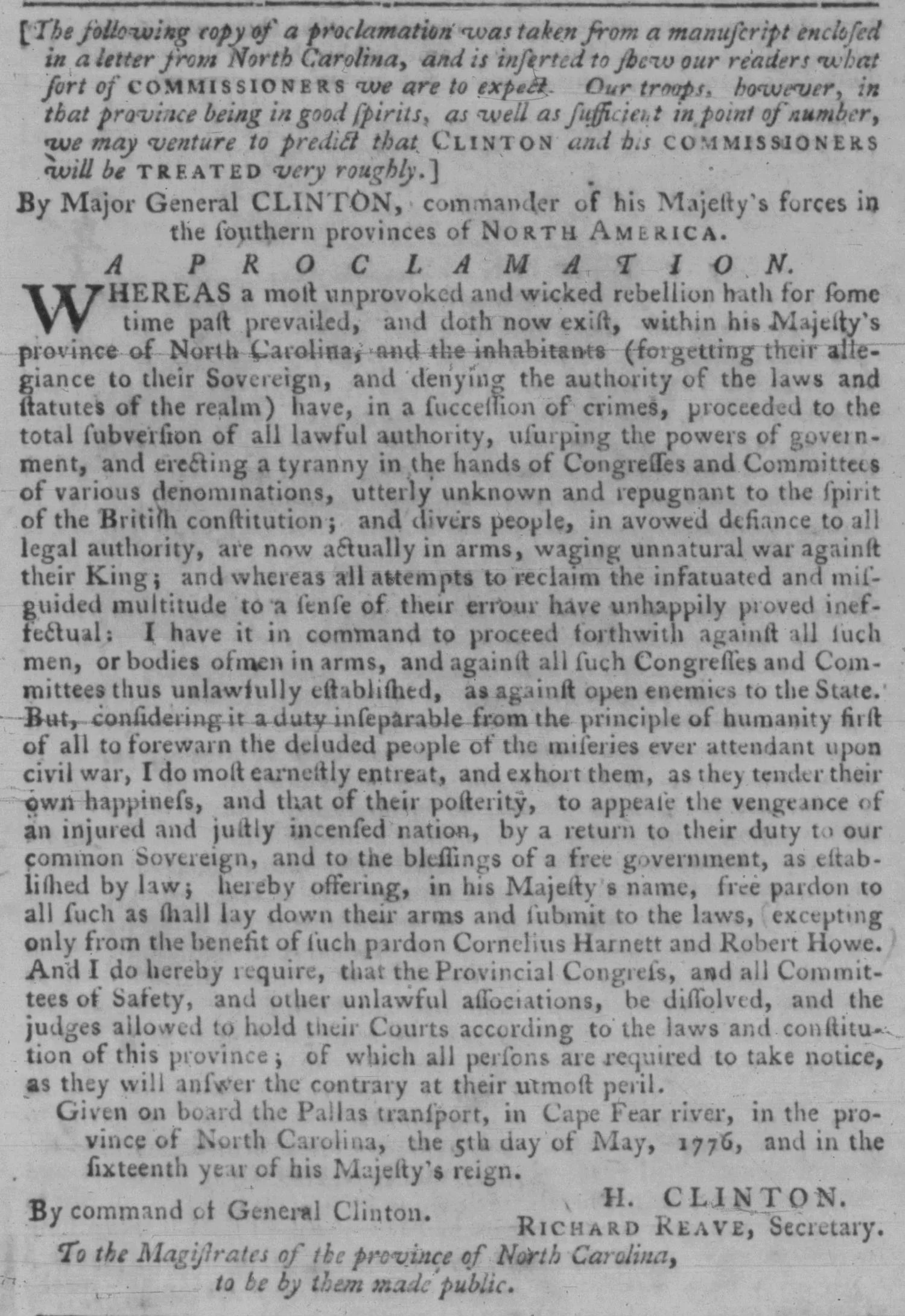
The Patriot editors ran it with an editorial note in italics, predicting that Clinton and his commissioners "will be TREATED very roughly." The sarcasm is unmistakable. But the document they reprinted is still a primary source. It is a British military proclamation preserved in a Patriot newspaper, and it names exactly two men who were cut out of the offer of pardon.
Those men were Cornelius Harnett and Robert Howe. Their names appear in the proclamation not as heroes but as enemies of the Crown who would receive no mercy. Their neighbors could read those names in the same paper where they read the shipping news.
Proclamations like this one are genealogical records in disguise. They name people who were prominent enough to be singled out by British commanders. They show you who was being targeted, who was being courted, and what the British understood about the people living in that county. And they were reprinted in colonial papers because Patriot editors knew their readers wanted to know what the enemy was saying.
Searching NewspaperArchive for proclamations, loyalty oaths, and British military notices alongside your ancestor's name and county can surface this kind of document when no other record exists.
What the Proclamation Tells You About Research Strategy
The Clinton proclamation is worth paying attention to as a research model. Two names are excluded from the pardon offer. Everyone else, the unnamed thousands in North Carolina who had taken up arms against the Crown, is being offered a way out if they submit.
That means the newspaper is quietly documenting a whole population. The people reading this proclamation were people who had to decide whether to accept it. If your ancestor was in North Carolina in May 1776, this proclamation was directed at them. Searching for their name near this date and location will sometimes turn up a response: a loyalty oath, a Committee of Safety record reprinted in a local paper, or a confiscation notice if they refused to submit.
The Loyalist newspaper trail is not just about the Loyalists themselves. It is about the moment of decision, and newspapers were there for all of it.
After the War: The Refugee Return
The Revolution ended formally in 1783, but the Loyalist story in newspapers did not. Thousands of Loyalist families had fled to Britain, Canada, or the Caribbean during the war. After the peace treaty was signed, some of them came back.
A notice in the Newport Mercury of August 16, 1783, reported the arrival of two ships from London at New London, Connecticut. The ships had been at sea long enough to miss the post from Boston. They carried several Refugee families. Among them was the family of the late Martin Howard, Esq.
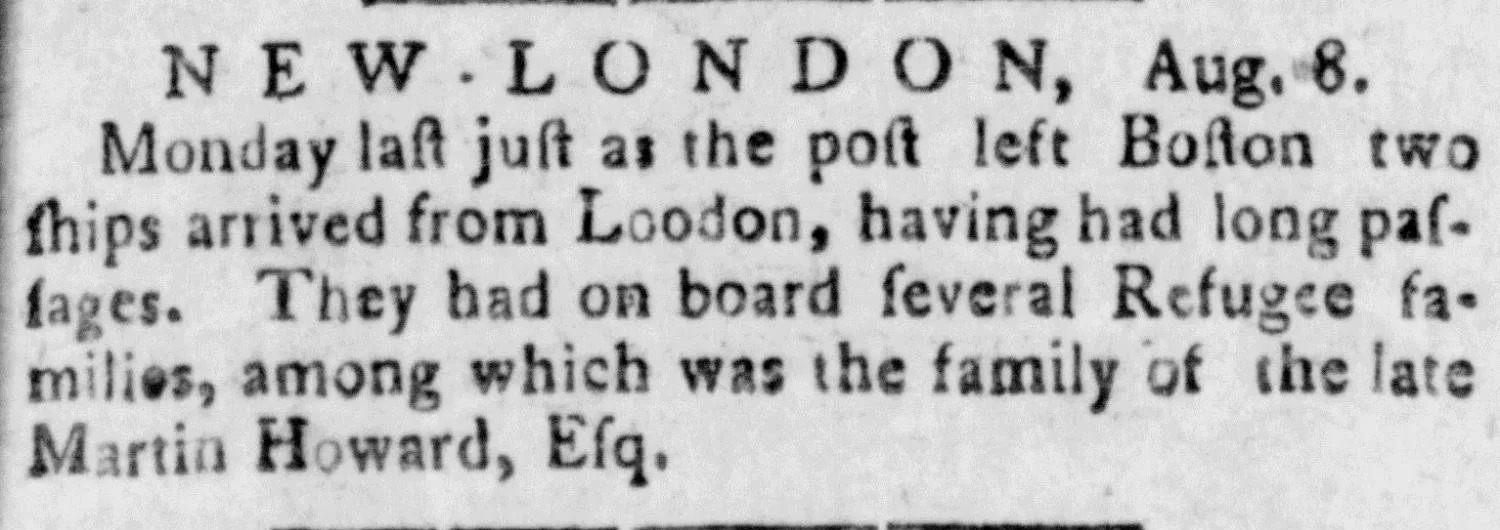
Martin Howard was a Rhode Island lawyer who had been a prominent Loyalist since before the war even began. He had served as Chief Justice of North Carolina under the Crown. By 1783, he was dead. His family was coming home to a country that no longer had a place for what he had represented.
The notice is brief, just five sentences. But it names a family, puts them at a specific port on a specific date, and places them among a group of returning refugees. That is more than a lot of genealogical records give you.
Postwar Loyalist return notices appear in coastal papers from 1783 through the early 1790s. They tend to show up around major port cities, Newport, New York, Charleston, Boston, because those were the entry points for ships coming from Britain and Nova Scotia. If your Loyalist ancestor came back after the war, the notice of their arrival may still be out there.
Why the Loyalist Trail Gets Missed
Most genealogy research into the Revolutionary era focuses on military service records, pension files, and Patriot community tributes. That makes sense. Those records are easier to find, well-indexed, and satisfying to land on. But it means the Loyalist ancestor gets skipped.
The Loyalist ancestor did not file a pension claim. They did not appear in DAR lineage records. They were not named in the tributes that ran in regional papers fifty years after the war. They showed up in the newspaper when their estate was seized, when a British commander named them as an enemy, or when their family arrived on a ship from London.
Those are not easy records to find. But they are records. And if your family line goes cold in the 1770s, knowing that your ancestor may have left a legal and political paper trail instead of a military one can open up research that would otherwise stay stuck.
What to Search in NewspaperArchive
Search Terms That Surface Loyalist Records
These phrases appear frequently in Revolutionary-era newspaper coverage of Loyalist families. Search them with a state filter and a date range of 1775 to 1795 for best results.
"condemned tory" — estate sales and confiscation notices
"refugee families" — postwar return notices in coastal papers
"loyalist" combined with a county or colony name
"laid down their arms" — responses to pardon proclamations
"confiscated estate" — property seizure notices
"departed the province" — notices of Loyalists who fled
Your ancestor's surname combined with "tory" or "loyalist"
Date Ranges
Period | What to Search For |
|---|---|
1775 to 1783 | Confiscation notices, proclamations, loyalty oath records, banishment orders |
1783 to 1795 | Refugee return notices, estate restitution claims, readmission to community |
1795 to 1820 | Obituaries that may note Loyalist past, land records, family notices |
Newspaper Titles to Search for Loyalist Records
These three titles in NewspaperArchive are the strongest starting points for Loyalist research and together cover wartime Virginia, occupied New York, and the postwar coastal story.
Virginia is the strongest starting point. The Virginia Gazette runs from 1736 through 1930 and covers the entire Revolutionary period. NewspaperArchive holds more than 13,000 pages from this title. It is the most reliable source in the collection for confiscation notices, loyalty declarations, property sales, and reports involving suspected Loyalists. The John Wilkie and Clinton Proclamation clippings in this post both come from that paper.
New York is historically critical for Loyalist research because British forces occupied New York City for most of the war. The New York Herald (1763 to 1922) and the New York Weekly Magazine (1764 to 1797) are the strongest candidates in the collection for this era. The exact wartime issue survival within those date ranges should be checked directly in NewspaperArchive before assuming broad coverage.
Rhode Island is best used for late-war and postwar research. The Newport Mercury in NewspaperArchive begins in 1782, during the final stage of the Revolution. Newport had experienced British occupation earlier in the war, so the paper is useful for postwar refugee returns, property and commercial notices, and peace-era coverage of displaced families. The Newport Mercury clipping in this post comes from 1783, precisely within that window.
What You Are Looking For
The Loyalist newspaper record will not look like a Patriot veteran obituary. It will not name battles or describe a community mourning one of its heroes. It will look like a legal notice: short, matter-of-fact, sometimes a little cold.
John Wilkie's entire newspaper record may be one estate sale notice. John Wilkie, condemned TORY, Gloucester County, Virginia. Schooner, rigging, boat, half a vessel on the stocks. John Peyton, overseer.
That looks like the whole file, except it is not. That notice is the starting point. It names him, places him, and tells you his neighbors considered him an enemy. From there, county court records, land records, colonial assembly proceedings, and British Loyalist claims records all become searchable. Newspapers do not hold the whole story. But they are often the record that makes the rest of the story findable.
If your family line goes quiet in the 1770s, the answer may not be that your ancestor was obscure. The answer may be that you have been searching the wrong side of the newspaper.
NewspaperArchive holds records from every side of 1776. The confiscation notice, the proclamation, the refugee return: they are all in there, waiting to be found. Search NewspaperArchive and see what your family's 1776 actually looked like.
FAQ
Did Loyalists appear in American newspapers during the Revolution?
Yes, and in several different ways. Confiscation and estate sale notices ran when their property was seized. Proclamations issued by British commanders named specific individuals. Loyalty oath records were reprinted by colonial assemblies. Banishment orders appeared in local papers. These notices ran in the same papers that carried Patriot military news and were read by the same communities.
What is a confiscation notice and where do I find one?
A confiscation notice is a legal advertisement announcing the sale of property seized from someone identified as a Loyalist. These notices ran in local newspapers throughout the war years and typically name the property owner, the county, a description of the assets, and the official overseeing the sale. NewspaperArchive holds the Virginia Gazette and several other eighteenth-century publications that may contain confiscation notices, property advertisements, loyalty proceedings, and reports involving people accused of supporting the British. Coverage varies by title and year, so researchers should confirm that issues survive for the specific period and location they are investigating.
What happened to Loyalists after the Revolutionary War?
It varied. Some fled to Britain, Canada, or the Caribbean during the war and never came back. Some returned after the 1783 peace treaty, and their arrivals were noted in coastal newspapers. Some stayed in their communities throughout the war with reduced standing. A small number successfully reclaimed property or reputation afterward. British Loyalist Claims Commission records also exist and can be a useful companion to newspaper research.
My ancestor disappears from records in the 1770s. Could they have been a Loyalist?
It is worth looking into. Loyalist ancestors tend to drop out of Patriot community records like muster rolls, pension files, and church membership lists, while showing up in legal and government records instead. If your ancestor is present before 1775 and largely gone afterward, searching for confiscation notices, loyalty oath records, and postwar return notices in their county and state is a good next step.
Were British military proclamations really printed in Patriot newspapers?
Yes, and fairly often. Patriot editors reprinted British proclamations as a form of political commentary, sometimes with editorial notes, sometimes to warn readers, and sometimes simply because people wanted to know what the British were saying. The Clinton Proclamation in the Virginia Gazette on June 8, 1776, is a good example. The editors added a note predicting Clinton would be "treated very roughly." These documents are useful for researchers because they sometimes name specific individuals and help you understand the political situation your ancestor was living through.