Inside the 1876 Centennial Exposition: What Newspapers Reported from Philadelphia
Newspapers across the country covered the 1876 Centennial Exposition in Philadelphia from planning through closing day. Here's what they reported and how to find it.
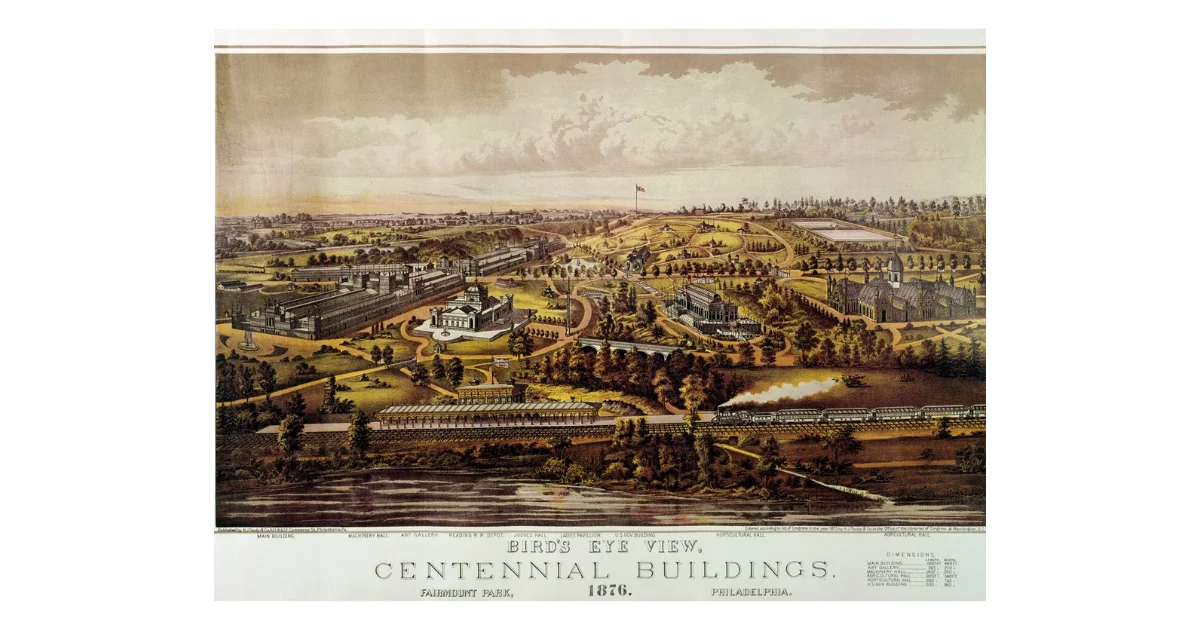
The 1876 Centennial International Exhibition in Philadelphia was the first official World's Fair held in the United States and the centerpiece of the nation's 100th birthday celebration. It ran from May 10 to November 10, 1876, at Fairmount Park in Philadelphia, Pennsylvania. Newspapers covered it from the planning stages beginning in 1872 through the closing ceremonies in November 1876. Coverage included pre-opening logistics such as state appropriations and exhibitor shipping rules, opening day ceremonies featuring President Ulysses S. Grant and a 1,000-voice chorus, firsthand accounts from journalists and commissioners who traveled to Philadelphia, attendance figures that topped 300,000 on opening day alone, and closing tributes that described the event as a superb triumph for the United States. NewspaperArchive holds newspapers from this period across dozens of states, including opening day coverage, state participation notices, and firsthand accounts from correspondents who attended the exposition in person.
The Nation Threw Itself a Party, and Newspapers Covered Every Minute of It
In the summer of 1876, the United States turned 100 years old. The country marked the occasion with the grandest celebration it had ever staged: the Centennial International Exhibition at Fairmount Park in Philadelphia, a six-month World's Fair that drew visitors from across the globe and dominated newspaper coverage from Maine to California.
The 1876 Centennial Exposition was not just a big event. It was the biggest event most Americans alive at the time had ever witnessed. And newspapers treated it that way. From the funding debates of 1872 to the closing ceremonies of November 1876, editors published planning notices, program schedules, firsthand accounts, attendance figures, and tributes that filled columns for months.
If your ancestor was paying attention to the world in 1876, they were reading about Philadelphia.
And while Philadelphia was the centerpiece, the centennial was playing out in every county and small town across the country at the same time. For the local side of that story, including community barbecues, founding family retrospectives, and the names newspapers recorded in towns far from Pennsylvania, see How Newspapers Covered the 1876 Centennial.
Before the Doors Opened: Planning a World's Fair
The Centennial Exposition did not happen overnight. The planning started years before the gates opened, and newspapers documented it every step of the way.
As early as December 1872, the Philadelphia Inquirer described the planned exposition as "national and purely patriotic in its scope" and called on Congress to provide whatever funding was needed to make it a success. By April 1876, the stockholders of the United States Centennial Commission held their third annual meeting to review the finances. The estimated cost had reached $8.5 million. Admissions, they hoped, would cover the remaining $1.5 million gap.
States across the country stepped up to help fund the effort. The Madison Wisconsin State Journal reported in January 1876 that the Wisconsin legislature had passed a resolution to appropriate $25,000 to ensure the state had a presence at the exposition. In today's dollars, that figure would be well over $600,000.
Beyond money, states also contributed exhibits. The Burlington Daily Hawk-Eye Gazette published the full set of rules established by Iowa's executive council for shipping goods to Philadelphia, right down to a printed tag that exhibitors could attach to their packages.

This kind of pre-opening coverage is exactly the type of record that turns up in NewspaperArchive searches and connects an ancestor to the exposition before a single visitor had walked through the gates.
Opening Day: 300,000 People and a President
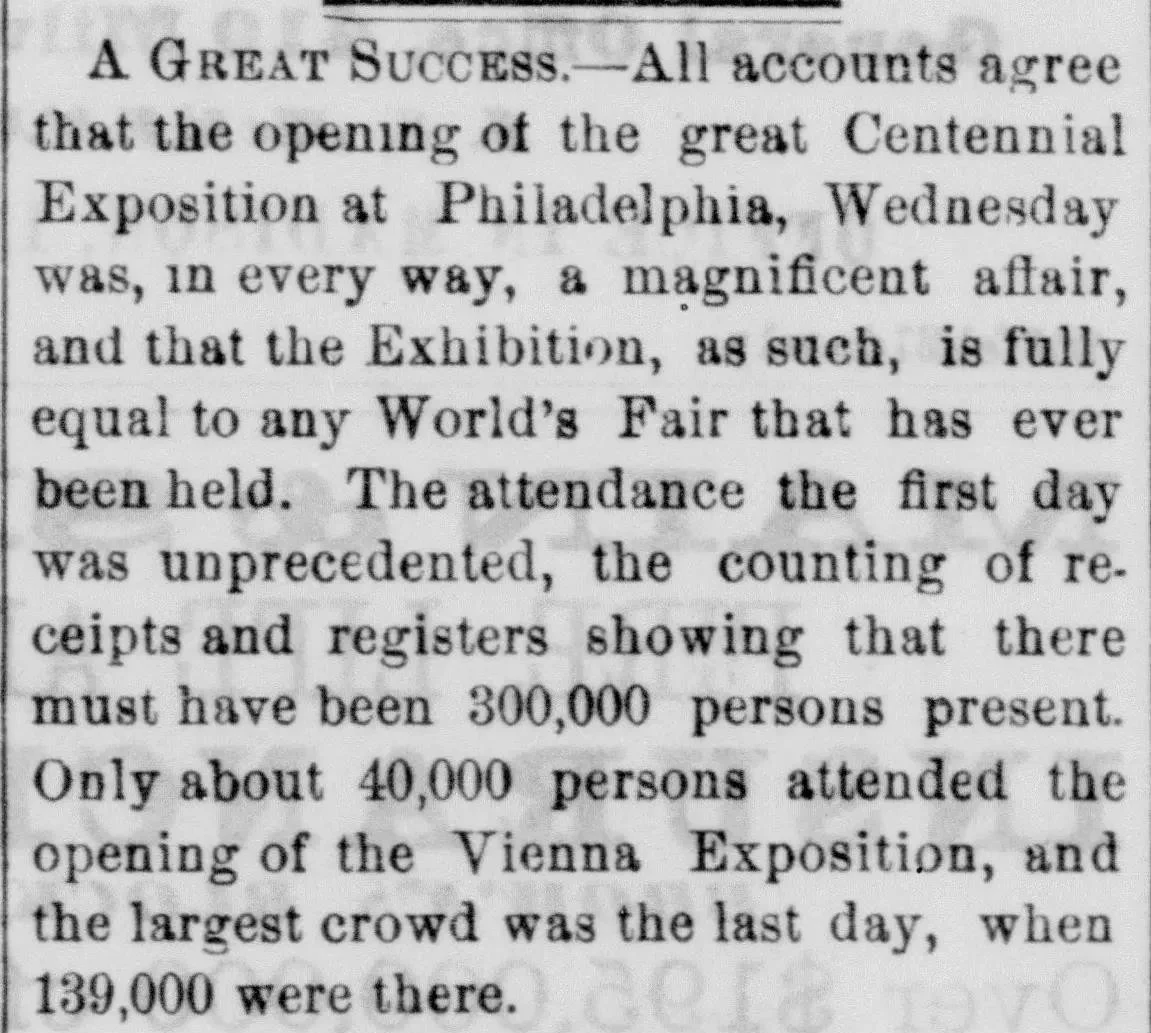
On the morning of May 10, 1876, all the bells in Philadelphia rang for half an hour, including the Liberty Bell. The gates of the Centennial grounds opened at nine o'clock, and the formal inauguration ceremonies began at a quarter past ten at Memorial Hall.
The Winona Daily Republican published the full opening day program. It included a Centennial Inauguration March composed by Richard Wagner of Germany, a prayer by the Reverend Bishop Simpson, a hymn by poet John G. Whittier set to music by John K. Payne of Massachusetts, and a cantata with words by Sidney Lanier of Georgia. An orchestra of 150 pieces and a chorus of 800 voices performed under the direction of Theodore Thomas. President Ulysses S. Grant addressed the crowd and then walked to Machinery Hall, where he turned on the steam to set the great Corliss engine in motion, furnishing power to all the machinery in the building. The Winona Daily Republican described the close of the ceremonies:
"Thus, amid the booming of cannon, the strains of patriotic music and the plaudits of happy thousands, will be inaugurated the great Centennial Exposition which is to mark the hundredth year of our national existence."

The Indianapolis Journal splashed "Our Jubilee" across its front page and ran a description of the scene by writer Bayard Taylor, promising a "complete coup d'oeil of the panorama of nations" and full particulars of the great event.
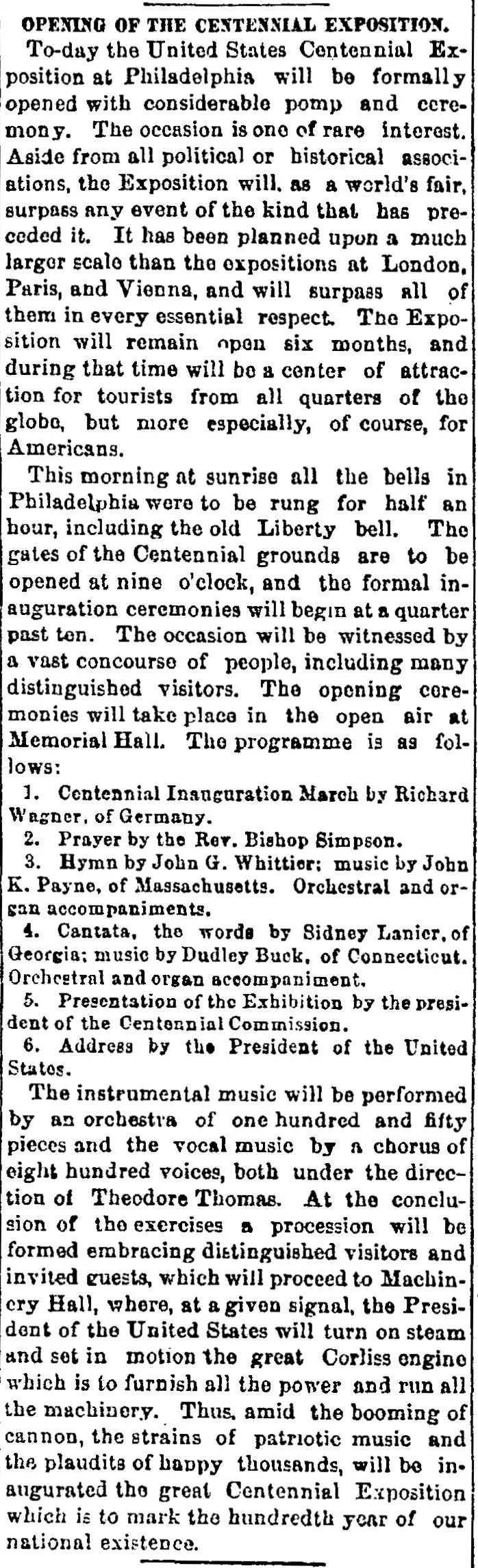
Two days later, the Madison Wisconsin State Journal reported the results:
"All accounts agree that the opening of the great Centennial Exposition at Philadelphia, Wednesday was, in every way, a magnificent affair."
The attendance on opening day was described as unprecedented. Receipts and registers showed that roughly 300,000 people were present. For comparison, only about 40,000 had attended the opening of the Vienna Exposition, and the largest single crowd at Vienna's entire run had reached just 139,000.
Firsthand Accounts: What It Was Actually Like to Be There
Newspapers did not just cover the opening ceremonies from a distance. They sent correspondents and published letters from eyewitnesses who described the exposition in vivid detail.
In the Wichita City Eagle, Colonel John A. Martin, the United States Centennial Commissioner for Kansas appointed by President Grant, filed a detailed dispatch from Philadelphia. He described displays that "cover acres upon acres of floor and wall space" and admitted that the two days he had spent visiting could not begin to do the exposition justice. To truly see the Centennial Exposition as it deserved to be seen, he estimated, would require six months.

Other papers published letters from private citizens who had made the trip and wanted to share what they found. The Rome Weekly Courier ran a firsthand account by W.S. Crane, who went so far as to reassure readers that costs in Philadelphia were not excessive and offered to personally answer questions from anyone considering attending.
These accounts were the travel reviews of their day. For researchers, they are also a direct way to find ancestors who traveled to Philadelphia in the summer of 1876. If your ancestor wrote to a local paper about their trip, that letter may still exist in NewspaperArchive.
World's Fairs Beyond Philadelphia: A Tradition in American Newspapers
The 1876 Centennial Exposition was not the first World's Fair held in the United States, and it was not the last. The country hosted its first international exhibition in New York in 1853, and the tradition continued for more than a century. The most recent American World's Fair was held in New Orleans in 1984.
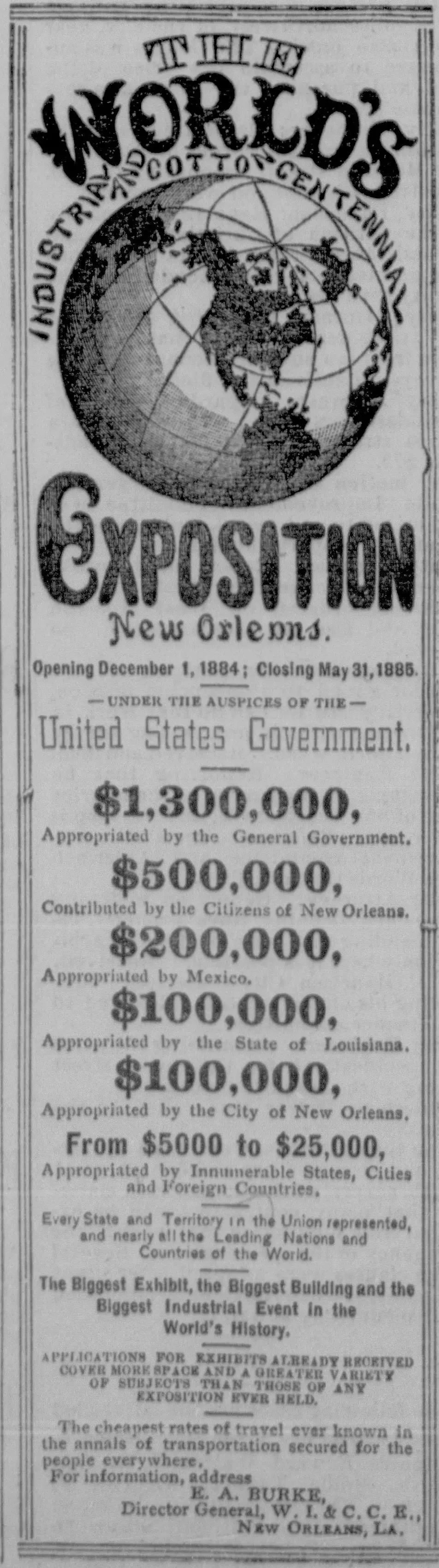
Each of those events generated newspaper coverage, and that coverage named people. The New Orleans World's Industrial and Cotton Centennial Exposition opened December 1, 1884, and closed May 31, 1885. The San Antonio Light ran a large advertisement for the event in August 1884, listing the financial backing: $1.3 million from the federal government, $500,000 from the citizens of New Orleans, $200,000 from Mexico, and $100,000 each from the state of Louisiana and the city of New Orleans. The advertisement promised it would be "the biggest exhibit, the biggest building and the biggest industrial event in the world's history."
Every major American World's Fair in this era generated the same types of newspaper coverage: pre-opening funding and logistics notices, opening day programs, firsthand accounts from correspondents and private citizens, state and county participation coverage, and closing tributes. The table below shows the major fairs and the types of records most likely to name your ancestor.
Year | City | Fair Name | Newspaper Records to Search |
|---|---|---|---|
1853 | New York, NY | Exhibition of the Industry of All Nations | Opening coverage, exhibitor notices, visitor accounts |
1876 | Philadelphia, PA | Centennial International Exhibition | Planning notices, state appropriations, opening day, firsthand accounts, closing tributes |
1884 | New Orleans, LA | World's Industrial and Cotton Centennial Exposition | Funding notices, state participation, commissioner appointments, travel accounts |
1893 | Chicago, IL | World's Columbian Exposition | Extensive coverage, named visitors, state commissioner appointments, travel letters |
1901 | Buffalo, NY | Pan-American Exposition | Opening and closing coverage, President McKinley assassination notices, visitor accounts |
1904 | St. Louis, MO | Louisiana Purchase Exposition | State exhibits, travel letters, named attendees, commissioner notices |
1915 | San Francisco, CA | Panama-Pacific International Exposition | State delegation coverage, named visitors, closing tributes |
1933 | Chicago, IL | Century of Progress | Depression-era visitor accounts, state participation, named attendees |
1962 | Seattle, WA | Century 21 Exposition | Modern coverage, named participants, community travel notices |
1984 | New Orleans, LA | Louisiana World Exposition | Final major American World's Fair, local participation coverage |
For genealogists, any fair in this table is worth searching. If an ancestor lived within traveling distance of one of these events, there is a reasonable chance a local paper mentioned their attendance, their exhibited goods, or their role in organizing a state or county display.
Closing Day: A Superb Triumph
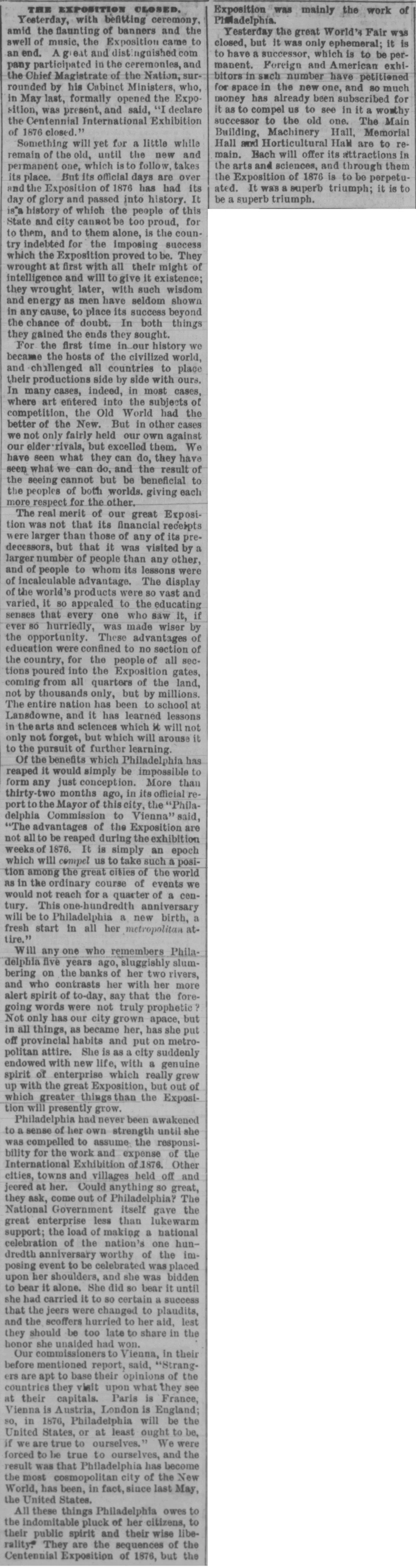
On November 10, 1876, the Centennial International Exhibition closed with ceremony befitting an event of its scale. The Philadelphia Inquirer published a tribute that ran to considerable length, crediting the people of Philadelphia for carrying the weight of the national celebration when the federal government had offered only lukewarm support.
"The real merit of our great Exposition was not that its financial receipts were larger than those of any of its predecessors," the paper noted, "but that it was visited by a larger number of people than any other, and of people to whom the lessons were of incalculable advantage."
The tribute ended with a line that speaks across a hundred and fifty years:
"It was a superb triumph; it is to be a superb triumph."
How to Find Your Ancestor in Centennial Exposition Newspaper Coverage
Centennial Exposition records are scattered across hundreds of newspapers from 1872 through late 1876. Here is how to find them efficiently in NewspaperArchive:
Search the full planning window, not just opening day
Coverage starts as early as 1872 with funding debates and runs through November 1876. Do not limit your search to May and July. State appropriation notices, exhibitor rules, and pre-opening logistics appear in papers from late 1875 through April 1876.
Use the right search terms
Try these in NewspaperArchive:
"Centennial Exposition" with your ancestor's state
"Centennial Commission" with a state name to find commissioner appointments
"Centennial Exposition" with a county or town name
Your ancestor's surname filtered to the year 1876 and their known state
"visited the Centennial" or "returned from Philadelphia" for travel notices
Look for exhibitor and commissioner notices
State centennial commissioners were appointed by governors and named in newspapers. County committees organized local exhibits and held public meetings. If your ancestor had any civic standing in 1876, these notices are worth searching.
Check for firsthand accounts and letters
Local papers regularly published letters from residents who had visited the exposition. Search your ancestor's home county paper for issues from May through October 1876 and look for travel correspondence or firsthand accounts.
Frequently Asked Questions
What was the 1876 Centennial Exposition? The Centennial International Exhibition of 1876 was the first official World's Fair held in the United States. It took place at Fairmount Park in Philadelphia, Pennsylvania, from May 10 to November 10, 1876, and celebrated the 100th anniversary of American independence. It attracted millions of visitors from around the world and featured exhibits from dozens of nations.
How many people attended the 1876 Centennial Exposition? Opening day attendance was estimated at 300,000 people. Total attendance over the six-month run reached approximately 10 million visitors, making it one of the most attended events in American history to that point.
What did newspapers cover about the 1876 Centennial Exposition? Coverage spanned the full arc of the event. Newspapers reported on funding debates starting in 1872, state appropriations and exhibitor logistics in early 1876, opening day ceremonies in May, firsthand accounts from correspondents and private citizens throughout the summer, and closing tributes in November. Local papers also covered the experiences of community members who traveled to Philadelphia.
Can I find my ancestor in Centennial Exposition newspaper coverage? There's a chance, if your ancestor had any connection to the exposition. People who appear in newspaper coverage include state and county centennial commissioners, exhibitors who shipped goods to Philadelphia, community members who traveled to the fair and wrote letters home, and residents named in local coverage of state participation efforts. NewspaperArchive holds newspapers from this period across dozens of states.
Were there other World's Fairs covered in American newspapers besides the 1876 Centennial? Yes. The United States hosted its first international exhibition in New York in 1853, and subsequent World's Fairs included events in Philadelphia (1876), New Orleans (1884), Chicago (1893), Buffalo (1901), St. Louis (1904), and others. Each generated substantial newspaper coverage that named participants, commissioners, and visitors.
The Archive Kept the Record
The 1876 Centennial Exposition lasted six months. The newspaper coverage of it lasted years. From the first funding debates in 1872 to the final tribute in the Philadelphia Inquirer, editors across the country treated this as the story of their lifetimes because it was.
If your family was in America in 1876, they were aware of Philadelphia that summer. And if they were involved in any way, a newspaper probably said so.
Search NewspaperArchive to find out what the papers said about your ancestor's corner of the centennial.