After the War: How Newspapers Followed Revolutionary War Veterans for Decades
Newspapers covered Revolutionary War veterans for nearly 90 years after the war ended. Here's how to find pension notices, obituaries, and last survivor records.
Historical newspapers covered Revolutionary War veterans from the war itself through the death of the last verified survivor in 1869, a span of nearly ninety years. The record types researchers can find include wartime notices (1775-1783), invalid pension lists published by authority of Congress beginning in 1808, obituaries noting Revolutionary service from the 1810s through the 1860s, last survivor tributes in the 1850s and 1860s, and community grave marker dedications extending into the twentieth century. NewspaperArchive holds records from all of these periods and allows searching by name, date range, and state. The post also includes a five-question FAQ covering search date ranges, productive search phrases, the three key pension acts, the length of newspaper coverage after the war, and how to find ancestors who left no military record.
The last verified survivor of the American Revolution died in 1869.
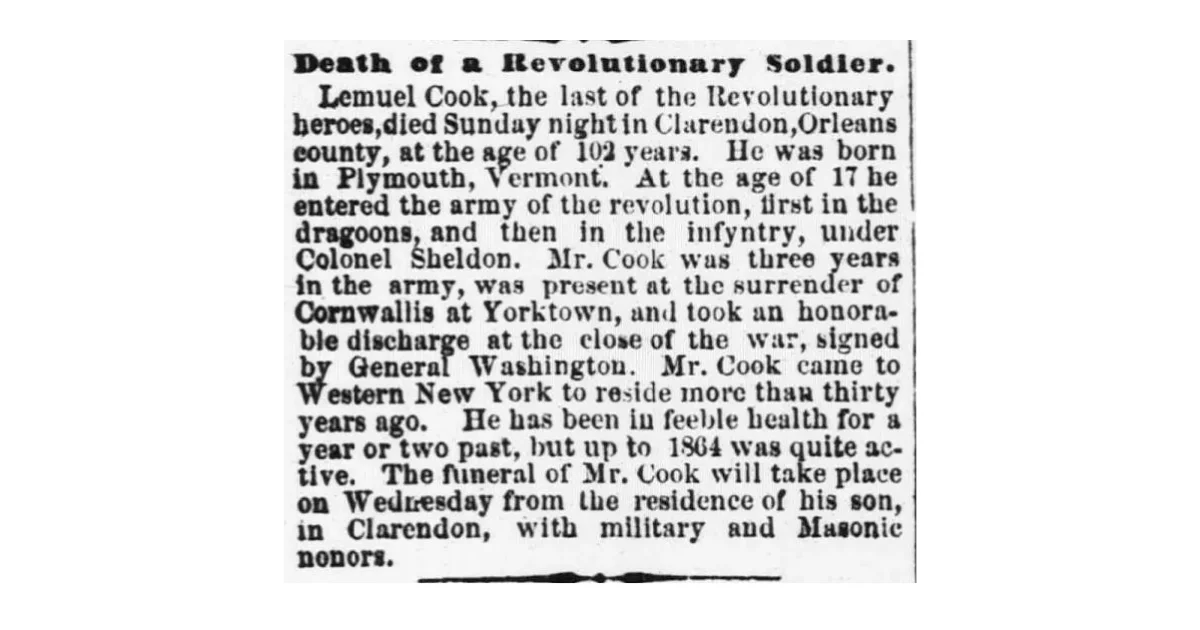
His name was Lemuel Cook. He was 102 years old. He had joined the army at 17, served in the dragoons and then the infantry under Colonel Sheldon, watched Cornwallis surrender at Yorktown, and carried a discharge signed by George Washington. He had been living in Clarendon, in western New York, for more than thirty years when the Indianapolis Daily Herald ran his obituary under the headline "Death of a Revolutionary Soldier."
The war had ended eighty-six years earlier.
Newspapers covered Revolutionary War veterans for nearly a full century after the Revolution ended. That is the fact that changes how you search. If you have a Revolutionary War ancestor and you have been limiting your newspaper searches to the war years, you have been missing decades of records: pension notices, obituaries, anniversary tributes, and last survivor coverage. Those records can tell you more about who that person was than any enlistment notice or muster roll.
The Record Begins Before the War Is Over
The newspaper record for Revolutionary War veterans starts before anyone knew they were veterans. During the war years, colonial newspapers published enlistment notices, deserter advertisements, muster calls, and the ordinary notices of daily life (land sales, estate settlements, missing property) that named ordinary men alongside the officers who commanded them.
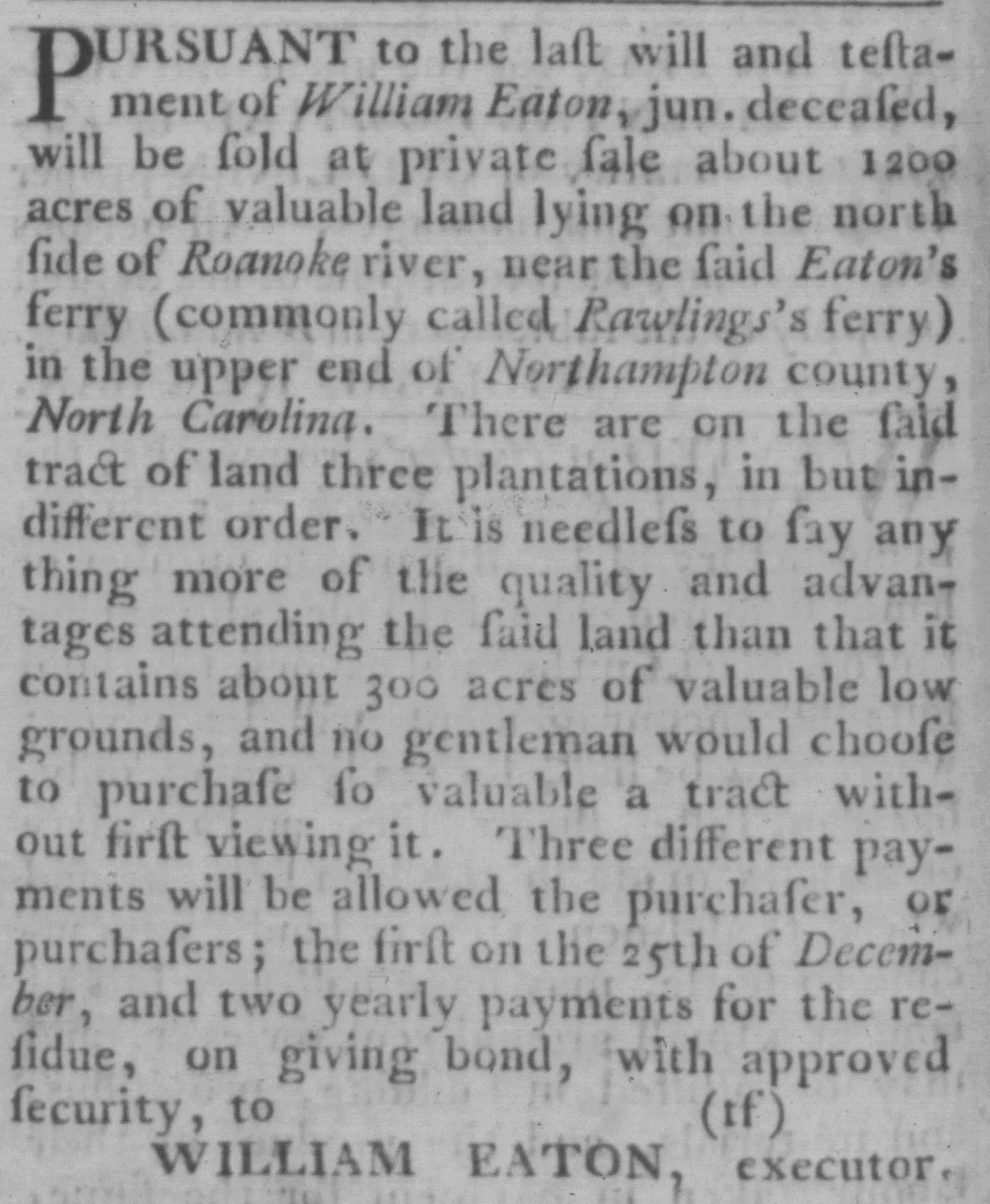
The Virginia Gazette ran dozens of these notices throughout the war. A June 1776 issue includes the estate sale of William Eaton, 1,200 acres on the north side of the Roanoke River in Northampton County, North Carolina, advertised by his executor, also named William Eaton. It is a brief notice about land. But it captures a man who existed, whose estate had to be settled while a war was being fought around him, whose name appears in print because life continued even in 1776.
Wartime notices are the earliest layer of the record. They name the community around the soldiers: the men placing ads, the officers calling for recruits, the families managing land while husbands and fathers were away. That community is the context for everything that follows.
What to search: The exact newspaper name combined with your ancestor's county or state and date range 1775-1783. Search also for unit names and the names of officers who commanded your ancestor's regiment.
The Pension Years: 1808 to 1832
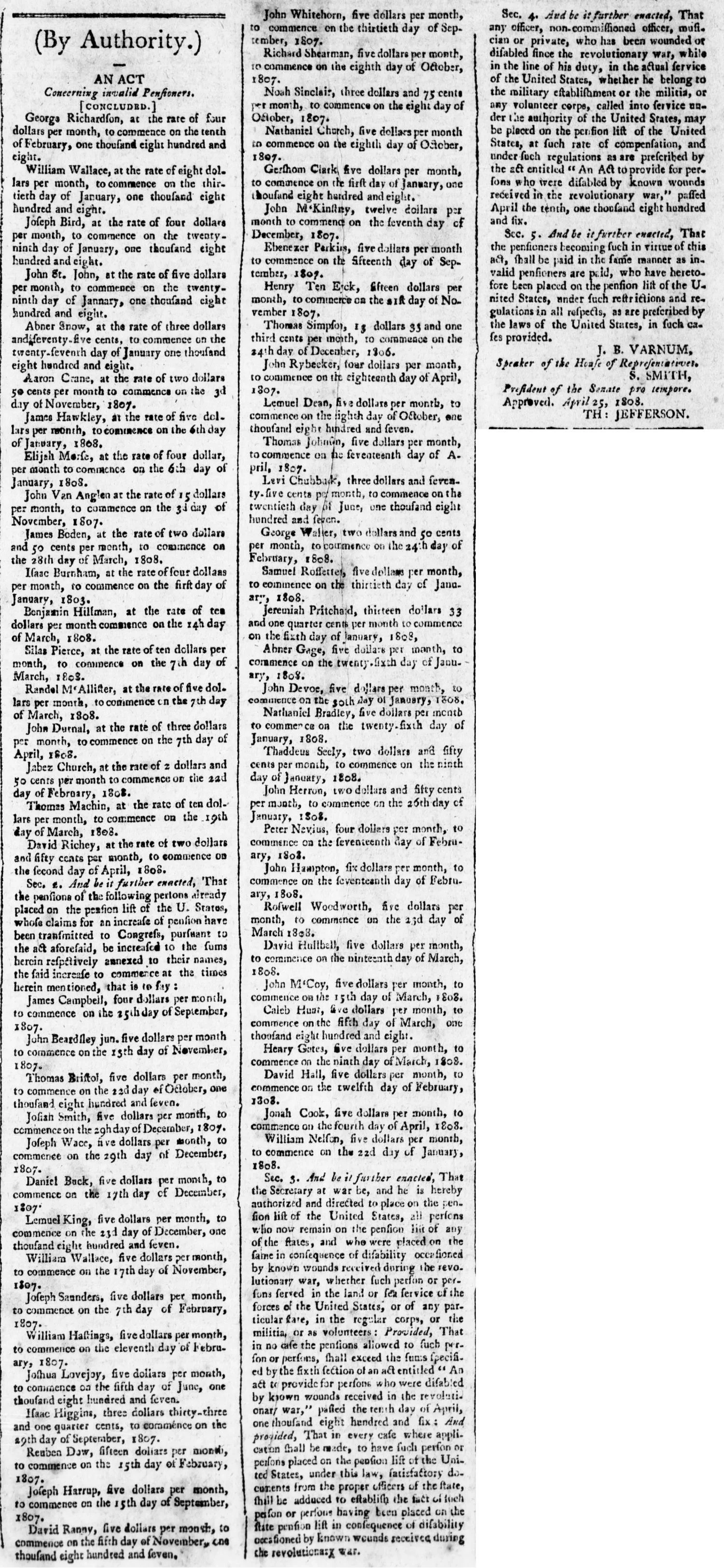
The federal government did not immediately provide pensions for Revolutionary War service. Early legislation covered only those disabled in service, men who had been wounded and could no longer support themselves. In 1808, Congress published lists of invalid pensioners in newspapers across the country, naming each man, his monthly payment, and the date it was to begin.
The Augusta Chronicle ran one of these lists on August 13, 1808. Printed under the heading "By Authority," it carries the names of dozens of veterans with their pension amounts listed to the penny. The act was signed by President Jefferson. The men listed had been wounded in the Revolution. Twenty-five years had passed since the war ended, and here they were, still in the newspaper record.
The 1818 Pension Act expanded eligibility to veterans who could demonstrate financial need, regardless of whether they had been wounded. Local newspapers began publishing pension application notices, pension grants, and pension revocations. A man who received a pension and was later removed from the rolls when his finances improved might appear in his county paper multiple times in a single decade.
The 1832 Pension Act went further, granting pensions to nearly all surviving veterans regardless of financial need. The resulting wave of applications brought men into the public record who had never appeared there before. By the 1830s the surviving veterans were in their 70s and 80s. Their applications named battles, units, and commanding officers. Newspapers sometimes reprinted these statements or noted the pension grants as community news.
Pension lists, application notices, and pension revocations for Revolutionary War veterans are searchable by name in NewspaperArchive. Search the pension years here.
What to search: Your ancestor's name combined with "pension," filtered by the state where he was living after the war. Date range 1808-1840. The exact phrase "invalid pensioners" surfaces the federally published lists.
The Obituary Years: 1820 to 1860
The richest single record type for most Revolutionary War researchers is the obituary. As veterans aged into their 70s, 80s, and 90s, newspapers increasingly framed their deaths as community events and historical losses.
These obituaries are often long. They name battles. They name units. They name the men and officers the veteran fought beside. They locate the veteran in a specific county and community, name surviving family members, and carry personal details that no pension file or muster roll could preserve.
The phrase "Revolutionary Hero" became a consistent headline signal. Searching it as an exact phrase surfaces this record type quickly without pulling in unrelated results.
Nathan Fish, whose obituary anchors another post in this series, was born in 1750, enlisted as a fifer at 15, fought at Lexington, Concord, Bunker Hill, and White Plains, found Washington on his knees in prayer before dawn, and was present when Benedict Arnold betrayed West Point. He also served in the War of 1812. His obituary ran in the Democratic Expounder in November 1851. A single clipping. A complete life.
Not every obituary reaches that level of detail. But many come close. The archive holds hundreds of them.
What to search: "Revolutionary Hero" as an exact phrase; "veteran of the Revolution"; "soldier of the Revolution"; "soldier of independence." Narrow by state and date range 1820-1860 for the highest density of results.
The Last Survivors: 1850 to 1869
By the 1850s, the surviving veterans were approaching 90 and 100 years old. Newspapers understood the weight of what was happening. Coverage shifted from routine obituaries to something closer to witness accounts, dispatches from the end of a living connection to the founding of the country.
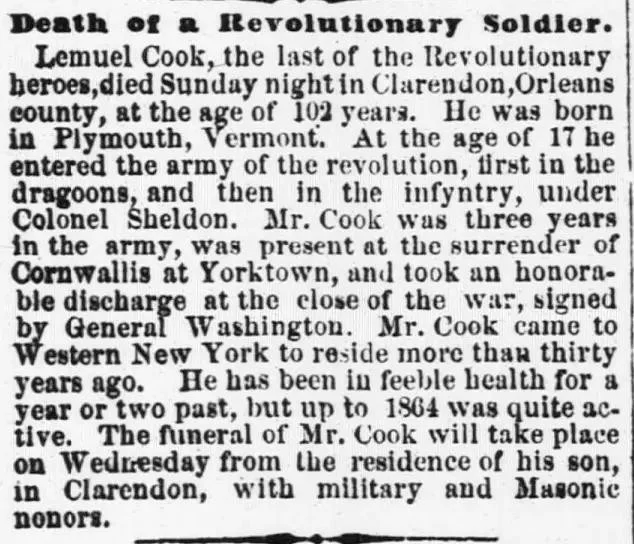
Lemuel Cook was called "the last of the Revolutionary heroes" when he died in 1866. His obituary in the Indianapolis Daily Herald is a single short column, but it contains the essential arc of a life: born in Plymouth, Vermont; joined the army at 17; served in the dragoons and the infantry under Colonel Sheldon; present at Yorktown when Cornwallis surrendered; discharged by Washington personally; still active as recently as 1864. He had been living in western New York for thirty years when he died. His funeral was conducted with military and Masonic honors.
These obituaries were written by journalists who knew they were recording something that could not be repeated. That awareness shaped the language. The phrases "last survivor," "last of the Revolution," and "last of the Revolutionary heroes" appear frequently in headlines and body copy throughout this era. The last verified Revolutionary War veteran, Daniel F. Bakeman, died in 1869 at the reported age of 109. By that point the war had been over for eighty-six years, and newspapers had been tracking its veterans continuously since the first enlistment notices of 1775.
What to search: "last survivor"; "last of the Revolution"; "last of the Revolutionary heroes." Date range 1850-1870. State filters for New York, Vermont, Ohio, Indiana, and Pennsylvania are particularly productive because many veterans had moved west after the war.
After Death: The Record Keeps Going
The newspaper record for a Revolutionary War veteran does not end with his obituary.
In the decades that followed the last survivors' deaths, newspapers carried tribute coverage at anniversary events. Descendants were named. DAR and SAR chapters were organized, and their formation and induction notices appeared in local papers naming the qualifying ancestor and the service that made membership possible. Grave marker dedications, centenaries of specific battles, community history columns: all of them reached back to name the men who had been there.
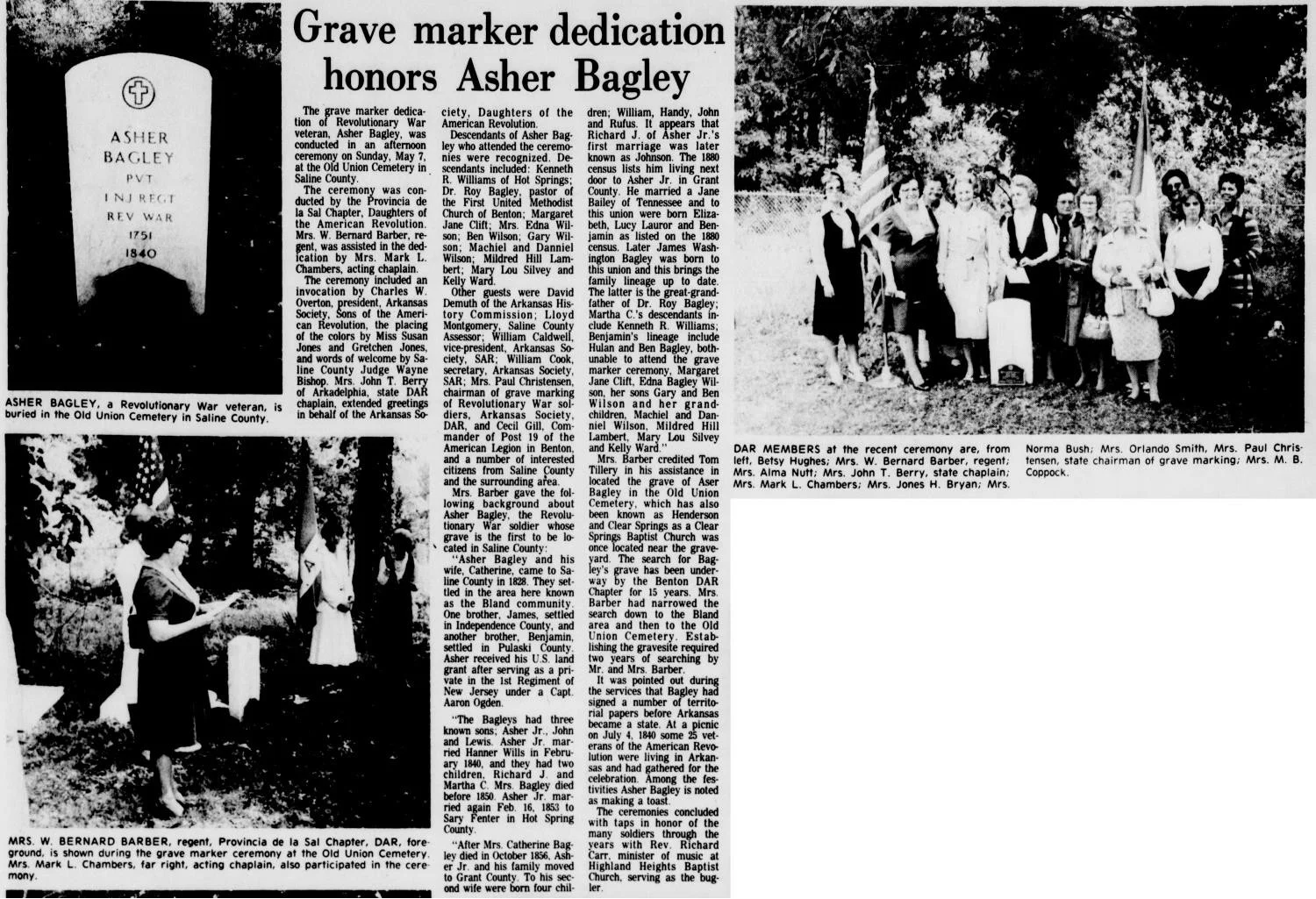
Asher Bagley came to Saline County, Arkansas, in 1828 with his wife, Catherine. He had served as a private in the 1st Regiment of New Jersey under Captain Aaron Ogden. He died in 1840. More than a century later, in May 1978, the Benton Courier covered a grave marker dedication ceremony at the Old Union Cemetery in Saline County, organized by the Daughters of the American Revolution, that gave Bagley a proper stone for the first time. Descendants were in attendance. His family lineage was traced four generations forward in the same column of newsprint.
The search for Bagley's grave had taken fifteen years. The ceremony took an afternoon. The newspaper kept the record.
What to search: Your ancestor's full name combined with "DAR" or "Daughters of the American Revolution" or "Sons of the American Revolution," with no date restriction. For anniversary coverage, search the ancestor's name in the decade of the 1876 centennial, the 1926 sesquicentennial, and the 1976 bicentennial.
Frequently Asked Questions
How long did newspapers cover Revolutionary War veterans after the war ended?
Newspapers covered Revolutionary War veterans for nearly ninety years after the war ended in 1783. Coverage began during the war itself with enlistment notices, deserter advertisements, and muster calls. It continued through the pension years of the 1810s and 1820s, the obituary peak of the 1830s through 1850s, and the last survivor coverage of the 1860s. The last verified Revolutionary War veteran died in 1869. DAR and SAR tribute coverage extended the record well into the twentieth century.
What is the best date range to search for Revolutionary War veteran obituaries?
The best window for Revolutionary War obituaries is 1832 to 1860. The 1832 Pension Act brought thousands of veterans into the public record for the first time, and local newspapers increasingly treated the deaths of these men as community and historical events. Veterans in this era were in their 70s, 80s, and 90s, and their obituaries often named specific battles, units, commanding officers, and surviving family members. Searching the phrase "Revolutionary Hero" as an exact phrase within this date range produces strong results quickly.
What pension acts should I know about when searching for a Revolutionary War ancestor in newspapers?
Three acts are most relevant. The 1808 Invalid Pensioners Act covered veterans disabled by wounds and generated published lists in newspapers that name veterans by name with monthly payment amounts. The 1818 Pension Act expanded eligibility to veterans who could demonstrate financial need, producing application notices and pension grants in county papers. The 1832 Pension Act extended pensions to nearly all surviving veterans regardless of financial need and is the act most likely to bring a previously undocumented ancestor into the newspaper record for the first time.
What search phrases work best for finding Revolutionary War veteran records in historical newspapers?
The most productive exact phrases are "Revolutionary Hero," "veteran of the Revolution," "soldier of the Revolution," "soldier of independence," "last survivor," and "invalid pensioners." For wartime records, search the name of the specific newspaper combined with your ancestor's county and a date range of 1775 to 1783. For post-war records, combine your ancestor's full name with "pension" and filter by the state where he was living after the war.
Can I find my Revolutionary War ancestor in newspapers even if he never appeared in a military record?
Yes. Many Revolutionary War veterans left no surviving military records but appear in newspaper pension lists, community obituaries, DAR and SAR induction notices, and anniversary tribute coverage. The 1832 Pension Act in particular generated a wave of newspaper coverage for men who had never been formally documented before. Searching by name across a wide date range, rather than limiting to the war years, significantly increases the chance of finding someone who slipped through the official military record.
What You Are Looking For
A Revolutionary War ancestor does not disappear after the last shot was fired. The newspaper record follows him forward through pension offices, county papers, anniversary ceremonies, and the hands of descendants who wanted his grave to have a proper stone.
Lemuel Cook received a discharge signed by George Washington and carried it for eighty-six years. Asher Bagley came to Arkansas, died in 1840, and waited 138 years for a newspaper to tell the story of how his grave was finally found and marked.
The archive holds a lot of stories. Start searching yours.