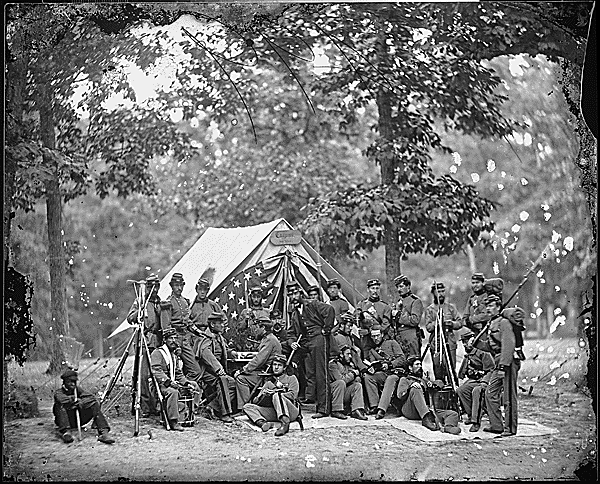
How to Find Your Civil War Ancestor in Historical Newspapers
Old newspapers can tell you far more about a Civil War ancestor than pension files alone. Here is what to search for, where to look, and what each record type can reveal.
Historical newspapers are a valuable resource for Civil War genealogy research. Researchers can find Civil War ancestors through ten main record types: enlistment and departure notices (1861 to 1865), letters from the front reprinted in hometown papers (1861 to 1865), battle accounts and casualty lists (1861 to 1865), death notices and postwar obituaries (1861 to 1920), homecoming and return rosters (1864 to 1866), pension and legal notices (1865 to 1920), GAR and Confederate veterans memorial coverage (1865 to 1940), community donation and supply lists (1861 to 1865), poetry and human interest pieces (1861 to 1870), and war correspondent dispatches reprinted in local papers (1861 to 1865). Small-town newspapers are especially useful because they named ordinary soldiers, not just officers. Researchers should search the hometown paper before major city papers, use regiment numbers as search terms, extend searches well past 1865, and try name variants when direct searches fail. NewspaperArchive offers searchable access to more than 15,500 newspaper titles from across the United States, including strong coverage of small-town and rural papers from the Civil War era.
Somewhere between the muster rolls and the pension files, there is a person. A name on an enlistment list. A letter reprinted in the local paper. A short notice that a soldier came home, or did not. If you have been searching for a Civil War ancestor and feel like the official records are only telling you half the story, old newspapers are where the other half lives.
Newspapers covered the Civil War the way nothing else did. Reporters wrote from the field. Editors reprinted soldiers' letters. Local papers named the men who left town and noted when they returned. Communities published donation lists, casualty counts, and farewell poems. Decades after the war ended, veterans' obituaries named the battles they survived and the units they served with.
This post walks through ten types of newspaper records that can help you find and understand a Civil War ancestor, whether he fought for the Union or the Confederacy, whether he came home or did not, and whether you know his regiment or only his name.
Quick Answer
Historical newspapers can help you find Civil War ancestors through enlistment notices, letters from the front, casualty lists, death notices, homecoming reports, pension notices, community tributes, donation lists, poetry, and war correspondent accounts. Small-town papers are especially useful because they named ordinary soldiers, not just officers. NewspaperArchive includes searchable newspapers from all 50 states dating back to 1607, with strong coverage of small-town and rural papers from the Civil War era.
If you have a name, a hometown, and a rough date range in mind, try searching NewspaperArchive and see what the local papers were saying about your ancestor's community during the war years.
1. Enlistment and Departure Notices
Search window: 1861 to 1865
The first place many soldiers appeared in print was not a casualty list. It was an enlistment notice in their hometown paper.
When men signed up to fight, local editors took note. These notices often named the soldier, his unit, and sometimes his age or occupation. In smaller communities, the paper might add a few words of community pride, a send-off that tells you exactly how the town felt about losing one of its own.
This notice from the Algona Pioneer Press in May 1861 is a good example of what to look for.
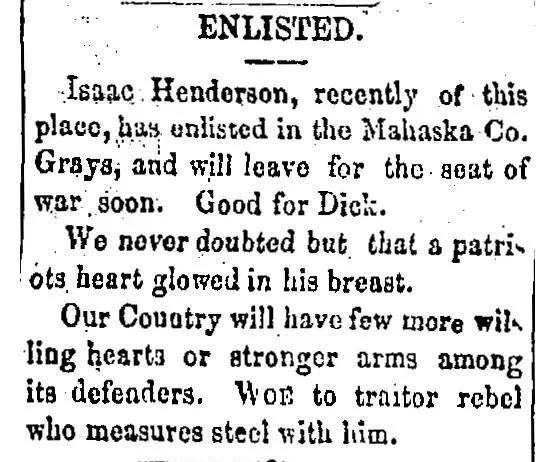
Isaac Henderson enlisted in the Mahaska Co. Grays. The paper noted he would "leave for the seat of war soon" and added, "Good for Dick." That nickname is worth paying attention to. If you searched for Isaac Henderson and came up empty, searching for Dick Henderson might be the search that finds him. Enlistment notices are one of the earliest places name variants show up in the record.
What to Search
Search your ancestor's name alongside his hometown or county, with a date range of 1861 to 1865. Try both his given name and any known nicknames. If you know his unit, search the unit name to find notices about other men who enlisted alongside him. For more on name variants and how to work around them, see The Name Game: 15 Smart Ways to Search Name Variants in Historical Newspapers.
2. Letters from the Front
Search window: 1861 to 1865
Soldiers wrote home. Families shared those letters with local editors. Editors printed them.
A letter reprinted in a hometown paper might include where the regiment was camped, what the weather was like, who had been sick, which officers had been praised or criticized, and what the soldier hoped was waiting for him at home. These accounts are not official records. They are personal ones, and that is exactly what makes them useful.
If your ancestor wrote a letter that was printed in his local paper, you may find details that appear nowhere else in the historical record. Even if his letter was never published, letters from men in his unit can tell you where his regiment was and what conditions were like when he was there.
What to Search
Search your ancestor's name, his regiment number, or his commanding officer's name alongside his hometown paper. Search within a few weeks of known camp movements or battles. Letters often appeared in print two to four weeks after they were written.
This record type is explored more fully in the companion post to this one, They Were There, which looks at the Civil War as chronicled through the words of soldiers and the correspondents who wrote alongside them.
3. Battle Coverage and Casualty Lists
Search window: 1861 to 1865
When a major engagement ended, newspapers printed the names of the dead and wounded as quickly as they could gather them. Larger papers published these lists within days. Smaller papers sometimes ran them weeks later, reprinted from bigger city papers or compiled from local reports.
Casualty lists from the Civil War era often included more than just a name. Many listed rank, regiment, and a description of the injury: slightly, severely, dangerously, or supposed dead. Finding your ancestor in a list like this one from the New York Herald in March 1865 can confirm his presence at a specific battle and point you toward additional records.
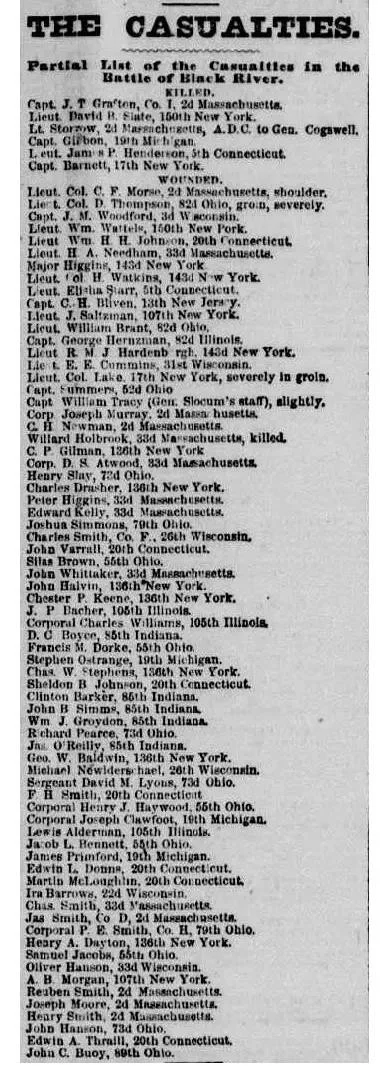
A name in a casualty list is not just confirmation of a wound. It is a starting point. Once you know which battle your ancestor was present at, you can search for the full battle account, look for letters written from the field around that date, and begin to understand what he experienced in a way that pension files and muster rolls cannot show you.
What to Search
Search your ancestor's name alongside a known battle name or regiment number, within two to four weeks of the battle date. If you do not know which battles he was present at, search his regiment number alongside major engagements in the theater where he served. Battle accounts in larger papers often named officers and occasionally named enlisted men, especially those who distinguished themselves.
4. Death Notices and Obituaries
Search window: 1861 to 1920
Not every soldier who died in the Civil War received a formal obituary. Wartime death notices were often brief, sometimes just a line or two naming the soldier, his unit, and his surviving family. But those few lines can confirm a death date, a regiment, and family relationships that help you build the rest of the record.
Postwar obituaries written years or decades later often told a fuller story. By the time a veteran died in his sixties or seventies, a local editor might devote a full column to his service, naming the battles he survived, the unit he served with, and the veteran organizations he joined after the war.
The two clippings below show what this difference looks like in practice.
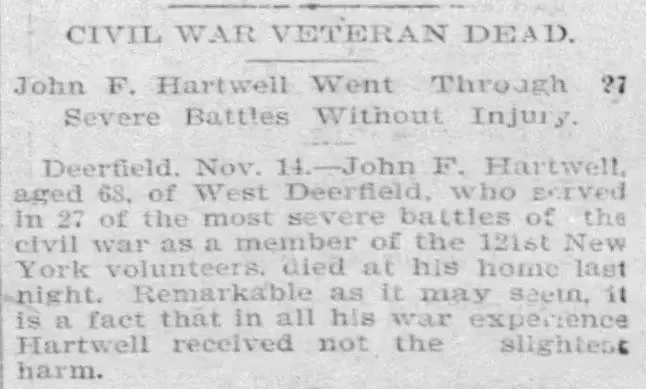
John F. Hartwell of West Deerfield served in 27 of the most severe battles of the Civil War as a member of the 121st New York Volunteers and died in 1899 without ever having been wounded. That detail appears in his obituary more than three decades after the war ended. It would not appear anywhere in a wartime record.
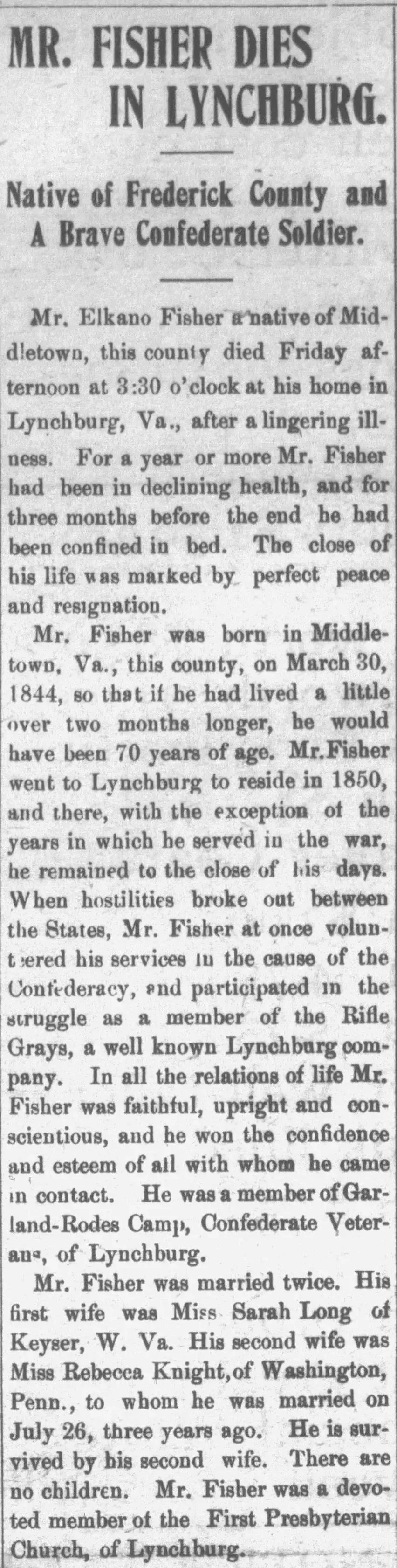
Elkano Fisher of Lynchburg, Virginia, served as a Confederate soldier with the Rifle Grays and was a member of the Garland-Rodes Camp of Confederate Veterans of Lynchburg. His 1903 obituary names his unit, his veteran organization, both of his wives, and his church. A researcher looking for a Confederate ancestor might find more in a postwar obituary like this one than in any wartime document.
What to Search
Search your ancestor's name with a date range of 1861 through the early 1900s. Do not stop at 1865. Many of the most detailed Civil War obituaries were written when veterans were in their sixties and seventies, long after the war ended. For Confederate ancestors, search Southern state papers alongside the veteran's home county. For more on what obituaries can reveal, see Why You Can't Find an Obituary (and How to Fix It).
5. Homecoming and Return Notices
Search window: 1864 to 1866
When soldiers came home, papers noted it. Sometimes a homecoming notice was a single sentence. Sometimes it was a full roster.
A return notice can confirm that your ancestor survived the war, establish when he was discharged, and place him back in his hometown at a specific moment. That information helps bridge the gap between wartime records and postwar census entries, land records, and marriage notices.
These two clippings from the Grand Rapids Wood County Tribune in June 1864 show what a full regimental return list looks like.
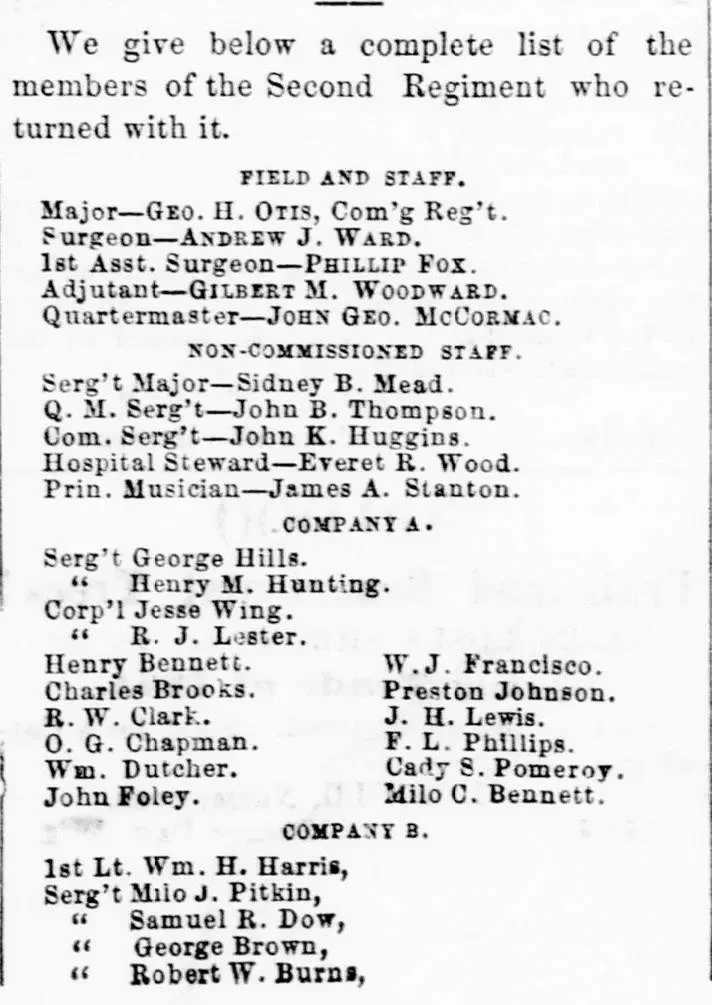
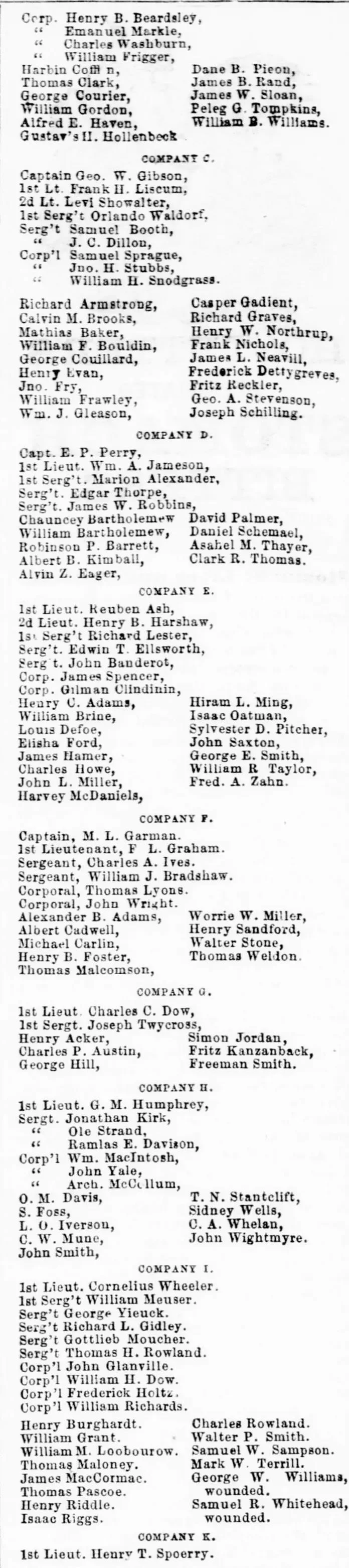
This list names every man who came back with the Second Regiment, organized by company, with rank noted for officers. If your ancestor appears here, you have his rank, his company, and the date his regiment returned. If he does not appear, that absence is also information worth following.
What to Search
Search your ancestor's name or regiment number with a date range of 1864 to 1866. Also search the regiment number alone to find return lists that may name him, even if you search for nothing else. Homecoming notices in small-town papers often appeared weeks after a regiment officially mustered out, so cast a wider date net than you might expect.
6. Pension and Legal Notices
Search window: 1865 to 1920
Pension records are a well-known genealogy resource, but many researchers do not realize that pension-related notices sometimes appeared in newspapers. Approvals, appeals, and dependent family member claims were occasionally noted in local papers, especially in smaller communities where any official proceeding was considered news.
This clipping from the Albert Lea Enterprise in 1884 is a good example of a pension notice that points directly to a soldier without naming him in the headline.
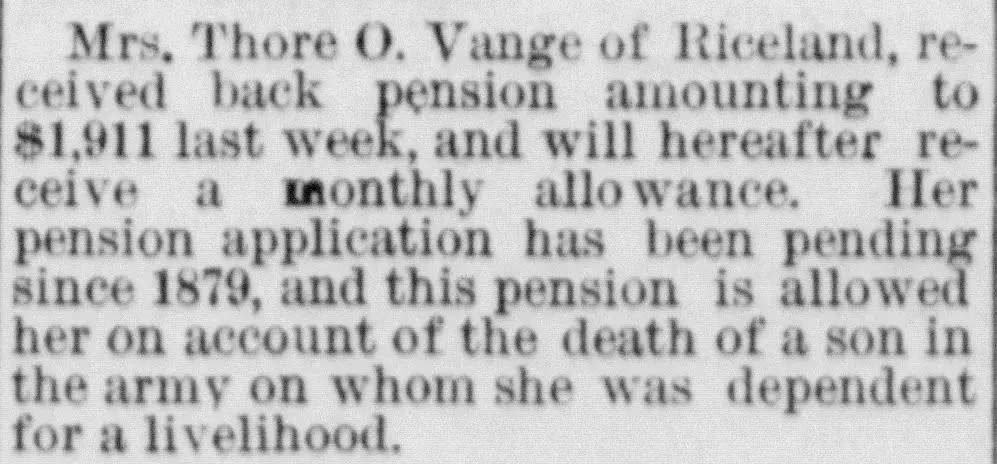
Mrs. Thore O. Vange of Riceland received a back pension of $1,911 after an application that had been pending since 1879. The pension was granted on account of her son's death in the army, on whom she had been dependent for a livelihood. There is no soldier named in this clipping. But it tells a researcher that Mrs. Vange had a son who died in military service, that the family was from Riceland, and that the application process took five years. Each of those details is a thread to follow.
What to Search
Search your ancestor's surname alongside pension, claim, or allowance with a broad date range of 1865 to 1920. Also search for widows and mothers by surname. Dependent family members often appeared in pension notices long after a soldier's death, and those notices can name the soldier indirectly or confirm family relationships that other records leave unclear.
7. Community Tributes and GAR Memorial Notices
Search window: 1865 to 1940
The Grand Army of the Republic was the primary Union veterans' organization after the Civil War. Local GAR posts held regular meetings, published memorial notices for deceased members, and organized Memorial Day observances that were covered extensively by local papers. Confederate veterans organized similarly through groups like the United Confederate Veterans.
These notices ran for decades. A veteran who survived the war and lived into his seventies or eighties might appear in GAR coverage well into the early twentieth century.

The 1895 GAR encampment coverage in the Roanoke Times shows the scale of what these gatherings became. Veterans came from across the country. Special trains ran to accommodate them. Confederate veterans were invited as guests. If your ancestor attended an encampment like this one, he may have been named in the coverage of his local post's delegation.
What to Search
Search your ancestor's name alongside GAR, Grand Army, or veterans with a date range of 1865 to 1940. Also search the name of his hometown or county post. Memorial Day coverage in small-town papers often listed the names of local veterans who participated in observances, and those lists can surface names that appear nowhere else in the postwar record.
8. Donation and Supply Lists
Search window: 1861 to 1865
This is one of the most overlooked record types in Civil War newspaper research, and one of the most useful for finding the families soldiers left behind.
Throughout the war, communities organized drives to send food, clothing, and medical supplies to the front. Local papers published the names of donors and what they gave. These lists named ordinary people, women especially, in a way that few other records of the era did.
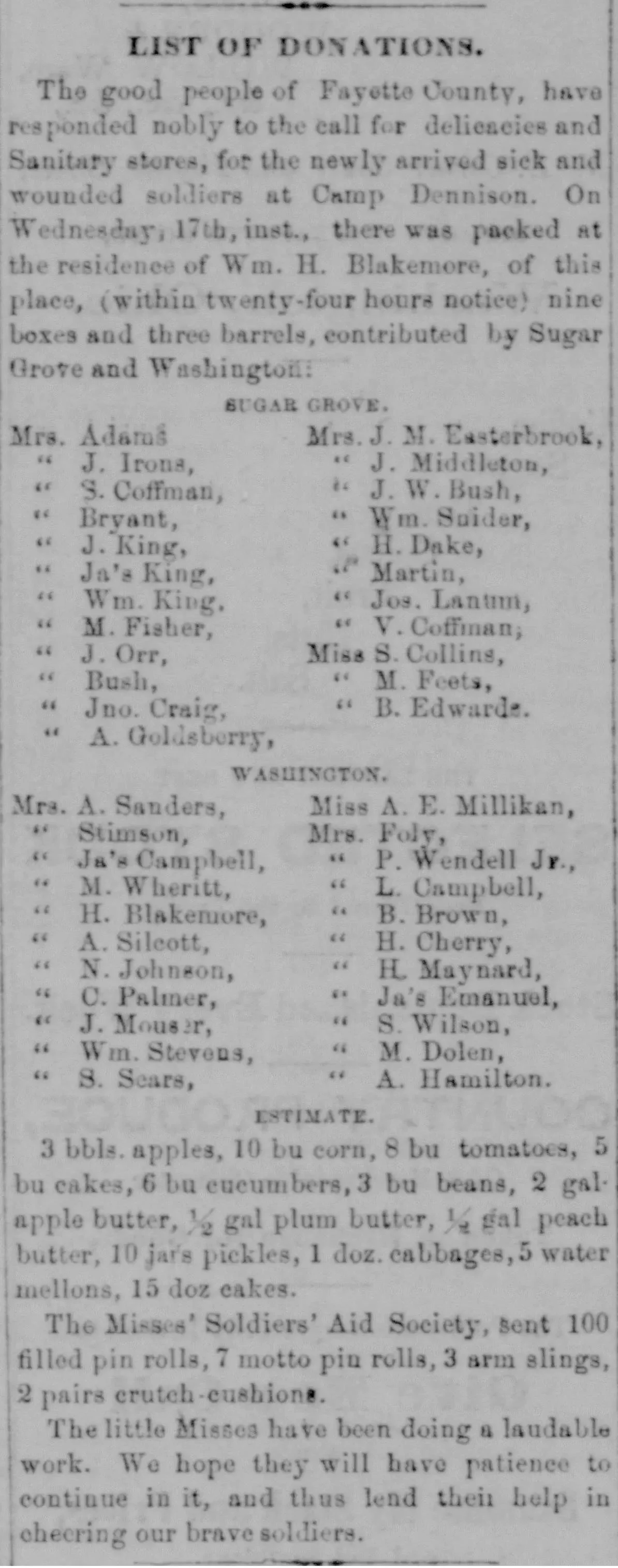
This list from Fayette County names dozens of women by their married names, Mrs. Adams, Mrs. J. Irons, Mrs. S. Coffman, organized by community. The Misses' Soldiers' Aid Society contributed separately. If your ancestor's mother, wife, or sister lived in this community during the war, she may appear in a list exactly like this one.
What to Search
Search your ancestor's surname alongside donation, aid, relief, or sanitary with a date range of 1861 to 1865. Search the hometown paper rather than a large city paper. These lists appeared most consistently in local and county papers that covered community news closely. Finding a female relative in a donation list can help you confirm a family's location, surname spelling, and community ties during the war years.
9. Poetry and Human Interest Pieces
Search window: 1861 to 1870
Nineteenth-century newspapers published poetry regularly, and the Civil War produced an enormous amount of it. Poems about soldiers leaving, dying, and returning home appeared in papers large and small throughout the war years and for several years afterward.
These pieces rarely name specific individuals. Their research value is different from a casualty list or an enlistment notice. But they can help you understand the emotional world your ancestor lived in, what his community believed about the war, how loss was publicly expressed, and what was expected of the men who served.
Occasionally, a poem or tribute piece did name a specific soldier or family. Memorial verses written for a named individual are worth searching for, particularly in small-town papers where a poet might be honoring a neighbor.
What to Search
Search your ancestor's surname alongside poem, tribute, or memorial with a date range of 1861 to 1870. Also browse the front pages of his hometown paper during the war years. Human interest pieces, community tributes, and memorial verses were often placed prominently and can surface details that a targeted name search would miss.
10. War Correspondent Accounts
Search window: 1861 to 1865
The Civil War was one of the first conflicts covered by professional war correspondents. Reporters traveled with armies, filed dispatches from the field, and sent long accounts of battles, camp life, and military movements back to their papers. Those dispatches were then reprinted in papers across the country, including small-town papers far from the action.
A correspondent traveling with your ancestor's regiment may have named officers, described specific units in action, or mentioned individual soldiers who distinguished themselves. Searching for a regiment number or commanding officer's name in newspaper archives can surface accounts that include details no official record preserves.
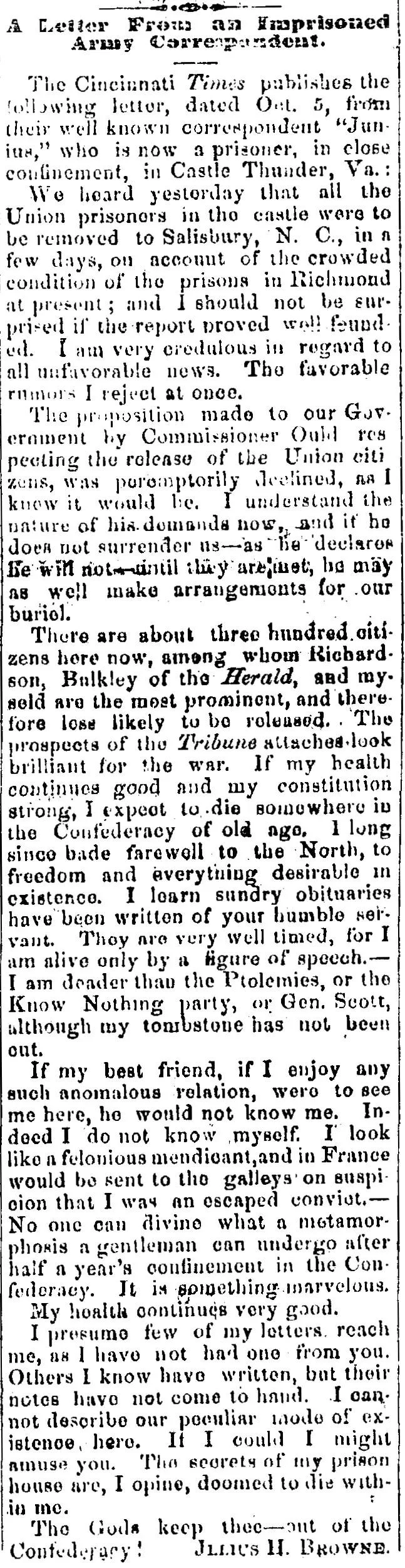
Junius H. Browne, a correspondent for the New York Tribune, wrote this letter from Castle Thunder prison in Virginia in 1863. It was reprinted in the Crown Point Register in Indiana, hundreds of miles from where it was written. That is how war correspondent coverage worked. A dispatch filed in Virginia might appear in an Iowa paper a few weeks later. Searching broadly across state lines can help you find accounts that traveled far from their origin.
What to Search
Search your ancestor's regiment number, commanding officer's name, or a specific battle name with a date range of 1861 to 1865. Do not limit your search to papers from your ancestor's home state. Correspondent dispatches were reprinted widely, and the account most relevant to your ancestor's experience may have appeared in a paper from a completely different region. For a deeper look at what these accounts can reveal, see the companion post to this one at They Were There.
Why Small-Town Newspapers Matter for Civil War Research
Large papers covered large battles. Small-town papers covered the people.
A soldier from a rural Iowa county was unlikely to appear by name in the New York Herald unless he was killed at a major engagement or did something unusual enough to attract a correspondent's attention. But in his hometown paper, he might appear a dozen times: when he enlisted, when he wrote home, when his mother donated supplies, when his regiment returned, and when he died forty years later and the local editor remembered him as a neighbor.
NewspaperArchive has strong coverage of small-town and rural newspapers from the Civil War era, including many papers that are not available through other archives. If your searches in larger papers have come up empty, shifting your focus to the county-level paper from your ancestor's hometown is often the search that changes everything.
Small-town papers also covered the home front in ways that city papers did not. Community meetings about the war, local debates over conscription, letters from soldiers that never made it into bigger publications, and the names of women who organized aid societies and collected supplies. That context can help you understand not just what your ancestor did during the war, but what his family and community experienced while he was gone.
Search Tips for Civil War Ancestors in Newspapers
Start with the hometown, not the battlefield
The most productive searches often begin with where your ancestor lived, not where he fought. Search his home county paper across the full war period before searching major city papers or battle-specific coverage.
Use regiment numbers as search terms
If you know your ancestor's regiment, searching the regiment number alongside a state name or battle can surface accounts, casualty lists, and return notices that name men in his unit even when they do not name him specifically.
Search a wider date range than you expect
News traveled slowly in the 1860s. A battle fought in May might not appear in a small-town paper until June. A soldier who died in October might not be memorialized in his hometown paper until December. Give yourself a generous date window on either side of any known event.
Do not stop searching at 1865
Some of the most detailed Civil War newspaper records were written decades after the war ended. Postwar obituaries, GAR memorial notices, reunion coverage, and anniversary tributes can contain more specific military detail than anything published during the war itself.
Try name variants and spelling alternatives
Nineteenth-century newspapers were typeset by hand and printed on tight deadlines. Names were misspelled, nicknames were used interchangeably with given names, and OCR errors in digitized papers can make a correctly spelled name unsearchable. If your first search comes up empty, try alternate spellings, initials, and common nicknames before concluding the record does not exist.
Search for family members, not just the soldier
His mother's donation. His wife's pension notice. His father's mention in a community meeting about the draft. Family members who stayed home often appeared in newspaper records that can help you confirm relationships, locations, and timelines.
Frequently Asked Questions
What types of Civil War records appear in old newspapers? Historical newspapers from the Civil War era include enlistment notices, letters from soldiers reprinted by local editors, battle accounts, casualty lists, death notices, homecoming reports, pension notices, GAR memorial tributes, community donation lists, poetry, and war correspondent dispatches. Small-town papers are especially useful because they covered ordinary people, not just officers and commanders.
How do I search for a Civil War ancestor if I only know his state and approximate enlistment year? Start with the county-level paper from his home region and search broadly across 1861 to 1865. If you know his state, try searching regiment numbers from that state alongside battle names from the theater where his state's units served. Casualty lists and return notices often named men by regiment and company, which can help you narrow down an ancestor's unit even without a specific name match.
Can I find Confederate soldiers in historical newspaper archives? Yes. Southern newspapers covered Confederate enlistments, battles, casualties, and homecomings the same way Northern papers covered Union soldiers. Postwar obituaries in Southern papers often included detailed Confederate service summaries, unit names, and veteran organization memberships. NewspaperArchive includes newspapers from across the South, including many small-town papers with strong local coverage.
What should I do if my Civil War ancestor has a very common name? Pair the name with a specific location, regiment, or date range to narrow results. Searching a common name alongside a county name, a regiment number, or a unit designation is usually more productive than searching the name alone. If the name is genuinely too common to isolate, try searching for family members with less common names and working backward to the soldier from there.
Are small-town newspapers from the Civil War era searchable on NewspaperArchive? Yes. NewspaperArchive includes more than 17,000 newspaper titles with strong coverage of small-town and rural papers from the Civil War era. Many of these papers are not available through other archives. Searching by state and county can help you find the local paper most likely to have covered your ancestor's community during the war years.
Your Ancestor's Story Is in There
Official records tell you what happened on paper. Newspapers tell you what it looked like from the ground.
An enlistment notice tells you when he left. A letter tells you where he was and whether he was well. A casualty list tells you he was wounded at a specific battle on a specific day. A homecoming roster tells you he came back. A donation list tells you his wife was still at home, still sending apples and pickles and cakes to the men at camp. A postwar obituary tells you what his community wanted to remember about him.
None of those pieces of the story lives in a pension file. They live in newspapers, in the small-town papers that covered ordinary people because ordinary people were their readers.