Finding Irish Ancestors Through "Information Wanted" Ads in the Boston Pilot
For 90 years, the Boston Pilot ran "Information Wanted" ads from Irish immigrants searching for lost family. These notices are packed with clues for family historians.
The Boston Pilot published a column called "Information Wanted" (also called "Missing Friends") from October 1831 through October 1921, in which Irish immigrants and their families placed paid notices to locate missing relatives who had emigrated to America. The ads typically include full names, county and parish of origin in Ireland, occupations, ship names, last known locations in America, and contact information for the person searching. More than 41,000 records from the column have been digitized and are searchable through Boston College's Irish Studies program and other genealogy platforms. For family historians with Irish ancestry, these notices are among the most detailed personal records available from the 19th century, often containing information found nowhere else. Historical newspaper archives like NewspaperArchive can be used to follow the geographic clues in these notices and continue the search in local American papers.
"Information Wanted": How the Boston Pilot Helped Irish Immigrants Find Their Missing Family
Somewhere in the middle of reading old newspapers, you stop looking at them like records and start reading them like letters.
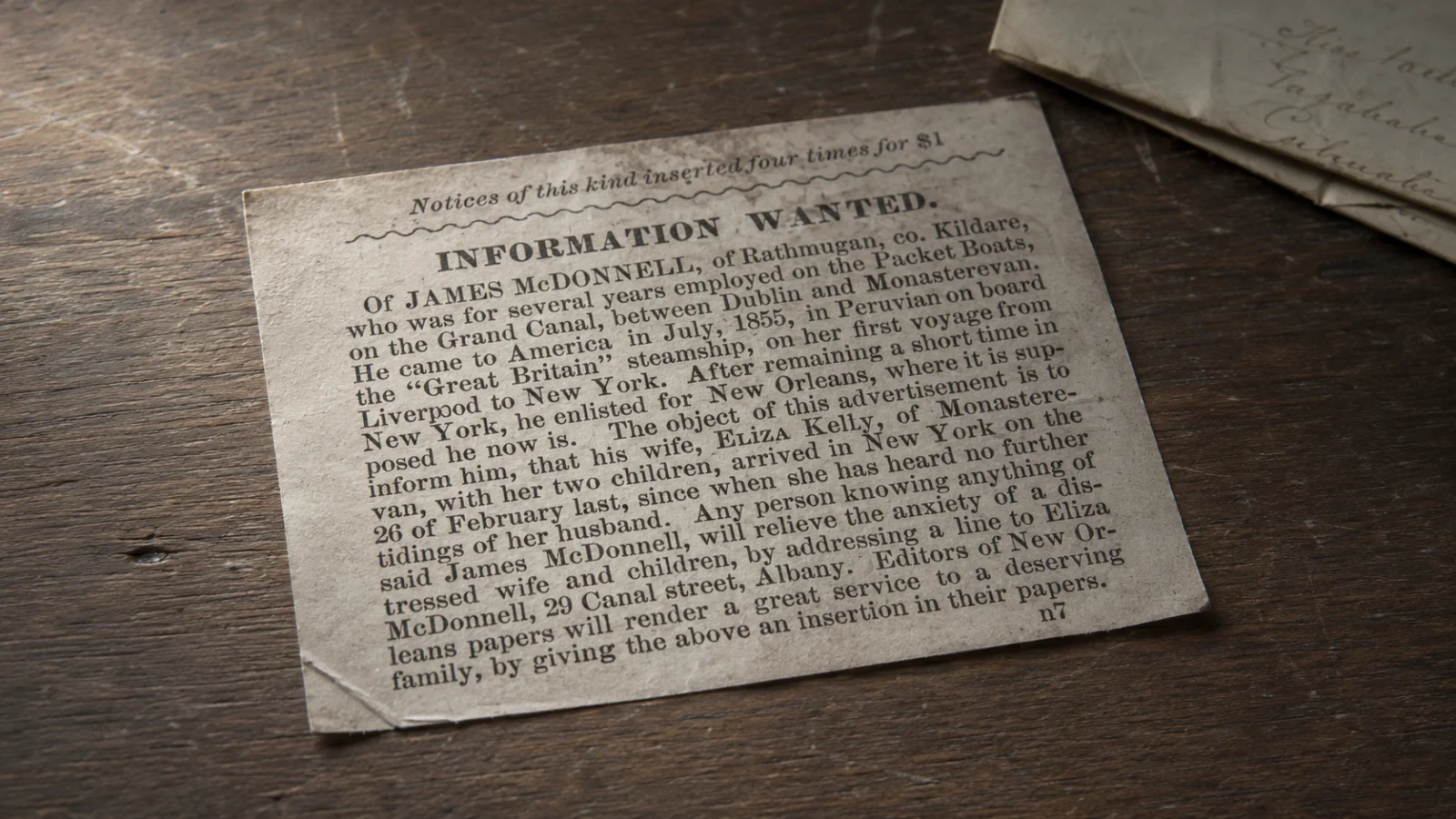
That happened to me the first time I found a Boston Pilot "Information Wanted" ad. I was searching for Irish ancestry clues in historical newspapers, not expecting much, when I landed on a small notice from 1847. A woman named Eliza Kelly had arrived in New York from Ireland with her two children. She was looking for her husband, James McDonnell, who had sailed ahead of her and had not been heard from since. She had no idea where he was. The ad asked anyone who knew anything about him to write to her in Albany.
I don't know if James McDonnell was ever found. But I know that Eliza Kelly showed up in a newspaper and left behind more than a name. She left behind a story.
Quick Answer
The Boston Pilot published a column called "Information Wanted" (also known as "Missing Friends") from October 1831 through October 1921. Irish immigrants and their families placed paid advertisements in the column to locate loved ones who had emigrated to America and lost contact. The ads often include the missing person's full name, county and parish of origin in Ireland, occupation, last known location in America, physical description, and the name of the person searching. For anyone with Irish ancestry, these records are among the most detailed and personal genealogical sources available from the 19th and early 20th centuries.
If you have Irish ancestry and a brick wall you haven't been able to break through, searching these notices is worth your time. NewspaperArchive includes the Boston Pilot in its collection, and you can search by name, location, or date.
What Was the "Information Wanted" Column?
From October 1831 through October 1921, the Boston Pilot printed a weekly column of paid advertisements from people looking for lost or missing friends and family members. The column ran for 90 years, covering the peak years of Irish immigration to America, including the Great Famine of 1845 to 1852, the Civil War era, and the decades that followed.
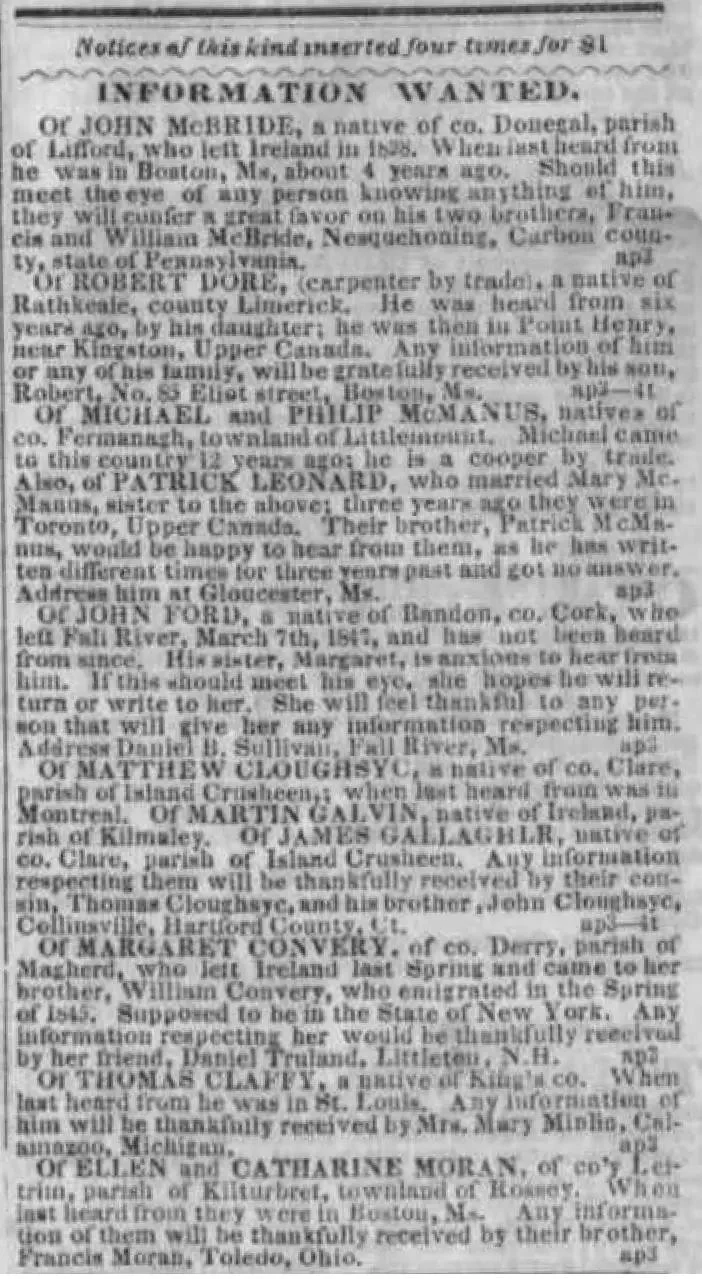
The notice at the top of each page said it plainly:
Notices of this kind inserted four times for $1.
For one dollar, a desperate wife, a worried brother, or an aging parent could put a name in front of thousands of readers and ask a simple question: has anyone seen this person?
The column ran during the years when Irish immigration to America was at its most desperate, and the distance between the two countries felt absolute. Millions of people left Ireland, often in dire circumstances, and the Atlantic crossing was only the beginning of the separation. Letters went unanswered. People moved from city to city following work on canals and railroads. Some changed their names. Many simply vanished into the size of a country they had never seen.
The "Information Wanted" column gave families a way to reach across that distance.
What These Ads Can Tell You About Your Ancestors
This is where the column becomes extraordinary for family history research. These were not brief death notices or one-line birth records. People paid for space, and they used it. A typical ad might tell you:
The person's full name, including maiden name if applicable
Their county, parish, and sometimes townland of origin in Ireland
Their occupation
The ship they sailed on and the year they arrived
Their last known location in America, sometimes with a specific street address
The name, relationship, and contact address of the person searching for them
Physical descriptions in some cases
Names of siblings, spouses, children, or cousins mentioned in connection
That is a remarkable amount of information to find in a newspaper notice. It often contains details that do not exist anywhere else.
Five Notices That Show What These Ads Can Reveal
These five notices come from actual Boston Pilot pages, found in the NewspaperArchive collection. Each one is a different window into the Irish immigrant experience.
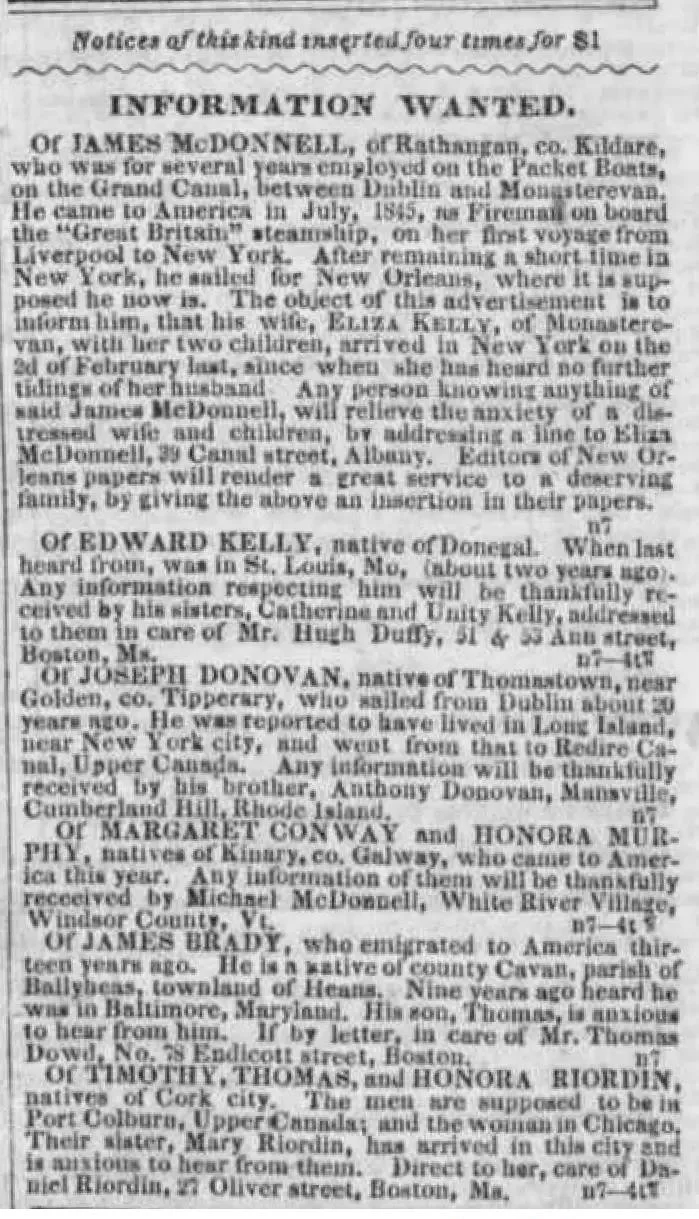
James McDonnell, November 7, 1846
James McDonnell left Rathangan, county Kildare, where he had worked on the Packet Boats on the Grand Canal between Dublin and Monasterevan. He came to America in July 1845 as a fireman aboard the steamship Great Britain on her first voyage from Liverpool to New York. He stayed briefly in New York, then sailed for New Orleans.
His wife, Eliza Kelly of Monasterevan, arrived in New York on February 2nd of the following year with their two children. She had heard nothing from her husband since.
The ad closes with a direct appeal to New Orleans newspapers to reprint the notice, so that it might reach him wherever he was.
This one notice gives a researcher a full name, a county and town in Ireland, a specific occupation, the name of the ship he sailed on, the voyage, his route through America, his wife's maiden name and hometown, and the date she arrived. It is the kind of record that can anchor an entire family tree search.
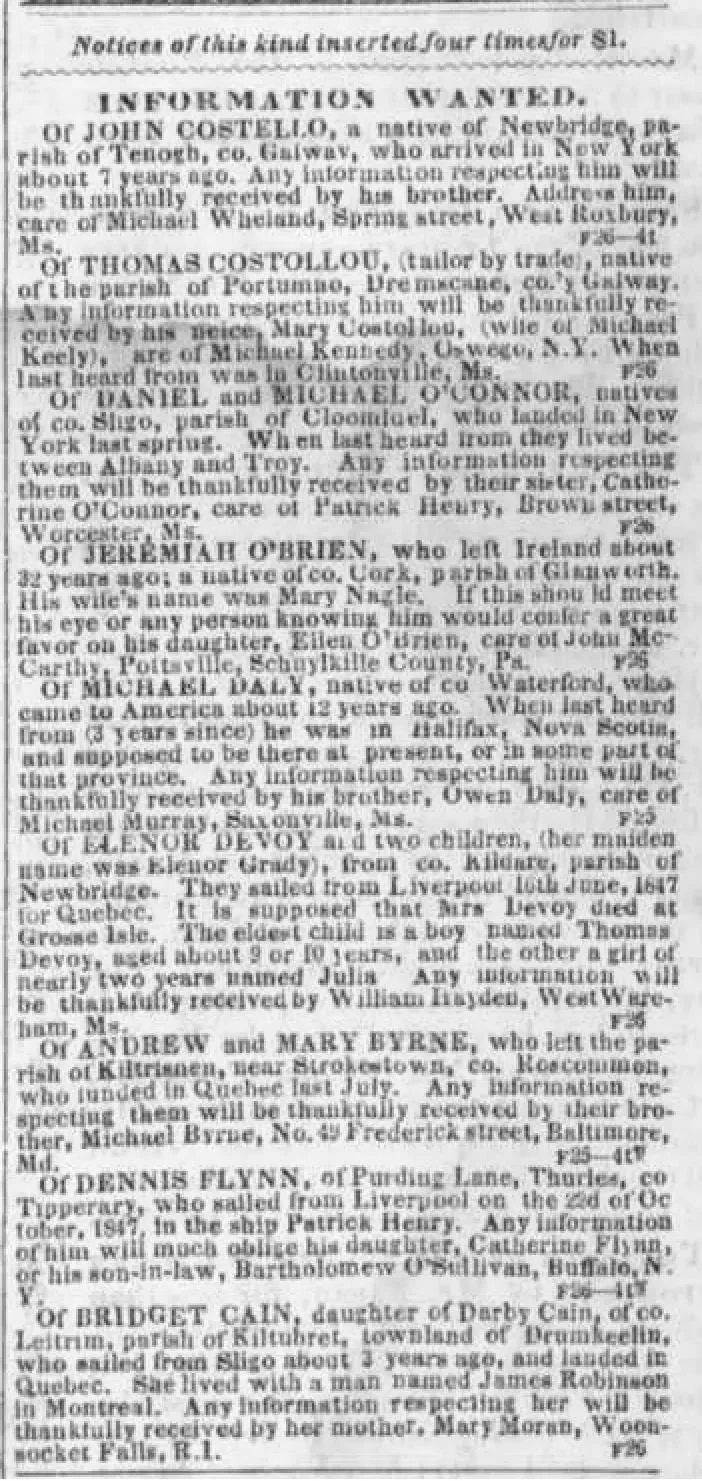
Elenor Devoy, February 26, 1848
The Devoy notice is one of the most heartbreaking on these pages.
Elenor Devoy, whose maiden name was Elenor Grady, sailed from Liverpool on June 15, 1847, for Quebec with her two children. The ad states plainly: It is supposed that Mrs. Devoy died at Grosse Isle.
Grosse Isle was the quarantine station in the St. Lawrence River where thousands of Famine-era Irish immigrants died of typhus before ever setting foot in Canada. If Elenor Devoy died there, she died within sight of land, after crossing the Atlantic.
Her two children were still unaccounted for. The older, a boy named Thomas Devoy, was about nine or ten years old. The younger, a girl named Julia, was nearly two. Someone named William Hayden of West Wareham, Massachusetts, was looking for them.
This single notice opens multiple research paths. You have a maiden name, a sailing date, a destination, a quarantine station, the children's names and approximate ages, and a contact name and location for the person searching. Each of those is a starting point.
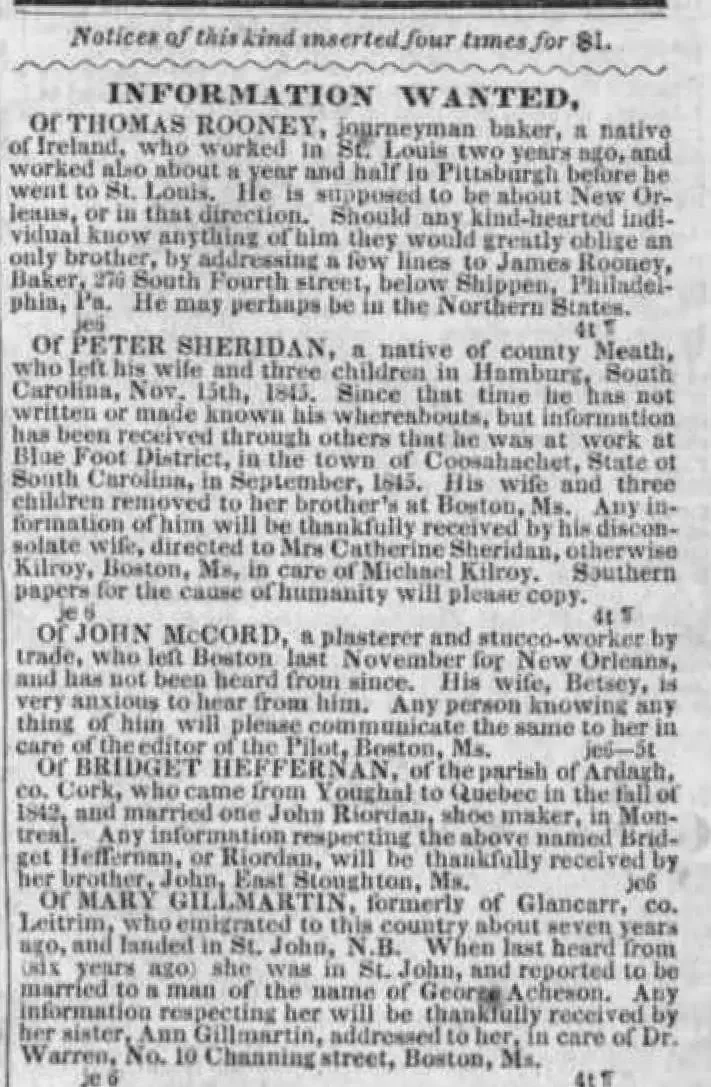
Peter Sheridan, June 6, 1846
Peter Sheridan left his wife and three children in Hamburg, South Carolina, on November 15, 1845. He had not written or made known his whereabouts since. A later report placed him at work in the Blue Foot District in the town of Coosahatchet, South Carolina, in September of that year, but after that, nothing.
His wife, Catherine Sheridan, described as "disconsolate," was looking for him. The notice asks Southern newspapers to reprint it for the cause of humanity.
What makes this notice useful for researchers is the specificity of the South Carolina locations. Most Irish Famine-era immigrants settled in northeastern cities. Finding an Irish family in rural South Carolina in 1845 is unusual, and those details would be hard to find anywhere else.
Robert Dore, April 3, 1847
Robert Dore was a carpenter from Rathkeale, county Limerick. He had been heard from six years earlier, by his daughter, when he was in Point Henry, near Kingston, Upper Canada.
His son Robert, living at No. 85 Eliot Street in Boston, placed the notice asking for any information about his father or any of his family.
This one is straightforward, but it shows something researchers often overlook: the ads were not only placed during the Famine. People had been losing track of emigrating family members since the 1830s, and the column ran long enough to capture searches across multiple generations.
Patrick and Michael Goggins, May 3, 1873
By 1873, the column had grown and changed in ways that are useful to understand. This page organizes notices by county and region of origin in Ireland: Down, Carlow, Mayo, Meath, Tipperary, Westmeath, Cork, Dublin, Kilkenny, and more. If you know your ancestor's county, you can scan directly to that section rather than reading every notice on the page. That kind of organization also tells you something about how the column was being used by that point. People had learned to include their county of origin because it helped. The detail had become expected.
There is also a caution printed near the top of the page warning readers about impostors who were taking advantage of families searching for missing loved ones. It is a small detail, but it says something about how desperate and vulnerable these searchers were, and how widely read the column had become.

Patrick Goggins left Mullingar, county Westmeath, for New York about 18 years before this notice was placed, and had not been heard from since. His cousin Michael, a tailor, had last been heard from keeping a shop in New York. The notice was placed by John Goggins, writing from Kingston, Ontario.
What stands out here is the family detail: Michael's father was Patrick Goggins, a pensioner who fought at the Battle of Waterloo, and he lived near Bombresna, near Multyfarnham. That kind of military and geographic detail does not appear in most genealogical records. It only survived because someone paid a dollar to put it in a newspaper.
Why These Records Matter Beyond the Famine Years
It is easy to think of the "Information Wanted" column as a Famine-era resource. The peak years of Irish immigration and the peak years of the column overlap, and the most famous notices tend to come from the 1840s and 1850s. But the column ran until 1921.
That means it captured searches from people who had emigrated in the 1830s, the 1850s, the 1860s during and after the Civil War, and the 1870s and beyond. Someone searching for a grandfather who left Ireland in 1852 might have placed their notice in 1870. Someone searching for a cousin who came over in 1880 might appear in the 1890s.
If your Irish ancestor arrived in America at any point in the 19th century, there is a reasonable chance that someone, somewhere, was looking for them and may have left a notice in the Boston Pilot.
How to Search These Records
The Boston Pilot "Information Wanted" column ran for 90 years and contains more than 41,000 records. If you have Irish ancestry, it is worth searching before you assume a brick wall cannot be broken.
When you search, try the following:
Search by surname first.
Even if you are not sure of the first name, a surname search will show you all the notices for that family name. Irish surnames appear in many spelling variations in these records, so try alternate spellings as well. If your name is O'Brien, try OBrien, O Brien, and Brien. If your surname includes "Mc" or "Mac," search both forms.
If you are hitting a wall on Irish ancestry and have not yet searched newspapers directly, the name variant strategies in NewspaperArchive's guide to searching name variations in historical newspapers can help you cast a wider net before you give up on a search.
Note the townland and parish.
Many notices include not just the county but the specific parish and townland of origin. These details can help you find the right person among many with the same name, and they give you a location in Ireland to search next.
Follow the contact address.
The person who placed the ad often tells you where they were living. That is a location clue for the person searching, not just the person being sought.
Search for connected names.
If you find a notice for one family member, look for other notices connected to the same place, time, or surnames. Families often emigrated in clusters, and multiple notices from the same townland or parish may be connected.
What Happened to the People in These Ads?
Honestly, we often do not know.
The Boston Pilot column was a broadcast, not a reply system. There is no record of how many notices resulted in a reunion, how many went unanswered, or how many of the missing had already died by the time the paper ran their name.
What the column left behind is the asking. Eliza Kelly asking for James. William Hayden asking about two children named Thomas and Julia. Robert Dore's son asking whether his father was still alive.
Those questions are still answerable, at least in part, through newspaper research. You can search for James McDonnell in New Orleans papers from the late 1840s. You can look for Thomas Devoy in Canadian records after Grosse Isle. You can follow Robert Dore's trail from Upper Canada through American newspapers and see what comes up.
One clipping rarely ends the story. It usually opens the next chapter.
Frequently Asked Questions
What is the Boston Pilot "Information Wanted" column? It was a paid advertisement column published in the Boston Pilot from October 1831 through October 1921. Irish immigrants and their families placed notices to locate missing relatives who had emigrated to America. The column contains more than 41,000 records and is one of the most detailed genealogical resources for Irish family history research in the 19th and early 20th centuries.
What information do these ads typically include? Most ads include the full name of the missing person, their county or parish of origin in Ireland, their occupation, their last known location in America, and the name and address of the person searching. Many also include the ship they traveled on, the year of arrival, physical descriptions, and names of other family members.
Are these records useful if my Irish ancestor didn't arrive during the Famine? Yes. The column ran for 90 years and captured searches for Irish emigrants from the 1830s through the early 20th century. Someone who emigrated in the 1870s or 1880s could appear in a notice placed in the 1890s or 1900s.
Can I find related clues in other historical newspapers? Absolutely. The Boston Pilot notices often mention specific cities, towns, or states where the missing person was last seen. Those locations are starting points for newspaper searches in local papers from those areas. If a notice from 1847 says someone was last seen in New Orleans, you can search New Orleans newspapers from that period for their name. NewspaperArchive's collection includes papers from across the United States, making it practical to follow those geographic clues.
Start With What You Know
The "Information Wanted" column is a reminder that the search for missing family members is not new. People have always needed to find each other. What is new is our ability to read their asking.
If you have Irish ancestry and surnames you have not been able to place, start with the Boston Pilot records and then keep going. A notice that mentions a specific county in Ireland, a ship name, or a last known address in America is not the end of the search. It is a map.
Use the names and places from those notices to search historical newspapers from the cities and towns where your ancestors were reported to be. Small-town papers, in particular, often recorded the arrivals, departures, and everyday lives of Irish immigrants in ways that larger city papers did not.