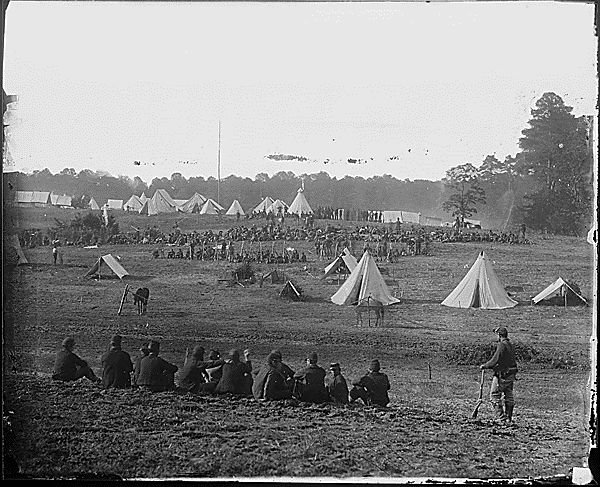
They Were There: The Civil War in the Words of the Soldiers & Correspondents Who Lived It
Soldiers wrote letters. Correspondents filed dispatches. Poets captured the grief at home. Here is what the Civil War looked like in the pages of newspapers, in the words of the people who lived it.
Civil War newspapers published firsthand accounts of the war from multiple perspectives including Union and Confederate soldier letters reprinted by hometown editors, dispatches from embedded war correspondents, home front poetry, death notices, prison correspondence, and winter quarters letters. These accounts appeared in papers large and small across the country, often reprinted far from where they originated, and captured details about daily life, battle conditions, camp rumors, grief, and resilience that official records never preserved. NewspaperArchive offers searchable access to more than 17,000 newspaper titles from the Civil War era, including many small-town papers that carried soldier letters and community accounts not available elsewhere. Researchers can search by soldier name, regiment number, battle name, or hometown paper to find firsthand accounts that bring the Civil War to life beyond the official record.
Before the Civil War, most Americans learned about conflicts through official reports, secondhand summaries, and the occasional letter home. The war that began in 1861 changed that completely.
For the first time in American history, professional correspondents traveled with armies and filed dispatches from the field. Soldiers wrote letters that their families shared with local editors, who printed them for the whole county to read. Poets published tributes in hometown papers. Correspondents were captured and wrote from prison cells. Editors reprinted accounts from papers on the other side of the conflict so their readers could understand what the enemy was thinking.
The result was something no war had produced before. A living, breathing, first-person record of what it felt like to be inside the fight, or waiting at home for news of someone who was.
That record still exists. Most of it is still waiting to be read.
Quick Answer
Civil War newspapers published soldier letters reprinted by hometown editors, firsthand battle dispatches from embedded correspondents, poetry written from the home front perspective, death notices, prison accounts, winter quarters letters, and correspondence from both Union and Confederate perspectives. These accounts appeared in papers large and small across the country, often reprinted far from where they originated. NewspaperArchive offers searchable access to Civil War-era newspapers, including many small-town papers that carried soldiers' letters and community accounts not available elsewhere.
If you want to read the Civil War the way families did in 1861, the way a Wisconsin mother or a Georgia editor or an Indiana neighbor would have read it, start with the newspapers.
In This Article
"My Charlie Has Gone to the War": The Home Front Speaks First
"We Will Be Off in a Few Minutes": Letters from the Field
"Rumors Float Ad Libitum in Camp": Winter Quarters and the Long Wait
"Several Balls Fell in a Field Immediately Behind Us": The Battle as Witnessed
"Virginia Boasts the Steepest Hills, the Muddiest Roads": What Soldiers Really Thought
"The Gods Keep Thee Out of the Confederacy": A Correspondent Behind Bars
"He Is Said to Have Been a Noble Fellow": When the News Was the Worst News
What These Accounts Have in Common
"My Charlie Has Gone to the War"
The Home Front Speaks First
Before the first dispatch arrived from the field, before the casualty lists, before the letters postmarked from camps with unfamiliar names, the war came home through poetry.
In November 1861, the Galesville Transcript in Wisconsin published a poem called "Gone to the War." It was written by Horatio Alger Jr., then a young writer publishing in New England papers, years before he became famous for anything else. The poem had appeared first in the Boston Transcript. Someone in Wisconsin thought their readers needed to hear it too.
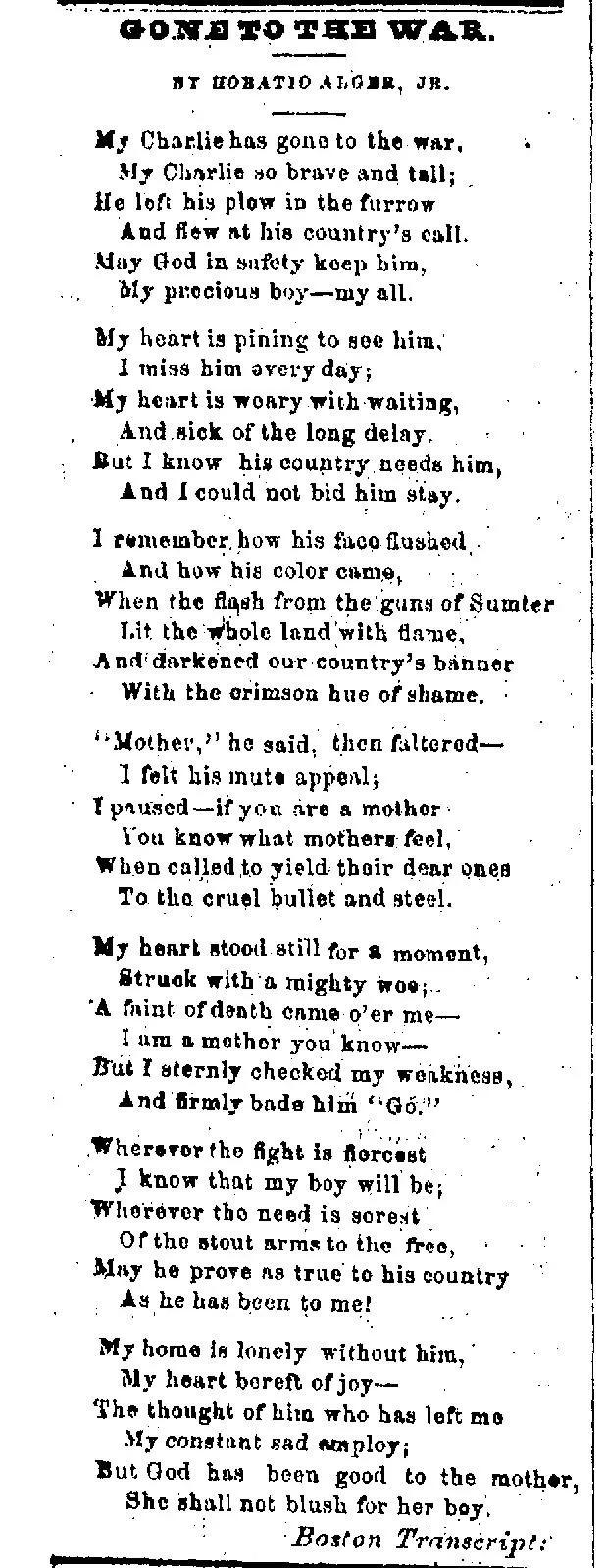
The poem is written in a mother's voice. Her Charlie left his plow in the furrow. He heard about Fort Sumter and his face flushed and he said "Mother" and then faltered. She writes: "I paused — if you are a mother, you know what mothers feel, when called to yield their dear ones to the cruel bullet and steel."
She let him go. She bade him go firmly. And now she waits.
What makes this poem worth sitting with is not its literary quality. It is the fact that it was printed at all, in a Wisconsin paper, weeks after it appeared in Boston. Grief traveled fast in 1861. Editors knew their readers were feeling something they did not have words for yet, and they went looking for the words on their behalf.
For Researchers
Home front poetry like this rarely surfaces through a name search. Browsing the front pages of a hometown paper from 1861 and 1862 is often how these pieces appear. They can help you understand what your ancestor's community was feeling when he left, and what his family was reading while they waited for news.
"We Will Be Off in a Few Minutes"
Letters from the Field
On November 4, 1861, two men sat down to write letters to their hometown papers. One was a Union correspondent writing from Camp Holton in Milwaukee. The other was a Confederate soldier writing from Camp Lawton near Savannah, Georgia. Neither knew the other existed.
They described the same day.
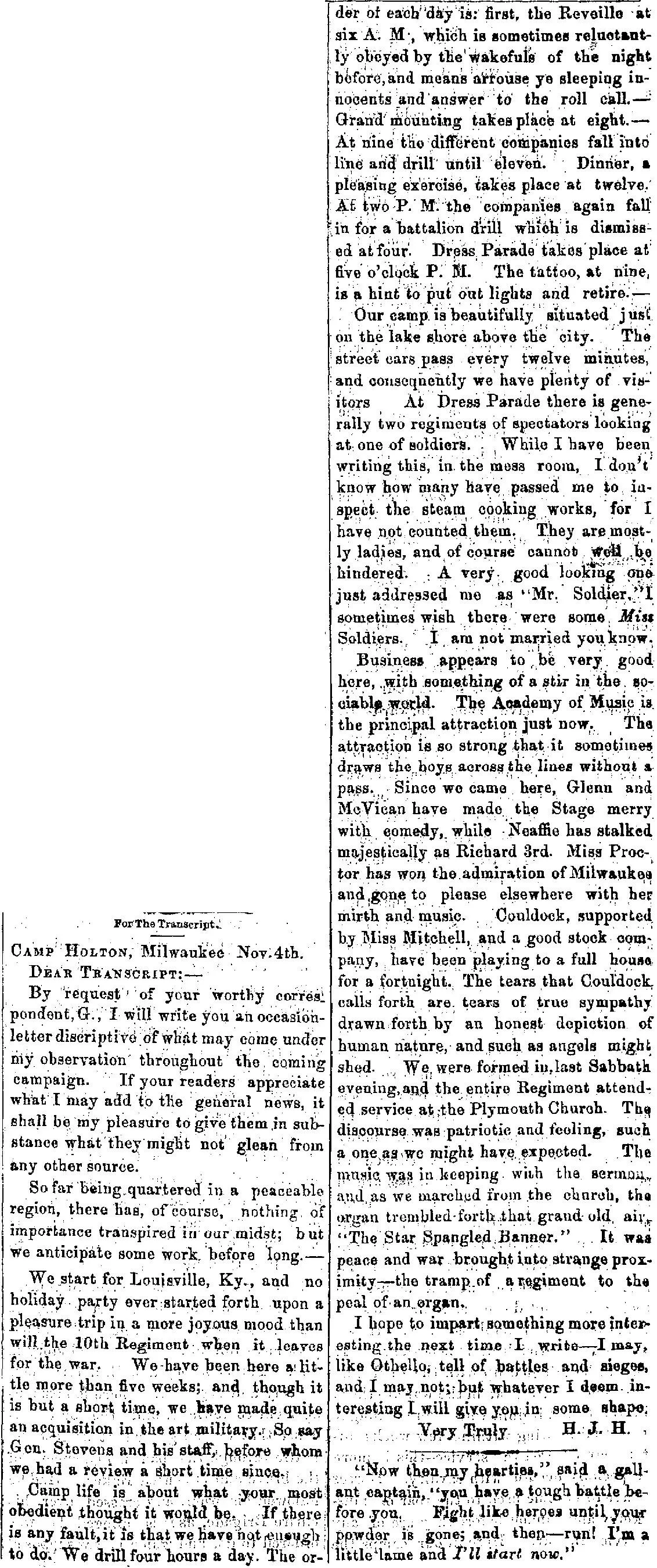
H.J.H., writing to the Galesville Transcript, described life in the 10th Regiment before it left for the war. Reveille at six in the morning. Drilling until eleven. Dinner at noon. Battalion drill in the afternoon. Dress parade at five. Tattoo at nine, which was the signal for lights out. He wrote from the mess room while ladies passed by to inspect the steam cooking works. He hoped his next letter would have something more thrilling to report.
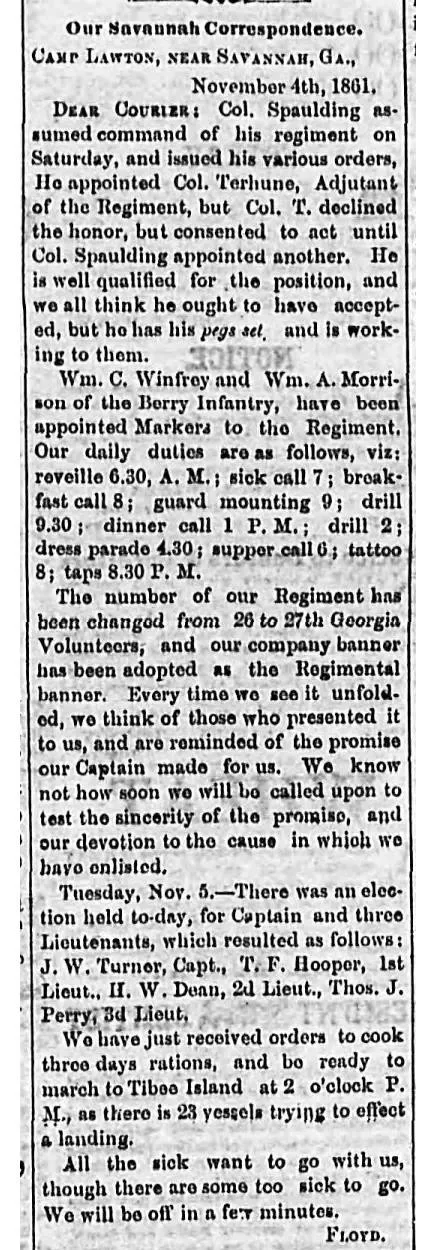
Floyd, writing to the Rome Weekly Courier in Georgia, described the daily order of the 27th Georgia Volunteers. Reveille at 6:30. Sick call at seven. Breakfast call at eight. Guard mounting at nine. Drill. Dinner. Dress parade. Supper. Tattoo. Taps at 8:30.
Then, midway through the letter, everything changed. Orders arrived. Cook three days of rations. Be ready to march to Tybee Island at two o'clock. There are 23 vessels trying to effect a landing.
Floyd finished his letter quickly. "All the sick want to go with us, though there are some too sick to go. We will be off in a few minutes."
Two men. Two armies. Two letters written on the same November day in 1861. The same hours, the same drills, the same waiting. One of them put his pen down and marched toward the sound of gunfire before the ink was dry.
For Researchers
Soldier letters reprinted in hometown papers often included regiment names, camp locations, officer names, and details about daily life that appear nowhere in official records. If your ancestor wrote a letter that was printed locally, it may be the most personal document he ever left behind. Searching the hometown paper across the full war period, rather than searching for a name in isolation, is often how these letters surface.
"Rumors Float Ad Libitum in Camp"
Winter Quarters and the Long Wait
Not every account from the Civil War was written in the heat of action. Some of the most honest writing came from the long stretches between battles, when soldiers sat in winter quarters with nothing to do but wait, write, and listen to rumors.
In March 1863, the Columbus Weekly Sun in Georgia published two letters written within days of each other. Both Confederate. Both exhausted. Both trying to make the waiting feel like something other than what it was.
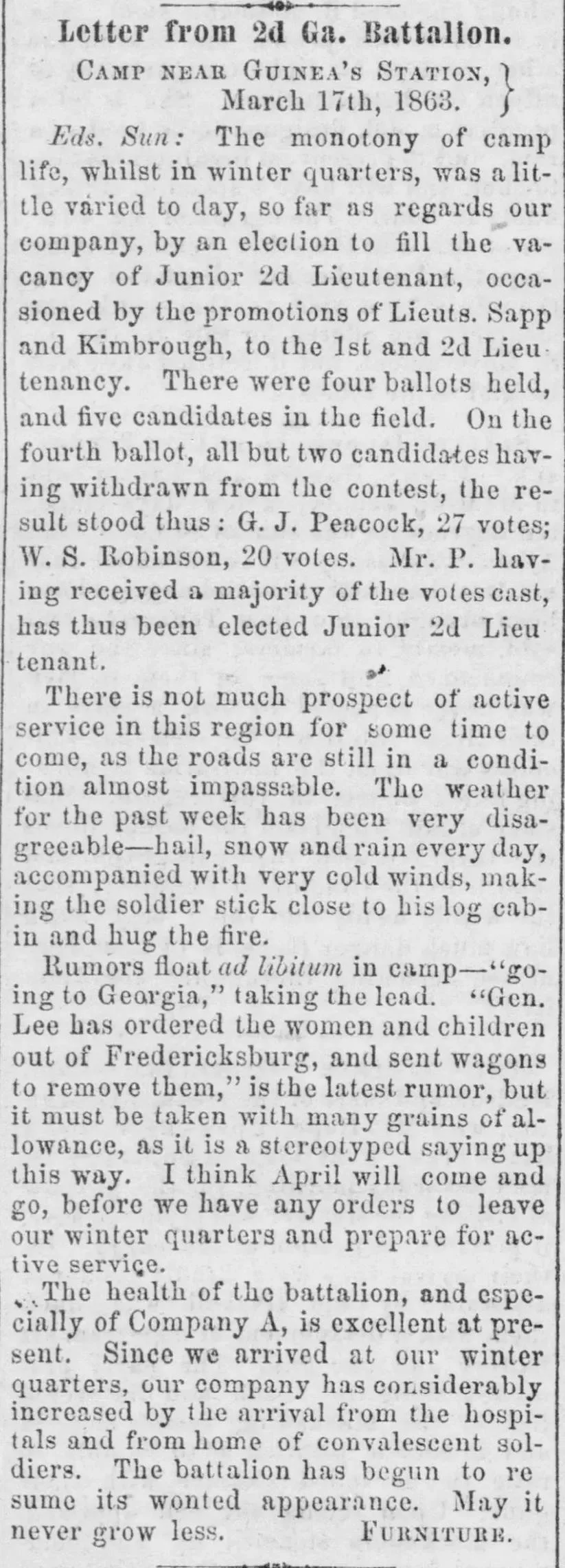
The writer signing himself "Furniture" described his situation from Camp near Guinea's Station. Hail, snow, and rain every day. Roads almost impassable. Soldiers hugging their log cabin fires. An election was held to fill a vacant lieutenant's position. Four ballots, five candidates, a clear winner on the fourth round. Then the weather again. The health of the battalion was excellent, he noted carefully. May it never grow less.
The rumors, he wrote, were floating ad libitum in camp. "Going to Georgia" was taking the lead. The latest report was that General Lee had ordered the women and children out of Fredericksburg and sent wagons to remove them. "It must be taken with many grains of allowance," he added, "as it is a stereotyped saying up this way."
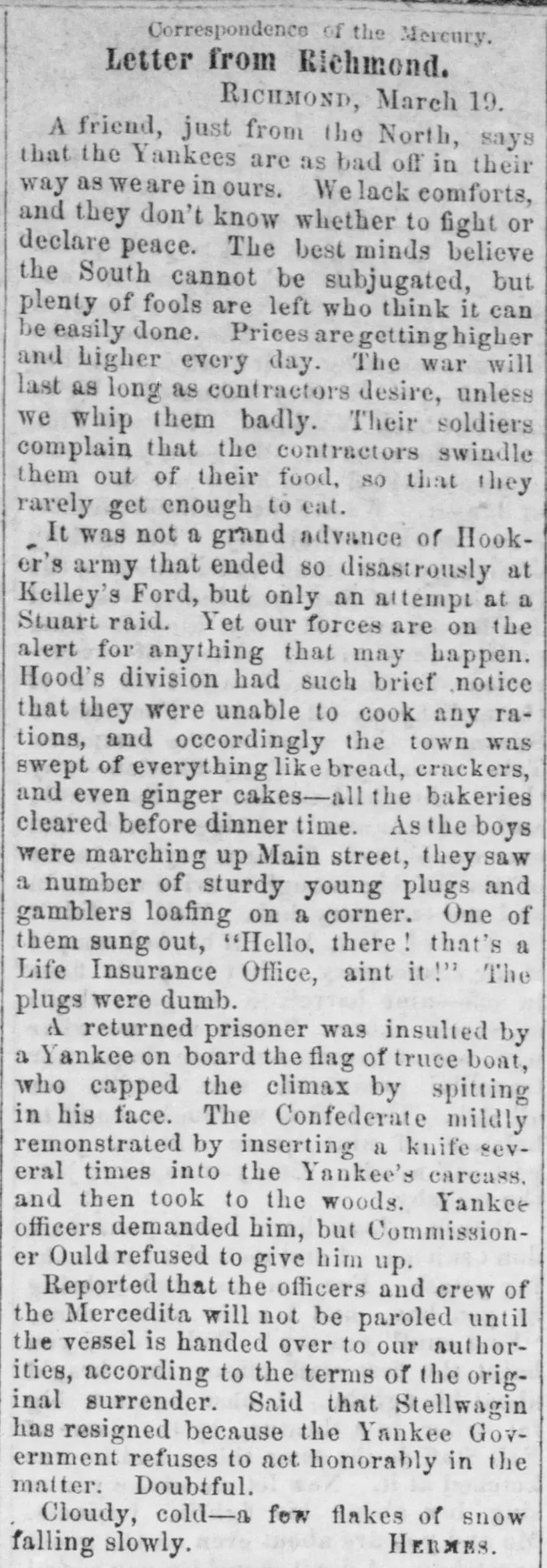
Hermes, writing from Richmond the same week, covered rising prices, war weariness, and a violent incident on a prisoner exchange boat that he described with matter-of-fact brevity. Then, at the end of the letter, almost as an afterthought: "Cloudy, cold, a few flakes of snow falling slowly."
Both men signed with pen names. Furniture. Hermes. Soldiers and correspondents regularly wrote under pseudonyms, partly for protection, partly for fun, partly because the war had made them into someone different from the person who had left home, and they were not quite sure yet what name that person should carry.
For Researchers
Winter quarters letters can reveal a regiment's location, the names of officers, the state of a unit's health, and the emotional texture of the waiting that official records never preserved. Because writers often used pen names, browsing the hometown paper rather than searching for a specific byline is often the better approach. A letter signed "Furniture" may have been written by your great-great-grandfather.
"Several Balls Fell in a Field Immediately Behind Us"
The Battle as Witnessed
On August 9, 1861, the Watertown Republican in Wisconsin reprinted a battle account from the Richmond Dispatch. A Northern paper. A Confederate source. The editors of the Watertown Republican apparently decided their Wisconsin readers deserved to understand what had happened at Manassas from the perspective of the people who had won it.
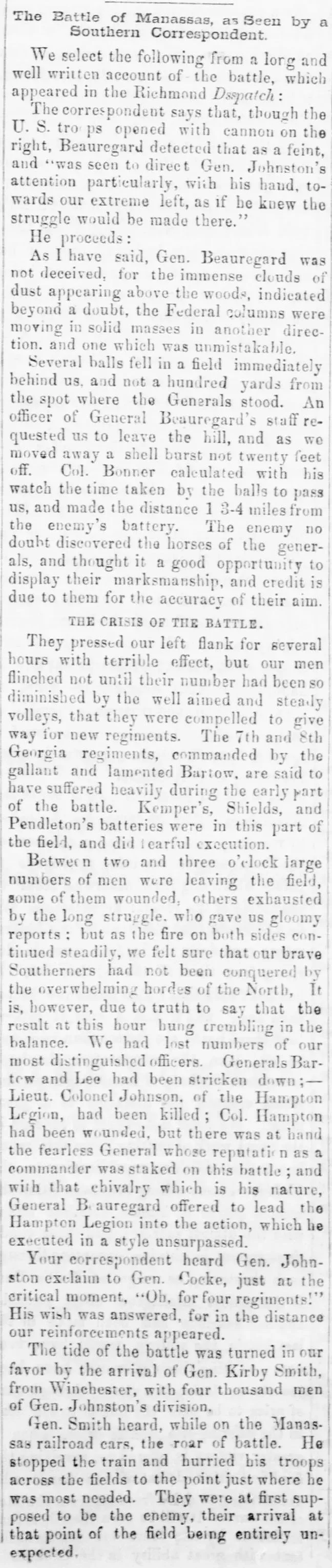
The Richmond Dispatch correspondent was standing on a hill with General Beauregard when the battle turned. Several cannon balls fell in a field immediately behind them, not a hundred yards from where the generals stood. An officer on Beauregard's staff suggested they leave the hill. As they moved away, a shell burst twenty feet off.
Colonel Bonner calculated the distance to the enemy battery with his pocket watch, measuring the time it took for the sound of the guns to reach them. One and three-quarter miles.
The correspondent watched the crisis of the battle unfold. The Confederate left flank being pressed with terrible effect. The 7th and 8th Georgia regiments holding until their numbers were too diminished to hold. General Johnston exclaiming at the critical moment, "Oh, for four regiments!" His wish answered when Kirby Smith's men arrived from Winchester, four thousand strong, crossing the fields at a run toward the sound of the guns.
The correspondent heard all of this. He wrote it down. His account traveled from Richmond to Wisconsin in a matter of weeks, and Wisconsin readers picked up their paper and found themselves on that hill, watching the battle tip.
That is what war correspondence did. It collapsed the distance between the battlefield and the kitchen table.
For Researchers
Battle accounts from embedded correspondents were reprinted widely across state lines, which means the most detailed account of your ancestor's regiment in action may have appeared in a paper from a completely different state. Searching by battle name or regiment number across multiple state papers, rather than limiting searches to the hometown paper, can surface accounts that put your ancestor's unit at the center of the story. For more on how to use battle accounts and casualty lists in your research, see How to Find Your Civil War Ancestor.
"Virginia Boasts the Steepest Hills, the Muddiest Roads"
What Soldiers Really Thought
Not every account from the Civil War was written with posterity in mind.
Some soldiers sat down and wrote exactly what they thought, with no particular concern for how it would read in a history book. The editors who printed those accounts apparently shared their lack of concern.
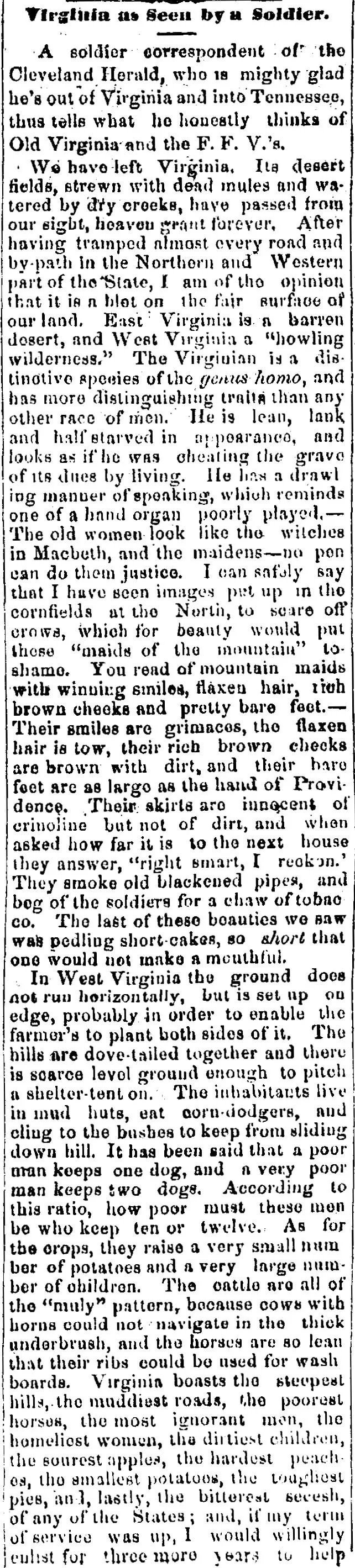
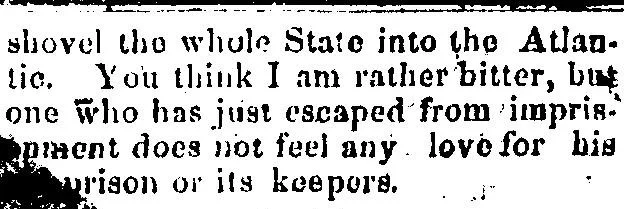
A soldier correspondent for the Cleveland Herald, writing in the Crown Point Register in November 1863, had left Virginia and was extremely glad about it. He described Virginia as a blight on the fair surface of the land. East Virginia a barren desert. West Virginia a howling wilderness. The roads the worst in any state. The crops consisting of a very small number of potatoes and a very large number of children.
He was not finished. He described the women of the region in terms that his editor printed without apparent hesitation, concluding that the old women looked like the witches in Macbeth.
He ended his piece with a sentence that says everything about where he had just been:
"You think I am rather bitter, but one who has just escaped from imprisonment does not feel any love for his prison or its keepers."
The anger is the point. This is what survival sounds like before it has had time to soften. This soldier was not writing for the record. He was venting, in the way soldiers vent, with dark humor and exaggeration and the particular freedom of a man who has seen too much to be polite about it anymore. His editor gave him the space to do it. His readers in Indiana probably laughed and passed the paper to the next person.
For Researchers
Not all newspaper accounts of the Civil War were formal or solemn. Irreverent dispatches, sharply opinionated soldier letters, and darkly funny accounts are part of the historical record, too. They can tell you as much about a soldier's state of mind as any battle report, and they are far less likely to surface through a name search. Browsing front pages and community columns of hometown papers often brings them into view.
"The Gods Keep Thee Out of the Confederacy"
A Correspondent Behind Bars
In the same issue of the Crown Point Register that carried the Virginia piece, there was another letter. This one was not darkly funny. It was something closer to darkly honest.
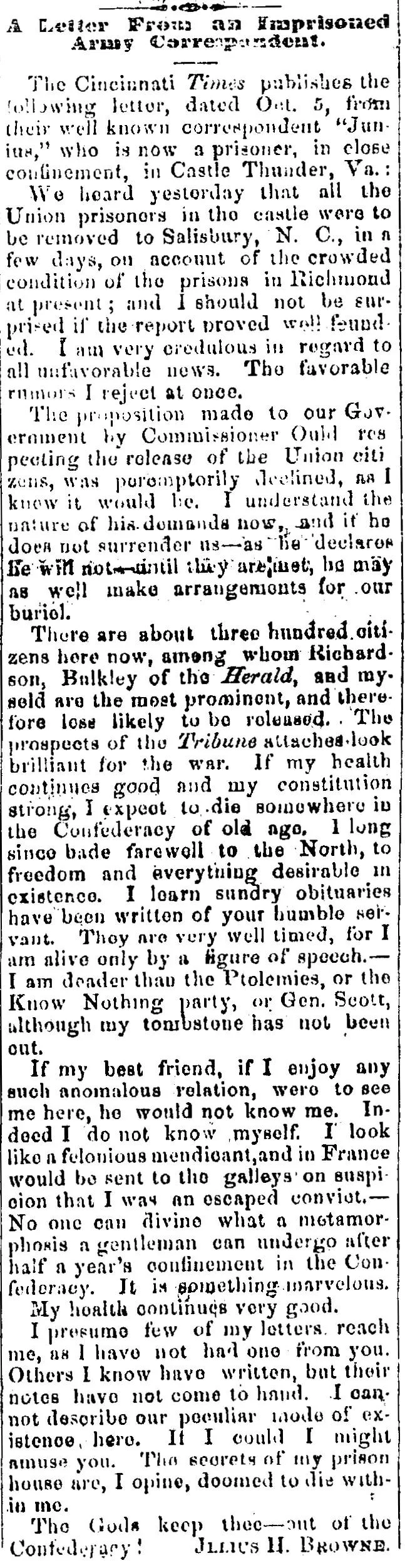
Junius H. Browne was a correspondent for the New York Tribune. He had been captured and was being held in Castle Thunder prison in Richmond, Virginia. He had been there for more than six months when he wrote this letter in October 1863.
He wrote that the Union prisoners in the castle were rumored to be moved to Salisbury, North Carolina, on account of the overcrowded conditions in Richmond. He wrote that a proposition for the release of Union citizens had been peremptorily declined, as he had known it would be. He wrote, with a certain precision, that if Commissioner Ould did not surrender them as he had declared he would not, the Commissioner might as well make arrangements for their burial.
Then he described himself. If his best friend were to see him now, he wrote, that friend would not know him. He did not know himself. He looked like a felonious mendicant. He was, he noted, alive only by a figure of speech. He was deader than the Ptolemies, or the Know Nothing party, or General Scott, although his tombstone had not been put out yet.
He ended the letter:
"The Gods keep thee out of the Confederacy."
The letter was published in the Crown Point Register in Indiana, hundreds of miles from where it was written. Someone carried it out of Richmond, passed it to the New York Tribune, and it traveled from there to a small Indiana paper where readers who had never heard of Julius Browne sat down and read what it felt like to be six months in Castle Thunder with no clear prospect of release.
One issue. One Indiana paper. A soldier who hated Virginia and could not wait to leave. A correspondent who could not leave at all.
For Researchers
Imprisoned and captured correspondents wrote some of the most vivid firsthand accounts of the Civil War, and their letters were reprinted in papers far from where they originated. Searching for a correspondent's name, a prison name like Castle Thunder or Andersonville, or a prisoner exchange notice can surface accounts that illuminate the broader prisoner experience and sometimes name specific individuals held alongside the writer.
"He Is Said to Have Been a Noble Fellow"
When the News Was the Worst News
Everything in this post up to this point has been about the texture of the war. The waiting and the drilling. The rumors and the weather. The battles and the prison cells. The dark humor that soldiers used to hold themselves together.
This clipping is about what happened when the humor ran out.
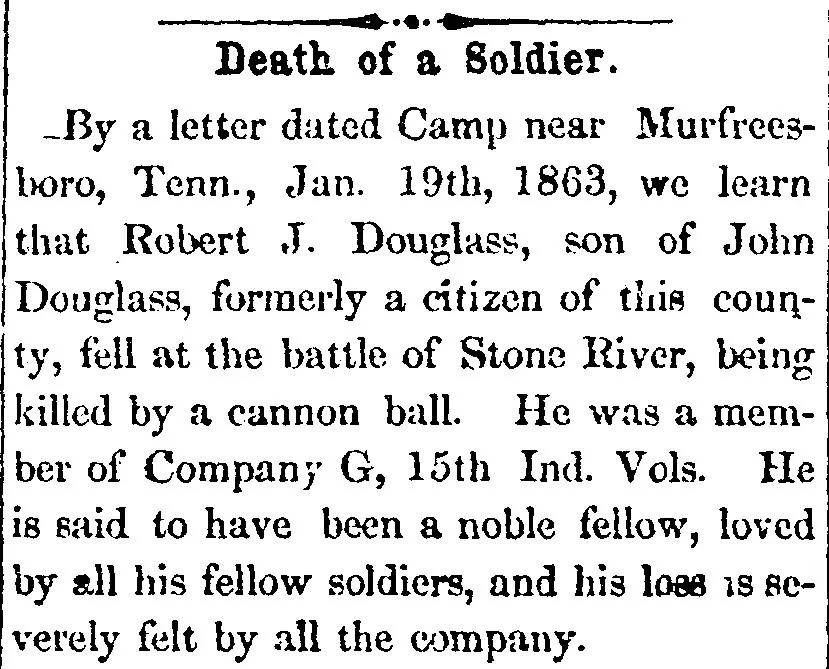
By a letter dated Camp near Murfreesboro, Tennessee, January 19th, 1863, the Rochester Chronicle learned that Robert J. Douglass, son of John Douglass, formerly a citizen of this county, fell at the Battle of Stone River. He was killed by a cannonball. He was a member of Company G, 15th Indiana Volunteers. He is said to have been a noble fellow, loved by all his fellow soldiers, and his loss is severely felt by all the company.
That is the entire notice. It appeared in March 1863, two months after the battle. The letter that carried the news had traveled from Tennessee to Indiana, passing through hands we will never know, before it reached the editor of the Rochester Chronicle.
There is no correspondent's prose here. No dramatic detail. No pen name. Someone in Company G sat down after the Battle of Stone River and wrote a letter home, the way soldiers write letters home when one of them does not survive, and found the plainest words they could for what had happened.
The editor printed it exactly as it came.
A county found out.
For Researchers
Wartime death notices like this one often appeared weeks or months after the fact, and they frequently named the soldier's father or a family connection that helps confirm relationships across records. Searching a surname alongside a battle name, a regiment number, or a state can surface notices like this one that a direct name search alone might miss. The letter that carried this news was written by a soldier who knew Robert Douglass. Sometimes those letters named the writer, too.
What These Accounts Have in Common
None of these writers knew they were writing history.
H.J.H. hoped his next letter would have something more thrilling to report. Floyd was already marching when he put his pen down. Furniture watched the snow fall and waited for orders that had not come yet. The Richmond Dispatch correspondent stood on a hill while cannon balls landed twenty feet behind him and wrote it all down anyway. Julius Browne made dark jokes from a prison cell because the alternative was despair. The men of Company G found the plainest words they could for the plainest grief.
Newspapers collected all of it. The poetry and the prison letters. The camp schedules and the battle accounts. The irreverent dispatches and the quiet death notices. They collected it in real time, on deadline, and sent it out to readers who were sitting at kitchen tables in Wisconsin and Georgia and Indiana, waiting to understand what was happening to the people they loved.
That record is still there. It has been sitting in archives for a hundred and sixty years, and most of it has never been searched by anyone looking for a specific name, a specific family, a specific county that lost a noble fellow to a cannon ball at Stone River.
The Story Is Still Being Told
History books give you the broad strokes. They give you the generals and the turning points and the dates.
Newspapers give you Floyd putting his pen down in the middle of a sentence because the orders just arrived. They give you Furniture watching the snow from his log cabin and taking the rumors with many grains of allowance. They give you a Wisconsin mother reading Horatio Alger's poem and recognizing her own grief in someone else's words. They give you Julius Browne, alive only by a figure of speech, signing off from a prison cell with a benediction that was also a warning.
They give you Robert J. Douglass. Son of John Douglass. Noble fellow. Loved by all his fellow soldiers.
These are not footnotes. They are the war itself, as the people who lived it understood it, written down in the moment and passed from hand to hand until they reached someone who needed to read them.
That someone might be you.