What Were Your Ancestors Doing 250 Years Ago? Historical Newspapers Can Tell You.
America250 is the moment to ask what your family was doing in 1776. Historical newspapers can tell you. Here's how to find them in NewspaperArchive.
Historical newspapers contain records that connect ordinary families to the American Revolution and the founding era. Genealogy researchers can find Revolutionary War veterans, civilian witnesses, and family members in several newspaper record types: enlistment notices, military supply and procurement notices from 1776, pension notices from the 1818 and 1832 pension acts, veteran obituaries published from the 1810s through the 1870s, anniversary tributes, and community items that name local people by name, age, and service. These records appear in NewspaperArchive, which holds more than 280 million pages of historical newspapers dating to 1607. The founding era newspaper record covers the Revolution itself and extends through the late nineteenth century, when the last survivors of the war were still being written about by name.
In November 1851, a newspaper in Michigan ran a short item under the headline "A Revolutionary Hero Gone."
The man it described was named Nathan Fish. He was 91 years old when he died. He had been born in Sandwich, Massachusetts, in 1750. At 15, the battles of Lexington, Concord, and Bunker Hill awakened what the paper called his military zeal, and he enlisted as a fifer. He marched to Washington's headquarters in Cambridge. He was present at White Plains. He was among the men sold by Benedict Arnold at West Point. He lived long enough to enlist again in the War of 1812, to marry twice, to father several children, and to end his days in a Massachusetts almshouse where he was, the paper noted, well taken care of at the public expense.
Seventy-five years after 1776, a local newspaper was still telling his story.
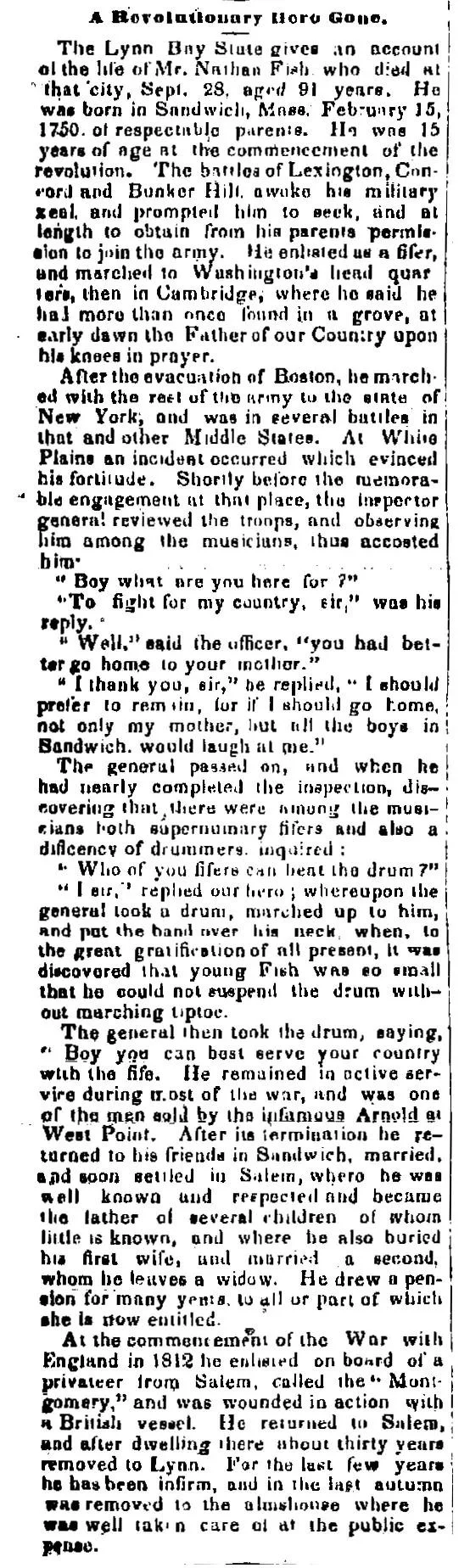
Nathan Fish was not a general. He was not famous. He was a fifer from a small Massachusetts town who happened to be in the right places at the right moments, and who lived long enough for a local editor to write his story down.
That clipping exists in the NewspaperArchive collection right now.
America250 is underway, the national commemoration of the 250th anniversary of American independence. It is a natural moment to ask a question most of us have never had the tools to answer: What was my family actually doing in 1776?
Not just the famous families. Not just the generals and signers. Your family. The ordinary people who lived through it.
Historical newspapers can tell you more than you might expect. And the record does not begin and end with the war years themselves.
Quick Answer
What newspaper records connect families to the American Revolution?
Historical newspapers contain multiple record types that connect ordinary families to the Revolution and the founding era. These include: enlistment and military supply notices from 1776 itself, which named local men and merchants by name; pension notices from the 1818 and 1832 pension acts, which documented veterans, their ages, their counties, and sometimes their units; obituaries published from the 1810s through the 1870s, which frequently named battles, family members, and personal details; anniversary and veteran tribute coverage, which appeared at every major national commemoration from 1826 through 1876 and beyond; and community items and Fourth of July coverage, which named ordinary people who lived through the founding era. Many of these records appear in small-town newspapers that have never been indexed elsewhere. NewspaperArchive holds more than 280 million pages of historical newspapers dating to 1607 and is searchable by name, keyword, date, and state.
Your Ancestor Was Somewhere in 1776
Here is what we know about 1776: roughly 2.5 million people lived in the thirteen colonies. Most of them were not at Bunker Hill. Most of them were not signing anything in Philadelphia. They were farming, running shops, practicing medicine, buying and selling land, relocating their families when the war came too close, and placing notices in the local papers to let their neighbors know where to find them.
Those notices still exist.
The Virginia Gazette was one of the most important newspapers in the colonies in 1776. It was published in Williamsburg and ran throughout the war. In May of that year, it carried the kind of ordinary community notices that historians have largely overlooked, but that genealogists know are often the most valuable finds of all.
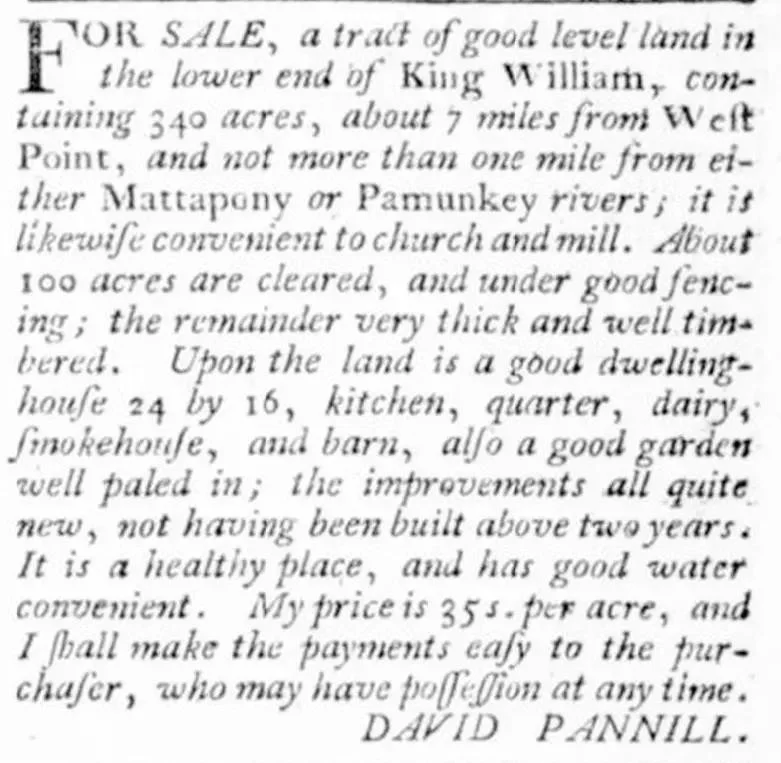
David Pannill was advertising 340 acres in King William County, Virginia. Good level land, about seven miles from West Point. A dwelling house, a kitchen, a smokehouse, a barn. All built within the past two years. He set his price at 35 shillings per acre.
Pannill was not a soldier. He was a landowner doing business in the middle of a revolution. His name in that newspaper places him in a specific county in a specific week of 1776. If you are descended from Virginia families, a notice like this one is exactly the kind of document that can confirm a time, a place, and a life.
That same week, a few pages away, another notice ran.
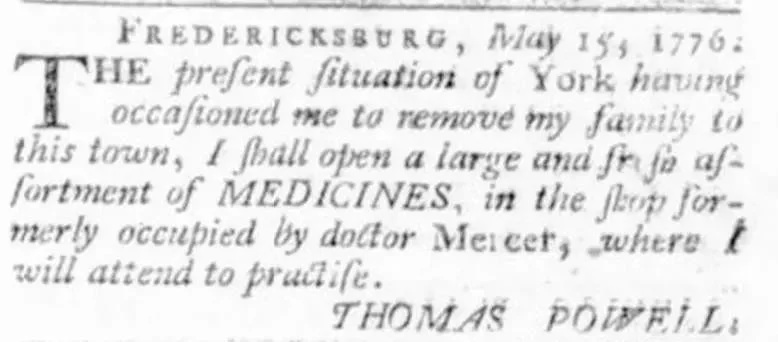
Thomas Powell was a physician. The war had come too close to Yorktown, and he moved his family to Fredericksburg. He placed a notice in the Gazette to let his patients know where to find him.
The present situation of York having occasioned me to remove my family to this town.
One sentence. It tells you his profession, his previous location, his new location, and his reason for moving, which was the Revolution itself. He did not enlist. He did not fight. He relocated his family to survive it. And he is named, located, and dated in a newspaper that has survived 250 years.
If Thomas Powell is in your family tree, that clipping is your evidence. If he is not, he is still an example of what old newspapers actually contain: the lives of ordinary people making ordinary decisions in extraordinary times.
The Record Does Not End in 1783
This is one of the most important things to understand about Revolutionary War research in historical newspapers: the record does not stop when the war does.
Veterans lived for decades after the Revolution ended. Newspapers tracked them. Pension legislation in 1818 and 1832 generated a fresh wave of notices in local papers, veterans applying for benefits, pension lists published by the state, and widows filing for their husbands' pensions. Obituaries for men who had served in the Revolution appeared from the 1810s through the 1870s, as the last survivors of the war died in their eighties, nineties, and beyond. At every major national anniversary, 1826, 1876, newspapers ran retrospectives that named veterans and founding families by name.
Nathan Fish died in 1851 and was still worth a full column in a Michigan paper. The last verified Revolutionary War veteran died in 1869. That means obituaries for men who fought in the Revolution span more than fifty years of newspaper publishing after the war ended.
The record you are looking for may be sitting in a paper from the 1840s or 1850s, decades after the war, and decades before anyone thought to preserve those documents anywhere else.
What Records Can Show My Ancestor Was Alive During the American Revolution?
If you want to find evidence that a specific person was alive and active during the founding era, these are the newspaper record types most likely to contain them:
Military records in newspapers (1775–1783)
Enlistment notices, deserter notices, supply procurement notices, and officer lists appeared in colonial and early American newspapers throughout the war. These often named specific men, their counties, and sometimes their units or ranks.
Land and business notices (1770s–1780s)
Ordinary people placed notices in wartime newspapers: land sales, shop openings and relocations, estate settlements, livestock stray notices. These are not military records, but they place named individuals in specific locations during the war years.
Pension notices (1818–1840s)
The pension acts of 1818 and 1832 generated newspaper coverage in local papers across every state. Veterans applied, and papers noted it. State pension lists were sometimes published in full, naming every pensioner by name and amount. Women appear in these lists as widows or wives of veterans.
Obituaries noting Revolutionary service (1810s–1870s)
When a veteran of the Revolution died, local papers frequently noted his service, named battles, and described his life. These obituaries can contain more personal detail than any official military record.
Anniversary and tribute coverage (1826, 1876, ongoing)
The 50th anniversary in 1826 and the Centennial in 1876 both produced newspaper coverage that named local veterans, founding families, and community members with deep roots in the Revolutionary era.
DAR and SAR membership announcements (1890s–mid-20th century)
When a community member joined the Daughters of the American Revolution or the Sons of the American Revolution, local papers often named both the applicant and the founding-era ancestor through whom membership was claimed. These notices can appear decades after the Revolution but point directly back to a specific ancestor.
Quick reference: newspaper record types by search window
Record Type | Best Search Window |
|---|---|
Military enlistment, supply, and officer notices | 1775–1783 |
Land, business, and civilian notices | 1770s–1780s |
Pension notices and state pension lists | 1818–1845 |
Veteran obituaries noting Revolutionary service | 1810–1870 |
Anniversary and veteran tribute coverage | 1826, 1876, ongoing |
DAR and SAR membership announcements | 1890s–1950s |
Each of these record types appears in NewspaperArchive and is searchable by name, keyword, state, and date range. Widening your search window beyond the war years is often where the most useful finds appear.
How to Start Searching
You do not need a complete family tree to begin. You need a name, a state, and a willingness to search across a wider date range than feels intuitive.
Start with your ancestor's surname alongside "Revolutionary War," "veteran of '76," or "soldier of the Revolution." Try a date range that runs from 1776 all the way through 1870. Then narrow.
If you find a pension notice, follow it forward: the veteran may appear in obituary columns decades later. If you find a land notice from 1776, search the same name in the years that follow to see how their story continued.
NewspaperArchive holds more than 280 million pages of historical newspapers, including deep coverage of the small-town papers where most of this research actually lives. The Virginia Gazette, the county weeklies of Indiana and Ohio, and Massachusetts papers from Concord, Boston, and Cambridge are all in there.
For a full list of search strategies organized by record type, including pension searches, DAR and SAR research, Fourth of July coverage, and the 1876 Centennial, see the America250 Genealogy Research Checklist: 10 Newspaper Searches to Try.
Your Family Was There
The Nathan Fish obituary is an extraordinary Revolutionary War clipping in the NewspaperArchive collection. A fifer at 15. Lexington. Concord. Bunker Hill. Washington on his knees in prayer at early dawn. Benedict Arnold's betrayal. The War of 1812. Two wives. An almshouse in Lynn.
Not every ancestor left a story like that behind. But every ancestor left something: a land notice, a pension list, a death item that mentioned their age and county and the war they had survived. A doctor's notice explaining why he was moving his family away from the fighting. A property sale in King William County, Virginia, in the spring of 1776.
America250 is the moment to go looking for it.
The newspaper record of the American Revolution stretches from the first colonial papers through the obituaries of the last surviving veterans in the 1860s. That is nearly a century of coverage of one event and its aftermath. The people in those pages are real. Some of them are yours.