Lusitania Sinking Toll Leaves Deep Wounds Across Ports
Dramatic reports detail the Lusitania disaster as German torpedoes sank the liner off Queenstown. Survivors recount chaotic scenes with lifeboats listing and crowds in morgues while officials confirm up to 1,500 dead and 700 saved. Notable figures Frohman Hubbard and Vanderbilt among the deceased.
MENTIONED IN THIS ARTICLE
Quenstown
Queenstown Harbor
Dublin
Holy Head
Dodd
Cunard Co
Lusitania
Lusitania Disaster Witness Describes Lifeboat Capsize
Queenstown passenger G D Lane recalls the Lusitania sinking after a torpedo strike. He describes the ship listing, scenes in the second cabin as a nursery for children, efforts to help passengers onto lifeboats, and the ship tipping bow first into the sea with chaos on the aft deck.
MENTIONED IN THIS ARTICLE
Queenstown
G. D. Lane
Wales
New York
Lusitania
Lualtania
Mies
Plans for Funeral for 139 Lusitania Victims
London Central News dispatch from Queenstown reports arrangements for burial of Lusitania victims. Coffins will be moved from the town hall at 9 AM, the funeral procession begins at 3 PM from Cunard offices, with a high Mass at St Coleman's Cathedral led by the Bishop of Cloyne. Memorial services will be held as possible.
MENTIONED IN THIS ARTICLE
London
Queenstown
Lusitania
Cunard
St. Coleman’s Cathedral
Cloyne
Lusitania Sinking Moves President Toward Action
Washington reports show President Wilson silent yet deeply moved by the Lusitania disaster. Officials expect a measured response short of war as the nation weighs potential courses amid diplomatic strain with Germany.
MENTIONED IN THIS ARTICLE
Washington
Lusitania
Wilson
United States
White House
Ger
Ambassadors Questioned Over Berlin Recall Scenario
Unofficial discussions consider recalling Ambassador Gerard from Berlin while Count Von Bernstorff would receive his passports. Germany's interests in belligerent capitals would shift to neutral representatives as reports from Gerard and Page are awaited. Telegrams flood the White House as public opinion splits on war, severing relations, or firm but peaceful action.
MENTIONED IN THIS ARTICLE
Gerard
Berlin
Count von Bernstorff
Washington
Page
London
Italians Mass Troops Reach The Front
Berlin reports Italy has called to the colors all infantry classes from 1876 and sent troops by train. An Italian army of about 600,000 men, fully equipped, concentrates at Verona near the Tyrolean Alps. Bellinzona dispatch notes Austrians and Germans fleeing Italy. trains toward the frontier crowded with Teutonic travelers.
MENTIONED IN THIS ARTICLE
Copenhagen
Berlin
Italy
Verona
Tyrolese Alps
Austria-Hungary
Bellinzona
Switzerland
Vanderbilt Heroism as Lusitania Sinks Protecting a Woman
London. Thomas Slidell of New York described Alfred Gwynne Vanderbilt’s fatal gallantry aboard the Lusitania. Vanderbilt, unable to swim, removed his life belt to clasp it on a young woman then searched for another belt before the liner sank seconds later. Slidell and Herbert Stone heard a torpedo and rushed to the deck, but Slidell could not locate Stone afterward.
MENTIONED IN THIS ARTICLE
Lusitania
Elbert Hubbard
Justin Miles Forman
Charles Frohman
Alfred Gwynne Vanderbilt
Cunard Line
London
Thomas Slidell
New York
Vanderbilt
Slidell
Mr. Slidell
Herbert Stone
Mr. Stone
Gas on Lusitania linked to Pittsburgh chemist claim
Dr. John Braun, a Pittsburgh chemist and University of Berlin graduate, asserts the Lusitania carried large quantities of gas produced in Pittsburgh. He says 250,000 pounds of tetrachloride of tin, shipped to the French government, aided the ship's destruction, countering conspiracy theories.
MENTIONED IN THIS ARTICLE
John Braun
University of Berlin
Pittsburg
Penn
Braun
Lusitania
Hubbard's Last Lecture Before Titanic Sinking
In Lexington Elbert Hubbard spoke of his fate, recounting the Titanic disaster and the deaths of Isidor Strauss and his wife. He described their deaths as a heroic culmination of shared life and love, warning audiences through prophecy.
MENTIONED IN THIS ARTICLE
Lexington
America
Elbert Hubbard
Cincinnati
New York
Hubbard
Isidor Strauss
Lusitania survivor tale of torpedo impact and brave captain
Master at arms Williams spotted gold braid on Captain Turner's arm as he stood at his post after the Lusitania was torpedoed. R. R. Timmis recounts Turner's remark that there was no chance of escape, and that Turner urged others to save themselves while remaining on the bridge. The staff captain perished and the helmsman survived.
MENTIONED IN THIS ARTICLE
Queenstown
Williams
Lusitania
Turner
R. R. Timmis
Mr. Timmis
Ministers Express Views On Lusitania Sinking
Chicago pastors commented on the Lusitania sinking urging caution and reliance on President Wilson. Adjectives used to condemn German motives included atrocious barbarous parasitic and murderous while Rev. Charles P. Anderson spoke on the mass death of noncombatants.
MENTIONED IN THIS ARTICLE
Chicago
Wilson
Charles P. Anderson
Germans Say Lusitania Sinking Justified
Former German official urges Americans to travel on ships flying their flag and warns raiders will sink any craft bearing war goods to Europe.
MENTIONED IN THIS ARTICLE
Europe
Brave Little Mis Saves a Boatload of Weak Humanity
Queenstown. Kathleen Kaye a fourteen year old passenger from New York aided stewards in loading women and children into a lifeboat. After all aboard she staffed a lifeboat by rowing to safety, while a sailor fainted at his oar. She then comforted sisters in misfortune.
MENTIONED IN THIS ARTICLE
Queenstown
Kathleen Kaye
New York
Miss Kaye
Dernburg Defends German Sinking of Lusitania
Dr Bernhard Dernburg former Colonial Secretary of the German Empire reiterates that Germany was justified in sinking the Lusitania to stop war munitions shipments. He argues warnings were given and cites British blockade as provoking German measures while noting American lives would have suffered if munitions reached Britain. He accuses Cunard officials of fault and cites submarine warfare as a common practice among nations.
MENTIONED IN THIS ARTICLE
New York
Bernhard Dernburg
Cleveland
Dernburg
Germany
America
Dr. Dernburg
Washington
Atlantic
Cunard Line
England
Holland
Denmark
Norway
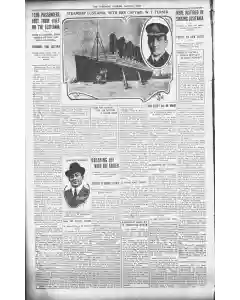
Lusitania torpedo strikes denied internal explosion claim
Captain W T Turner, commander of the Lusitania, testifies two torpedoes struck the vessel near Queenstown and that he could not maneuver to avoid them. He rejects charges of an inside explosion as untrue, saying he followed admiralty guidance and stayed in the channel center.
MENTIONED IN THIS ARTICLE
Queenstown
W. T. Turner
Lusitania
Turner
Admiralty
Also Mentioned on This Page
Alfred G. Vanderbilt
Chas. Frohman
Ernest Townley
Surbiton
Ratora
Frohman
Mr. Frohman
Ocean Wasp
Brave Little
Mis

 This is just the beginning! Our collection holds over 300 years of history, including rare newspapers, obituaries, marriage records, birth records, and so much more—most of which you won’t find anywhere else!