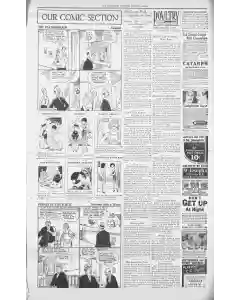
Not Done in Oils Reflects a Sardonic Exchange
A humorous dialogue presents Artist-Say Fred and Friend arguing over value and civilization. The scene touches on material wealth, social status, and gendered cost as a mother probes a husband’s worth while a daughter notes dressing as a social signal.
MENTIONED IN THIS ARTICLE
Fred
Alfalfa Outperforms Corn for Digestible Feed per Acre
R H Wilcox of the University of Illinois notes alfalfa yields greater digestible feed per acre at lower cost than corn. His figures show corn at 2,087 pounds per acre and $1.20 per 100 pounds of digestible feed, while alfalfa yields about 2,146 pounds and the cost drops to $1.14 per 100 pounds.
MENTIONED IN THIS ARTICLE
R. H. Wilcox
Agricultural Economics
University of Illinois
Wwnu
Illinois
Ensilage Methods Compared Ears In Corn Silage
An Iowa subscriber asks if corn in silage should include ears or just stover. Hoard's Dairyman says including ears provides more total digestible nutrients than stover silage and reduces the need for extra protein in the feed mix.
MENTIONED IN THIS ARTICLE
Iowa
Hoard's Dairyman
Rations Using Limited Legume Hay for Fattening Cattle
Farmers with limited hay supply or low quality forage can stretch rations by using small amounts of high grade legume hay and grinding ear corn with oats for bulk. For cattle, include 2 to 4 pounds of legume hay per head daily, with dairy cows needing a bit more. Add 1 to 3 pounds of protein meals such as cottonseed or soybean meals to meet protein needs.
MENTIONED IN THIS ARTICLE
Wallaces
Fertilizer Units and Cost Per Unit Explained
Fertilizer is sold by units equal to 1 percent of a ton or 20 pounds of plant food. A 45 percent super phosphate ton has 45 units, while a 4 16 4 complete fertilizer ton has 24 units. Cost per unit equals ton price divided by units. for example 20 percent superphosphate at $32 per ton yields $1.60 per unit, aiding comparison of alternatives.
Pickaway County Grower Wins Sweet Corn Honor
George Bitel of Pickaway county produced four tons per acre on five and a half acres this summer and is the sole successful entrant in the Sweet Corn club sponsored by the state university. The field previously grew potatoes in 1938 and soybeans last year. Commercial fertilizer at 600 pounds per acre was used with 30 inch row spacing.
MENTIONED IN THIS ARTICLE
George Bitel
Pickaway County
The
State University
Ohio
Keep Disease Out of Poultry Flock
Dr. Charles Murray from Iowa State College urges strict poultry sanitation to prevent disease. He warns visitors should disinfect footwear or wear provided overshoes, and quarantine any new stock for several weeks before mixing with home flocks.
MENTIONED IN THIS ARTICLE
Charles Murray
Iowa State College
Maintaining Proper Body Weight in Laying Pullets Strategy
The University of Missouri agricultural extension notes pullets often lose weight after heavy egg production. Prompt feeding of a moist fattening mash at noon helps recover weight and egg production. A daily mix for 100 pullets uses six pounds corn meal, three pounds shorts, and one pound dried milk, moistened to a crumbly mash.
MENTIONED IN THIS ARTICLE
Agricultural Extension Service
University of Missouri
Missouri
English Egg Laying Contest Sees Record Egg Totals
The national egg laying contest at Milford Surrey claims the world’s largest event with 3311 pullets competing. In the eighth month 405914 eggs were laid averaging 127.4 per bird. A pen of 12 Black Leghorns tops with 1828 eggs averaging 152.3. A Rhode Island Red pullet leads individual records with 218 first grade eggs. another Red Bullet totals 218386 but many were under two ounces.
MENTIONED IN THIS ARTICLE
Milford
Surrey
England
Rhode Island
Timely Poultry Hints on Feed and Hatchability
Poultry writers question mangels as high quality feed noting possible reduced egg hatchability. Alfalfa is praised as an excellent green feed and winter storage for hens. Carrots are suggested as a practical succulent alternative, usable in small garden spaces.
Winter Laying Breeds for Early Hatchery Success
Winter laying is vital for autumn production. Early-hatched pullets from White Wyandottes Buff Plymouth Rocks and Rhode Island Reds mature into sturdy stock. Middle-weight birds yield fine plump table birds and strong winter layers.
MENTIONED IN THIS ARTICLE
Plymouth
Breeding Hints for Breeding Males in Pen Use
Males should be placed in the breeding pen to acclimate to new surroundings and allow about 60 days for mating and production before eggs are saved for hatching. Select breeding males quickly, ensuring vigor and proven performance that conform to breed standards before turning them onto the breeding pen.
Bugler Uses Megaphone at Scott Field Army Camp
The lesson radio crooners taught is put to use as a bugler blasts reveille mess and taps through a giant megaphone hung from a metal pipe. The amplified calls carry clearly across the camp to remote areas.
MENTIONED IN THIS ARTICLE
Scott Field
Also Mentioned on This Page
OUR Comic
Felixe
Western Newspaper Union
Felix
First Oil
Finney
Ipet Umio
Yez
Sweet Corn
St. Joseph’s
Tannr
Senator
Crosby Frisian Fur Company
Lyell Avenue
Rochester
Haarlem
Lydia E. Pinkham

 This is just the beginning! Our collection holds over 300 years of history, including rare newspapers, obituaries, marriage records, birth records, and so much more—most of which you won’t find anywhere else!