Your Ancestor Doesn't Have to Be Famous: How Ordinary People Left Extraordinary Records
Robert Newsum never fought in the Revolution. But six newspaper clippings tell his story. Learn how to find your ordinary ancestor in historical newspapers.
Ordinary people who never served in the military and never held public office still left records in colonial and Revolutionary era newspapers. Property sale advertisements, estate notices, business announcements, reward notices for lost animals, and court proceedings all appeared regularly in newspapers like the Virginia Gazette. A researcher can build a detailed picture of an ancestor's life, community, family connections, and death entirely from these notice types without a single military record. NewspaperArchive holds Virginia Gazette issues from the early 1700s through the Revolutionary period and allows searching by name, date range, and state.
Quick Answer
You do not need a general, a founding father, or a war hero to tell your ancestor's story. Ordinary people left records in colonial newspapers all the time, and with just a handful of clippings you can reconstruct a real life in vivid detail. This post shows you exactly how, using one ordinary Virginia man as the example.
He Was Not Famous. He Was Real.
Most of us do not descend from people whose names appear in history books. Our ancestors were farmers, merchants, tavern keepers, and tradesmen. They bought land, lost horses, signed documents, and died leaving behind a family that had to figure out the rest of life without them.
That is the story of Robert Newsum of Petersburg, Virginia.
He did not fight at Bunker Hill. He did not sign the Declaration of Independence. He was not a general or a governor. He was a planter and businessman who owned property near Petersburg, ran a business in town, married into a respected Virginia family, and died on January 1, 1776, just as the country he lived in was about to become something entirely new.
He left behind a wife, a set of executors, and a paper trail that tells his story better than many famous men of his era.
Here is how that story comes together, piece by piece, entirely from records you can search right now.
1766: A Horse, a Reward, and a Name
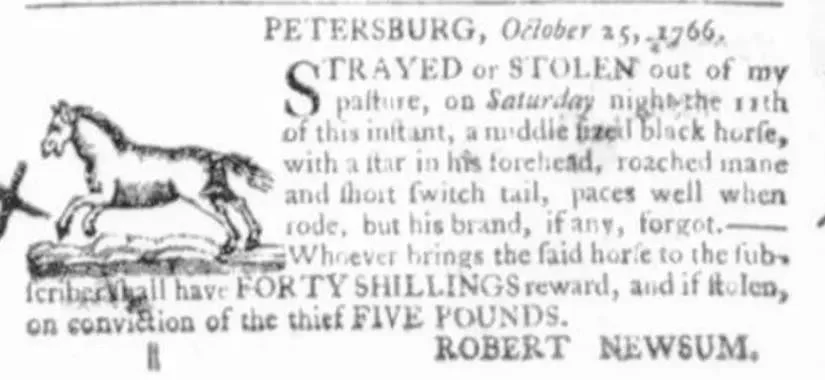
The earliest record of Robert Newsum in the NewspaperArchive collection comes from the Virginia Gazette, October 25, 1766. A middle-sized black horse with a star on his forehead, a roached mane, and a short switch tail had gone missing from his pasture on a Saturday night. Whoever brought the horse back would receive forty shillings. If stolen and the thief convicted, the reward was five pounds.
The notice is signed: Robert Newsum. Petersburg.
That is all it takes to establish a person. He is in Petersburg. He owns a horse worth recovering. He has enough standing in the community to place a notice in the Virginia Gazette and enough money to back up a reward.
One small ad, and he exists.
1772: A Marriage Bond and a Wife Named Martha
On October 22, 1772, Robert Newsum signed his name at the bottom of a marriage bond. He intended to marry Martha Ruffin, daughter of the Ruffin family of Surry County. Her brother Francis Ruffin co-signed as surety, putting fifty pounds behind his guarantee that there was no lawful cause to prevent the marriage.
You can see Robert's signature on the document. His handwriting. His name in his own hand, three years and two months before he would be dead.
The marriage bond is not a newspaper clipping, but it is a document that grounds everything that follows. It gives Martha her name and her place in the story. It connects Robert to one of the established families of colonial Virginia. And it shows him, alive and planning a future, in the autumn of 1772.
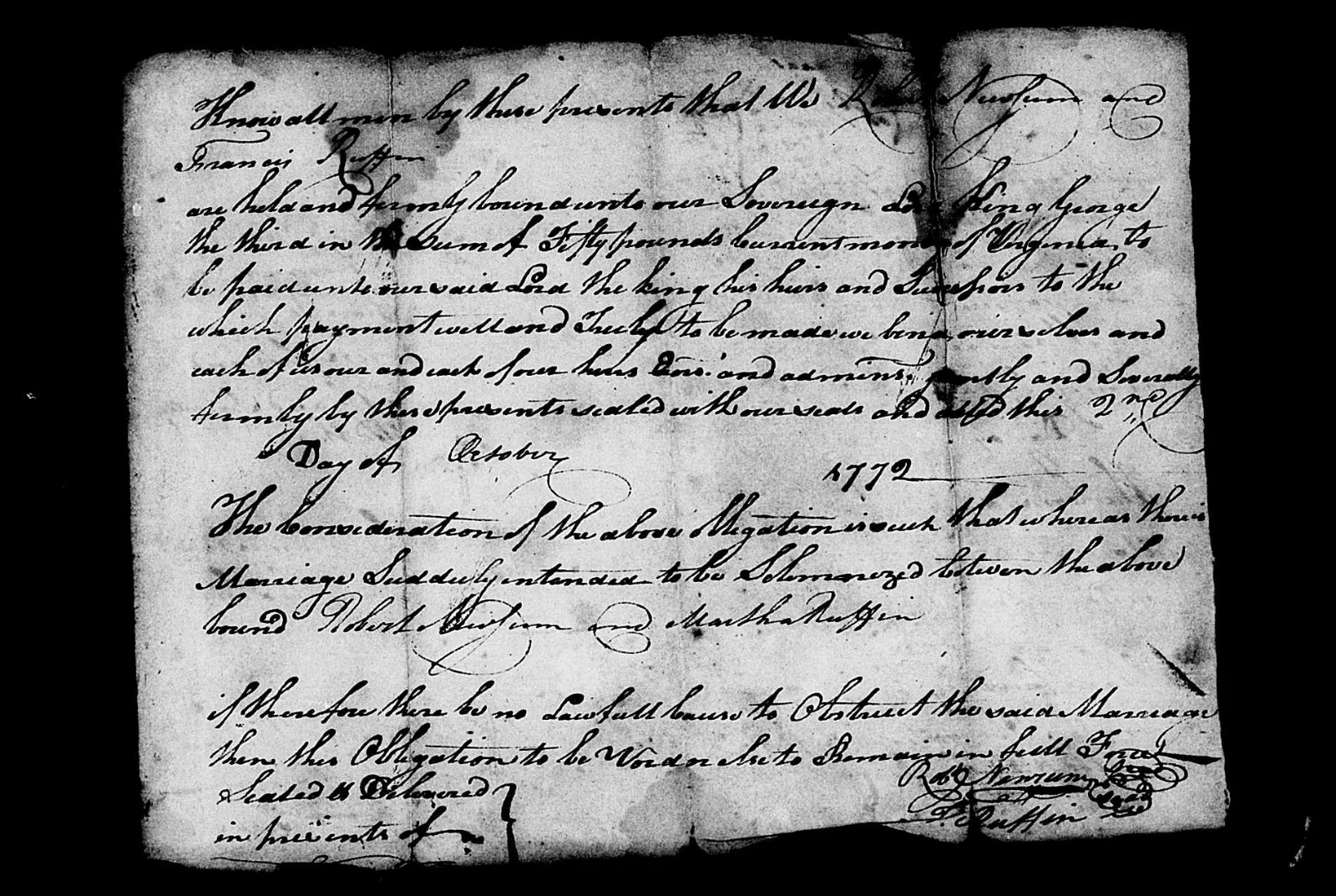
Marriage bond, Robert Newsum and Martha Ruffin, October 22, 1772. Courtesy of FamilySearch.
1773: A Tavern Lot and a Life in Town
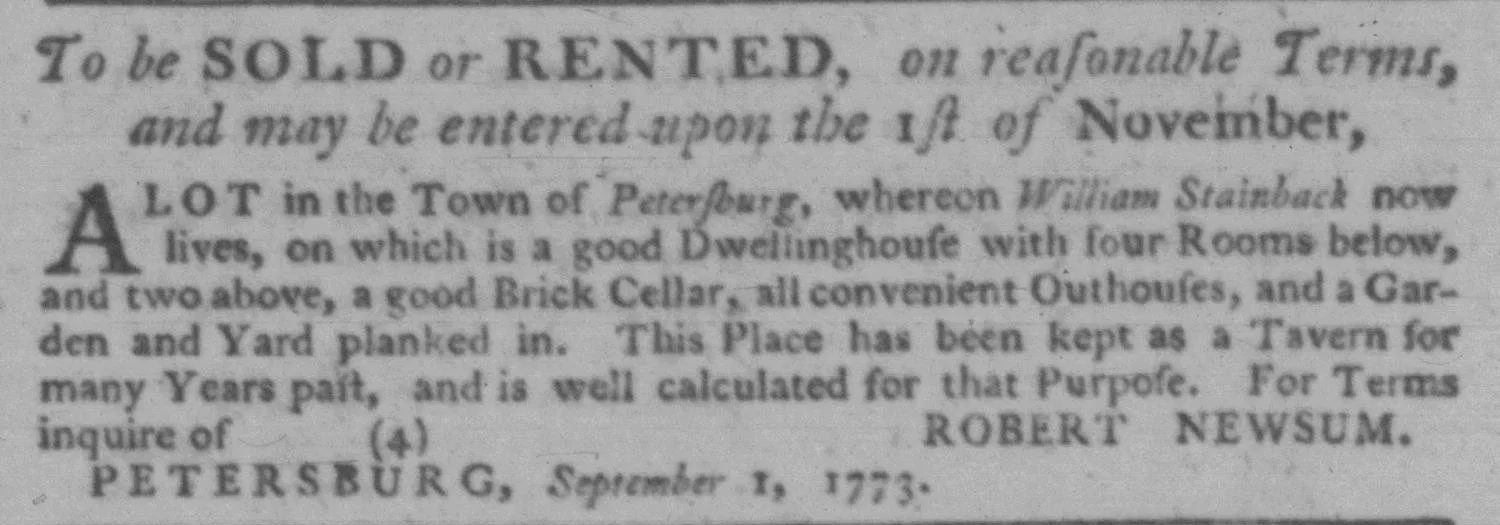
The following year, Robert was advertising property in the Virginia Gazette. A lot in the town of Petersburg, where William Stainback currently lived, had a good dwelling house with four rooms below and two above, a brick cellar, convenient outhouses, and a garden and yard. The notice noted that the place had been kept as a tavern for many years and was well-suited for that purpose. For terms, inquire of Robert Newsum.
This notice tells you something the horse theft notice did not. Robert was not just a rural landowner. He had business interests in Petersburg itself. He was advertising town property, managing transactions, and operating as the kind of person other people came to with questions about terms and conditions.
He was part of the commercial life of a Virginia town in the years just before the Revolution changed everything.
February 1776: A Ghost in Print
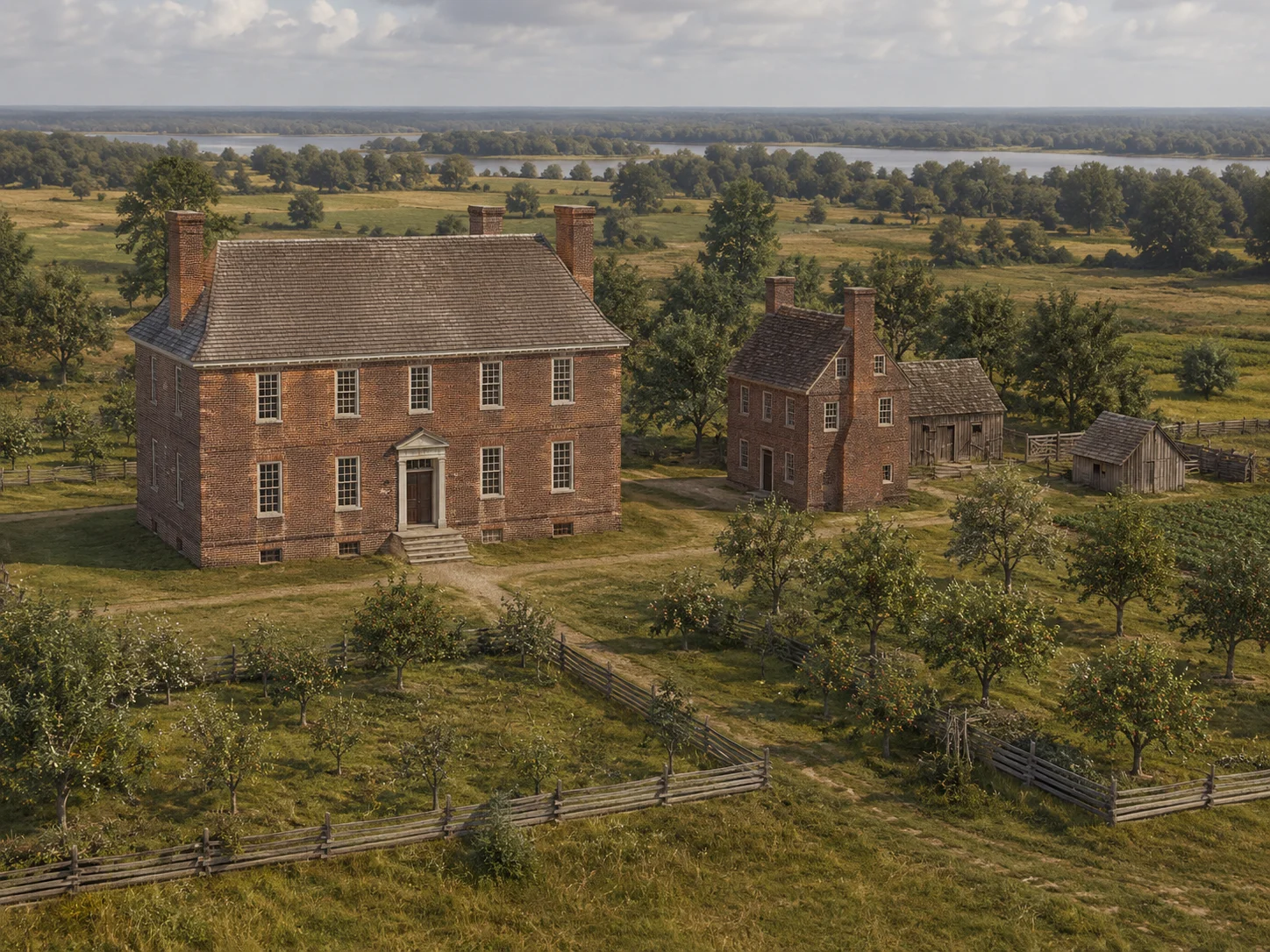
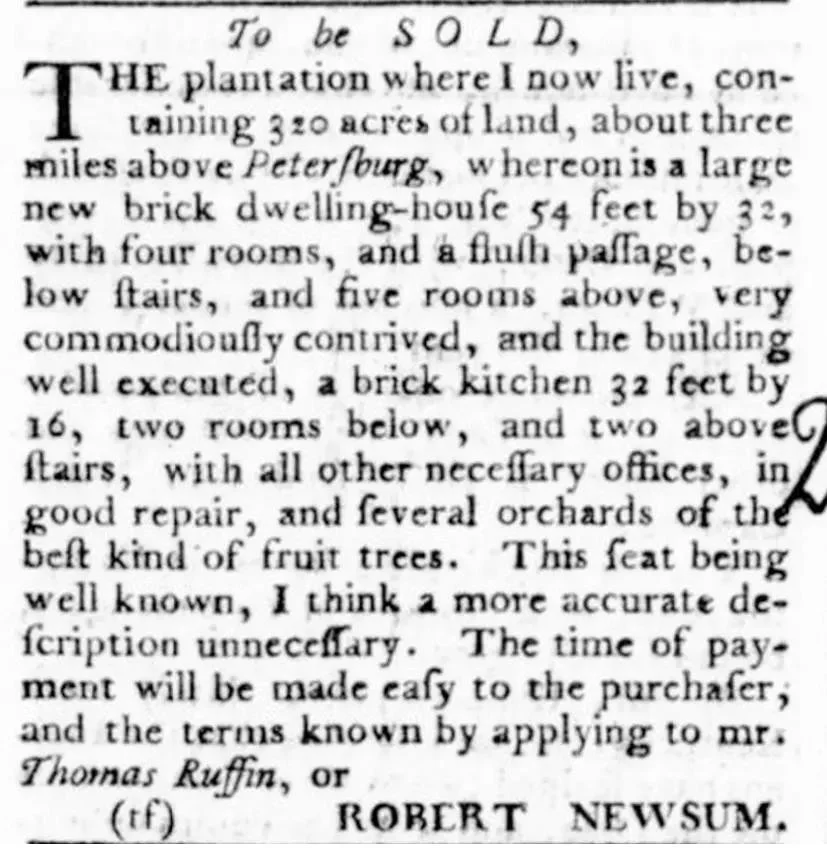
On February 23, 1776, the Virginia Gazette ran an advertisement for a 320-acre plantation about three miles above Petersburg. It described a large new brick dwelling house measuring 54 feet by 32 feet, with four rooms below and five rooms above. A brick kitchen measured 32 feet by 16 feet. There were orchards of the best kind of fruit trees and every convenience in the buildings. The terms would be easy for the purchaser. For more information, apply to Mr. Thomas Ruffin, or to the seller.
The seller's name at the bottom: Robert Newsum.
Robert Newsum had been dead for fifty-three days.
He died on January 1, 1776. The advertisement had almost certainly been written and submitted before his death. Colonial newspapers routinely ran notices for several weeks unless instructed to stop. His estate needed the property sold, so the notice kept running.
A dead man's words were still appearing in the Virginia Gazette in February 1776, addressed to any buyer who cared to inquire about the orchards and the brick kitchen and the easy terms.
While the Continental Congress was moving toward independence and Virginia militiamen were drilling outside Petersburg, Robert Newsum's plantation advertisement kept running as if he did not know yet that he was gone.
Also in February 1776: The Family Was Not Standing Still
While Robert Newsum's estate was beginning to be settled, his brother-in-law John Ruffin was doing something else entirely.
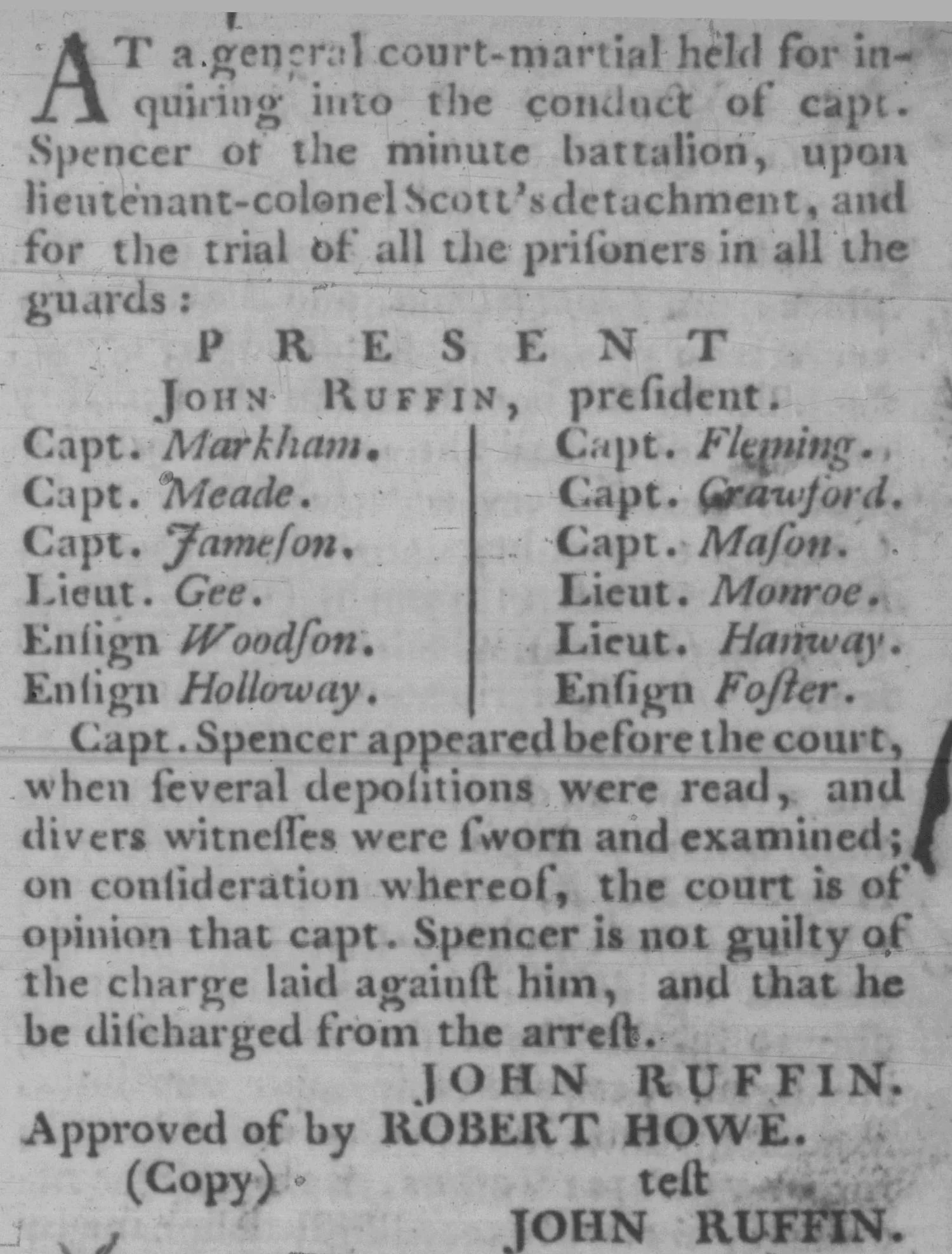
The Virginia Gazette from February 12, 1776, published the record of a general court-martial convened to inquire into the conduct of Captain Spencer of the minute battalion. John Ruffin presided as president of the court. The proceeding involved depositions, sworn witnesses, and a formal finding. Captain Spencer was found not guilty and discharged from arrest. The result was approved by Robert Howe.
John Ruffin signed his name at the bottom three times.
This was Martha Ruffin Newsum's brother. He was running military tribunals while his sister had just become a widow.
The Revolution was not an abstraction for this family. It was happening around them at the same moment they were trying to manage the ordinary business of death and property.
March 1776: Another Estate, the Same Family
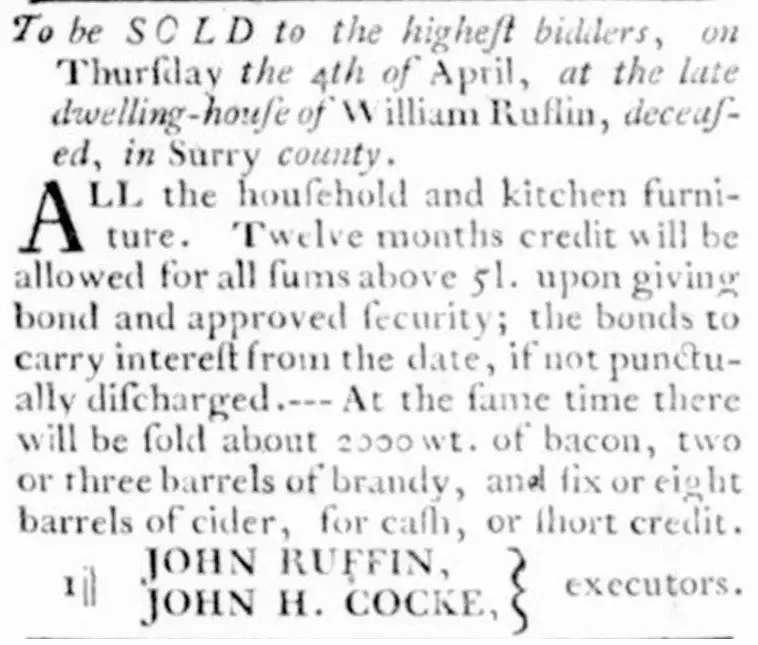
The Virginia Gazette from March 29, 1776, carried another estate sale notice. The household and kitchen furniture of William Ruffin, deceased, would be sold to the highest bidders on Thursday, the 4th of April, at his late dwelling house in Surry County. Also available for cash: about 2,000 weight of bacon, two or three barrels of brandy, and six or eight barrels of cider.
John Ruffin and John H. Cocke were named as executors.
William Ruffin was another of Martha's brothers. He had died around the same time as Robert Newsum. In the first three months of 1776, this family was settling two estates simultaneously while John Ruffin was serving in the military and Martha had just lost her husband.
The Virginia Gazette was where all of this played out in public. Estate sales, court proceedings, property advertisements. The newspaper was the record of a community trying to keep functioning while the world around it came apart.
December 1776: The Final Notice
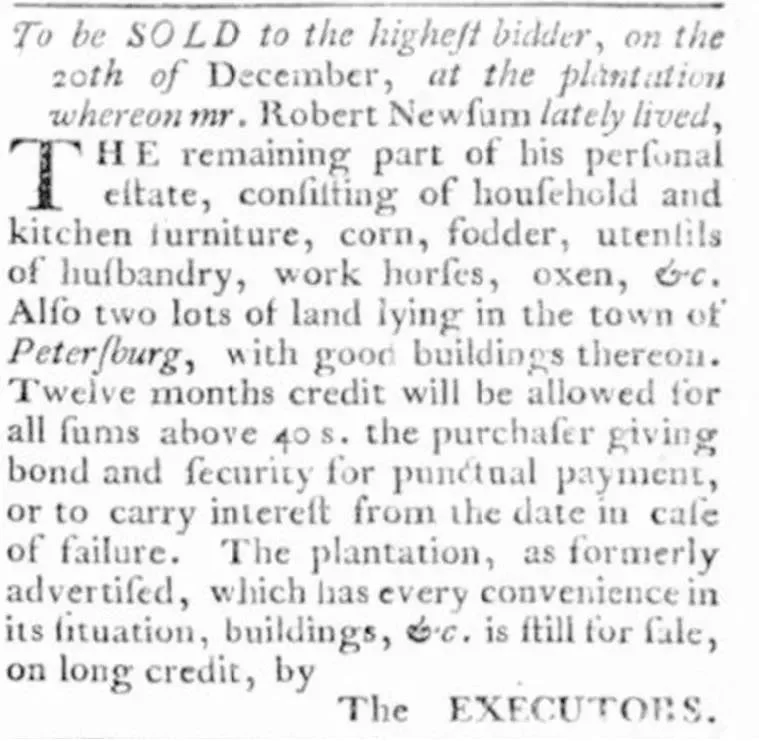
Nearly a year after Robert Newsum died, his executors ran one more notice in the Virginia Gazette. The remaining personal estate would be sold to the highest bidder on December 20th at the plantation where he lately lived. Household and kitchen furniture. Corn. Fodder. Farm tools. Work horses and oxen.
Also: two lots of land in the town of Petersburg with good buildings. The plantation itself was still for sale on long credit.
Twelve months of credit would be extended for sums above forty shillings. The executors signed simply as "The Executors."
Robert Newsum had been dead for nearly a year. His wife, Martha, was gone too. The plantation he had advertised in February was still being sold in December by the people left behind to finish what he could not.
The Virginia Gazette carried his name in print one last time, not as a man placing an ad, but as a man whose belongings were being dispersed to whoever showed up on December 20th with ready money or a promise to pay.
What This Story Took to Tell
Here is the complete list of what built Robert Newsum's story:
One horse theft notice from 1766
One marriage bond from 1772
One tavern lot advertisement from 1773
One plantation sale advertisement from February 1776
One court-martial record naming his brother-in-law, February 1776
One estate sale notice for his wife's brother, March 1776
One estate sale notice from December 1776
None of these are military records. None name a battle. None call him a hero. Together, they give you a man's life, his town, his family connections, his business interests, his death, and the world that kept moving after he was gone.
That is what newspaper research can do for an ordinary person. And ordinary is not a small thing. Ordinary is most of us.
How to Find Your Own Robert Newsum
If you have an ancestor from the colonial or Revolutionary era and are not sure where to start, here is what worked in this case.
Start with a name and a location. Robert Newsum and Petersburg gave me the 1766 horse notice almost immediately. A name paired with a county or town will often do the same.
Search a wide date range. NewspaperArchive covers the Virginia Gazette from the 1730s through the Revolution. Running a name across 1760 to 1800 can surface multiple hits across different years and notice types.
Look for the family around them. The Ruffin family notices, the court-martial record, the estate sale for William Ruffin, none of those were direct searches for Robert Newsum. They came from following family connections once the first clippings identified them.
Let the documents point to each other. The marriage bond named the Ruffin family. The Ruffin name in a February 1776 court-martial notice surfaced John Ruffin as a military officer. The March 1776 estate sale for William Ruffin appeared because John Ruffin's name was already in view. Each document suggested the next one.
Do not stop at one year. The full span of Robert Newsum's story runs from 1766 to December 1776. Searching only 1776 would have missed the horse theft notice and the tavern lot advertisement that established who he was before the Revolution arrived.
Frequently Asked Questions
Do I need military records to tell an ancestor's story from 1776?
No. Robert Newsum had no military record at all. Newspaper research works for any person who appeared in print for any reason: property transactions, business notices, legal matters, family milestones. The record types available in colonial newspapers are broad enough to build a detailed picture of someone's life without a single military document.
What if my ancestor's name is very common?
Pair the name with a county, town, or state to narrow results. Once you find one clipping, note any other names mentioned alongside your ancestor and search those too. Family members and business associates often appear together repeatedly across multiple notices.
How far back does NewspaperArchive go for Virginia?
The Virginia Gazette, published in Williamsburg, is available in the NewspaperArchive collection from the early 1700s through the Revolutionary period. It is one of the most important colonial newspaper sources for Virginia research and covers a wide range of notice types, including land sales, estate settlements, court records, and business advertisements.
My ancestor lived in a different state. Does this approach still work?
Yes. The same notice types appeared in newspapers across all the colonies and early states. Pennsylvania, Massachusetts, New York, South Carolina, and Georgia all had active newspaper cultures in the 1760s and 1770s. Search the newspaper name along with your ancestor's state and a wide date range.
What if I can only find one or two clippings?
One clipping is enough to start. Robert Newsum's 1766 horse notice establishes his name, his location, and something about his life. A single notice can anchor further research in courthouse records, family genealogies, and state archives that then point you back to more newspaper results.
Not sure where to start? The America250 Newspaper Research Checklist walks you through exactly what to look for and where.
Not Famous. Just Real.
Robert Newsum was not important in any historical sense. He did not shape events. He is not in any textbook.
But he owned a horse in 1766. He fell in love with Martha Ruffin and signed his name on a bond that still survives. He built a brick house on 320 acres above Petersburg and planted orchards he would never harvest. He died on the first day of the year the country was born, and his plantation advertisement kept running in the newspaper as if he did not know it yet.
His wife Martha lost her husband and her brother in the same season. Her other brother was presiding over military courts while all of it unfolded.
None of them are in the history books. All of them are in a newspaper archive.
The archive holds a lot of ordinary people. Yours might be one of them.