How Historical Newspapers Covered the Hatfield-McCoy Feud (And Why That Matters for Your Family History)
Learn how historical newspapers covered the Hatfield-McCoy feud and what the coverage reveals about using old newspaper archives for family history research.
The Hatfield-McCoy feud was covered extensively in historical newspapers from the early 1880s through the early 1890s, with the heaviest coverage following the New Year's Night Massacre of January 1, 1888. Local papers near the Tug Fork region, including the Big Sandy News in Louisa, Kentucky, reported the violence in detail, while papers as far away as Ohio carried the story through wider reprinting and circulation. Historical newspapers from this era also preserved ordinary community mentions of people with feud-connected surnames alongside the dramatic coverage, illustrating how newspapers captured both major events and everyday life. For genealogy researchers, searching historical newspapers from this period can help establish historical context, locate ancestors in community columns, and build a fuller picture of the world their families lived in. NewspaperArchive offers searchable access to small-town and regional papers from this era across Kentucky, West Virginia, Ohio, and surrounding states.
By the late 1880s, newspaper readers across much of the United States were encountering reports about the Hatfields and McCoys. The feud between these two Appalachian families wasn't just regional news. It traveled through wire services and reprints into papers hundreds of miles from the Tug Fork River valley, the kind of story editors kept feeding to readers who couldn't seem to get enough of it.
That reach is what makes the feud such a useful entry point for thinking about historical newspapers and family history research. The families became nationally famous because editors turned a regional conflict into a dramatic and often sensational story for readers far beyond Appalachia. But in the newspapers of the era, the Hatfields and McCoys also appeared the way your ancestors did: in local columns, in community notices, in brief items that had nothing to do with violence at all.
If you want to understand how your ancestors lived, what they read, and what shaped their world, old newspapers are one of the most direct paths you have. The Hatfield-McCoy feud is a useful illustration of why.
Quick Answer
Historical newspapers covered the Hatfield-McCoy feud from the early 1880s through the early 1890s, with the most intense coverage following the New Year's Night Massacre of January 1, 1888. Papers from local Kentucky and West Virginia titles to regional papers in Ohio ran the story. Searching newspapers from this era can help family historians understand the historical context their ancestors lived through and find their own family members mentioned in local community coverage.
If your ancestors lived anywhere in the Ohio Valley, the border states, or Appalachia during this period, try searching their names in NewspaperArchive alongside the towns and counties where they lived. Local papers from this era captured far more than the headlines.
The Feud and the Newspapers That Covered It
The Hatfield and McCoy families lived on opposite sides of the Tug Fork River, which forms the border between Pike County, Kentucky, and what was then Logan County, West Virginia. The Hatfields, led by William Anderson "Devil Anse" Hatfield, were a prosperous timber family on the West Virginia side. The McCoys, led by Randolph "Old Ranel" McCoy, farmed on the Kentucky side.
Later accounts often trace some of the bitterness to the Civil War era. Many members of both families supported the Confederacy, while Randolph McCoy's brother, Asa Harmon McCoy, served in the Union Army and was killed shortly after returning home. Historians, however, caution that no single event or dispute fully explains the violence that followed. The West Virginia Encyclopedia notes that various explanations have been offered, including differences originating in the Civil War and strains caused by the rapid industrialization of the region, but that none adequately explains the depth of bitterness between the neighbors on the Tug Fork.
Violence flared in 1882 when three of Randolph McCoy's sons fatally stabbed Ellison Hatfield, Devil Anse's brother, during an election day celebration. The Hatfields took the McCoy brothers by force, held them in West Virginia, and when Ellison died of his wounds, tied them to pawpaw bushes and shot all three dead. Their deaths became one of the feud's defining episodes and deepened the cycle of threats, arrests, revenge, and violence that followed.
The violence escalated dramatically on New Year's Night, 1888, when a group of Hatfield men crossed into Kentucky, surrounded the McCoy family cabin, set it on fire, and killed two of Randolph's children: Alifair and Calvin. The newspaper of the time reported that Sarah McCoy had been struck or shot in the head and left unconscious. Later historical accounts generally describe her as having been severely beaten during the attack. Randolph escaped into the woods in his nightclothes while, according to the contemporary report, at least fifty shots were fired around him.
That raid triggered a major wave of national coverage. Newspapers continued to revisit the feud as posses pursued suspects, courts considered the interstate arrests, defendants went to trial, and coverage continued through the February 18, 1890, execution of Ellison "Cottontop" Mounts, the only person legally executed for a feud-related crime.
What the Local Papers Were Saying
The Big Sandy News in Louisa, Kentucky, was one of the papers closest to the action. Louisa sits at the junction of the Big Sandy and Levisa Fork rivers, about 40 miles from the heart of Hatfield-McCoy territory. When the January 1888 raid happened, the paper reported it in plain, specific language.
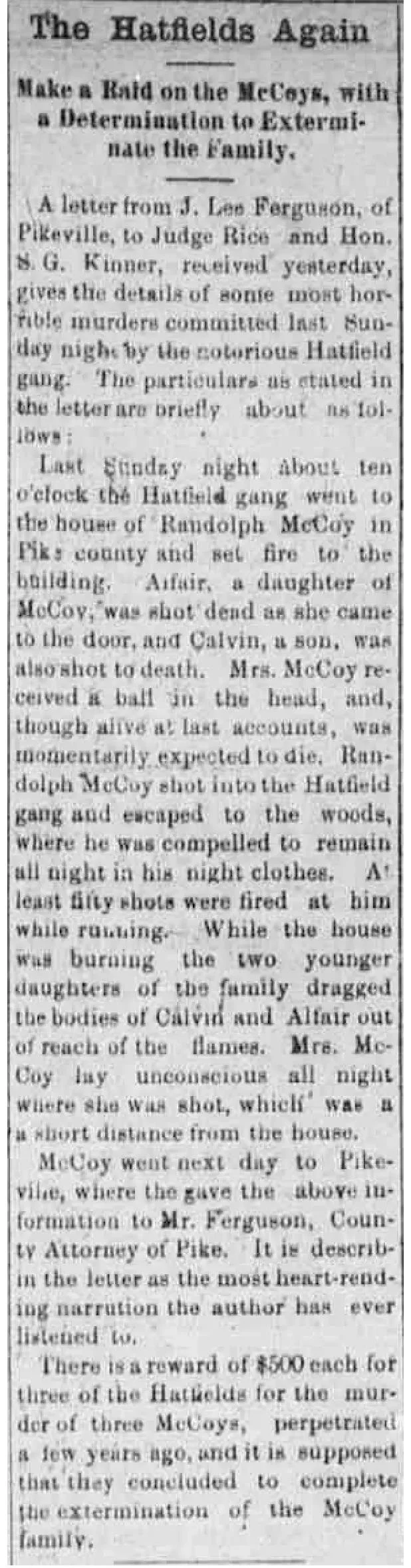
The January 5, 1888, edition of the Big Sandy News, published just four days after the raid, ran a piece headlined "The Hatfields Again." It relayed a letter from J. Lee Ferguson, the Pike County Attorney, describing the attack in detail: the cabin set on fire, Alifair shot dead at the door, Calvin killed as he tried to escape. A $500 reward had been posted for three Hatfields for earlier murders. The paper noted the raid appeared to be an attempt to finish what had started years before.
What's striking about reading this clipping today isn't just the violence. It's the geography. Ferguson wrote from Pikeville. The letter went to a judge. The Big Sandy News published it four days after the attack. That's how information moved in 1888: through letters and local editors, and then outward into papers that reprinted and relayed the reports.
A reader in a nearby Kentucky county may have encountered this same account within days of the raid.
The Same Issue, a Different Kind of Story
Here's what makes newspaper research worth your time.
In the very same January 5, 1888, issue of the Big Sandy News, readers could also find this brief community item:
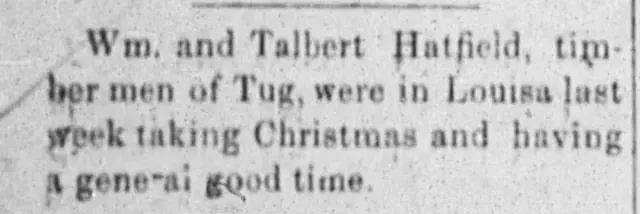
"Wm. and Talbert Hatfield, timber men of Tug, were in Louisa last week taking Christmas and having a general good time."
That's it. Two men named Hatfield, identified by occupation and home territory, in town for the holidays.
The brief notice does not establish exactly who Wm. and Talbert Hatfield were or whether either man had any connection to the feud. Nothing in the item links them to the raid. What it does show is that men carrying the Hatfield surname were also being recorded as timber workers and holiday visitors, not only as figures in reports of violence.
They could also appear in the kinds of brief community notices familiar to genealogists: visits, occupations, court matters, business activity, and local events. Elsewhere in the issue, a raid report ran that would put the Hatfield name in papers across the country. On another page, a short social item recorded two men from the same territory simply going about their lives.
That contrast is part of what makes a newspaper worth examining beyond a single article.
How Far the Story Traveled
When a story was big enough, it didn't stay in the regional papers. The Hatfield-McCoy feud became national news, and you can see that in coverage that appeared hundreds of miles from Appalachia.
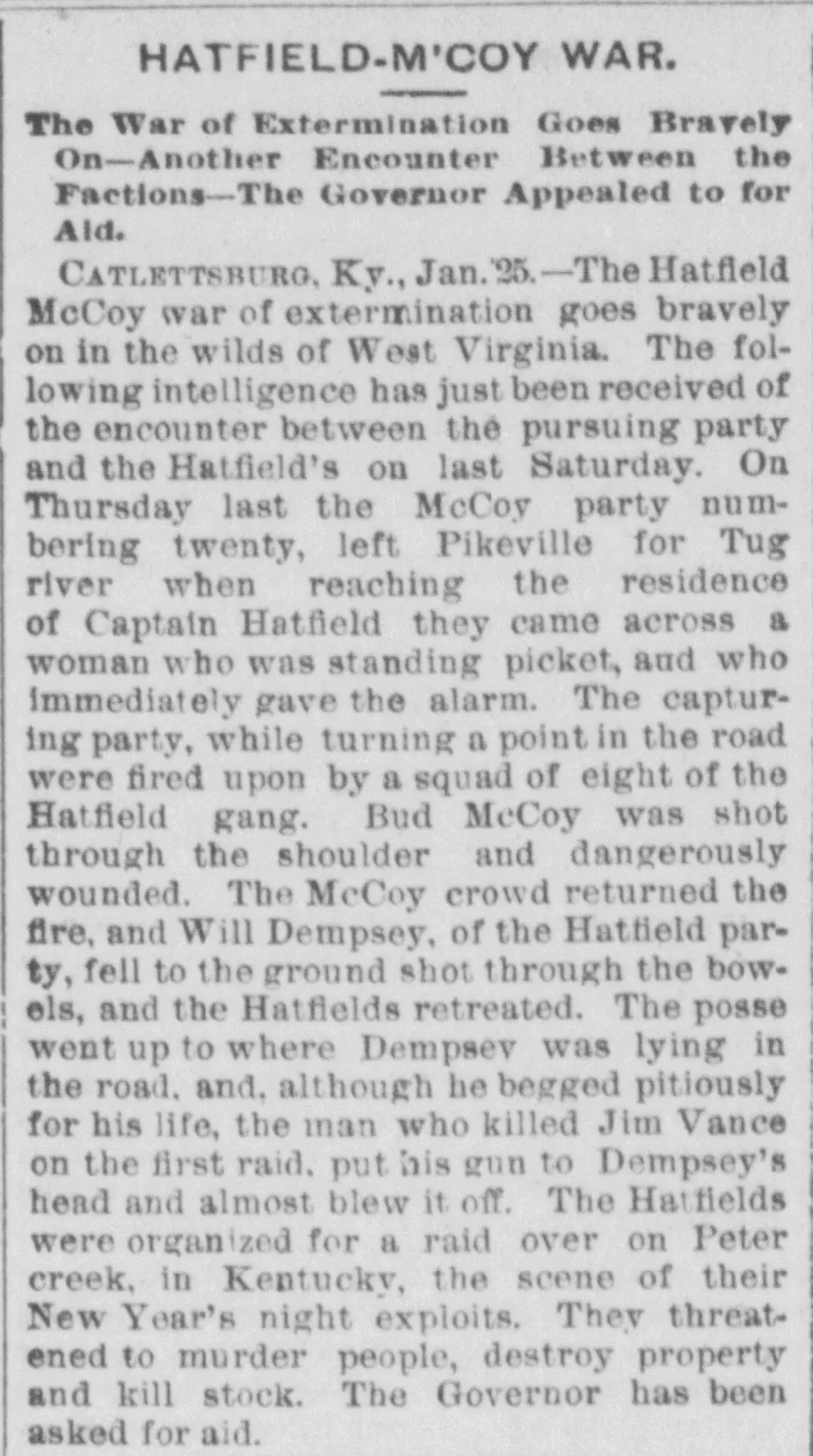
The Norwalk Daily Reflector in Norwalk, Ohio, ran a piece on January 25, 1888, headlined "Hatfield-M'Coy War." Norwalk is in north-central Ohio, nearly 300 miles from the Tug Fork. The piece carried a Catlettsburg, Kentucky, dateline and was evidently part of the wider circulation and reprinting of feud reports beyond Appalachia. It described a McCoy posse numbering twenty, leaving Pikeville for the Tug Fork, a Hatfield ambush, one man shot through the shoulder, another shot through the bowels. The governor had been appealed to for aid.
This is the research lesson here. A reader in Huron County, Ohio, in January 1888, could pick up the local paper and read about fighting on the banks of the Tug Fork River in Kentucky. That was their world too, whether or not they had ever visited Appalachia. Historical events didn't stay local. They moved through newspapers, and newspapers moved through communities.
When you search for your ancestors in old newspapers, you're not just looking for their names. You're reconstructing the world they were reading about, the events that shaped what they worried about, what they talked about, what they understood about the country they lived in.
A Note on Reading Old Newspaper Reports Carefully
One thing the feud coverage illustrates well is why newspaper accounts need to be read as products of their time and place, not simply as verified fact.
Reports were relayed through letters, recopied by editors, and sometimes garbled along the way.
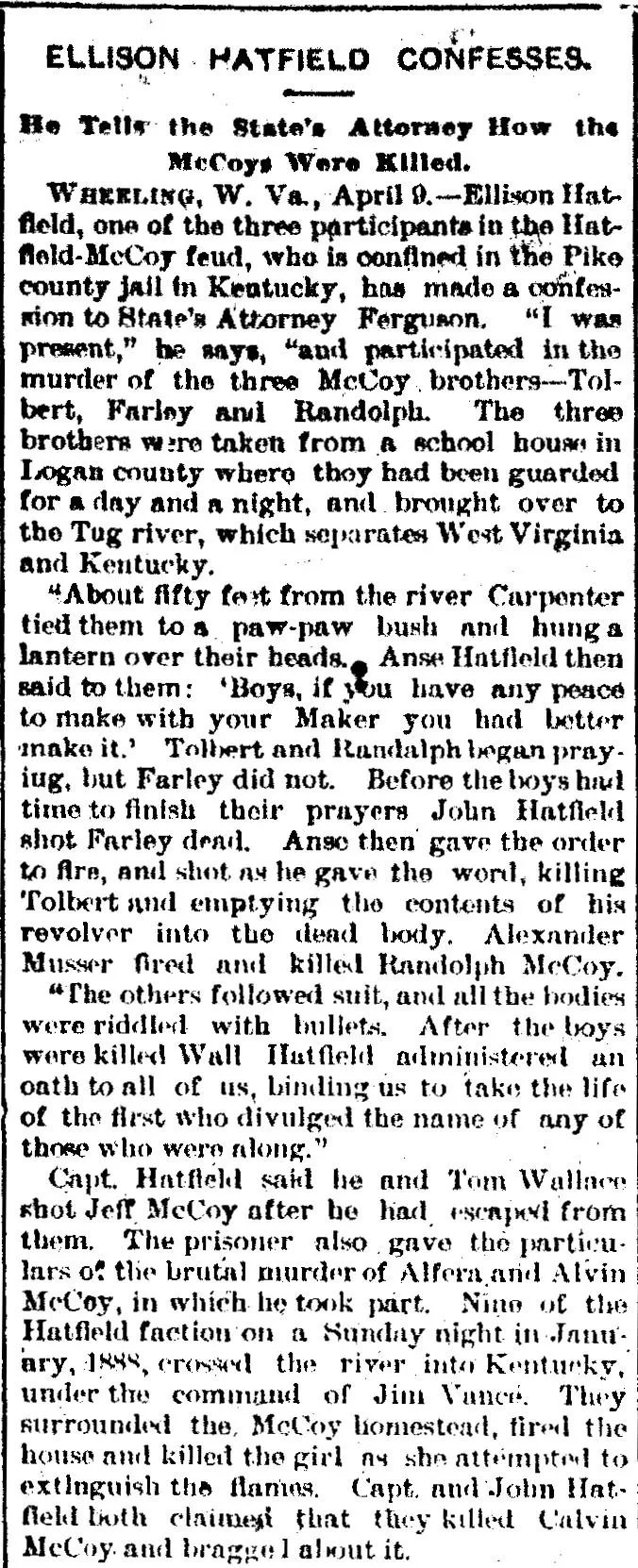
This April 1889 report from the Wellsville Daily Reporter in Ohio is a good example. It presents a detailed confession about the killing of three McCoy brothers and the New Year's Night raid, complete with direct quotes. But it identifies the confessor as "Ellison Hatfield," while the man actually prosecuted and executed was Ellison "Cottontop" Mounts, a supporter of the Hatfield faction whose exact relationship to the family was reported inconsistently across sources. The confession a newspaper printed as definitive could contain details that historians later disputed or could not fully verify.
That same caution applies to any newspaper research. A clipping is a valuable record of what was reported at a specific moment. It is not always a complete or perfectly accurate account. Names were misspelled. Relationships were misidentified. Details transmitted by letter or telegraph were sometimes compressed or changed in the telling. Treating a clipping as evidence to investigate further, rather than a final answer, is one of the most useful habits a family historian can build.
Why This Matters for Your Own Research
Most family historians start with obituaries, birth records, and marriage announcements. Those are essential. But newspapers covered life in ways that no other record type did.
The same paper that ran a national news story might also have carried a community member's name in a church social column, a property transfer notice, or a brief mention of a local business. Small-town papers in particular were built on community coverage. They named people constantly: who visited whom, who was ill, who opened a new shop, whose children attended the county school.
Here are a few practical ways to use this in your own research:
Search around major events, not just for names.
If your ancestor lived in an area touched by a significant regional event, search local papers from that period. You may find community coverage that places your family in a specific place at a specific moment.
Look at the whole issue, not just the article.
The Hatfield Christmas mention sat in the same issue as the raid coverage. Context matters. Neighboring items can point you toward related names, locations, and research threads.
Try papers from a distance.
If your ancestor lived in Ohio, Indiana, or Illinois, their local paper was still covering national and regional stories. Searching those papers can tell you what your ancestor was reading and thinking about, even when their own name doesn't appear.
Use the community columns.
Social notices, local columns, and brief mentions are where ordinary people showed up in print most often. These aren't indexed the way obituaries are, but they're searchable in a full-text archive and often reveal details that formal records never captured.
NewspaperArchive has a strong collection of small-town and regional papers from this era, including titles from Kentucky, West Virginia, and the surrounding border states. If you have ancestors from this region and time period, searching local papers alongside the major event coverage can help you build a fuller picture of where your family was and what they were living through.
Frequently Asked Questions
Were both families associated with the Confederacy during the Civil War? Many members of the Hatfield and McCoy families served or sympathized with the Confederacy, although the loyalties of individuals varied. Randolph McCoy's brother, Asa Harmon McCoy, served in the Union Army and was killed shortly after returning home. Historians do not regard Civil War loyalty alone as a complete explanation for the feud that followed.
When did newspapers start covering the Hatfield-McCoy feud? Scattered local coverage appeared through the early 1880s following the 1882 election day violence, but national newspaper coverage intensified sharply after the New Year's Night Massacre of January 1, 1888. By early 1888, papers across the country were carrying regular updates on the feud, the pursuit of the Hatfields, and the legal battles that followed.
How did the feud end? There was no single peace agreement that ended the nineteenth-century violence. Arrests, trials, imprisonment, and the weakening of the armed factions gradually brought the bloodshed to a close. Ellison "Cottontop" Mounts was hanged in Pikeville on February 18, 1890, the only person legally executed for a feud-related crime, and seven other Hatfield supporters received life sentences. More than a century later, on June 14, 2003, more than 60 Hatfield and McCoy descendants signed a symbolic formal truce in Pikeville.
Why do historical newspapers matter for genealogy research? Historical newspapers captured everyday community life in ways that official records did not. Obituaries, social columns, legal notices, business mentions, and local news items all named ordinary people, often with details about their families, occupations, neighbors, and movements. For family historians, those mentions can fill in gaps that birth and death certificates leave behind.
How do I find my ancestors in historical newspapers? Start with a name, a place, and a time period. Search both the full name and common variations. Look at local papers from the counties where your ancestors lived, and also at papers from nearby towns and cities that may have carried community news from surrounding areas. NewspaperArchive is a useful place to search, particularly for small-town papers that aren't available through other archives.
The Story Behind the Coverage
By the early 1890s, the major cycle of feud-related killings had largely subsided, although legal proceedings and the public retelling of the feud continued for years. Devil Anse Hatfield lived until 1921. Randolph McCoy survived until 1914. On June 14, 2003, more than 60 descendants of both families signed a symbolic formal truce in Pikeville.
But the newspapers from 1888 capture something that no later account quite matches: the story as it was unfolding, reported by editors who lived nearby, read by communities who were following it in real time, and printed in the same issues as Christmas notices and brief mentions of timber men passing through town.
That's what old newspapers give you. Not just the record of what happened, but the world that surrounded it.
If you have ancestors from Kentucky, West Virginia, Ohio, or anywhere in the border states region during this period, the newspapers from those decades are worth searching. You may find your family in a community column you never expected, in a paper that also happened to be running the news of the feud on another page.