What Was Actually in a 1776 Newspaper? These Ads Tell the Story.
Revolution or not, people still needed linens, spices, and a place to stable their horse. See what was actually advertised in 1776 newspapers.
Colonial newspaper advertisements from 1776 reveal a society carrying on ordinary life alongside a war. A single issue could contain a military surgeon appealing for donated bed linens to treat wounded soldiers, a merchant selling imported cinnamon and coffee, a tavern keeper announcing a new establishment, and a commanding officer ordering his regiment to rejoin General Washington immediately. Ads for land, goods, rewards for deserters, and runaway servants appeared on the same pages as war news. For genealogical researchers, these advertisements are among the most specific records in the archive, naming individuals, describing them physically, placing them in exact locations, and dating their activity to a specific week. NewspaperArchive holds colonial newspapers from Virginia, Maryland, Massachusetts, and other original colonies covering the entire Revolutionary War period.
Most people picture the American Revolution as battles, speeches, and founding documents. And it was all of that. But if you actually sat down with a newspaper from 1776, you might be surprised by what you found next to the war news.
A surgeon asking his neighbors to donate old bedsheets. A merchant selling cloves and coffee. A tavern keeper announcing he had just opened for business and had everything a gentleman and his horse might need.
The Revolution was real. So was everything else.
That is what makes colonial newspaper advertisements so valuable for family history research. They are not grand documents. They are the paperwork of daily life, and they name names. A merchant, a doctor, a commanding officer, a man described in enough detail that someone might recognize him on the street. If your ancestor was alive in 1776, there is a chance they appear somewhere in these pages -- not because they were famous, but because they bought, sold, hired, borrowed, or served alongside someone who placed an ad.
Here are five advertisements from the Revolutionary War era that show you exactly what those pages looked like.
When the Revolution Ran Out of Bandages
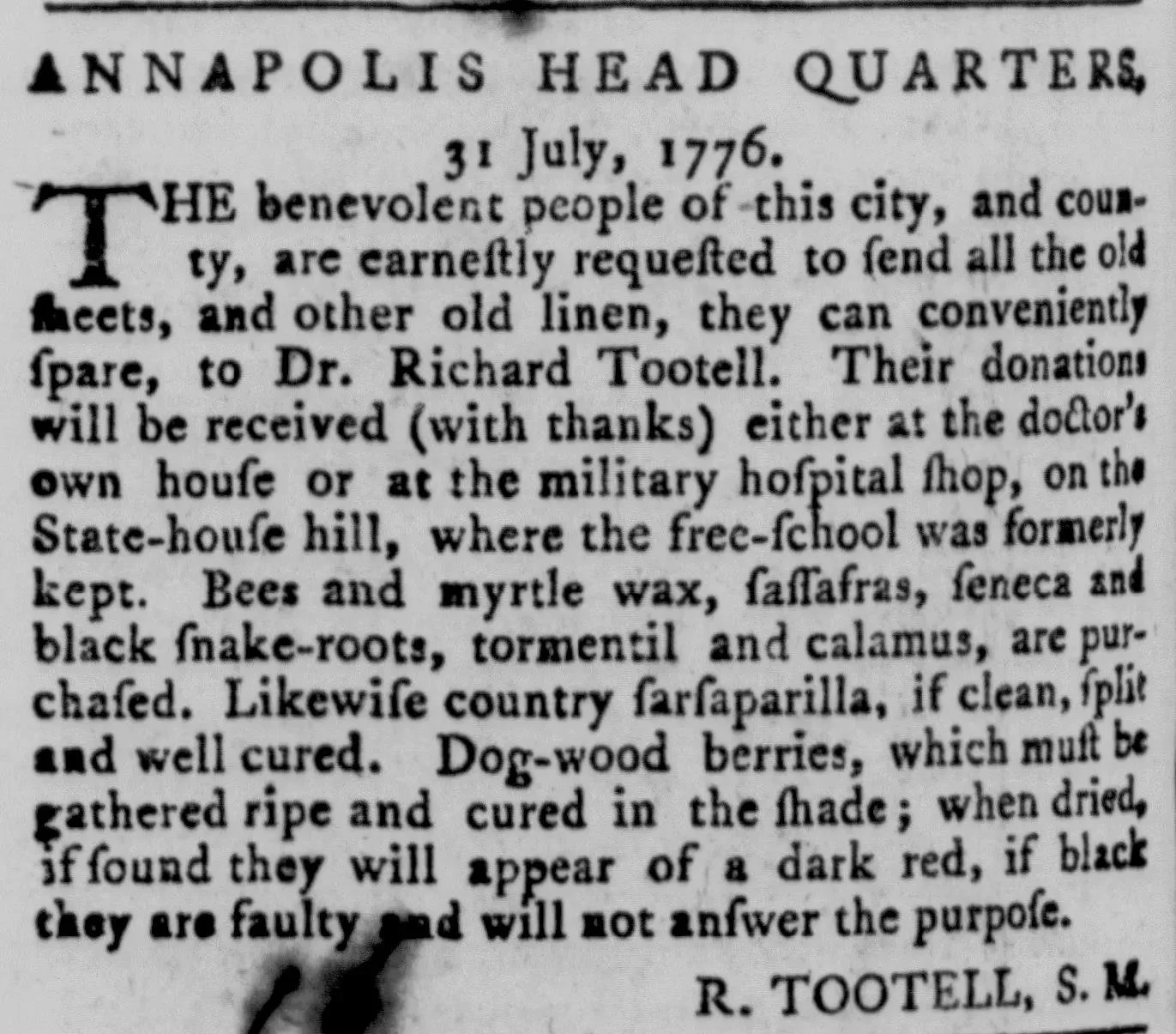
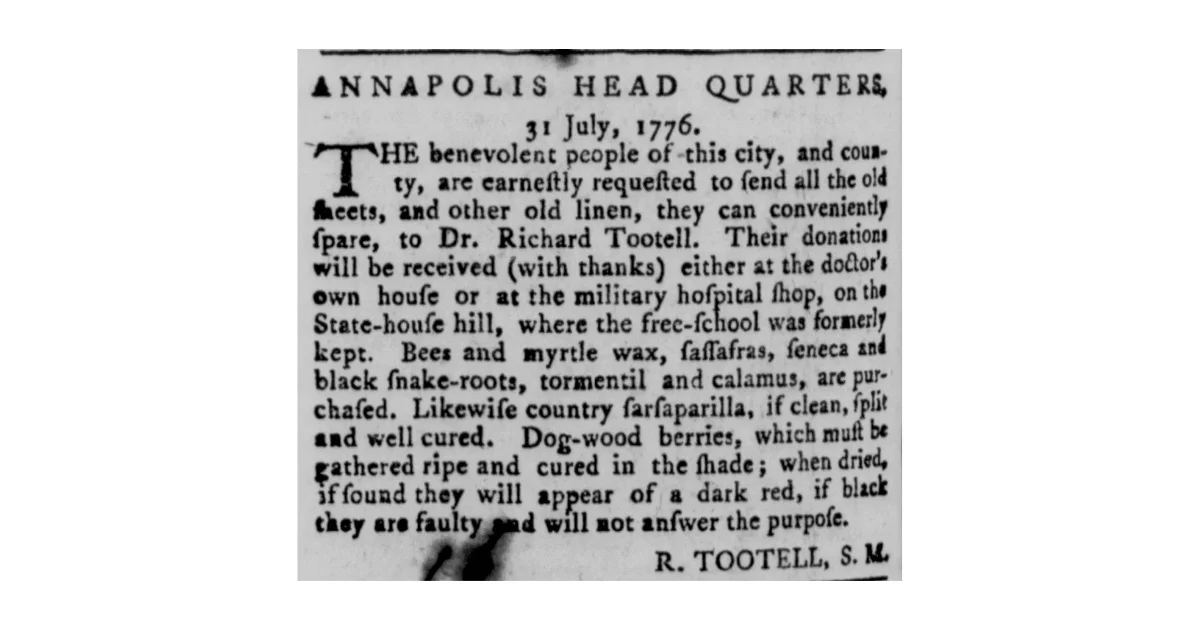
This notice ran in the Annapolis Maryland Gazette in 1776, and it is unlike almost anything a modern reader would expect to find in a newspaper.
Dr. Richard Tootell, surgeon at the Annapolis military hospital, was asking ordinary citizens to bring him their old sheets and worn-out linen. Not money. Not food. Sheets. Because that is what you made bandages from in 1776, and the army needed them.
What This Ad Tells Researchers
The notice goes further. Dr. Tootell was also buying medicinal plants from anyone who could gather them: sassafras, black snake-roots, tormentil, calamus, dogwood berries. The dogwood berries, he specified, had to be gathered ripe and dried in the shade. If found properly cured they would appear dark red. If black, they were faulty and would not answer the purpose.
That level of detail in a newspaper ad is remarkable. It tells you that civilian colonists were actively supplying the war effort not through formal channels but through the kinds of transactions that appeared in the local paper. If your ancestor lived near Annapolis in 1776, they may have read this notice, gathered plants, donated linens, or walked past that hospital on Statehouse hill.
Dr. Tootell signs himself "R. Tootell, S.M." -- Surgeon's Mate. A title that appears in no monument and on no battlefield marker. But here he is, in print, doing the work that kept soldiers alive.
Life Goes On: A Merchant in Newbury Port
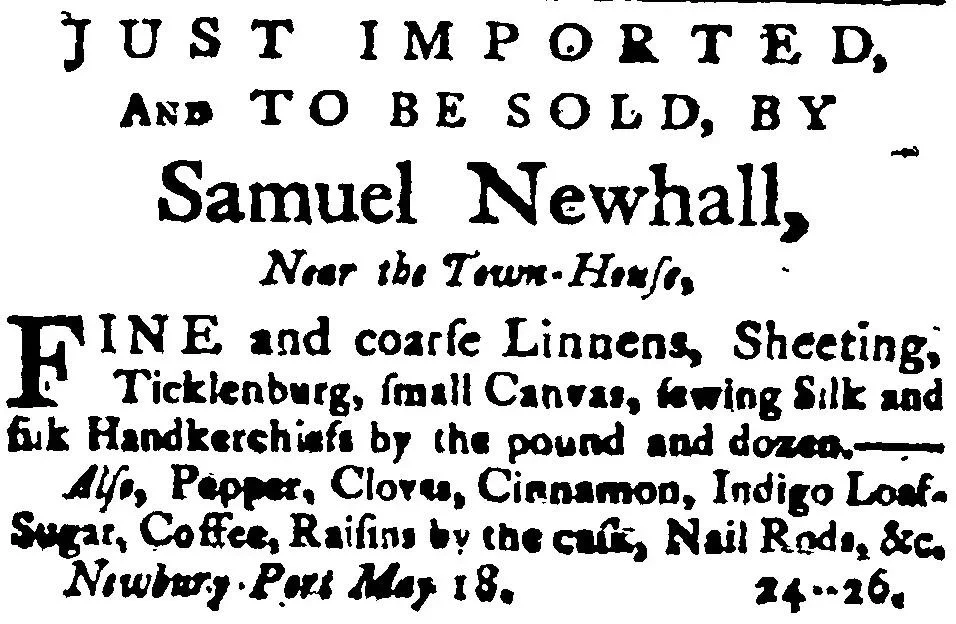
Two weeks before this ad ran, the Second Continental Congress was still debating independence. You would not know it from Samuel Newhall's advertisement.
Newhall, operating near the Town House in Newbury Port, Massachusetts, had just received a shipment and wanted you to know about it. Fine and coarse linens. Sheeting. Canvas. Sewing silk and silk handkerchiefs by the pound and dozen. Pepper, cloves, cinnamon, indigo, loaf sugar, coffee, raisins by the cask. Nail rods.
Why Merchant Ads Matter for Genealogy
This kind of ad is easy to overlook. There is no drama in a list of imported spices. But for family history researchers, merchant advertisements like this one are a useful category of record for a few reasons.
First, they place a named individual in a specific town at a specific date. Samuel Newhall was in Newbury Port in May 1776. That is a documented fact now because he placed this ad.
Second, they show community context. Someone was selling these goods. Someone was buying them. A family that lived near the Newbury Port Town House that spring might have bought their linen from this man. That puts them in the same neighborhood, at the same moment in history.
Third, merchant ads run repeatedly. A merchant who advertised in May might advertise again in August and again the following spring. Searching a name like Newhall across multiple issues can show you a business active throughout the war years, or one that suddenly went quiet.
Washington Needed More Men. Now.
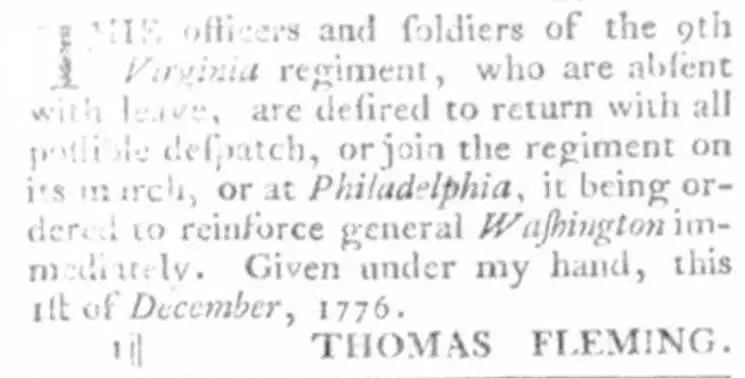
This notice is two sentences long. It is also one of the most urgent documents in this entire set.
Colonel Thomas Fleming, writing on December 1, 1776, ordered every officer and soldier of the 9th Virginia Regiment who was home on leave to return immediately. They were to join the regiment on its march, or meet it at Philadelphia. The reason: General Washington needed reinforcements without delay.
What Was Happening When This Ran
December 1776 was one of the lowest points of the entire war. Washington's army had been pushed out of New York and was retreating across New Jersey. The enlistments of thousands of soldiers were about to expire. Morale was collapsing. Within weeks, Washington would cross the Delaware on Christmas night and attack Trenton in what became one of the most famous moments of the Revolution.
Thomas Fleming was trying to get his men to that fight. And he did it the way you reached people in 1776. Through the newspaper.
For researchers, this notice is valuable precisely because it names a specific regiment at a specific moment. If your ancestor served in the 9th Virginia, this notice was directed at him. He may have read it. He may have responded to it. Searching for "9th Virginia regiment" or "Thomas Fleming" in this period will surface notices like this one that place named individuals at documented points in the war.
The Tavern That Opened During the Revolution
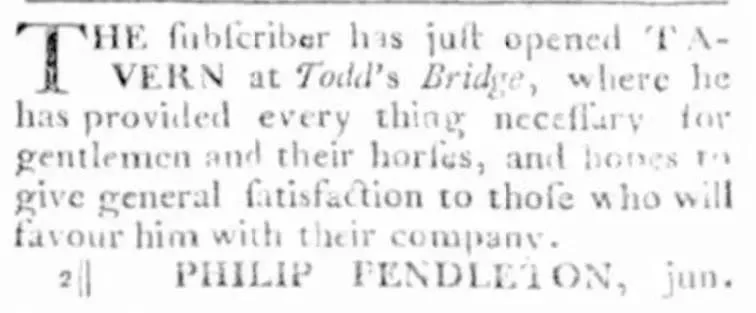
On the exact same day that Colonel Fleming's urgent call to arms appeared in the Virginia Gazette, so did this.
Philip Pendleton, jun., had just opened a tavern at Todd's Bridge. He had provided everything necessary for gentlemen and their horses. He hoped to give general satisfaction to those who would favor him with their company.
That is the whole ad. A man opening a business, same page, same date as a military emergency.
The Contrast That Makes 1776 Real
This is the detail that brings history into focus in a way that no textbook can. The war was real. People were dying. Washington needed men. And also: a man in Virginia was opening a tavern and hoping you would stop in.
Life did not pause for the Revolution. Businesses opened. Merchants sold spices. Tavern keepers advertised for customers. That is not callousness. It is the reality of how people live during periods of upheaval, trying to keep things going while history happens around them.
For researchers, tavern ads are also a useful type of record. Taverns were social hubs. A family traveling through Virginia in 1776 might have stopped at Todd's Bridge. A soldier passing through on his way to join Fleming's regiment might have eaten there. Philip Pendleton, jun., was a named person in a named place at a documented moment.
The Runaway Who Was Going to Try to Join the Army
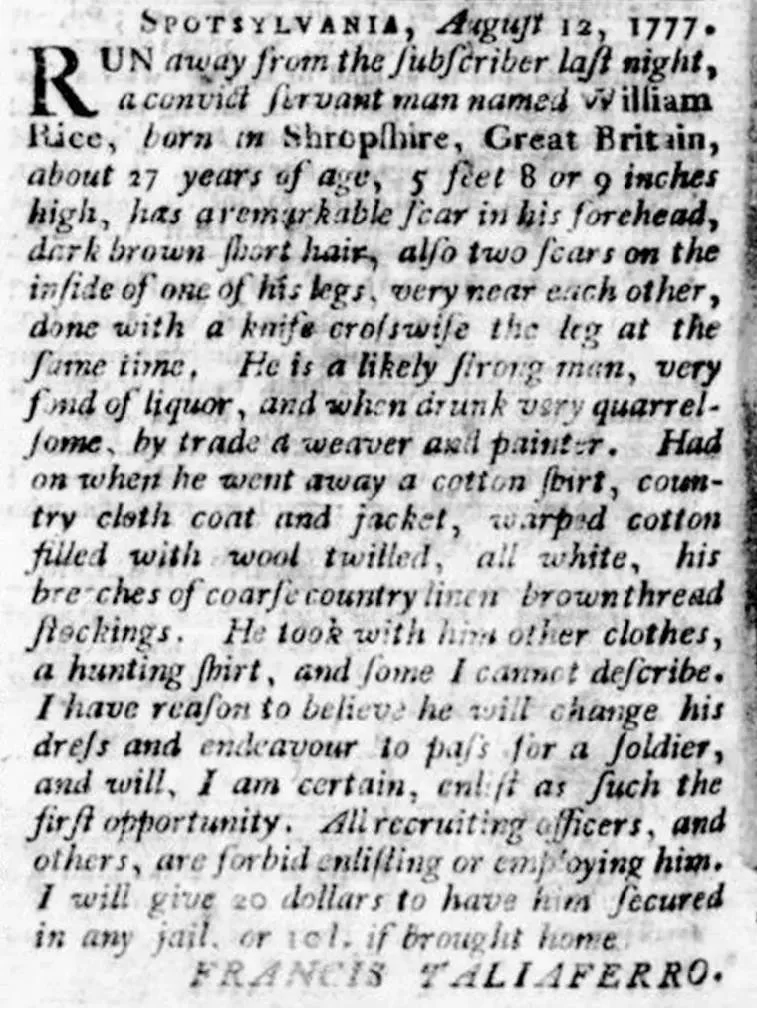
This one is the most layered ad in the set.
Francis Taliaferro of Spotsylvania was looking for William Rice, a convict servant who had run away the night before. Taliaferro described him in specific detail: born in Shropshire, England, 27 years old, 5 feet 8 or 9 inches tall, a notable scar on his forehead, two crossed scars on his leg done with a knife. A weaver and painter by trade. Fond of liquor and quarrelsome when drunk.
But the most striking part of this ad is the warning Taliaferro added at the end.
The Line That Changes Everything
Taliaferro wrote that he was certain Rice would change his clothes and try to pass himself off as a soldier. And would enlist at the first opportunity. He specifically warned all recruiting officers and others that they were forbidden from enlisting or employing him.
Think about what that tells you about 1776 and 1777. The Continental Army needed men badly enough that a runaway convict servant could walk up to a recruiting officer and sign on. Taliaferro knew it. He was trying to get ahead of it by publishing a warning in the newspaper.
The ad also tells you something about William Rice himself. He was not just fleeing an unpleasant situation. He had a plan. He was going to become a soldier. Whether he succeeded, no one knows, but this ad is evidence that the Revolution created opportunities for people who had very few options, and that newspapers were the mechanism through which those opportunities were both advertised and contested.
For researchers, runaway servant and convict notices are among the most physically descriptive records in the colonial newspaper archive. They name the person, give an age and height, describe clothing and identifying marks, and locate the employer. If William Rice appears in any later record, a pension file, a muster roll, or a later newspaper notice, the physical description in this ad becomes a tool for confirming identity.
How to Find Ads Like These in NewspaperArchive
These five advertisements came from three different colonies and span roughly two years of the Revolutionary War period. All of them are searchable in NewspaperArchive using a combination of date ranges, state filters, and keyword searches.
Search Terms to Try
Ad Type | Search Terms to Use | Date Range |
|---|---|---|
Military supply and hospital notices | "head quarters" + state name; "wanted for the army" | 1775 to 1783 |
Regiment orders and muster notices | "officers and soldiers" + regiment name; officer surname + state | 1775 to 1783 |
Imported goods and merchant ads | "just imported"; "to be sold by" + town name; "near the town house" | 1770 to 1783 |
Tavern and business openings | "has just opened" + county or town; subscriber surname + state | 1770 to 1800 |
Runaway servant and convict notices | "run away" + state; physical description keywords + county | 1770 to 1783 |
Naval and military deserter rewards | "deserted" + ship or regiment name; "reward" + state | 1775 to 1783 |
Estate and property sales | "to be sold" + county; surname + "estate" + state | 1770 to 1790 |
Which Papers to Search
Some of the most useful colonial and Revolutionary-era newspapers available in NewspaperArchive include the Virginia Gazette of Williamsburg, the Maryland Gazette of Annapolis, and the Essex Journal and New Hampshire Packet of Newburyport, Massachusetts. NewspaperArchive also includes early Pennsylvania coverage, worth searching for notices from Philadelphia and surrounding communities.
These newspapers placed reports of war, government actions, shipping, business, and everyday commercial notices side by side. That mix makes them especially useful for finding the brief departure notices shown here.
For the full guide to searching Revolutionary War newspaper records and finding your ancestor in the archive, see the America250 research checklist.
What These Ads Tell Us About 1776
A doctor collecting bedsheets. A merchant selling cinnamon. A colonel ordering his men to march. A tavern keeper hoping for your business. A landowner trying to recover a servant who was heading off to become a soldier.
These five advertisements appeared in newspapers over the course of two years while the United States was fighting for its existence. None of them are famous. None of the people in them are in history books. But they were there. They were doing things, buying things, building things, fleeing things. And they left a record.
That is the argument for looking in the newspaper archive when you research your family. History was not only made by the people at the top of the page. It was made by everyone in the columns below them, too.
Search for your ancestor in NewspaperArchive.
FAQ
What kinds of ads appeared in 1776 newspapers?
Colonial newspapers from the Revolutionary War era carried a wide variety of advertisements. Military notices, enlistment calls, orders to return to service, deserter rewards, appeared alongside ordinary commerce: land sales, imported goods, tavern openings, professional services, and estate auctions. Personal notices, such as rewards for runaway servants and property recovery ads, were also common. All of these record types name individuals and place them in specific locations, making them useful for genealogical research.
Can I find my ancestor in a colonial newspaper ad?
It depends on who they were and where they lived. Military officers and surgeons placed notices directly. Merchants and tradespeople advertised their businesses. Landowners posted reward notices. Ordinary people appear less often as the subject of an ad and more often as context, a neighbor, a customer, a community member named in passing. The more unusual a person's name or the more prominent their role, the more likely they appear. Searching NewspaperArchive by name, location, and date range is the most direct approach.
Which colonial newspapers are available in NewspaperArchive?
NewspaperArchive includes collections from several colonial and Revolutionary-era newspapers, including the Virginia Gazette of Williamsburg, the Maryland Gazette of Annapolis, and New England papers such as the Essex Journal and New Hampshire Packet of Newburyport, Massachusetts. Early Pennsylvania newspapers are also represented, although coverage varies by publication and year.
Use the state filter with a date range such as 1770 to 1783 to identify newspapers and surviving issues available for a particular area.
Are runaway servant and deserter notices considered reliable historical records?
Yes, and they are among the most detailed personal descriptions in the colonial newspaper archive. The person posting the notice had a financial reason to be accurate. They needed someone to recognize the individual they were looking for. Physical descriptions, ages, clothing, occupations, and identifying marks in these notices are generally specific and can help confirm identity when compared to other records such as muster rolls, pension files, or later census entries.
Why did newspapers carry so many different types of content on the same page?
Colonial newspapers were the primary public communication medium of the era. A single issue might carry war dispatches, political commentary, shipping news, legal notices, and commercial advertisements all on the same four pages. There was no separate classified section and no separation between news and commerce. This mixing is exactly what makes colonial newspapers so valuable for researchers. A single issue can place a named individual in context with the military, commercial, and civic events of the same week.