"I Intend to Leave the Colony": The Two-Line Notice That Opens a Life
A two-line notice in an old newspaper can place your ancestor in a town, name their business partners, and open a story you never expected to find.
Departure notices in colonial and early American newspapers were brief public announcements placed by individuals who were about to leave their colony or state for an extended period. Their legal purpose was to settle financial obligations before travel: creditors could come forward to collect debts, and people who owed money to the departing person were put on notice to pay up. These notices appear throughout American newspapers from the 1760s through the mid-1800s and were so standardized that multiple notices often ran on the same newspaper page using nearly identical language. For genealogy researchers, departure notices establish a person's presence in a specific location on a specific date, may name appointed attorneys or business partners, and can document travel patterns, health crises, and community networks. The phrase "intends to leave the colony" was common in the pre-independence era and can help narrow a date range, though political language shifted gradually and unevenly across regions, so the term should be treated as a clue rather than a definitive date marker. After independence, notices shifted toward "intends to leave the state," though wording varied by location and printer. Researchers can find these notices in NewspaperArchive by searching a surname alongside phrases like "intend to leave," "intending to leave the state," or "leave the colony." Coverage varies by state, newspaper title, and year, so researchers should check what survives for a specific place and period before searching.
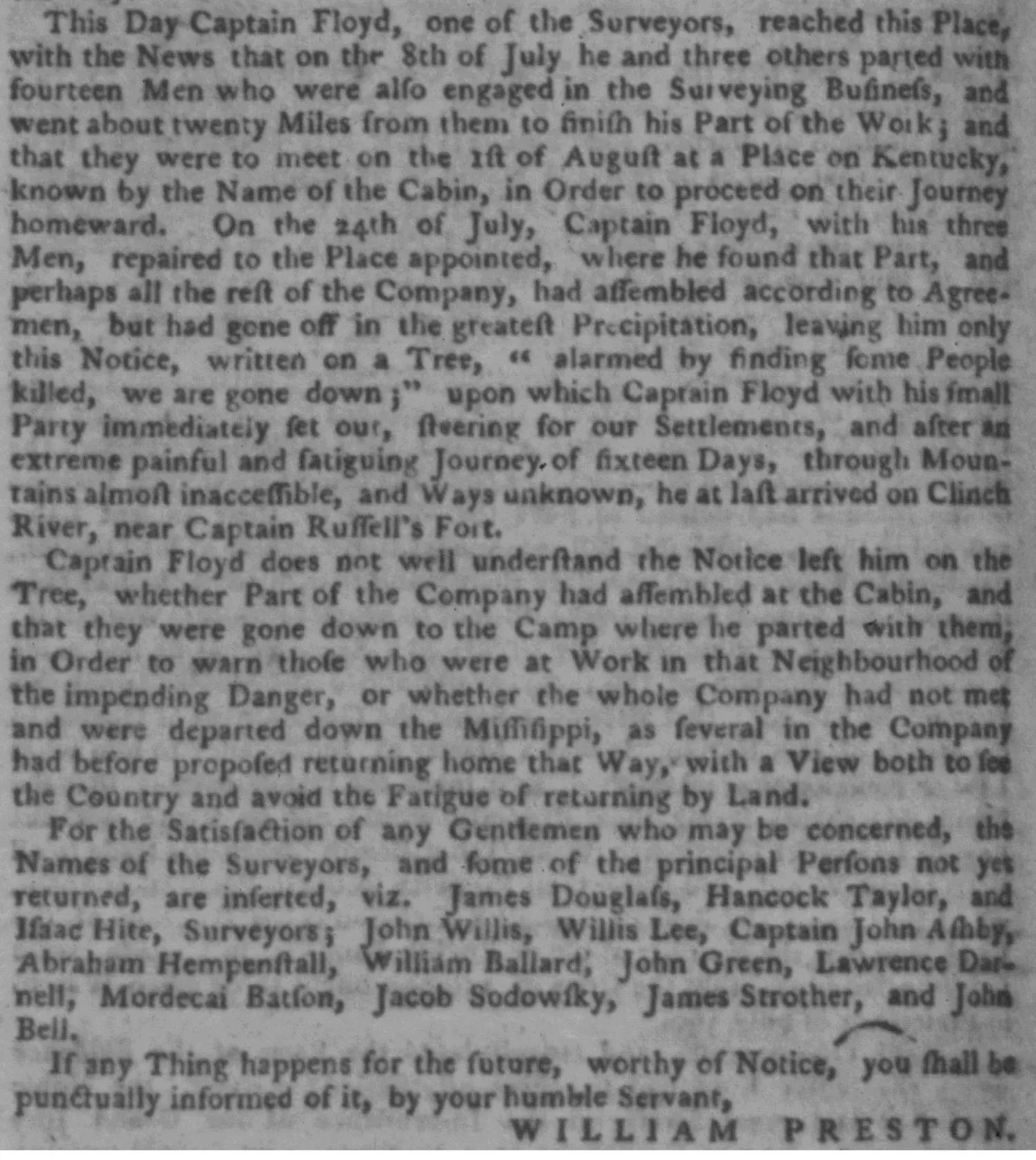
In the fall of 1774, Captain John Floyd was somewhere in the Kentucky wilderness. Lost.
He had parted from his surveying company on July 8th to finish his section of the work. They were to meet on August 1st at a place called the Cabin, on the Kentucky River, and head home together. When Floyd arrived at the meeting point with his three men, the others were gone. In their place was a note carved into a tree.
Alarmed by finding some people killed, we are gone down.
Floyd led his small party out on foot. Sixteen days through mountains that William Preston, his commanding officer, later described as "almost inaccessible." They came out at Clinch River, near Captain Russell's Fort, half-starved and exhausted. Preston published the account in the Virginia Gazette in September 1774, naming Floyd by rank and listing the men still unaccounted for.
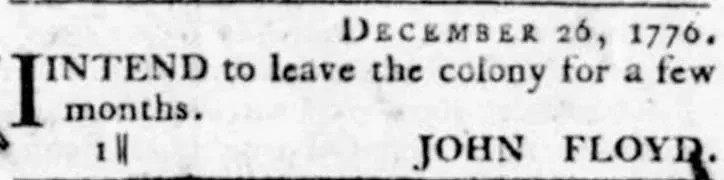
Two years later, on December 26, 1776, the same Virginia Gazette published this:
I intend to leave the colony for a few months.
Signed John Floyd.
That is the entire notice. Two lines. No explanation. No attorney named. No creditors called forward.
But you already know who John Floyd was.
Why Men Placed These Notices
The departure notice was a practical institution in colonial and early American life. When a person of any standing left their colony or state for a significant stretch of time, business did not pause for them. Debts continued to come due. Customers kept walking into stores. Anyone with a financial claim against the person needed to know where to direct it.
The notice solved this in a single public announcement. If you had a claim against the person, come forward now. If you owed them money, pay it now or deal with the appointed attorney. One printing in the local paper gave creditors, debtors, customers, and business associates public notice of the person’s plans and instructions.
David Blair's notice from Fredericksburg, February 14, 1776, shows how a fuller version worked.
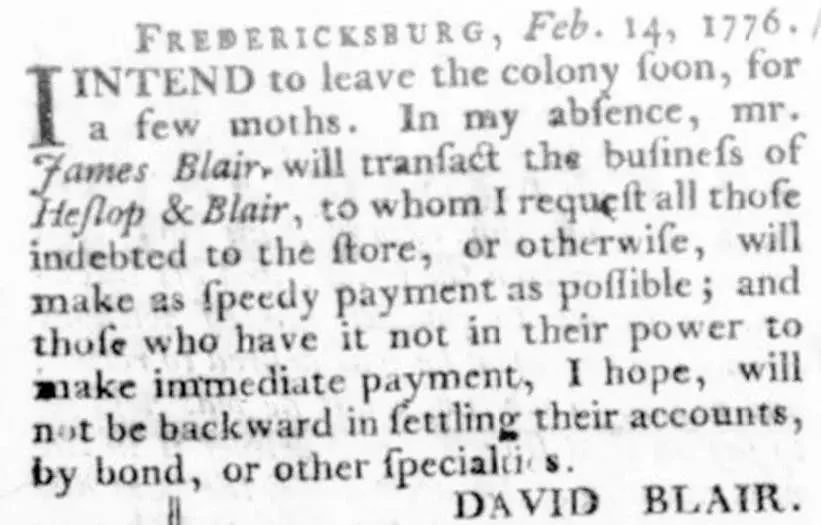
Blair named his replacement: Mr. James Blair, who would handle the business of Heslop and Blair while he was away. He asked those who could pay to do so promptly, and told those who could not to at least settle the account by bond. The notice gives you a business name, a trusted associate, a location, and a date. Four pieces of information from a notice that takes thirty seconds to read.
Now look at what the Virginia Gazette was publishing just weeks later.
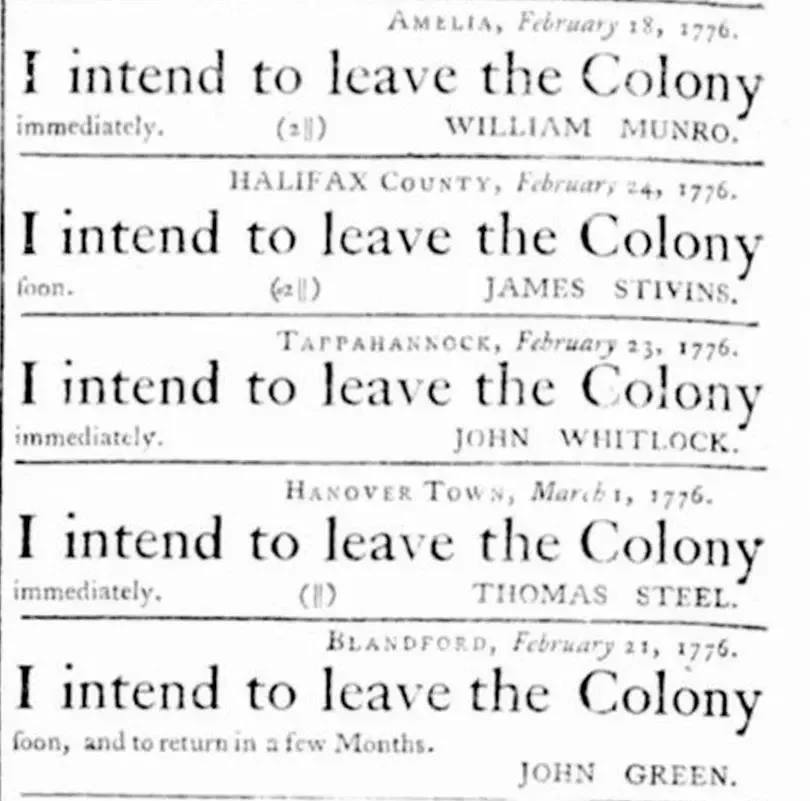
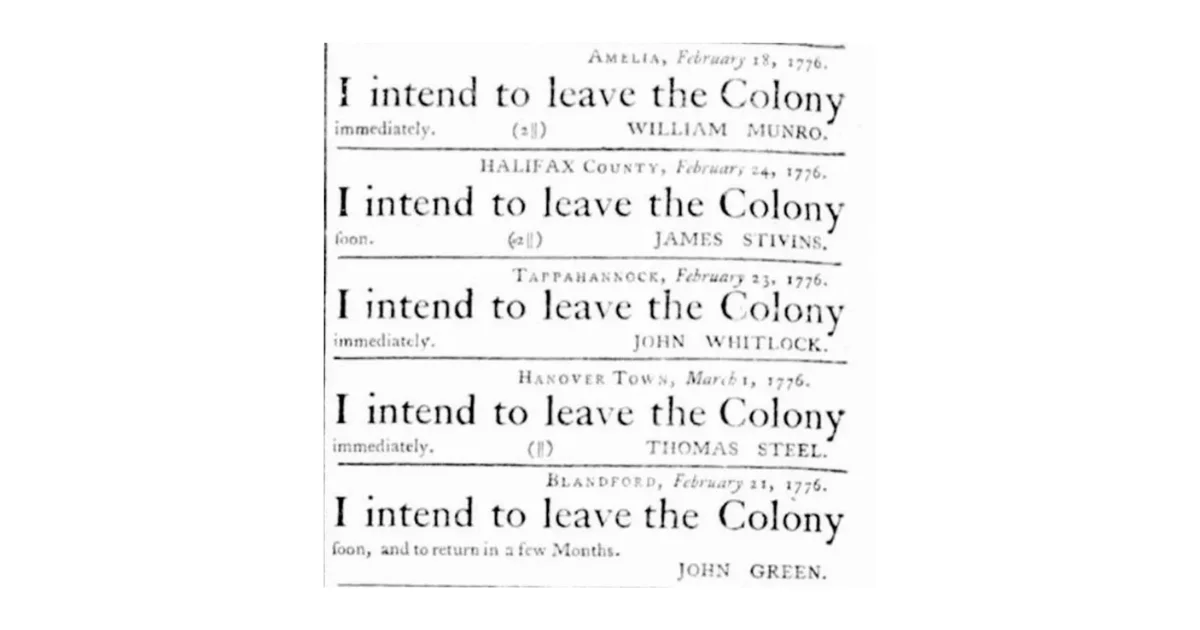
Five men. Five Virginia towns. Five notices using the exact same phrase, stacked one after another on the same newspaper page.
William Munro, Amelia. James Stivins, Halifax County. John Whitlock, Tappahannock. Thomas Steel, Hanover Town. John Green, Blandford.
They likely did not know each other. They did not coordinate. They were scattered across Virginia, from the Piedmont to the Northern Neck. But they all reached for the same familiar phrase and placed the same two words at the top of their notice: I intend.
This was not personal expression. It was a formula. And that formula is exactly what makes these notices findable more than two hundred and fifty years later.
Two Men Leaving Together
Sometimes the notice names more than one person.
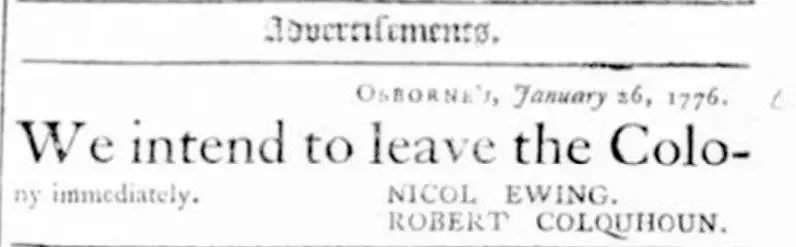
Nicol Ewing and Robert Colquhoun, Osborne's, January 26, 1776.
"We intend to leave the Colony immediately."
They placed the notice together. That joint signature documents a relationship. They were business partners, travel companions, or both. The notice does not explain. But it names them in the same place on the same day, and that is a documented connection that can anchor further searching in land records, court minutes, and other newspapers.
The Language Tells You When
One detail in these notices matters more than it might appear at first.
Every clipping in this collection uses the word "colony." Not "state." Colony.
That word is a timestamp.
Virginia declared itself a commonwealth in June 1776. The Declaration of Independence came in July. By 1777 and certainly by 1778, newspaper notices were shifting to "state" in their language. The men who placed notices using "colony" in early and late 1776 were writing at the exact hinge point of American history, in the months when the political language itself was changing under their feet.
For a researcher, that word tells you something a date alone cannot. The word “colony” can help narrow the likely period, especially when compared with notices using “state.” But political language did not change everywhere at once. Printers and advertisers continued using familiar wording during the transition, so the term should be treated as a clue rather than proof of a specific date.
The Convention Traveled
This was not only a Virginia practice. The same formula appeared in newspapers up and down the eastern seaboard and continued for decades after independence.
By 1800, the Savannah Columbian Museum and Savannah Advertiser was running the same type of notice in Georgia, with the same structure and purpose, now using "state" in place of "colony."
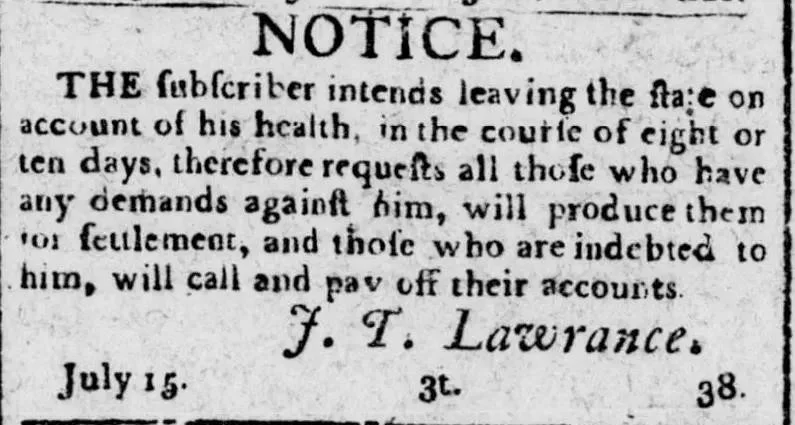
J.T. Lawrance left for his health. He gave creditors eight to ten days to find him. The health detail is easy to overlook, but for a genealogy researcher it is worth noting. A notice placed for health reasons may precede an obituary, a change of permanent address, or a long absence from the local record. It can mark a turning point.
N. McLeod's notice from March of the same year adds the attorney appointment that the Lawrance notice omits.
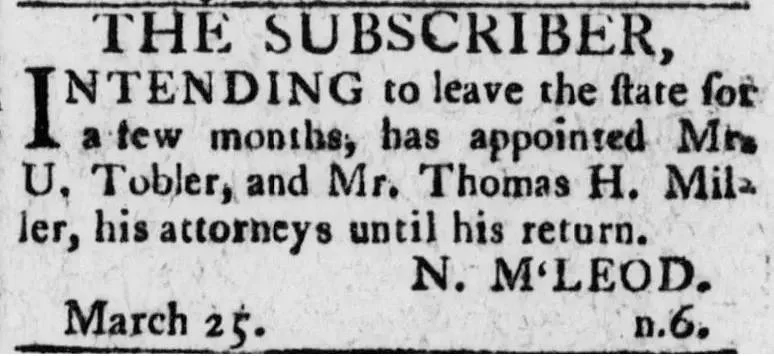
McLeod appointed two attorneys: Mr. U. Tobler and Mr. Thomas H. Miller. Those names are now part of his paper trail. They were trusted enough to handle his legal and financial affairs in his absence. If McLeod is your ancestor, those two men are worth finding in their own right. They place him in a network.
From a note carved on a Kentucky tree in 1774 to a two-line notice in a Williamsburg newspaper in 1776 to a Savannah merchant settling accounts before a health trip in 1800, the same human need drove the same newspaper practice for more than a generation. Someone was leaving. They needed to say so in public, settle what they owed and what was owed to them, and name someone to hold the fort.
The archive kept all of it.
What Happened to Captain Floyd
John Floyd came back from Kentucky in 1774. He came back from wherever he went in December 1776. He survived the Revolution, settled permanently in Kentucky, and was elected to the Virginia legislature.
On April 9, 1783, nine days before his 34th birthday, he was ambushed near his station in Jefferson County, Kentucky, by a raiding party. He died of his wounds the following day. The Treaty of Paris, which officially ended the war he had helped fight, was still months away from being signed.
His two-line notice in the Virginia Gazette is one of the few places he appears in the newspaper record as a private individual rather than an officer or a political figure. He was simply a man settling his affairs before a journey. The archive preserved it alongside the survival account from 1774, the notices from five strangers who used the same words in the same weeks, and the Savannah merchant who placed the same kind of notice a generation later.
That is what a two-line newspaper notice can hold when you know where to look.
How to Find These Notices in Newspaper Archives
Departure notices are scattered throughout early American newspapers, typically in the back pages alongside legal and commercial advertisements. They rarely carry headlines beyond the opening phrase itself. The most reliable way to find them is to search for the characteristic language they used.
Search terms that work:
"intend to leave the colony"
"intends to leave the state"
"intending to leave the state"
"leave the colony for a few months"
"those who are indebted to him"
"demands against him" combined with a surname
The phrase structure was consistent across decades and regions. Try a surname alongside any of these phrases, or search the phrases alone within a specific state or date range to browse what the archive holds.
Date ranges and language to expect:
Period | Language worth trying | Research note |
|---|---|---|
Before 1776 | “leave the colony” | Common wording in colonial notices |
1776 to early 1780s | Search both “colony” and “state” | Political language did not change everywhere at once |
1780s to early 1800s | “leave the state” | Often appears with debts, accounts, attorneys, or business arrangements |
After 1800 | Search multiple variations | Wording became less predictable and differed by location |
States with strong NewspaperArchive coverage for this notice type:
NewspaperArchive includes particularly useful early coverage for this type of search in Virginia and Georgia, along with selected Revolutionary-era newspapers from Pennsylvania and Massachusetts. Coverage varies considerably by state, title, and year, so researchers should check the location and publication pages before assuming a newspaper survives for a particular place and date.
Frequently Asked Questions
What is a departure notice in a colonial or early American newspaper?
A departure notice was a brief public announcement placed by someone who planned to leave their colony or state for an extended period. Its purpose was to give creditors a chance to collect before the person left, and to put debtors on notice to settle their accounts. These notices appear regularly in American newspapers from the 1760s through the mid-1800s and followed a consistent formula across regions and decades.
Why does the notice say "colony" instead of "state"?
Language shifts take time. Virginia declared itself a commonwealth in June 1776 and the Declaration of Independence came in July, but the word "colony" stayed in casual and printed usage for months afterward. A notice using "colony" was likely placed before mid-1777. For researchers, that word can help narrow a date range even when other dating information is unclear.
What can a departure notice tell me that other records cannot?
It places your ancestor in a specific town on a specific date. It may name attorneys or business partners they trusted, giving you new people to follow. If your ancestor left for health reasons, the notice may precede a significant event such as a death or permanent relocation. And because the language was so standardized, these notices are genuinely searchable across large collections without knowing much else about the person.
What does it mean when two people sign a departure notice together?
A joint notice documents a relationship. The two people were business partners, travel companions, or both. The notice does not explain the connection, but it names them together in the same place on the same date, and that documented pairing can anchor searches in land records, court minutes, and other newspapers.
How is a departure notice different from an estate notice or a legal notice?
A departure notice is placed by a living person who is about to travel. An estate notice appears after someone has died, initiating the probate process. A legal notice might involve a court action, a land transaction, or a debt judgment. Departure notices are voluntary, forward-looking announcements placed to protect both the traveler and their creditors.
If the notice names an attorney my ancestor appointed, is that person worth searching?
Yes. Appointed attorneys were trusted associates, often neighbors, business partners, or family members. Searching that name in the same newspaper and date range frequently surfaces additional connections: property notices, court appearances, and community roles. One departure notice can open several new research paths through the people it names.