Women and the Revolution: How to Find Female Ancestors in Historical Newspapers
Old newspapers recorded women of the Revolutionary era more than you might think. Here's how to find your female ancestors in historical newspaper records.
Historical newspapers recorded women of the Revolutionary era in several distinct record types. Widow pension notices appeared in regional papers beginning after 1838 legislation extended pension benefits to widows of Revolutionary War soldiers; these notices name the widow, her late husband, his regiment or unit, and sometimes the county where she filed. Marriage notices from the 1770s through the early 1800s name women by their full maiden name alongside the groom's name and occupation. Death notices for women who reached extreme old age in the mid-1800s frequently identify them as widows of Revolutionary War soldiers, with details about their husband's service and the number of descendants they left behind. Community tribute coverage in local and regional papers occasionally named women directly for acts of courage or loyalty during the war, particularly in South Carolina, Virginia, and other states where British and Loyalist activity brought conflict into civilian life. Researchers can find these records in NewspaperArchive by searching a woman's maiden or married name, her husband's name combined with "widow," or phrases such as "widow of a Revolutionary soldier," "pension," and "relict of." Searching by county or state and narrowing to the relevant date range increases the likelihood of surfacing specific results.
Quick Answer
Historical newspapers recorded women of the Revolutionary era in several distinct record types: widow pension notices (especially after 1838), death notices identifying women as widows of soldiers, marriage notices naming women by their full maiden name, and occasional community tribute coverage recognizing women for specific acts of loyalty or courage. Researchers can find these records in NewspaperArchive by searching a woman's maiden or married name, her husband's name combined with "widow," or phrases such as "widow of a Revolutionary soldier" and "relict of."
Women and the Revolution: How to Find Female Ancestors in Historical Newspapers
The story of the American Revolution was not just written by generals and statesmen. It was also lived by women who kept farms running while their husbands were away, raised children in the middle of a war, refused to give information to enemy soldiers, and filed pension papers decades later to prove what their families had sacrificed.
Newspapers recorded all of it. Not in the same volume they recorded men, and not always by name. But the records are there, and once you know where to look, they tell stories that no other source quite matches.
This post covers the specific types of newspaper records that name women from the Revolutionary era, the decades in which each type appears, and how to search for them in NewspaperArchive. For women who became famous for their roles in the war, see the companion post Molly Pitcher and the Women Old Newspapers Never Forgot.
What Record Types Name Women from the Revolutionary Era
Widow Pension Notices
The most useful newspaper record for finding female ancestors connected to the Revolution is the widow pension notice. But there is a catch: most of these notices appear later than you might expect.
Congress passed the first widow pension legislation in 1838. Before that, widows of Revolutionary War soldiers generally had no legal path to a pension on their own. The 1838 act changed that, followed by additional legislation in 1848 and 1853 that broadened eligibility and increased the number of women filing claims.
When a widow filed her petition with Congress, it was sometimes noted in regional and national newspapers. These notices are brief, but they are specific. They name the widow, her late husband, and often his unit or service record. They also establish her location and the fact that she was still living decades after the war ended.

The Susanna Titus notice from the Washington National Intelligencer in 1839 is a good example of how these records work. The notice is only two sentences. It names Susanna, names Solomon, and tells you that her petition went to the Committee on Revolutionary Pensions. That is enough to confirm she was alive in 1839, that Solomon Titus had served in the Revolution, and that she was fighting to claim what she was owed.
From one small notice in a newspaper, you now have a name, a husband, a date, and a paper trail to follow.
How to search: Try the widow's name plus "pension." Try her husband's name plus "widow." Try the phrase "widow of a Revolutionary soldier" in a date range from 1838 to 1860. State filtering can help narrow results when you know the county where the family lived.
Death Notices Identifying Widows of Soldiers
Some of the most detailed newspaper records for Revolutionary War widows appear not as pension notices, but as death notices written when the women themselves died. By the 1840s, 1850s, and 1860s, women who had been young wives during the Revolution were dying in their 80s and 90s. Newspapers often noted their connection to the war directly in the death notice.
These notices tend to include the woman's name, her age, a reference to her late husband's service, and sometimes a count of the descendants she left behind. When a woman had lived to extreme old age, newspapers treated the death notice almost as a local history record.
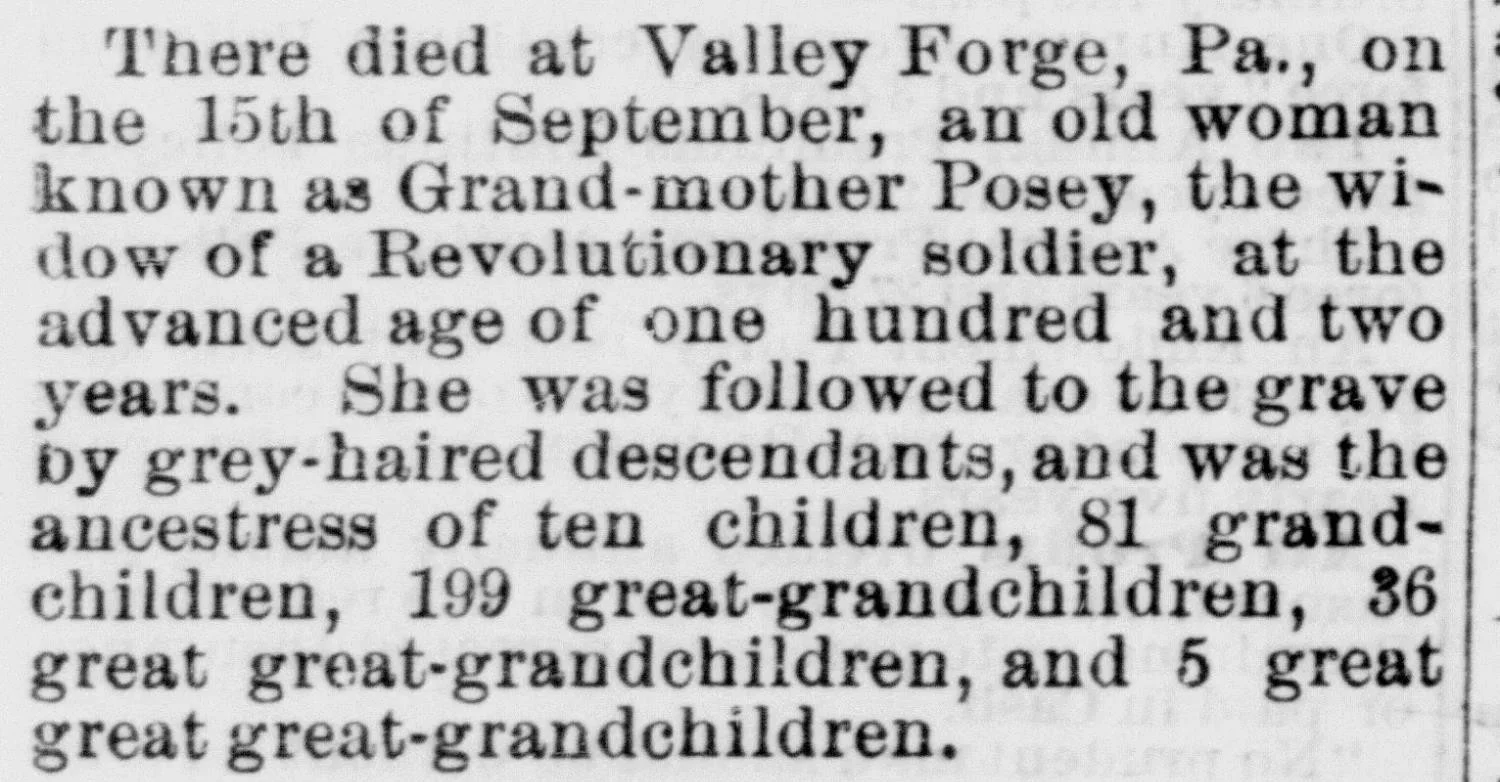
The notice for Grandmother Posey, published in the Deseret Evening News in December 1868, is one of the more striking examples you will find. She died at Valley Forge, Pennsylvania, on September 15, at the age of 102. The newspaper did not use her first name, only the community name by which she was apparently known. But they recorded something remarkable: she was the ancestress of 10 children, 81 grandchildren, 199 great-grandchildren, 36 great-great-grandchildren, and 5 great-great-great-grandchildren.
Think about what that means for a researcher today. If Grandmother Posey is your ancestor, you are almost certainly descended from one of those 321 people. And this single clipping tells you she was living at Valley Forge, that her husband was a Revolutionary soldier, and that she died in 1868.
Finding a notice like this in NewspaperArchive opens up a family tree in every direction.
How to search: Try "widow of a Revolutionary soldier" as an exact phrase. Try "relict of" combined with a soldier's surname. Relict was a common 19th-century word for widow. Try a woman's name plus the state and a date range from 1840 to 1870. If you know she lived to an old age, include "aged" in your search.
Marriage Notices
Marriage notices are among the earliest newspaper records to name women directly, and they are worth searching even for women who married well before the Revolution.
A woman who appears in a marriage notice in the 1770s or 1780s is named by her full maiden name. That maiden name is often the detail that unlocks the rest of her family history. Marriage notices typically give the names of both parties, sometimes their occupations or hometowns, and occasionally the name of the officiant.
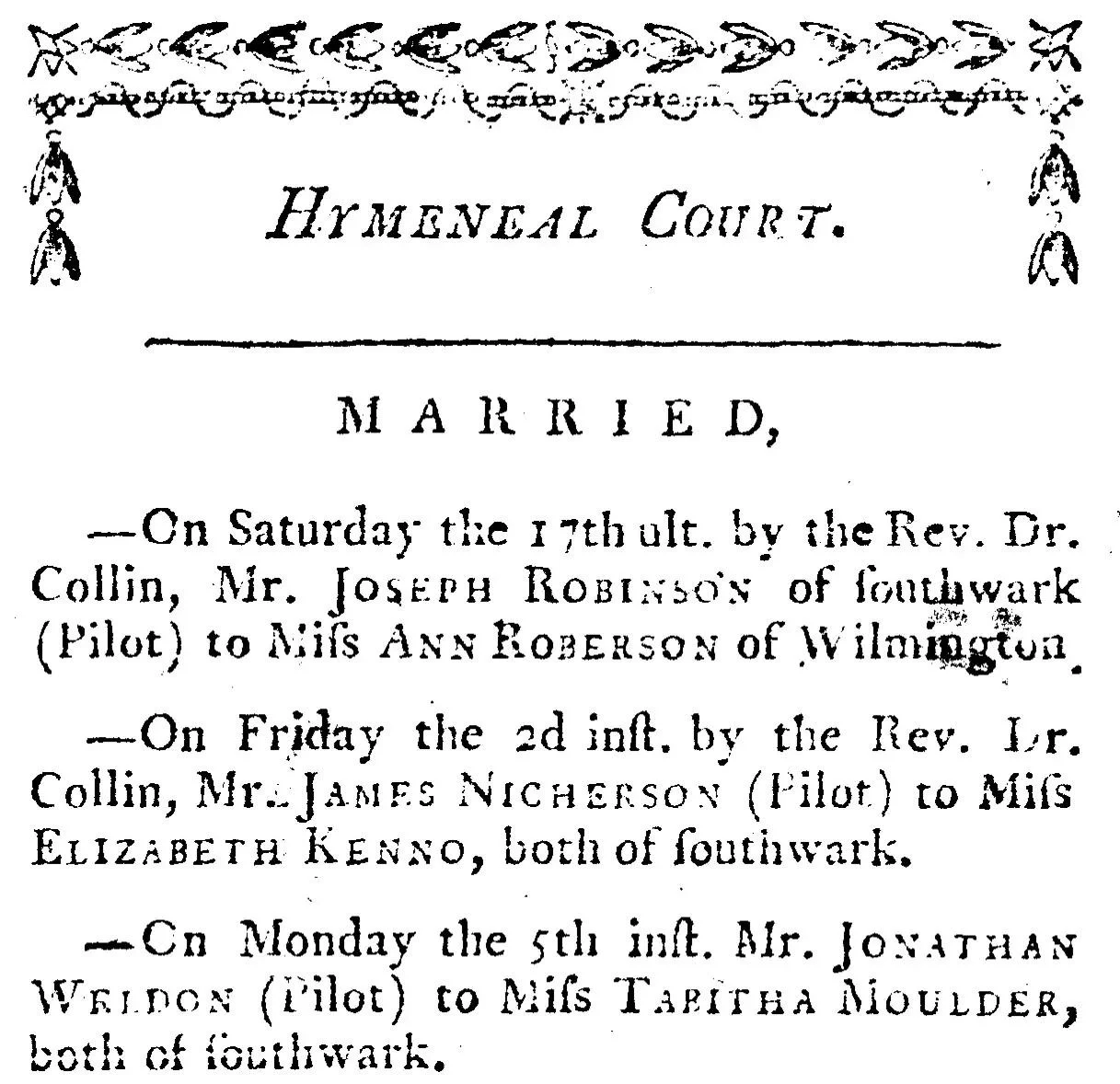
The Philadelphia Minerva notices from 1798 are a good example of what these records look like at scale. Three women are named in the same column: Miss Ann Roberson, Miss Elizabeth Kenno, and Miss Tabitha Moulder. Each is identified by name, and each is connected to a specific husband and location. For a researcher trying to confirm that a woman named Elizabeth Kenno existed, married in the Philadelphia area, and was documented before 1800, this notice does exactly that.
Marriage notices do not tell you whether a woman's husband or father served in the Revolution. But they establish her existence, her maiden name, her approximate age, and her location at a specific point in time. That is often the piece a researcher needs to move forward.
How to search: Try the woman's maiden name in a date range from 1770 to 1810. Try "married" plus her surname. Try searching the husband's name and looking for marriage coverage. Section headings to watch for include "Hymeneal Court," "Married," and "Matrimony."
Women Named for Courage During the War
This category is rarer than widow notices or marriage records, but it is the one that stays with you. Some newspapers, particularly in the South, published accounts of women who acted with courage, loyalty, or defiance during the British occupation or in areas where Loyalist and Patriot forces both operated. These accounts sometimes appeared years or even decades after the war, written as local history or published by organizations like the Daughters of the American Revolution.
The records in this category are the longest and the most detailed. They read less like notices and more like stories. And they name women who would otherwise appear nowhere in the historical record.
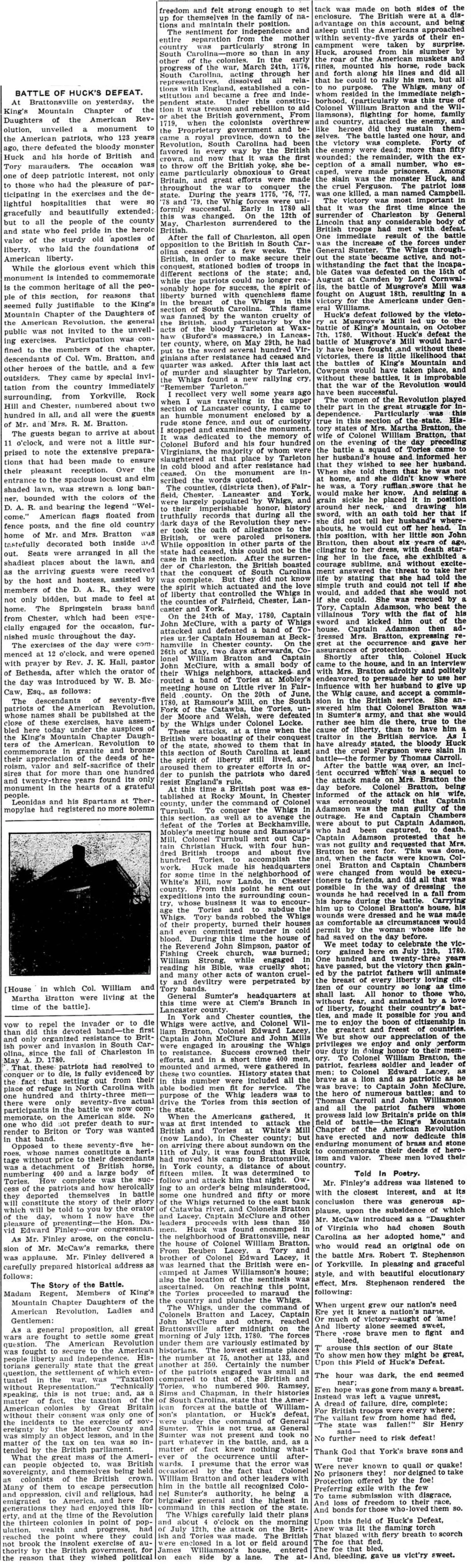
The 1903 Yorkville Enquirer article from the King's Mountain Chapter of the DAR tells the story of Mrs. Martha Bratton. Her husband, Colonel William Bratton, was away fighting with the Patriots when British and Tory forces came to their South Carolina home. A Tory informer tried to extract information from her about her husband's whereabouts. She refused. Captain Adamson tried to coerce her further, drawing his sword and physically threatening her. She still refused. The article describes her as holding her position at the risk of her own life and gives her full credit for her role in the events that followed.
The Battle of Huck's Defeat on July 12, 1780, is recorded in military history. Martha Bratton's name does not appear in that military record. It appears here, in a local newspaper, in an article written by women who understood that the story was incomplete without her.
For a researcher descended from the Bratton family or from any of the other South Carolina families named in this article, this clipping is the record that completes the picture. It names Martha directly. It names her husband. It names other families in the area. And it gives her a role in the outcome of a battle.
How to search: Try a woman's surname combined with "Revolution" or "war" in a broad date range from 1820 to 1920. Try "daughters of the American Revolution" combined with a county name. Tribute coverage of this kind often appeared in local papers around July 4th, in DAR chapter anniversary coverage, or in historical retrospectives published during the centennial years of the late 1870s and early 1880s.
The Search Strategy for Female Ancestors
Finding women in historical newspapers takes a slightly different approach than finding men, because women appear in fewer record types and sometimes only by their relationship to a man rather than by their own name. Here are the strategies that work best.
Search Her Husband's Name First
If you know who her husband was, start there. Search his name in NewspaperArchive with a broad date range. Look for every notice where he appears. Often, you will find him in a pension notice, an obituary, or a service record, and his wife will be named in the same item. Once you have her name from one notice, you can search for her directly.
Use the Word "Relict" or "Widow"
Relict was the standard 19th-century newspaper word for widow, and it appears frequently in the date ranges where Revolutionary War widow coverage is most common. Searching "relict of" followed by a soldier's surname will surface notices you would not find with a standard name search. "Widow of" works the same way.
Search Her Maiden Name in Marriage Notices
If you know a woman's maiden name, search it specifically in the 1770 to 1810 date range. Marriage notices are the most likely place her maiden name appears in print. They are also often the earliest newspaper record that documents her existence.
Look in DAR Chapter Coverage
DAR chapter records, published in local newspapers from the 1890s onward, frequently name women and their qualifying ancestors. If you know a woman was a DAR member, or if you suspect her descendants were, DAR newspaper coverage can name her directly or name the ancestor through whom she qualified. See our companion post DAR and SAR in Newspapers for how to search this record type.
What These Records Tell You
When you find a woman in a Revolutionary era newspaper, you are usually finding one piece of a larger puzzle. A marriage notice gives you her maiden name. A widow pension petition gives you her husband's service. A death notice at extreme old age places her in a community and connects her to hundreds of descendants. A tribute account gives her actions and her character.
None of these records gives you everything. But each one gives you something no other source does, and together they can build a picture of a real person living through an extraordinary time.
Martha Bratton stood at her door and refused to tell a British officer where her husband had gone. Grandmother Posey outlived almost everyone she had known in the Revolution and died at 102 with 321 descendants behind her. Susanna Titus went to Congress decades after her husband died and asked for what she had earned.
These women are in the newspapers. They are waiting to be found.
NewspaperArchive holds records from across the dates and states where these women lived. Start with what you know and see where the archive takes you.
Frequently Asked Questions
Can I find my female ancestor in Revolutionary War newspapers if she never served in the military?
Yes. Women's names appear in marriage notices, widow pension records, death notices, community tribute coverage, and DAR chapter records. You do not need a military connection to find a woman in the newspaper record. Start with the time period when she would have been an adult and search by her name, her husband's name, or the location where she lived.
What is the best date range to search for Revolutionary War widows?
Widow pension legislation began in 1838, so the most productive date range for widow pension notices is 1838 to 1860. Death notices for women who were young adults during the Revolution will appear from the 1820s through the 1870s. Marriage notices for women who married during or just after the Revolution will appear from 1770 to 1800.
What does "relict" mean in an old newspaper?
Relict is a 19th-century word for widow. It appears frequently in death notices, pension coverage, and estate notices. When you see "relict of" followed by a man's name, it means the woman named in the notice was his widow. Searching "relict of" plus a surname is one of the most reliable ways to find widow records in NewspaperArchive.
Why does the newspaper sometimes use only a nickname or no first name for a woman?
This was common in 19th-century newspaper coverage. Women were sometimes identified only by their relationship to a man ("widow of Captain Posey") or by a community name ("Grandmother Posey") rather than their given name. If you encounter this, try searching for her husband's name first, then look for any notice that references his widow or his family in the surrounding years.
Were women ever named in Revolutionary War military records in newspapers?
Occasionally, yes. Women who provided specific acts of service, hid soldiers, refused to cooperate with the British, or otherwise took active roles were sometimes named in later tribute coverage, particularly in southern states where civilian life intersected directly with military operations. These accounts tend to appear in local history columns, DAR chapter coverage, and anniversary tributes rather than in the original war-era newspapers. Searching a broad date range up to the early 1900s gives you access to retrospective coverage as well as contemporary records.
How do I find a woman who changed her name after marriage?
If you know her maiden name, search it in the 1770 to 1810 period and look for a marriage notice that connects her to her married name. If you only know her married name, search for her husband first. His notices will often reference her by her married name, and an obituary for either of them may include information about her birth family.