She Held the Hill: Molly Pitcher and the Women Old Newspapers Never Forgot
Historical newspapers told the stories of Molly Pitcher, Deborah Sampson, and other women who served in the Revolution. Here's what they recorded and how to find them.
Historical newspapers covered women who participated in the American Revolution in several ways. Molly Pitcher, born Mary Ludwig in 1744, was covered in biographical sketches and anniversary tributes published in newspapers from the mid-1800s through the early 1900s. These accounts describe her carrying water to soldiers at the Battle of Monmouth in June 1778, taking over her husband's cannon after he was wounded, and receiving a sergeant's commission from George Washington. Deborah Sampson, who enlisted in the Continental Army under the name Robert Shurtleff in 1781, received extensive newspaper coverage in the late 1800s describing her service in the 4th Massachusetts Regiment, her participation in three campaigns, her honorable discharge in 1783, and the act of Congress that eventually granted her full military pay. Caroline Scott Harrison, wife of President Benjamin Harrison and first president general of the National Society Daughters of the American Revolution, was covered extensively in DAR chapter newspapers from the 1890s onward for her role in establishing the organization. Researchers looking for newspaper coverage of women in the Revolutionary War era can search NewspaperArchive using names, phrases such as "heroine of the Revolution," "soldier of the Revolution," and "Daughters of the American Revolution," combined with date ranges from the 1840s through the early 1900s.
Quick Answer
Historical newspapers covered women who participated in the American Revolution through biographical sketches, anniversary tributes, and DAR chapter coverage spanning from the mid-1800s through the early 1900s. The most frequently covered women include Molly Pitcher (Mary Ludwig Hays), who carried water at Monmouth and took over a cannon when her husband fell; Deborah Sampson, who enlisted as a man and served in the Continental Army for two years; and Caroline Scott Harrison, first president general of the DAR. Researchers can find newspaper coverage of these women in NewspaperArchive by searching their names directly, or by using phrases such as "heroine of the Revolution" and "soldier of the Revolution" in a date range from 1840 to 1920.
What Historical Newspapers Say About Molly Pitcher (And the Women Who Fought Beside Her)
Most people who grew up learning American history know the name Molly Pitcher. Fewer know that she was born Mary Ludwig, worked as a servant in a doctor's house, married a barber named Hays, and carried water to soldiers on the battlefield at Monmouth on a June day in 1778 when the temperature in the shade hit 96 degrees.
Newspapers knew all of it. They wrote about Molly Pitcher for more than a century after the Revolution ended, and they wrote about other women who served beside her, women like Deborah Sampson, who disguised herself as a man and enlisted in the Continental Army, and women like Caroline Scott Harrison, who turned the memory of Revolutionary women into an organization that still exists today.
This post walks through what historical newspapers actually said about these women, where those records live in NewspaperArchive, and why the Molly Pitcher story is more than a legend. It is also a model for how newspapers recorded women who would otherwise have vanished from history.
For the full guide to finding female ancestors in Revolutionary era newspapers, see our companion post, Women and the Revolution: How to Find Female Ancestors in Historical Newspapers.
Molly Pitcher in Newspapers
Who She Was
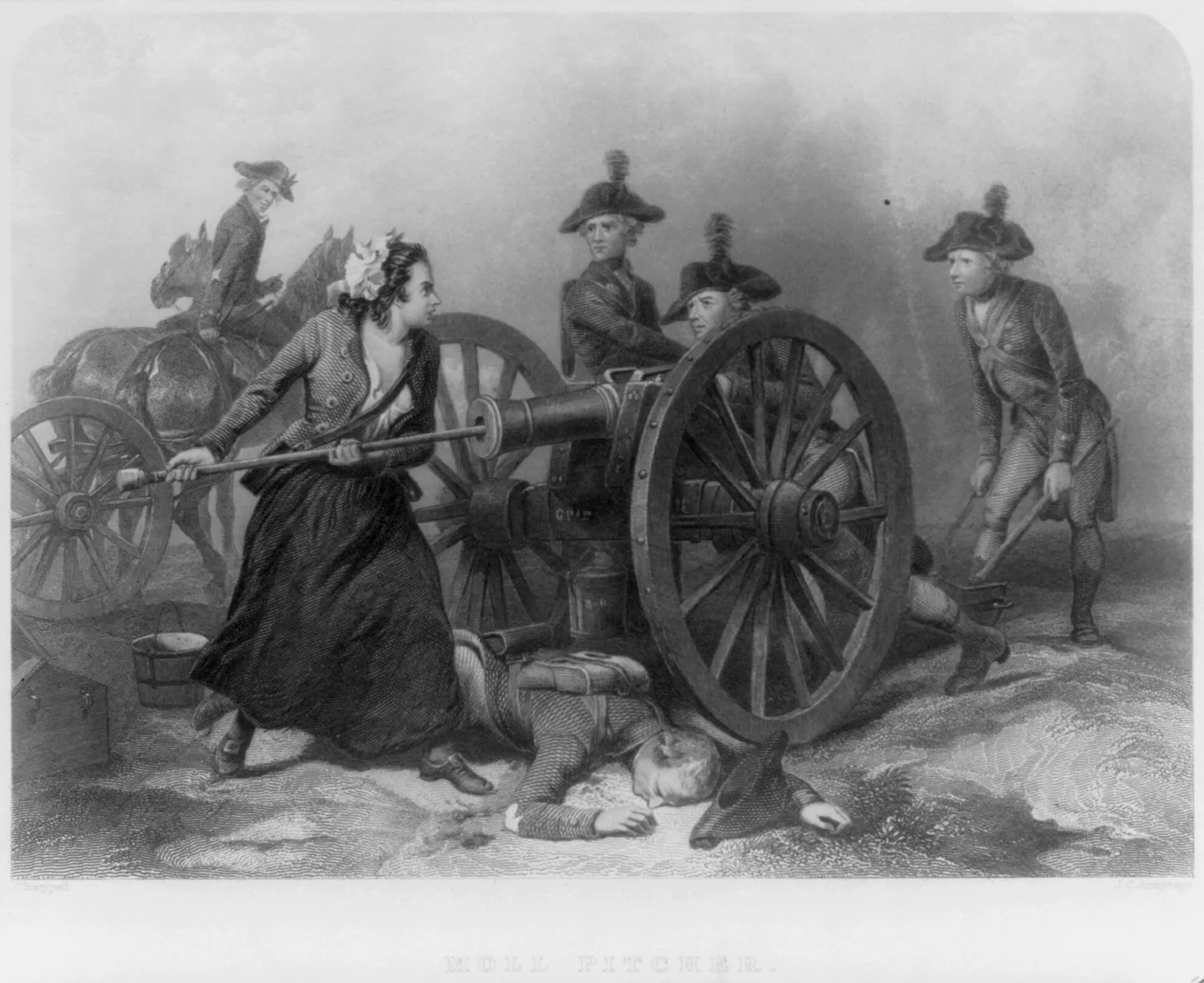
Molly Pitcher was born Mary Ludwig on October 13, 1744. She lived in Pennsylvania, worked in a doctor's household, and married a barber named Hays. When the Revolution broke out, her husband enlisted and became a gunner in the Continental Army. She followed him, as many wives of soldiers did, making herself useful doing laundry and darning.
She was at the Battle of Monmouth on June 28, 1778. She was not supposed to be in the fight. She was carrying pitchers of water to the men, which is where the name Molly Pitcher comes from. When her husband was hit while firing his cannon on an advanced position on a hill, orders came down to withdraw the gun. Molly announced she could shoot. She held the hill while her husband lay dying.
Washington praised her after the battle and gave her a sergeant's commission. Some accounts say she fought through the rest of the war. She died in 1823 with two monuments to her courage already built.
How Newspapers Covered Her
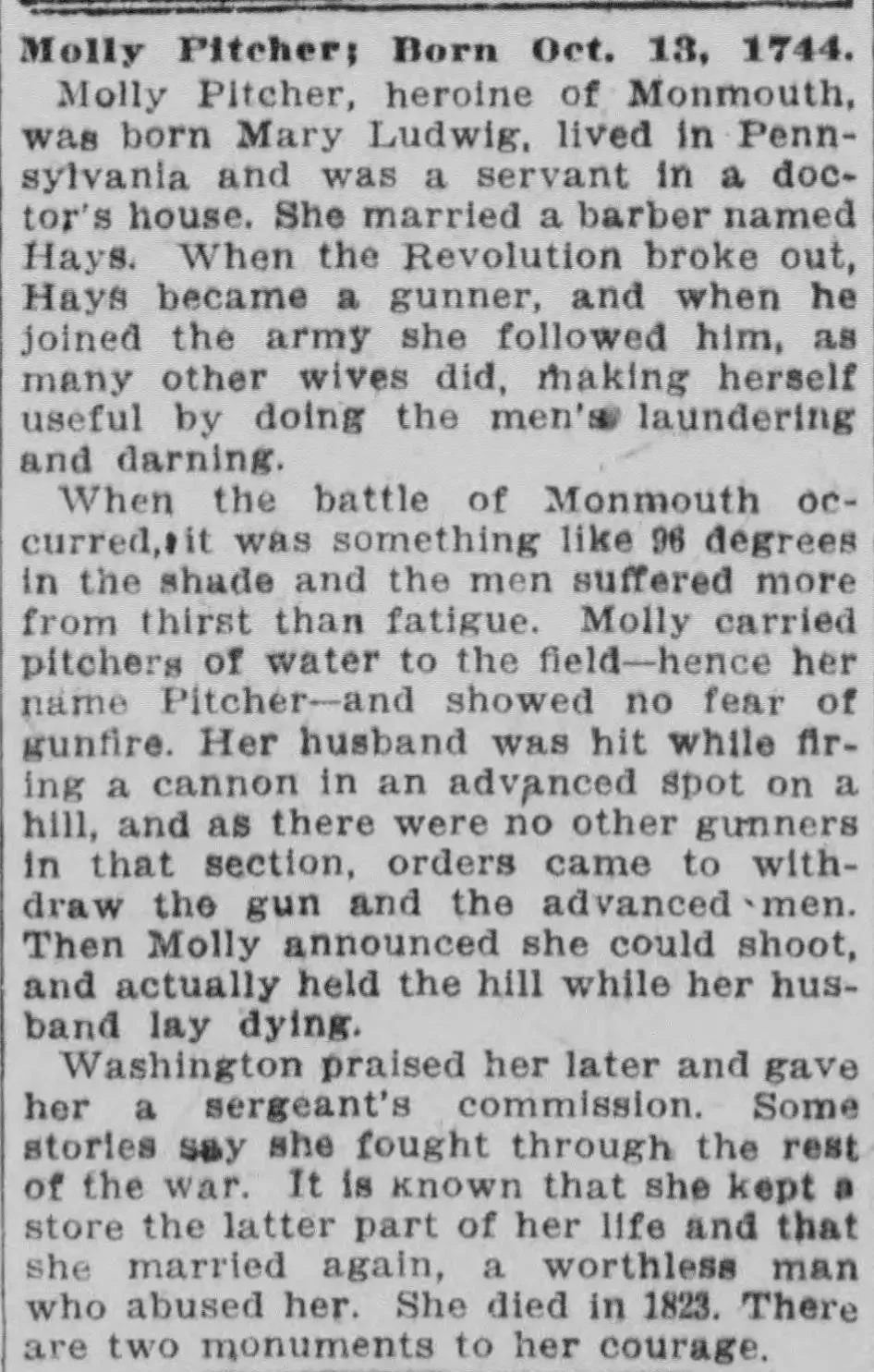
The Boston Post ran this item on October 13, 1919, Molly Pitcher's birthday. That date was not an accident. By the early 1900s, anniversary coverage of Revolutionary War figures had become a regular feature in American newspapers, and Molly Pitcher had enough name recognition to earn a birthday notice.
What the clipping shows you is how newspapers treated her story by then: not as legend or rumor, but as fact. The details are specific. The temperature. The position on the hill. The order to withdraw the gun. Her announcement that she could shoot. These are not vague tributes. They are an account of what happened on a specific afternoon in New Jersey in 1778.
Newspaper coverage of Molly Pitcher spans roughly from the 1840s through the 1930s. The earlier pieces tend to be shorter tributes or passing references in Fourth of July coverage. The later pieces, like this one, read more like biographical summaries written for readers who had never heard the story in full. Together they form a record that no single document from 1778 can match.
How to search: Try "Molly Pitcher" as a name search in NewspaperArchive. Try "heroine of Monmouth." Try "Mary Ludwig" for coverage that uses her birth name rather than her battlefield name. A date range from 1840 to 1930 will surface the broadest range of coverage. October 13 is her birthday and a good date to search around for anniversary tributes.
Deborah Sampson: The Woman Who Enlisted as a Man
Who She Was
Deborah Sampson's story is one of the most remarkable in the entire Revolutionary War record, and newspapers told it in extraordinary detail.
She was born on December 17, 1760, in Plympton, Massachusetts. She was well-read for a woman of her time, had worked as a teacher, and had heard the cannon fire at Bunker Hill while growing up. In April 1781, at age 20, she left her home in secret, obtained cloth, sewed herself a Continental Army uniform, and enlisted at Bellingham under the name Robert Shurtleff.
She enlisted in Capt. Webb's company of the 4th Massachusetts Regiment. Her height was recorded as five feet seven and a half inches. She served for over two years. She was wounded twice, once in the thigh and once in the leg. At one point she extracted a musket ball from her own thigh rather than let a doctor examine her and discover her identity. She was present at the siege of Yorktown. She served on expeditions against Tories east of the Hudson. She crossed the Chesapeake, marched through Virginia, and never missed a day of active service.
On October 23, 1783, she received an honorable discharge from General Knox, with certificates of faithful performance of duty from General Paterson, General Shepard, Colonel Henry Jackson, and Colonel Jackson. She was the only woman in the Continental Army officially discharged.
She married Benjamin Gannett in 1784 and had one son and two daughters. She died April 27, 1827, at age 62.
How Newspapers Covered Her
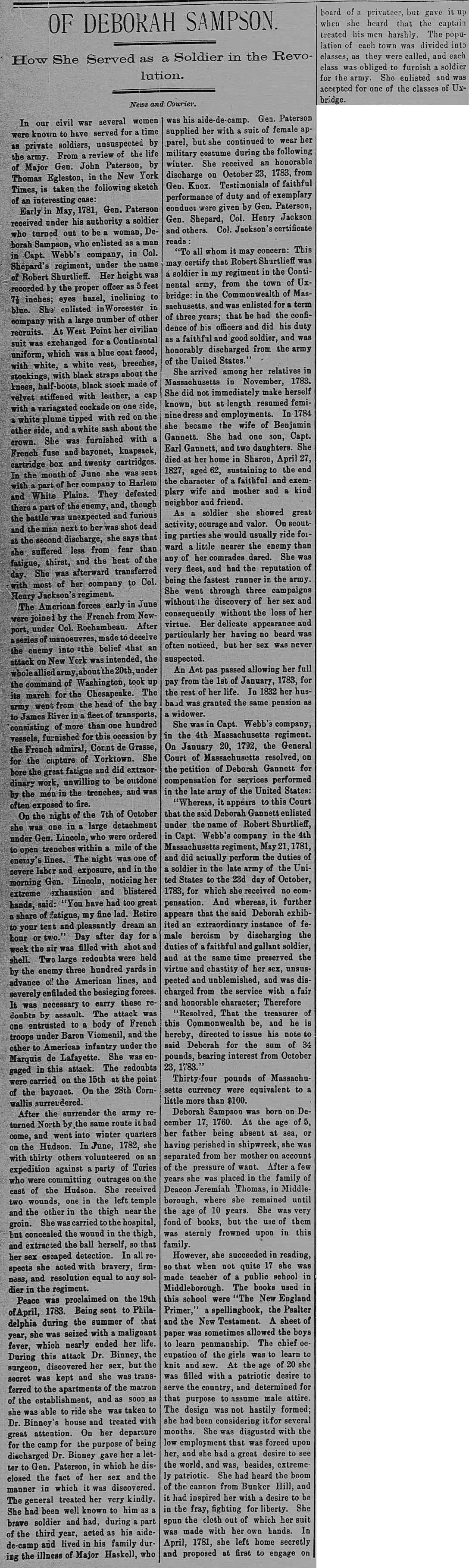
The Anderson Intelligencer piece from 1898 is the kind of newspaper coverage that makes NewspaperArchive so valuable for researchers. It is not a brief mention. It is a full biographical account that runs multiple columns and includes details that you would expect to find only in a military record or a court document.
The piece quotes the General Court of Massachusetts resolution on her petition for compensation, dated January 29, 1792, which reads in part:
"Whereas it appears to this Court that the said Deborah Gannett enlisted under the name of Robert Shurtleff in Capt. Webb's company in the 4th Massachusetts regiment, May 21, 1781, and did actually perform the duties of a soldier in the late army of the United States to the 23rd day of October, 1783."
That resolution is a primary source embedded inside a newspaper article. If you are descended from Deborah Sampson, this clipping is both biography and documentation. It establishes her service dates, her regiment, her commanding officers, and the legal recognition she eventually received.
Congress later granted her full pay for her service. Thirty-four pounds of Massachusetts currency, equivalent at the time to a little more than $100. It was not much. But the newspaper recorded it, and the record survived.
How to search: Try "Deborah Sampson." Also, try "Robert Shurtleff," the name under which she enlisted, in the date range 1781 to 1785, for any wartime records that might have used her alias. For biographical coverage, the most productive date range is 1860 to 1920. Try "soldier of the Revolution" combined with "woman" for coverage of her alongside other female patriots.
Caroline Scott Harrison and the Women Who Built the DAR
Who She Was
Caroline Scott Harrison was not a soldier. But her connection to the American Revolution shaped the way Americans would remember and research Revolutionary women for more than a century.
She was born October 20, 1832. She married Benjamin Harrison on October 20, 1853, and became First Lady when he was elected president in 1888. She died in the White House on October 25, 1892. But her most lasting work happened between those dates, when she became the first president general of the National Society Daughters of the American Revolution.
The DAR was founded in 1890. Caroline Harrison did not just lend her name to it. She presided at the first congress in February 1892, gave the address of welcome, gave the first reception to the congress in the White House, and spent some of her last months in that role even as her health was failing. The organization's early success was credited directly to her willingness to take on the work personally, at a time when the prestige of the White House gave the DAR legitimacy it could not have built on its own.
How Newspapers Covered Her
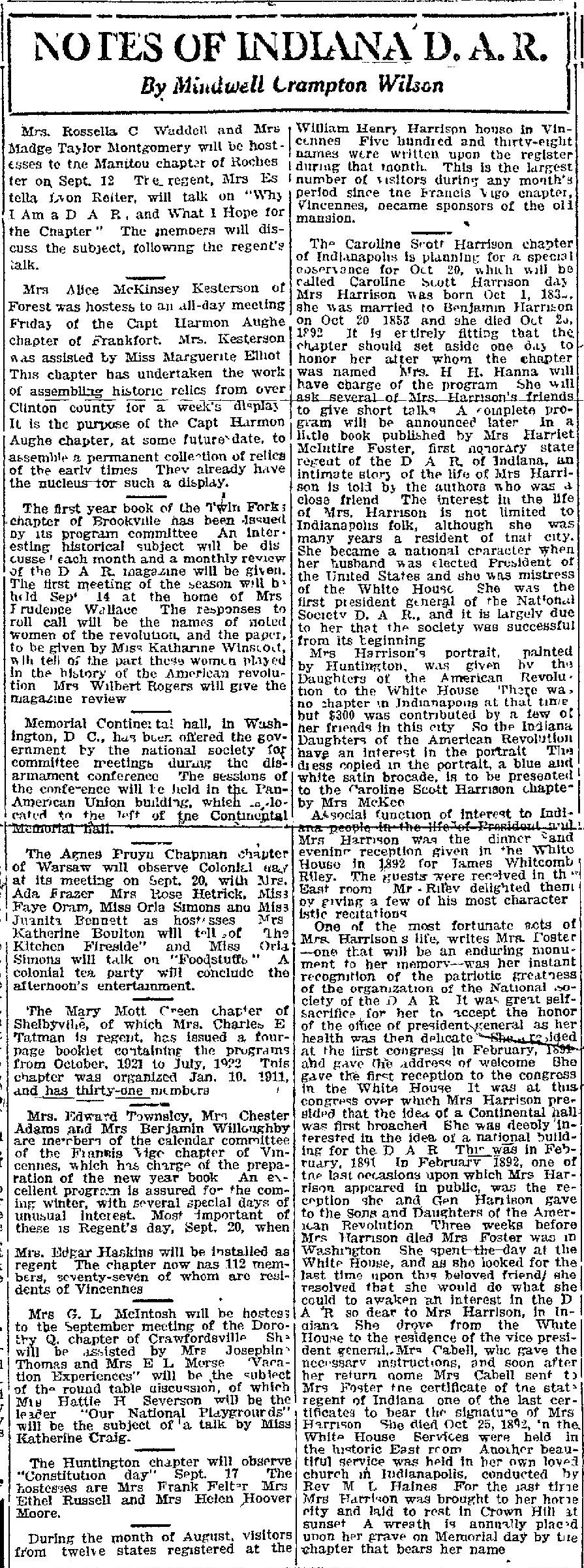
The Indianapolis Star column from 1921 shows how Caroline Harrison's memory was carried forward in DAR newspaper coverage for decades after her death. The Caroline Scott Harrison chapter of Indianapolis was planning a full observance of her October 20 birthday, centered on a book about Mrs. Harrison's life, written by Harriet McIntire Foster, the first honorary state regent of Indiana.
For a researcher today, this kind of DAR chapter coverage does two things. It connects living members of an organization to their founding ancestor, and it preserves details about the founding generation that would otherwise be scattered across individual obituaries and pension records.
The column names dozens of Indiana DAR members, their chapter affiliations, and the work of those chapters in preserving Revolutionary War history. Every name in a column like this is a potential family history connection. Every chapter mentioned has a founding ancestor worth searching.
How to search: Try "Caroline Scott Harrison" for coverage of her life, her role in the DAR, and the chapter tributes that continued after her death. For DAR chapter coverage more broadly, try the chapter name combined with a state or county. The most productive date ranges for DAR newspaper coverage are 1890 to 1930, when the organization was new, and chapter news was a regular feature in local papers. For the full guide to DAR newspaper research, see our companion post DAR and SAR in Newspapers.
What the Molly Pitcher Story Tells Researchers
Molly Pitcher is famous. Deborah Sampson is less famous but just as well documented. Caroline Scott Harrison is almost unknown outside DAR circles. All three women appear in historical newspapers, and all three newspaper records have something to teach a researcher who is trying to find a woman from the Revolutionary era.
What they have in common is this: none of their newspaper records is the original source. No newspaper in 1778 sent a correspondent to the Battle of Monmouth to interview Molly Pitcher. No newspaper in 1781 reported on Deborah Sampson's enlistment. These women's stories entered the newspaper record later, through biography, tribute, anniversary coverage, and organization reporting.
That matters for how you search. If you are looking for a woman who lived through the Revolution, you are unlikely to find her in newspapers published during the war. You are much more likely to find her in the newspapers published fifty or seventy years afterward, when local historians were writing retrospectives, when the DAR was forming chapters and naming them after founding ancestors, and when anniversary tributes were a regular feature of every July 4th issue.
The date range that works for the women in this post is roughly 1840 to 1920. That is where the coverage is. That is where the names are. And that is where a researcher who knows what to look for can find a woman who has been invisible in every other record.
NewspaperArchive holds coverage across all of those decades and all of the states where Revolutionary War women lived. Start with a name and a date range, and see what the archive has kept.
Frequently Asked Questions
Did newspapers cover Molly Pitcher during her lifetime?
Coverage of Molly Pitcher during her own lifetime was sparse. She died in 1823, and the most detailed newspaper accounts of her life came in the decades after her death, as interest in Revolutionary War history grew. By the 1840s and 1850s, her name appeared in Fourth of July tributes and historical retrospectives. By the 1880s and 1890s, full biographical accounts were being published. The Boston Post item from 1919 is typical of the anniversary coverage that continued into the early 20th century.
Was Deborah Sampson the only woman to serve in the Continental Army?
She is the most thoroughly documented, but she was likely not the only one. Newspaper coverage from the late 1800s occasionally mentions other women who disguised themselves as soldiers, and historical researchers have identified a small number of additional cases. Deborah Sampson is unique in that her service was officially recognized by both the state of Massachusetts and the U.S. Congress during her own lifetime, which is why her name appears so frequently in documentary sources, including newspapers.
What is the best way to find women in Revolutionary War newspaper records?
The most productive approach is to search in the 1840 to 1920 date range rather than during the war years themselves. Women are named most frequently in widow pension notices (after 1838 legislation), in death notices identifying them as widows of soldiers, in DAR chapter formation and membership coverage (after 1890), and in anniversary tributes. The phrases "widow of a Revolutionary soldier," "relict of," and "heroine of the Revolution" are among the most reliable search terms. For a complete guide to searching for female ancestors in this period, see the companion post Women and the Revolution: How to Find Female Ancestors in Historical Newspapers.
How do I find DAR chapter records that might name my ancestor?
DAR chapters were frequently covered in local newspapers from the 1890s through the 1930s. Chapter formation notices typically named the founding ancestor and explained the qualifying service connection. Annual meeting and program coverage named current members. If you know a woman in your family who was a DAR member, searching her county's local newspaper in the 1890 to 1930 range is a reliable way to surface chapter coverage that may name her. Searching the chapter name directly is also effective if you know it.
Were women ever named in wartime newspaper coverage from 1775 to 1783?
Occasionally, yes, but rarely by name and almost never for military service. Women appeared in wartime newspapers primarily in notices of their husbands' deaths or in property-related announcements. A small number of accounts mention women who harbored soldiers, passed information to Patriot forces, or refused to assist the British, but these accounts are much more common in retrospective coverage published decades later than in the original wartime newspapers.