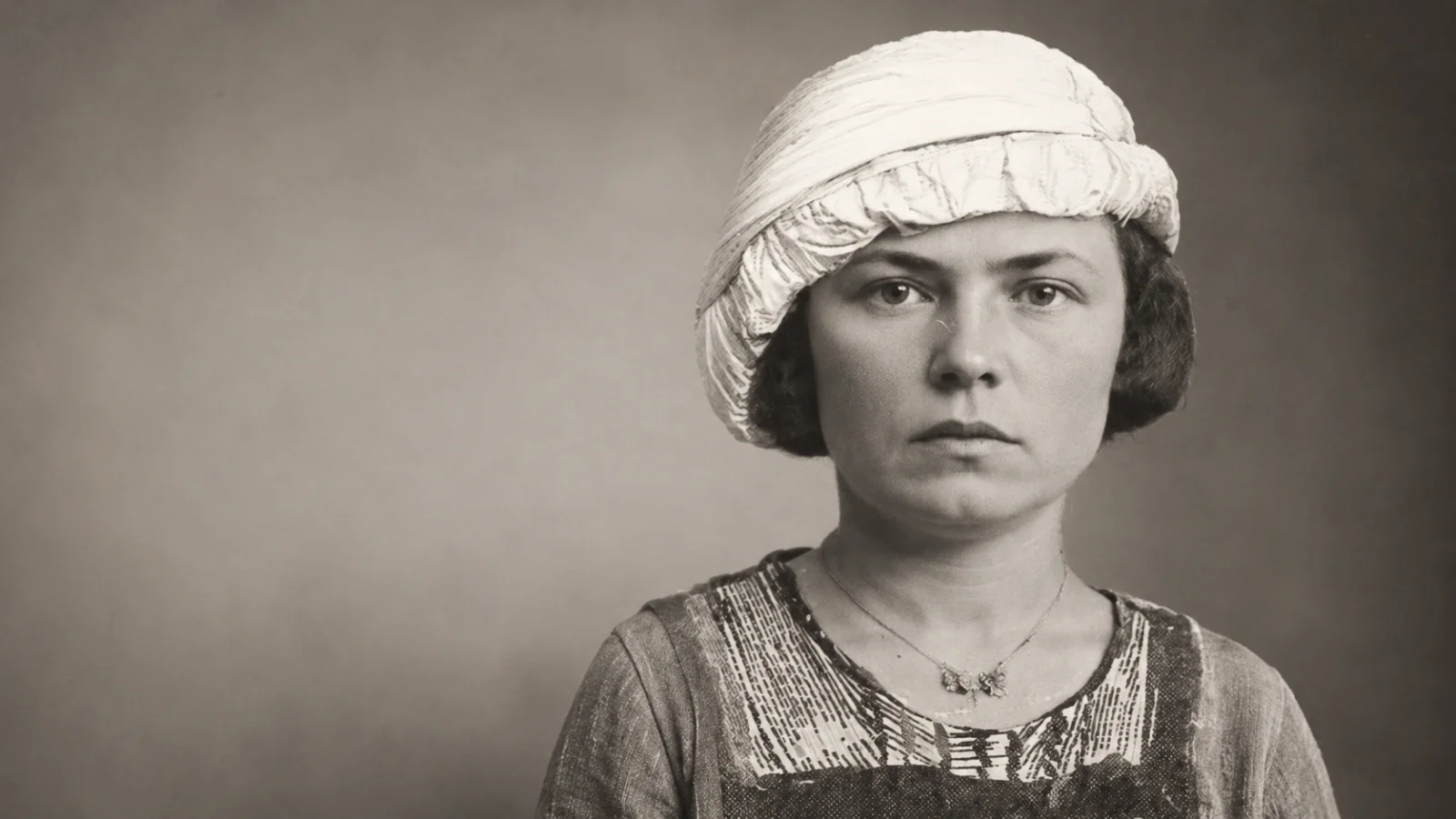
A Kiss Will Drive Him From Your Mind
A family history discovery reveals the 1921 Baltimore shooting of Leo Bonne, the arrest of Annie Scroggs, and the sensational murder trial that followed.
In 1921, Leo Bonne, a young marine engineer from Iowa, was found dead in a Baltimore saloon after Annie Scroggs repeatedly rejected his marriage proposals. His death was first ruled a suicide, but Annie later admitted firing the fatal shot and claimed she acted during a struggle after he attacked her. The case drew sensational newspaper coverage, including references to Annie as the “$10,000 Beauty of South Baltimore.” After spending more than a year in jail, she was tried in Ellicott City and found not guilty. The story shows how historical newspapers can reveal dramatic, long-forgotten events involving relatives who might otherwise remain only names in a family tree.
First it was their mother in 1918. Followed by their father in 1919 and brother George in 1920. The three remaining Bonne family members, though they were all young adults, were no doubt overwhelmed at the succession of tragedy that befell their family living in Gilmore City, Iowa. But in 1921 they would say goodbye to yet another one of their own; in a way none of them would have predicted.
While the oldest son Maurice Bonne stayed in Gilmore City teaching at a local school, Rose and her husband Frank Hartnett relocated and raised three children on a farm in Fort Dodge. Leo Bonne was the youngest, and found himself 27 and single.
With World War I at an end, Leo joined the Navy and began work as a marine engineer in Baltimore, Maryland. He found a room to rent in a neighborhood on Locust Point, near Fort McHenry on the Patapsco River — the waterway that feeds into the Chesapeake Bay. The shipbuilding industry in Maryland and Virginia was booming so naturally, Leo could find steady employment and hope for a successful life there.
And then he met Annie.
The Barmaid at the “Near-Beer” Saloon
In the early years of the 20th century, Anna “Annie” Scroggs grew up on Clement Street in Baltimore with her mother, her sister Agnes, brothers John and Harry. Her father, Joseph, had passed away when she was only thirteen and her mother remarried soon after.
Now it was 1921, Annie was a 20-year-old barmaid hired at a local eatery in Locust Point by Irish immigrant Mrs. Agnes Bannan, a recent widow who continued her late husband’s saloon business through Prohibition. Mrs. Bannan reinvented it as a “near-beer* saloon” to appease both the law and the public. At this location on the corner of Andre and East Fort Street, she eked out a living by running the restaurant and renting out rooms to boarders. After all, she had three young boys to feed.
Leo Bonne, who had started renting a room at Mrs. Bannan’s place earlier that year, noticed the young barmaid. After a hard day’s work, or maybe on breaks, he would have likely seen or interacted with Annie regularly. In one way or another, the marine engineer made it quite clear that he intended to marry her. He makes a bold move, though she’s already told him she’s not interested, and informs her that he’s put a deposit on a home at 1534 Latrobe Park Terrace, the perfect place for the two of them to live after they were husband and wife.
By mid-August he’s getting impatient and desperate. She’s not coming around to the idea — she’s refusing all of his advances. On August 31st things take a tragic turn.
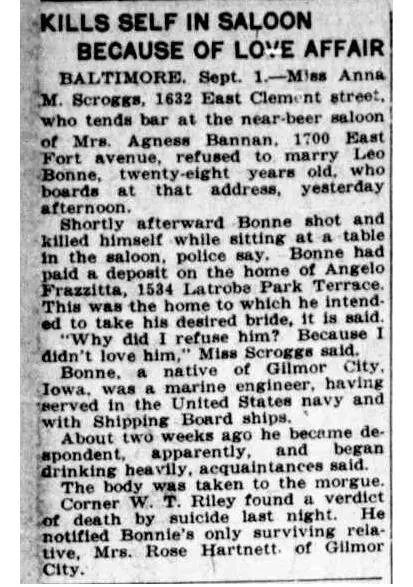
“Commits Suicide In Saloon Because of Love Affair: Leo Bonne Shoots Self After Woman Barkeeper Refused to Marry Him” September 1, 1921 — The Baltimore Sun
It was inferred by police that she was hired at the saloon to “attract the male trade” and it must have been shocking to the public that she would reject a marriage proposal so adamantly that it drove the poor young man commit suicide.
Police reported that he shot and killed himself while sitting at a table in the saloon. The Baltimore Sun reported that when asked why she didn’t say yes to his marriage proposals, Annie simply replied,
“Because I didn’t love him.”
A request for revisiting the suicide ruling came from the officials of the American Legion who knew Bonne as well as his sister Rose back in Iowa. There were suspicions that the angle of the gunshot would have been nearly impossible to self-inflict, and the fact that he came to Baltimore with “negotiable papers valued at about $12,000”, inherited from his deceased parents, there seemed to be a motive. Fingers began pointing to Annie and Mrs. Bannan.
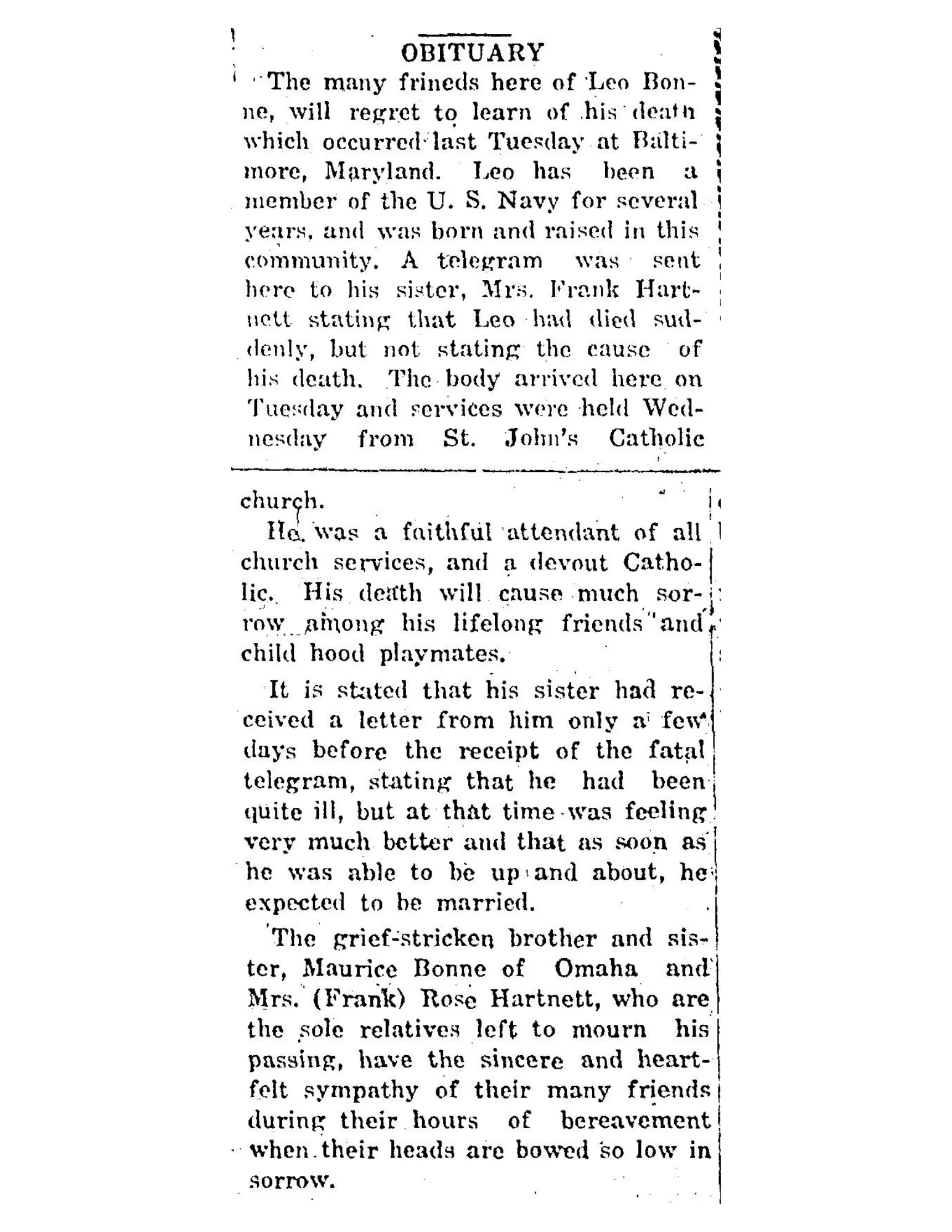
I wonder if some thought it to be a sign of the times; now that American women had won the right to vote just a year prior, perhaps there were females emboldened by their newfound “power” — even though Maryland was slow to uphold this 19th Amendment and even took legal measures to strike women’s names from the voting rolls. Finally in February of 1922 The U.S. Supreme Court ruled that the law was valid in all states.
Twenty-three days later, mid-Atlantic newspapers had a completely different story to tell.
We Both Reached for the Gun
During a second interview with the young barmaid, a lieutenant by the name of Burns acted out what he believed could have likely happened in a possible struggle between the two. Before he could finish the reenactment, she broke down and sobbed.
Through tears, she admitted she had shot Bonne — in self-defense. She told police that ever since he arrived in Baltimore he’d been begging her to marry him. Now, in the restaurant’s kitchen, Annie relayed how he pointed a gun at her and asked her to marry him. She insisted to police he would have killed her unless she said yes to being his wife. Done waiting for the answer he wanted, Bonne decided he would just marry her “the other way”. He grabbed Annie, but during the attempt to assault her, he dropped the gun and they both scrambled for it — and it went off.
Mrs. Bannan stated she wasn’t in the saloon when it happened. She would also later admit in court that Annie asked her to “keep with the story that Leo shot himself” when talking to the police.
The two women visited the body of Leo Bonne while arrangements to send his body back to Iowa were being made. Mrs. Bannan told Annie to give Leo a goodbye kiss. She said “a kiss will drive him from your mind.”
With this confession, the officers arrested Annie and walked her to the patrol wagon. A crowd gathered outside the station, waiting to see the young woman who killed the Navy man who wanted her to be his wife.
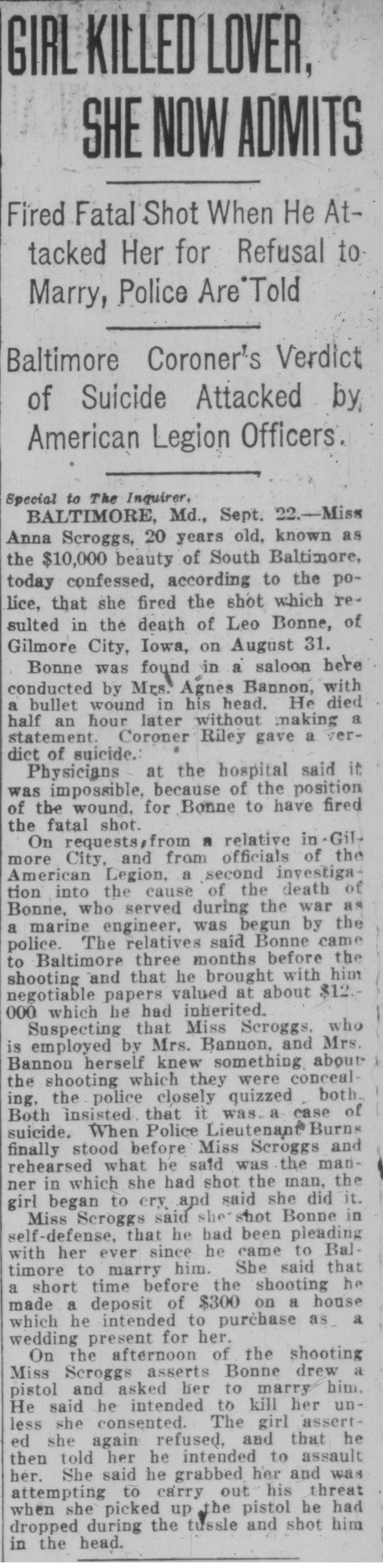
Meanwhile, articles from newspapers like The Baltimore Sun rushed to publish the dramatic turn of events. The headlines ranged from salacious to factual. “Accused of Killing Lover” and “Girl Who Confessed Killing Marine Engineer in Saloon Photographed at Bertillon Bureau”. But it was The Philadelphia Inquirer that dubbed her the “$10,000 Beauty of South Baltimore”.
That “beauty” would be held in jail for the next fourteen months awaiting her trial.
As the murder trial approached, newspapers reminded the public about the events of the previous summer. October 1922 editions of The Baltimore Sun flashed these intriguing headlines:
“She Claims Self-Defense: Judge Gorter Orders Case Removed to Circuit Court For Howard County”
“$10,000 Beauty Gets Trial Transferred: Annie M. Scroggs Charged with Killing Lee [Bonne] Granted Change of Venue”
“Neighborhood Beauty Faces Murder Trial”
“Locust Point Woman on Trial for Murder: Annie M. Scroggs ‘$10,000 Beauty’ called to answer charge at Ellicott City“
“$10,000 Beauty is Placed On Trial: Annie M. Scroggs Faces Charge of Killing Lee Bonne At Locust Point”
Saloons around South Baltimore were full of talk about how they heard Annie say she’d kill him. It didn’t help that prosecuting Attorney O’Conor had announced (in court) that he would prove that Miss Scroggs made the comment,
“I will kill him with a butcher knife as he lies asleep. No, I want his eyes to be open when I kill him.”
Oddly specific, O’Conor thought. Then he brought up the kiss. How she “kissed his body in the casket waiting to be shipped to his people in the West”.
The trial commenced in December at Ellicott City Courthouse. “There were as many women spectators in the room as there were men,” one article reported.
The next day, twenty people were gathered on behalf of Annie’s defense. Friends and witnesses described her as “a respectable, decent girl.” It was also claimed that Annie’s sister Agnes heard the shot. Agnes told police she was told Leo shot himself and it was she who had cleaned up the blood.
Taking the Stand
After the character witnesses, it was Annie’s turn. On the stand, her appearance and “manner of answering questions showed confidence”, one article stated. The elderly all-male jury were “visibly impressed with her story” as she testified.
Annie shared how she remembered Bonne telling her,
“If you won’t marry me the right way, you’ll marry me the other way,”
and began to assault her. He had grabbed her by the throat, choked her and threw her against a cupboard; her clothes were torn as she struggled to get away from him. Apparently, the gun came from a drawer in the cupboard, which she “secured in case of further attack”. They fought for possession of the revolver, and before she knew what was happening, the gun went off, and Bonne was shot in the head and died instantly. She claimed she couldn’t even be sure whose finger pulled the trigger.
When the prosecution gave their rebuttal, they accused Annie of lying and asserted that she shot him as he was walking away from her and not in the struggle as she described. She had deliberately plotted to murder Leo Bonne.
The jury deliberated for a little less than two hours and to the prosecution attorney’s dismay, Anna Scroggs was found not guilty.
A “score of women applauded” for the outcome of the verdict. As she thanked the jury, Annie was seen “smiling for the first time since the trial began”.
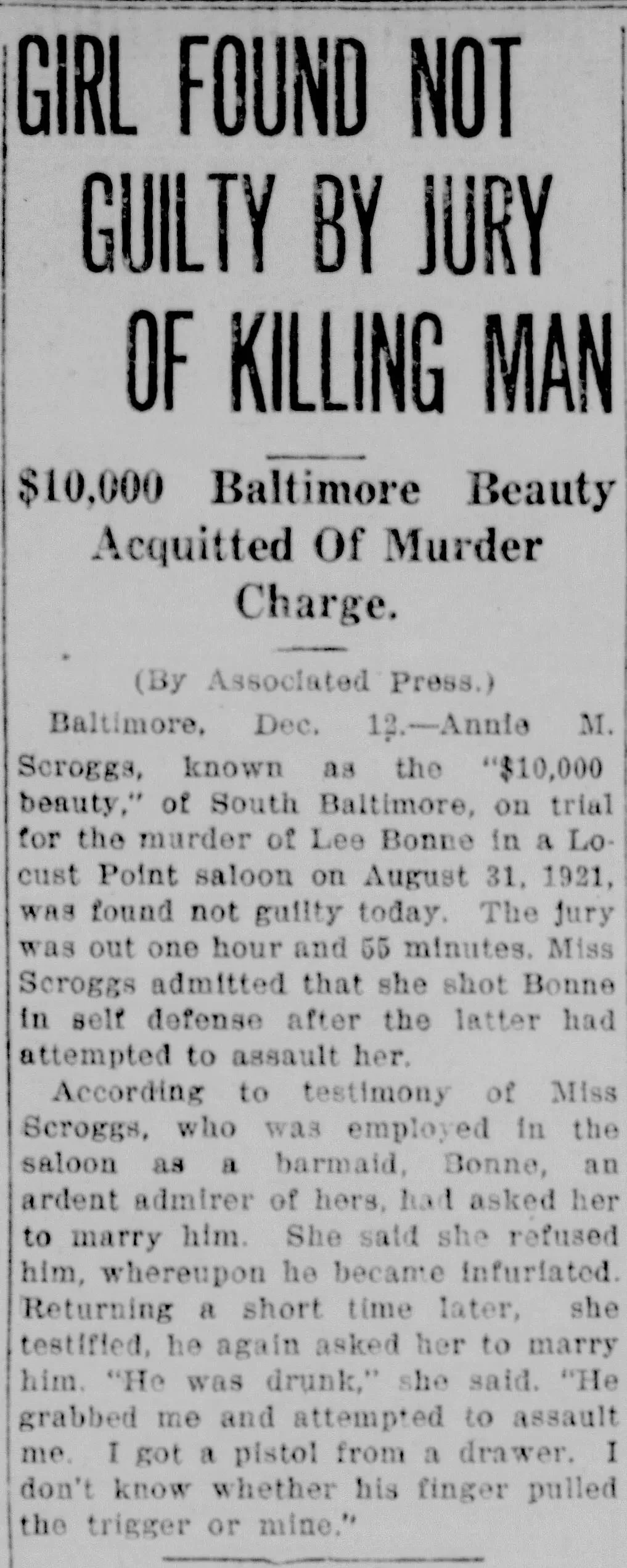
An article in the Iowa Democrat, the day following the end of the trial, read:
“Leo Bonne's Murderer Goes free in Baltimore — Annie M. Scroggs, the self-confessed murderer of Leo Bonne, the former Pocahontas county boy, was found not guilty by the jury in the trial of the case just finished at Baltimore, on Tuesday of this week. Mr. Bonne was murdered about a year ago last August by the woman, Miss Annie Scroogs, and the case has just been closed by the finding of the verdict of not guilty by the jury.
The claim of the defendant was that she killed Bonne during a struggle when he attempted to assault her.” - December 14, 1922
Annie’s Aftermath
I’m sure over the next few years, there was still plenty of talk about the murder. In a few short months she married (and one assumes fell in love with) a man named Henry Kazmierski, a Polish immigrant. In October of 1923, living at 632 East Clement Street in Baltimore, they welcomed a son, Henry William Kazmierski and that same year her older sister Agnes died at the age of 24. Their daughter Evelyn was born in 1927 and by 1930, Henry was working as a stevedore for a steamship longshoreman business. Anna’s younger brother John also lived with the young family.
What was hopefully a happy married life was sadly cut short. Anna May Scroggs Kazmierski died at the age of 32 on October 7, 1933. She is buried at Holy Cross Cemetery in Brooklyn Park, Anne Arundel County, Maryland. I have to wonder how the events of the summer of 1921 changed the trajectory of her life, her personality, her relationships. And how Leo Bonne found himself in the predicament that ended up cutting his life short.
Until stumbling upon articles in a series of editions printed by The Baltimore Sun between 1921 and 1922, I only had Anna “Annie” May Scroggs as a side-lined name in my family tree. She is my first cousin three times removed (1C3R)— the first cousin of my Great-Grandfather Harry Edward Scroggs, a Lightweight/Featherweight Prizefighter and Baltimore native. I had been busy gathering dozens of digital newspaper clippings about him and his exciting “fistic” escapades when the story of Annie, the unresearched and distant family member, caught my eye and piqued my interest.
Newspapers Referenced
“Commits Suicide in Saloon Because of Love Affair: Leo Bonne Shoots Self After Woman Barkeeper Refused to Marry Him.” The Baltimore Sun (Baltimore, Maryland), September 1, 1921.
“Girl Killed Lover, She Now Admits: Fired Fatal Shot When He Attacked Her for Refusal to Marry, Police Are Told.” The Philadelphia Inquirer (Philadelphia, Pennsylvania), September 23, 1921.
“Miss Scroggs Taken to Jail for Her Trial: Girl Who Confessed Killing Marine Engineer in Saloon Photographed at Bertillon Bureau.” The Baltimore Sun (Baltimore, Maryland), September 23, 1921.
“Accused of Killing Lover: Miss Annie Scroggs Held for Shooting Leo Bonne.” The Baltimore Sun (Baltimore, Maryland), September 23, 1921.
“Beauty of South Baltimore Jailed on Murder Charge.” The Baltimore Sun (Baltimore, Maryland), September 24, 1921.
“$10,000 Beauty Gets Trial Transferred: Annie M. Scroggs Charged with Killing Lee Bonne Granted Change of Venue.” The Baltimore Sun (Baltimore, Maryland), October 9, 1922.
“She Claims Self-Defense: Judge Gorter Orders Case Removed to Circuit Court for Howard County.” The Baltimore Sun (Baltimore, Maryland), October 9, 1922.
“Neighborhood Beauty Faces Murder Trial.” The Baltimore Sun (Baltimore, Maryland), October 9, 1922.
“Locust Point Woman on Trial for Murder: Annie M. Scroggs, ‘$10,000 Beauty,’ Called to Answer Charge at Ellicott City.” The Baltimore Sun (Baltimore, Maryland), December 11, 1922.
“$10,000 Beauty Is Placed on Trial: Annie M. Scroggs Faces Charge of Killing Lee Bonne at Locust Point.” The Baltimore Sun (Baltimore, Maryland), December 11, 1922.
“Accused Slayer Will Take Stand: Annie M. Scroggs to Tell of Bonne Killing Today at Ellicott City Court.” The Baltimore Sun (Baltimore, Maryland), December 12, 1922.
“Says Man Was Shot as He Attacked Her: Annie Scroggs Declares Revolver Exploded During Struggle with Bonne.” The Baltimore Sun (Baltimore, Maryland), December 12, 1922.
“Barmaid Is Freed of Murder Charge: Annie M. Scroggs Found Not Guilty by Jury at Ellicott City.” The Baltimore Sun (Baltimore, Maryland), December 13, 1922.
“Leo Bonne’s Murderer Goes Free in Baltimore.” Pocahontas Democrat (Pocahontas, Iowa), December 14, 1922.
Additional Historical Source
Historical context regarding the 19th Amendment and its implementation in Maryland was drawn from the Maryland State Archives online collection.
About the Author
Allison Lawrentz Barnhart grew up in Ashland, Ohio, and graduated from Ashland University and The Art Institute of Pittsburgh.
After two decades as a professional graphic designer, she is now a full-time Heir Investigator & Research Analyst with a claimant representative agency for unclaimed funds recovery. She still has time to make art, garden, and of course, genealogy! Allison also loves sharing moments with her family, friends, and church community.
Genealogy research has been a constant love of hers since grade-school. Allison’s passion is not only discovering and sharing her own ancestry, but to help others discover their own unique family history stories only they can tell.
Allison resides in Ashland, Ohio, with her husband, two children, a rescue mini-dachshund, and an orange tabby they found in their garage one day.
Connect with Allison
If you enjoyed Allison’s story, visit allisonbarnhart.com to read more of her family history research, discoveries, and storytelling.