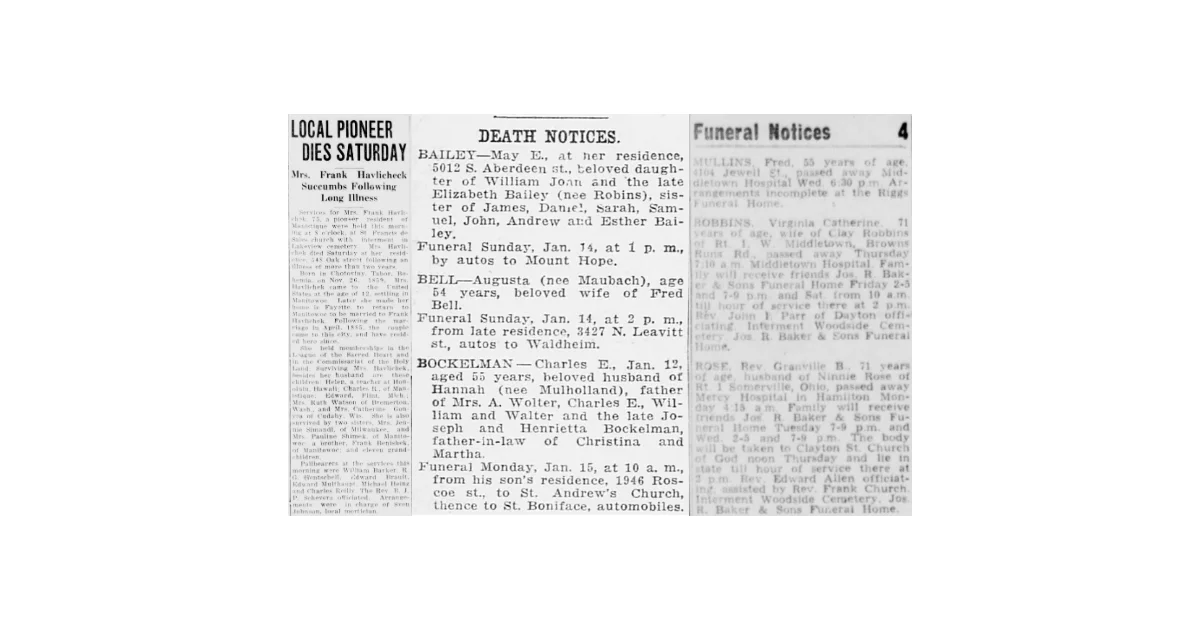
What’s the Difference Between an Obituary, Funeral Notice, and Death Notice?
Learn the difference between an obituary, death notice, and funeral notice, and how each one can reveal family history clues in old newspapers.
An obituary, death notice, and funeral notice are related newspaper records, but they are not always the same thing. An obituary is usually a longer article with life details such as birthplace, family members, occupation, church, immigration, funeral, and burial information. A death notice is usually shorter and may announce the death with names, relatives, addresses, age, and basic funeral details. A funeral notice focuses on service information such as funeral time, church, funeral home, visitation, cemetery, and interment. In old newspapers, these categories often overlap, so researchers should search beyond the word “obituary” and look for headings like “Death Notices,” “Funeral Notices,” “Deaths and Funerals,” and similar local columns.
At first, these all sound like the same thing.
Obituary.
Funeral notice.
Death notice.
Honestly, most of us use the words interchangeably when we’re searching. I know I do sometimes. We say, “I’m looking for an obituary,” when what we really mean is, “I’m looking for anything in the newspaper that mentions this person’s death.”
But in old newspapers, those differences matter.
A full obituary might tell you a person’s birthplace, family, immigration story, church membership, and burial place. A funeral notice might only give the service time and cemetery. A death notice might be a short announcement tucked into a column with several other names.
All three can help with family history.
You just need to know what you’re looking at.
Quick answer: obituary vs. funeral notice vs. death notice
An obituary is usually a longer write-up about a person’s life and death. It may include family members, birthplace, marriage, occupation, church, community ties, funeral details, and burial place.
A death notice is usually shorter. It announces that someone died and may include the person’s age, address, relatives, death date, or basic funeral information.
A funeral notice focuses mostly on the service. It often lists the funeral time, church, funeral home, cemetery, interment, visitation, or where friends may call.
The tricky part is that newspapers did not always separate them neatly.
What is an obituary?
An obituary usually gives you the most detail.
It is the kind of newspaper item most family history researchers hope to find because it can tell you more than a death date. It may help you understand where a person came from, who they belonged to, what they did, and how their community remembered them.
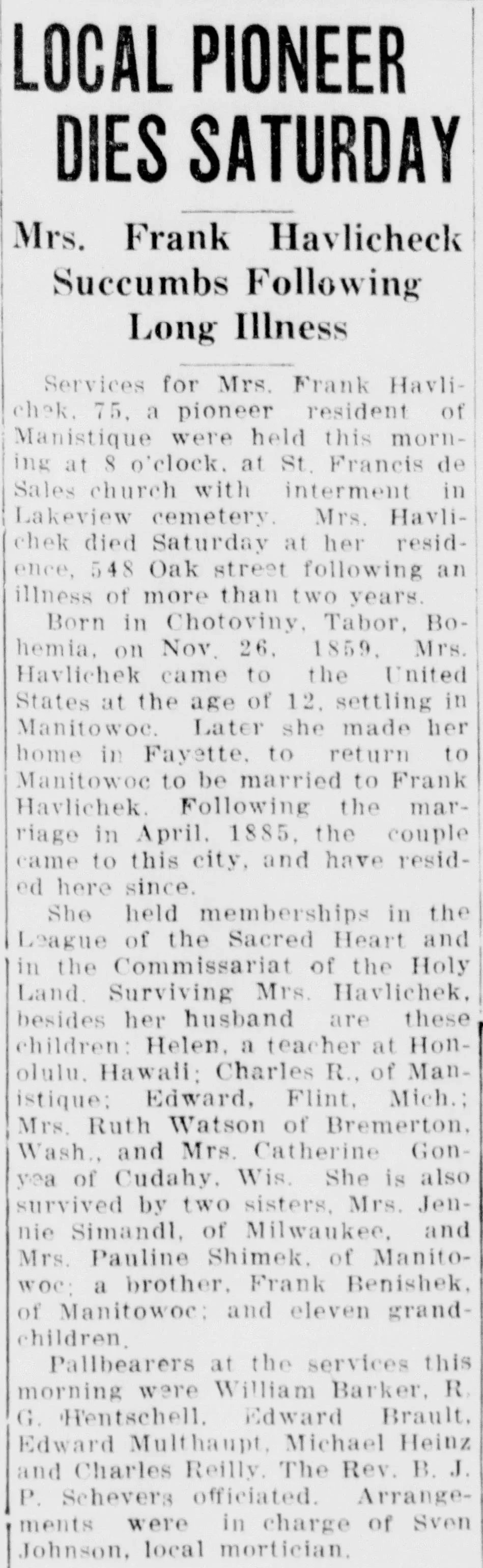
This obituary tells us Mrs. Frank Havlicheck was 75 and a pioneer resident of Manistique. It gives her address, 548 Oak Street, and says she died after an illness of more than two years.
But it does much more than that.
This obituary includes:
Birthplace in Bohemia
Birth date
Immigration to the United States at age 12
Early residence in Manitowoc
Marriage to Frank Havlicheck
Move to Manistique
Church or religious memberships
Names and locations of surviving children
Names of sisters and a brother
Number of grandchildren
Pallbearers
Officiating priest
Cemetery
Mortician
That is why obituaries matter so much.
This one does not just say she died. It gives the outline of a life.
What is a death notice?
A death notice is usually shorter than an obituary.
It may announce a death, list relatives, and sometimes include funeral details. In many newspapers, death notices appeared together in a column, almost like a classified section for recent deaths.
They can be brief, but do not dismiss them.
A death notice may give exactly the detail you need.
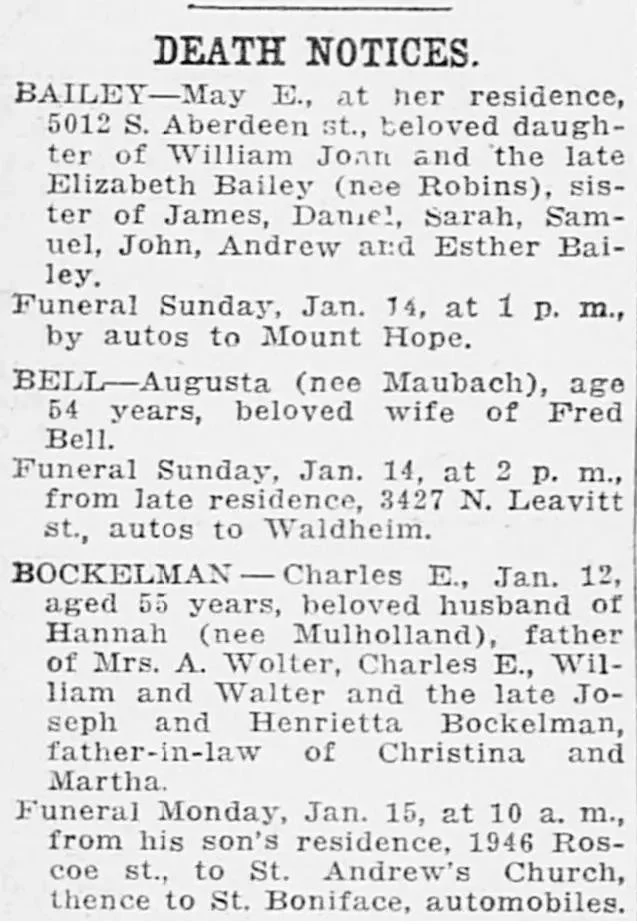
In this death notice for May E. Bailey, it lists:
Her residence
Her parents
Her siblings
Funeral date and time
Burial or destination to Mount Hope
For Augusta Bell, it gives:
Her maiden name, Maubach
Her age
Her husband’s name
Funeral date and time
Residence
Cemetery destination
For Charles E. Bockelman, it gives:
Date of death
Age
Wife’s name and maiden name
Children
Deceased relatives
In-laws
Funeral time
Residence
Church
That is a lot of information for something called a “notice.”
This is one reason I would never skip death notice columns. They may not feel as personal as a full obituary, but they can be packed with names.
What is a funeral notice?
A funeral notice is usually about the service.
It tells you what will happen next.
A funeral notice may include:
Funeral date
Funeral time
Church
Funeral home
Visitation
Cemetery
Interment
Officiating minister
Whether friends may call
Whether the body was taken somewhere else
This kind of notice may not give a full life story, but it can still be extremely useful.
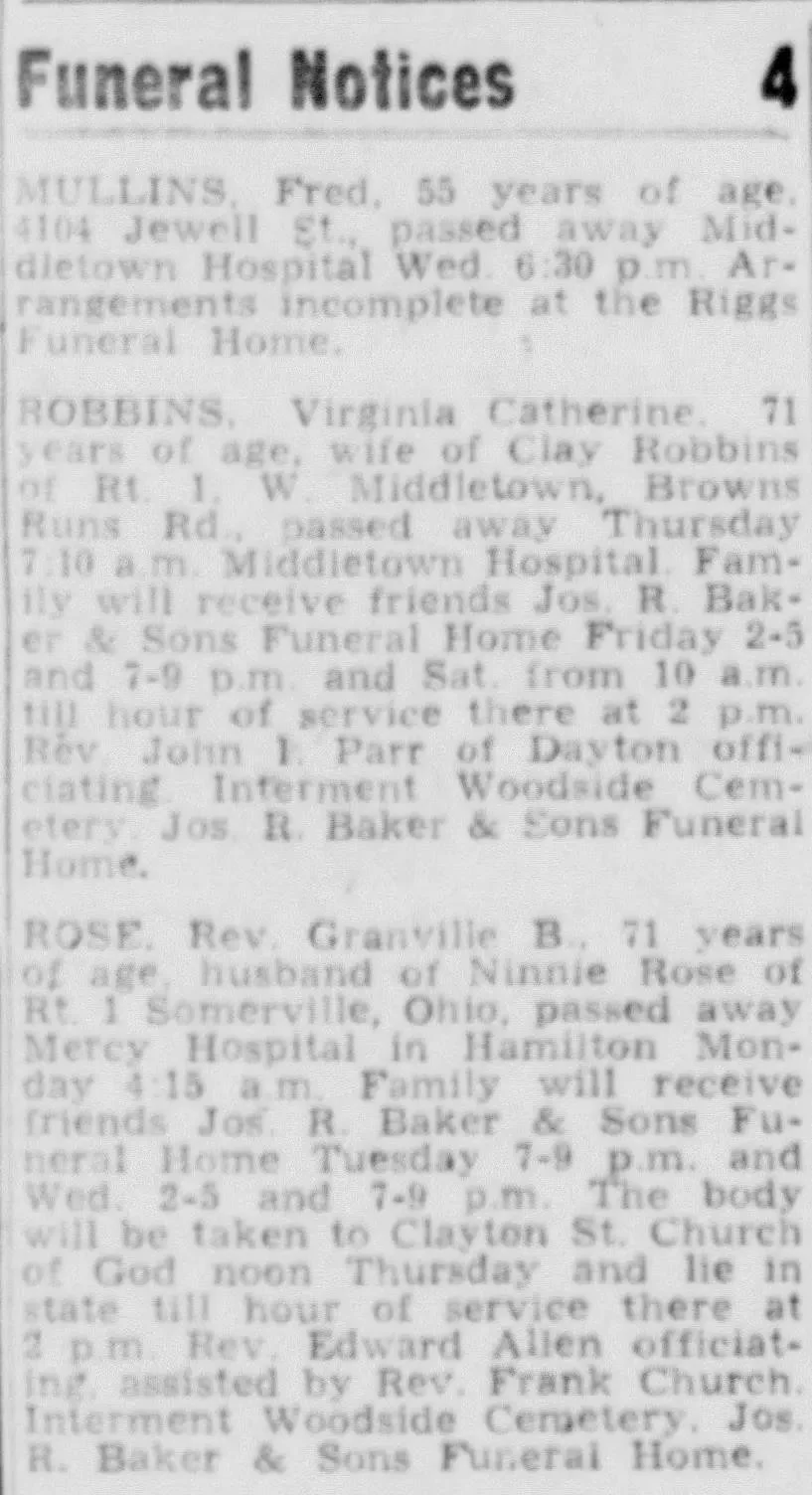
This funeral notice includes the names Fred Mullins, Virginia Catherine Robbins, and Rev. Granville B. Rose. The notices are not long, and the image is not perfectly clear, but you can still see the pattern.
These notices focus on:
Age
Residence
Place of death
Hospital
Funeral home
Visitation times
Service time
Church
Cemetery
Officiating ministers
That kind of detail can help you confirm you have the right person.
It can also lead to the next search.
If a funeral notice names a cemetery, search the cemetery.
If it names a church, search the church.
If it names a funeral home, search that too.
A funeral notice may be short, but it can point you in the right direction.
When the categories overlap
This is where old newspapers get messy.
Sometimes a newspaper section is labeled “Deaths and Funerals.”
That tells you right away that the paper was not always treating these as separate categories.
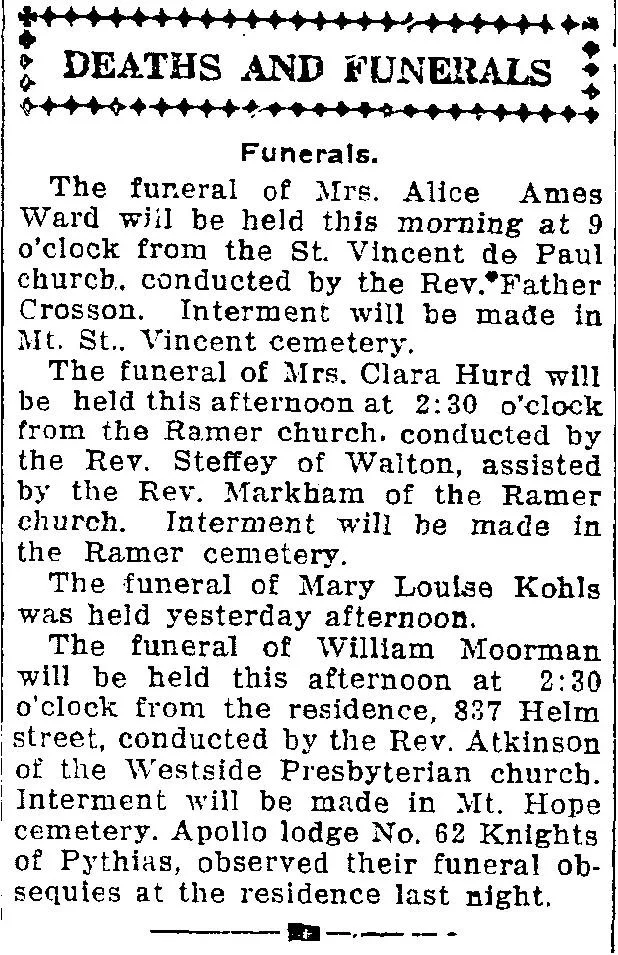
Some entries are very short. Others include:
Funeral time
Church
Minister
Cemetery
Residence
Lodge or organization involvement
Burial details
This is not a full obituary section.
It is not only a funeral notice section either.
It is a mixed death and funeral column.
And honestly, that is how many newspaper pages work.
The clue may not appear in the “right” category. It may be tucked into a column that uses a heading you were not searching for.
Why the difference matters when you search
This is not just a vocabulary lesson.
It changes how you search.
If you only search the word obituary, you may miss:
Death notices
Funeral notices
Death rolls
Local mentions
Church notices
Cemetery mentions
In-memoriam notices
Try searching with words like:
died
death
deaths
funeral
funeral services
services
burial
interment
cemetery
friends may call
remains
passed away
death notice
funeral notice
And if the search still does not work, browse the newspaper around the date.
Look for headings like:
Obituary
Death Notices
Funeral Notices
Deaths and Funerals
City Deaths
The Day’s Death Roll
Local News
Personals
That is usually where the missed clues are hiding in plain sight.
Which one is best for family history?
A full obituary is usually the richest find.
But I would not say it is the only useful one.
Here is how I would think about it:
Type of notice | What it usually gives you | Why it matters |
|---|---|---|
Obituary | Life details, family names, birthplace, marriage, occupation, church, burial | Best for building a fuller family story |
Death notice | Death announcement, relatives, address, age, basic funeral details | Best for confirming identity and family connections |
Funeral notice | Service time, church, funeral home, cemetery, interment | Best for finding burial and local records |
Mixed death/funeral column | Several brief notices under one heading | Best for browsing when search terms fail |
The best one is the one that gives you the next clue.
Sometimes that is the full obituary.
Sometimes it is one line in a funeral column.
What should you save from each one?
When you find any obituary-related notice, save more than just the name and date.
From an obituary, save:
Birthplace
Birth date
Parents
Spouse
Children
Siblings
Occupation
Church
Immigration details
Former residences
Cemetery
Funeral home
From a death notice, save:
Name as printed
Maiden name
Address
Age
Relatives
Funeral date
Church or cemetery
Paper title and date
From a funeral notice, save:
Funeral home
Service time
Visitation time
Church
Minister
Cemetery
Interment location
Whether the body was sent elsewhere
These details are search terms for your next round.
That is the part people forget.
The notice you find is not just the answer. It is also the next set of clues.
Common questions about obituaries, funeral notices, and death notices
Is a death notice the same as an obituary?
Not exactly. A death notice is usually shorter and focuses on announcing the death. An obituary usually gives more detail about the person’s life, family, and community connections. But in old newspapers, the lines can blur.
Is a funeral notice useful for genealogy?
Yes. A funeral notice may not include a full life story, but it can give you a church, cemetery, funeral home, service time, residence, or minister. Those details can help you confirm a person and find more records.
Why can’t I find an obituary if I found a funeral notice?
There may not have been a full obituary, or it may have appeared in another newspaper, on another date, or under a different heading. Search nearby days, nearby towns, and death-related terms instead of only “obituary.”
Which should I search first?
Search broadly. Try the person’s name with the town first, then add words like died, funeral, death notice, burial, interment, or cemetery. If the search does not work, browse the paper around the death date.
Can a death notice include family details?
Yes. Some death notices include parents, spouses, children, siblings, maiden names, addresses, and funeral details. They may be short, but they can be very useful.
Final thoughts
When you are searching newspapers, do not get too attached to the word “obituary.”
That is the word we use now, but it is not always the word the newspaper used then.
Look for obituaries, yes.
But also look for death notices, funeral notices, mixed columns, local mentions, and anything that points to a death, burial, or service.
If you want to test this in NewspaperArchive, try searching one ancestor’s name with the words funeral, death notice, burial, or interment instead of only obituary. You may find a notice you would have missed the first time.
Key takeaways
An obituary usually gives the most detailed life information.
A death notice is often shorter but may include strong family clues.
A funeral notice focuses on service, burial, church, cemetery, or funeral home details.
Old newspapers did not always separate these categories clearly.
Search for more than the word “obituary.”
Browse headings like Death Notices, Funeral Notices, and Deaths and Funerals.
Save every clue because even a short notice can lead to the next record.