How to Research Historical Crimes and Cold Cases Using Newspaper Archives
Learn how to research historical crimes and cold cases using newspaper archives, including arrests, inquests, trials, verdicts, and local crime stories.
Historical crime research in newspaper archives works best when researchers search by names, locations, dates, and crime-related terms. Newspapers may include arrest notices, coroner’s inquests, witness statements, trial coverage, sentencing reports, prison news, and follow-up articles that do not appear in court or police records. Local and small-town newspapers are especially valuable because they often covered crimes, hearings, and community reactions in greater detail than larger city papers.
Some of the most gripping stories in history do not begin in a courthouse file. They begin in a newspaper clipping.
A short arrest notice. A coroner’s inquest. A dramatic trial headline. A few lines buried in a local paper that name the victim, the suspect, the street, the witness, or the one detail that changes everything.
If you are researching a historical crime, an old family scandal, or a cold case from the past, newspaper archives are one of the best places to begin.
Quick Answer: How Do You Research Historical Crimes in Newspaper Archives?
To research historical crimes in newspaper archives, start with the names of the victim, suspect, witnesses, location, and approximate date. Search local newspapers first, then expand to county, state, and national newspapers. Look for arrest notices, coroner’s inquests, trial reports, sentencing notices, prison news, and later follow-up articles. Newspaper archives can reveal details that court records often leave out, including witness names, community reaction, crime scene descriptions, conflicting accounts, and the timeline of how a case unfolded.
Why Newspapers Are So Valuable for Historical Crime Research
Court records may tell you the charge, verdict, or sentence. Police records may document the arrest. But newspapers often show what happened in between.
Historical newspapers may include:
The first report of the crime
The names of victims, suspects, witnesses, officers, attorneys, and judges
Coroner’s inquest testimony
Trial updates and courtroom statements
Community reaction
Editorial opinions
Jail and prison updates
Sentencing details
Appeals, pardons, or later follow-up stories
For many historical crimes, especially local cases, newspapers may be the only place where the story was explained in detail.
That is what makes newspaper archives so powerful. They do not just tell you that something happened. They help you understand how people first heard about it, how the story changed, and how the community responded.
Have a historical crime, family mystery, or old court case you want to investigate? Try searching NewspaperArchive by name, place, and date. Start with one person’s name, then follow the clues as new names, towns, and court terms appear.
A Crime Story Often Begins With One Clipping
Historical crime research often begins with a headline that raises more questions than it answers.
In this 1900 clipping, the newspaper reported that William Barton had been killed in Waynesburg after objecting to Dr. Conda Beck’s attentions to his daughter.
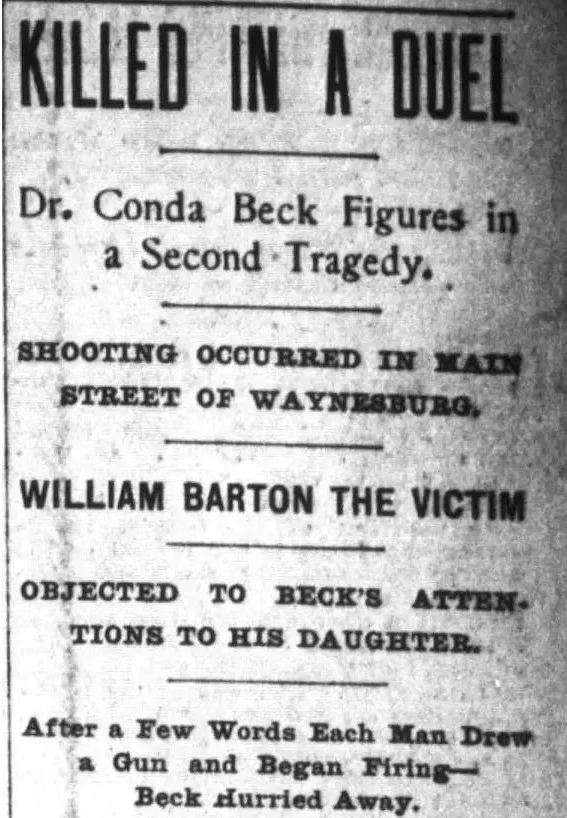
Even before checking court records, this one clipping gives us several research clues:
Detail Found in the Clipping | Why It Matters |
|---|---|
Dr. Conda Beck | Suspect or key person to search |
William Barton | Victim to search in later articles and records |
Waynesburg | Location to use when narrowing newspaper results |
Main Street | Address clue that may appear in later reports |
Barton’s daughter | Possible motive and family relationship clue |
Shooting occurred after an argument | Early version of the event |
Beck hurried away | Detail to compare with later articles |
This is the part of newspaper research that always pulls me in. One article gives you the shock of the event, but it also gives you a starting place. A name leads to a town. A town leads to a court date. A court date leads to testimony, verdicts, jail records, and sometimes a story that was never passed down in the family at all.
Types of Crime Coverage You Can Find in Historical Newspapers
Historical crime coverage appeared in many different forms. Some articles were large and dramatic. Others were only a few lines long. Both can be valuable.
Type of Newspaper Coverage | What It May Include | Why It Helps |
|---|---|---|
Arrest notice | Name, charge, date, officer, location | Confirms when someone entered the legal system |
Police blotter | Local arrests, fines, disturbances, minor offenses | Useful for finding small crimes and repeated behavior |
Coroner’s inquest report | Cause of death, witness statements, jury findings | May reveal details not found in a death record |
Trial report | Testimony, attorney arguments, judge’s comments | Helps reconstruct the case |
Sentencing notice | Sentence length, judge’s statement, jail or prison transfer | Confirms the outcome |
Execution account | Final statement, witnesses, crowd reaction | Common in older newspapers for capital cases |
Prison news | Transfers, escapes, pardons, conditions | Helps trace what happened after sentencing |
Follow-up article | Appeals, anniversaries, new developments | Shows how the story continued |
When researching a crime, do not assume the first article is the whole story. It rarely is.
Step 1: Start With the Facts You Already Know
Before searching a newspaper archive, write down what you already have.
Start with:
Name of the victim
Name of the suspect
Names of witnesses, relatives, officers, or attorneys
Approximate date of the crime
Date of death, arrest, trial, or sentencing
City, county, and state
Type of crime
Court or prison details, if known
Even one strong fact can narrow your search. A death date can tell you which week of newspapers to browse. A county name can point you toward the court where the case was handled. A witness name can lead to an inquest article you never would have found by searching the victim alone.
Step 2: Search for Both the Victim and the Suspect
Newspapers did not always lead with the same name.
Early reports may focus on the victim. Later reports may focus on the suspect. Trial articles may mention attorneys, witnesses, judges, or relatives more than either of the main people involved.
Search for:
Victim’s full name
Suspect’s full name
Surnames only
Initials and surname
Titles such as Dr., Mrs., Miss, Capt., Judge, or Sheriff
Witness names
Family member names
Attorney names
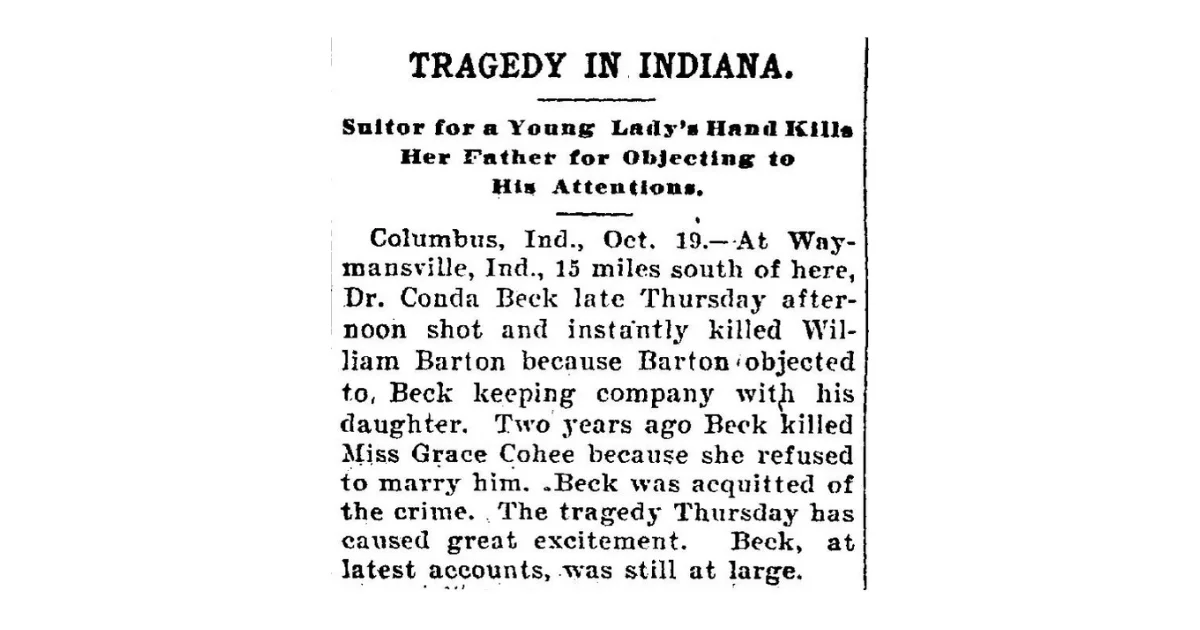
For the Beck and Barton case, a researcher would want to search both William Barton and Dr. Conda Beck. The first article focuses on the killing. The later article focuses on the indictment. Searching only one name could cause you to miss part of the story.
Step 3: Use Crime-Specific Search Terms
Crime articles often used repeated words and phrases. Try combining names or locations with terms that fit the case.
Research Goal | Search Terms to Try |
|---|---|
Arrest or charge | arrested, charged, warrant, indicted, arraigned |
Death investigation | inquest, coroner, homicide, suspicious death, slain |
Trial coverage | trial, testimony, witness, verdict, jury |
Outcome | convicted, acquitted, sentenced, jail, prison |
Violent crime | murder, manslaughter, shooting, stabbing, assault |
Older crime language | hanged, executed, desperado, outlaw, mob, vigilante |
Court process | grand jury, prosecution, defense, attorney, judge |
On NewspaperArchive, keep your searches simple and flexible. Start with the name. Then try the name plus one keyword, such as:
“Conda Beck” trial
“William Barton” killed
Beck indicted
Barton murder
Waynesburg shooting
Conda Beck verdict
If a search does not work, simplify it. Historical OCR can be messy, especially with older newspapers. Sometimes a surname and location will work better than a full name.
Step 4: Search by Place, Not Just Name
If the name search fails, search for the place.
Many crime articles included addresses, neighborhoods, streets, courthouses, jails, or county names. Sometimes the place is easier to read in OCR than the person’s name.
Try searching:
City or town
County
Street name
Courthouse
Jail or prison
Neighborhood
Nearby town
Name of a business or office connected to the case
In the Beck and Barton clipping, Waynesburg and Main Street are important clues. The follow-up article also mentions Hartsville, where Beck was reportedly found at his brother’s office. That gives a researcher another place to search.
Place names help you move beyond one article and follow the case into other communities.
Step 5: Search Local Newspapers First
Historical crime coverage usually worked outward.
A local newspaper might publish every detail. A county paper might cover the trial. A state paper might mention the case if it was sensational. A national paper might only pick it up if the crime was shocking or unusual.
Use this order when searching:
Newspaper Level | What You May Find |
|---|---|
Local town paper | Most detailed first reports, local gossip, witness names |
County seat paper | Court coverage, grand jury actions, trial reports |
Nearby town papers | Additional versions of the story |
State papers | Broader coverage of sensational cases |
National papers | Wire service reports for notorious crimes |
This is one reason small-town newspapers matter so much. Famous crimes may show up everywhere, but ordinary local crimes often survived only in the local paper.
NewspaperArchive is especially useful for this kind of research because so many historical crime stories appeared in small-town and regional newspapers, not just major city papers. If your ancestor, subject, or case was connected to a smaller community, those local pages may be where the real details appear.
Step 6: Follow the Case Over Time
Do not stop with the first clipping.
A crime could generate newspaper coverage for weeks, months, or even years. Each article may add a new piece of the timeline.
A case might include:
First report of the crime
Arrest notice
Coroner’s inquest
Grand jury action
Indictment
Trial date announcement
Daily trial coverage
Verdict
Sentencing
Jail or prison transfer
Appeal
Pardon, release, or later follow-up
That is exactly what happens with the Beck and Barton case. The first article reports the shooting. The second clipping, published later, shows the legal process moving forward.
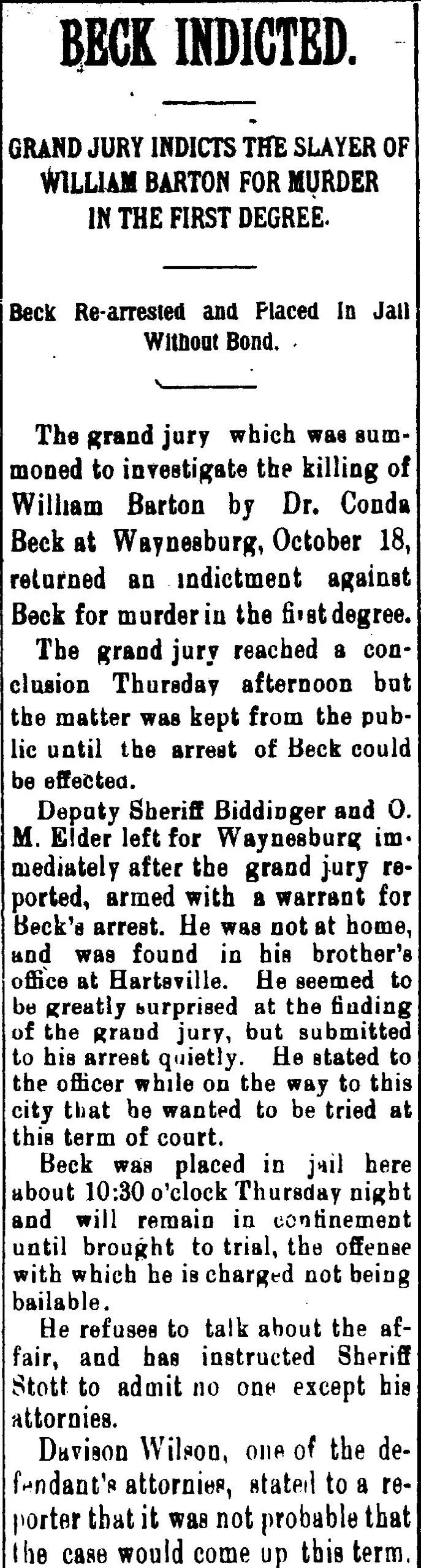
In the follow-up article, Beck had been indicted for murder in the first degree, re-arrested, and placed in jail without bond. The article also adds new details: deputies went to find him, he was located at his brother’s office in Hartsville, he refused to discuss the affair, and he limited visitors to his attorneys.
That is the value of tracking a case over time. One article tells you what happened. The next article tells you what happened next.
Step 7: Compare Multiple Newspaper Accounts
Historical newspapers did not always agree.
One paper may have rushed to publish the first version of the story. Another may have printed witness testimony days later. A third may have repeated gossip or used language that reflected the bias of the time.
When researching historical crimes, compare:
Local articles
County papers
Statewide coverage
Trial reports
Later summaries
Official records, when available
Look for differences in:
Names
Dates
Locations
Motive
Sequence of events
Witness statements
Legal outcome
Contradictions are not always a problem. They are part of the research. They can show how the story changed as more information became available.
Cross-Reference Newspapers With Other Records
Newspapers tell the story, but other records can help confirm the details.
Use newspaper articles as a roadmap to find:
Record Type | What It Can Confirm |
|---|---|
Coroner’s records | Cause and manner of death, inquest details |
Court records | Charges, indictments, verdicts, sentencing |
Prison records | Sentence, physical description, release or transfer |
Death certificates | Date, place, cause of death |
Probate records | Family relationships, estate impact |
Census records | Household, occupation, neighbors, family structure |
City directories | Addresses and occupations |
Cemetery records | Burial place and family connections |
For example, if a newspaper mentions an indictment date, you can use that date to search court records. If it names a coroner’s jury, you may be able to look for an inquest file. If it says someone was placed in jail or sent to prison, that can point you toward jail registers or penitentiary records.
Newspapers do not replace official records. They help you find them.
What Newspapers Reveal That Other Records Often Miss
Crime research is not only about the legal outcome. It is about context.
Newspapers may reveal:
How the crime was first reported
What neighbors believed happened
Who witnessed the event
Where the crime occurred
How the community reacted
Whether race, gender, class, or reputation shaped the coverage
How the accused was described
Whether the victim was portrayed sympathetically
Whether the story changed over time
That last point matters. In a cold case or historical crime, the first version of a story is not always the most accurate one. Later articles may correct, complicate, or completely change the original report.
A Note About Sensitive Crime Research
Historical crime research can uncover painful stories.
Some cases involved murder, domestic violence, racial injustice, false accusations, public shame, or families who never spoke about what happened. Newspapers are valuable sources, but they are not neutral. Reporters sometimes used biased language, repeated rumors, or published details before all the facts were known.
As you research, try to separate:
Confirmed facts
Reported claims
Rumors
Editorial opinion
Later legal outcomes
If you plan to write or share the story publicly, remember that historical crimes may still connect to living descendants. A thoughtful researcher can tell the truth without treating real people’s pain like entertainment.
How to Search NewspaperArchive for Historical Crimes
If you are using NewspaperArchive, start broad and then narrow your search.
Try searching:
The victim’s full name
The suspect’s full name
The surname only
The town or county
The street name
The crime term
The court term
The date range around the event
Then search again using related terms.
For example, if you are researching a shooting, try:
shooting
killed
slain
murder
inquest
indicted
trial
verdict
sentenced
If the article is hard to find, browse the newspaper by date. Crime stories often appeared in the days immediately after the event, but court coverage may appear weeks or months later.
If you have a name, a place, or even a rough date, try a search in NewspaperArchive and see what appears. Start simple, then add terms like “trial,” “inquest,” “arrested,” “indicted,” or “verdict” to follow the story.
Common Mistakes to Avoid When Researching Historical Crimes
Historical crime research can get messy quickly. These mistakes are easy to make.
Mistake | What to Do Instead |
|---|---|
Stopping at the first article | Search forward and backward in time |
Searching only the suspect | Search the victim, witnesses, attorneys, and places |
Ignoring local papers | Start with the newspaper closest to the event |
Trusting one account completely | Compare multiple articles and records |
Using only modern crime terms | Try older words like slain, inquest, hanged, or indicted |
Forgetting OCR errors | Try surnames, initials, places, and date browsing |
Skipping official records | Use newspapers to locate court, coroner, and prison records |
Frequently Asked Questions About Historical Crime Research
What is the best way to find old crime articles in newspapers?
Start with the names of the victim and suspect, then add the location and approximate date. Search local newspapers first because they often include the most detail. Then search nearby county, state, and regional newspapers for follow-up coverage.
Can newspaper archives help with cold case research?
Yes. Newspaper archives can help reconstruct timelines, identify witnesses, locate earlier reports, and compare conflicting accounts. For older cold cases, newspapers may preserve details that are not available in surviving police or court records.
What kinds of crime records appear in old newspapers?
Historical newspapers may include arrest notices, police blotters, coroner’s inquests, trial reports, sentencing notices, prison news, execution accounts, appeals, pardons, and anniversary follow-ups.
Why should I search small-town newspapers for crime research?
Small-town newspapers often covered crimes that larger newspapers ignored. They may include names, addresses, witness details, court updates, and community reaction. For genealogists and local historians, these small notices can be some of the most revealing sources.
What if I cannot find the crime by searching the person’s name?
Try searching by location, street name, county, courthouse, jail, or crime term. Also try initials, surname only, alternate spellings, and titles such as Dr., Mrs., Sheriff, or Judge. If the search still fails, browse newspapers by date.
Conclusion: One Clipping Can Open the Whole Case
Historical crime research is rarely one simple search. It is a trail.
You may begin with a dramatic headline, but the real story often appears across multiple articles. The first clipping may name the victim. The next may identify the suspect. A later article may reveal an indictment, a trial date, witness testimony, or a sentence.
That is why newspapers are so important for researching historical crimes and cold cases. They preserve the unfolding story, not just the final outcome.
Ready to test a case from your own family tree, hometown, or research files? Search NewspaperArchive by name, place, and date. You may find that a forgotten crime story has been waiting in the newspaper all along.