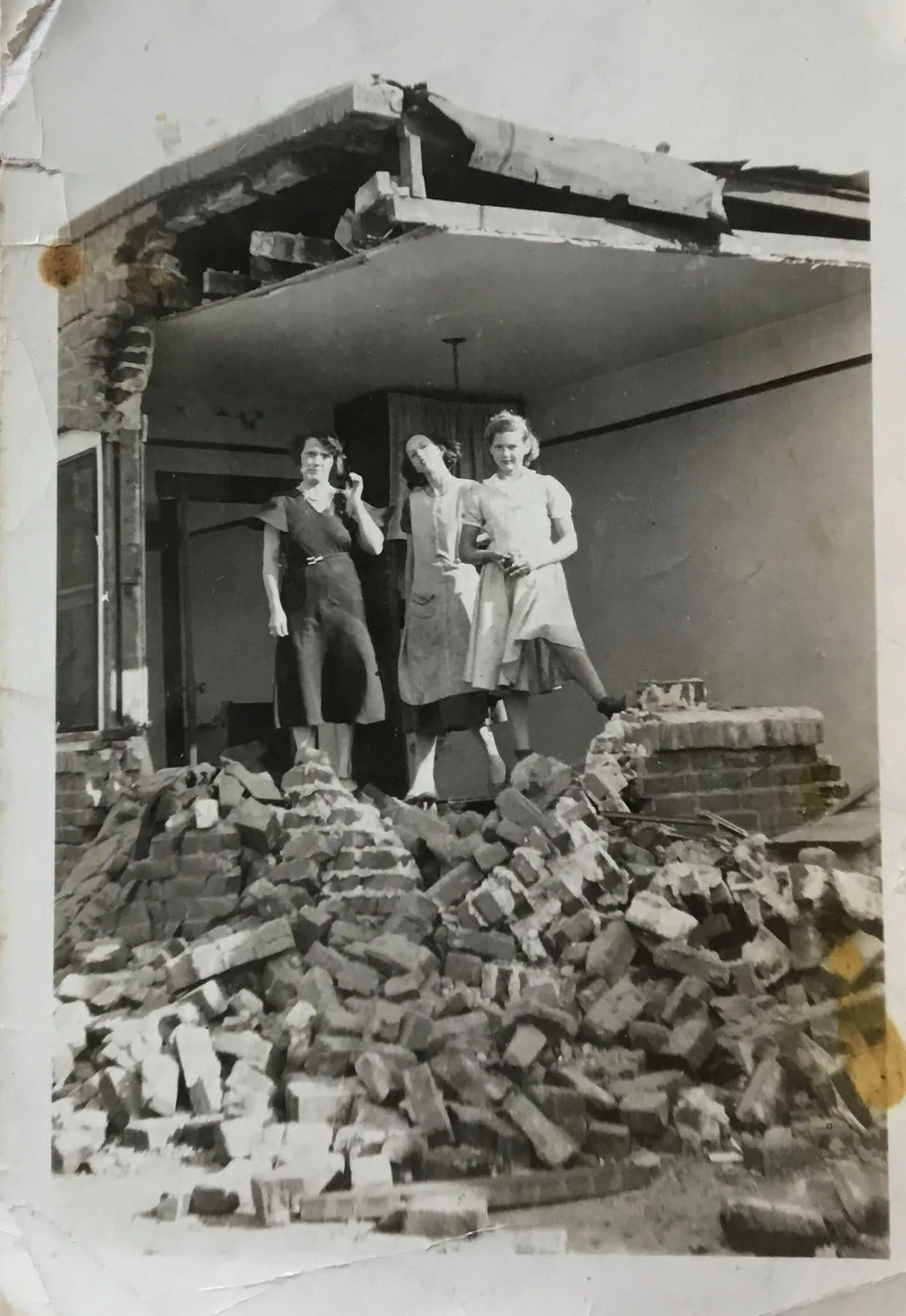
Real Survivor Stories from the 1933 Long Beach Earthquake
Real survivor letters from the 1933 Long Beach earthquake, preserved in small-town newspapers across the country. Read firsthand accounts from Hazel Smith and sailor Mahlon McKelvey.
This article presents firsthand survivor accounts from the 6.4 magnitude earthquake that struck Long Beach, California on March 10, 1933. It features two primary sources: a letter written by Hazel Smith of Long Beach to her mother in Michigan, published in the Clare Sentinel on March 15, 1933, describing tidal wave rumors, fires, displaced families, and exposed apartment buildings; and excerpts from a letter by sailor Mahlon McKelvey, published in the Clearfield Enterprise on March 16, 1933, recounting his escape from a collapsing diner, his rescue of a frozen waitress, and his subsequent duty at Seaside Hospital. The article also covers how survivor stories spread through small-town newspapers from Montana to Maryland as families across the country sought word of loved ones in the earthquake zone. It concludes with a brief FAQ covering the death toll (approximately 120), family communication methods, and the Field Act of 1933.
On March 10, 1933, a 6.4 magnitude earthquake struck Long Beach, California, devastating the city and surrounding communities. In the hours and days that followed, newspapers reported on the disaster as it unfolded, sharing early details and breaking updates.
But the most powerful stories didn’t come from the headlines. They came from the people who lived through it.
Within those pages are Long Beach earthquake survivor stories—firsthand accounts that capture not just what happened, but what it felt like to experience the earthquake in real time.
Why Survivor Stories Matter
Official records tell us what happened—the date, the location, and the damage left behind. Newspapers captured something else entirely. They preserved firsthand accounts from survivors—real-time, unfiltered glimpses of what it felt like to live through the quake as it was happening.
And those voices often appeared in places you wouldn’t expect.
As people across the country anxiously awaited word from friends and relatives in the California earthquake zone, newspapers reported on their phone calls, telegrams, and letters home.
A Letter Home from Long Beach
In Farwell, Michigan, Mrs. J. L. Littlefield shared a letter with her local newspaper, the Clare Sentinel, written by her daughter, Hazel Smith, just days after the earthquake.
Hazel wrote on March 15—only five days after the disaster—while the details were still fresh in her mind.
Her letter is filled with vivid detail. In the immediate aftermath, rumors spread quickly—including one that a tidal wave was coming. Hazel describes neighbors hurriedly packing their cars, sirens wailing, and fires flickering through dust-filled air.
The scene she captures is chaotic and uncertain—people reacting in real time, with little reliable information to guide them.
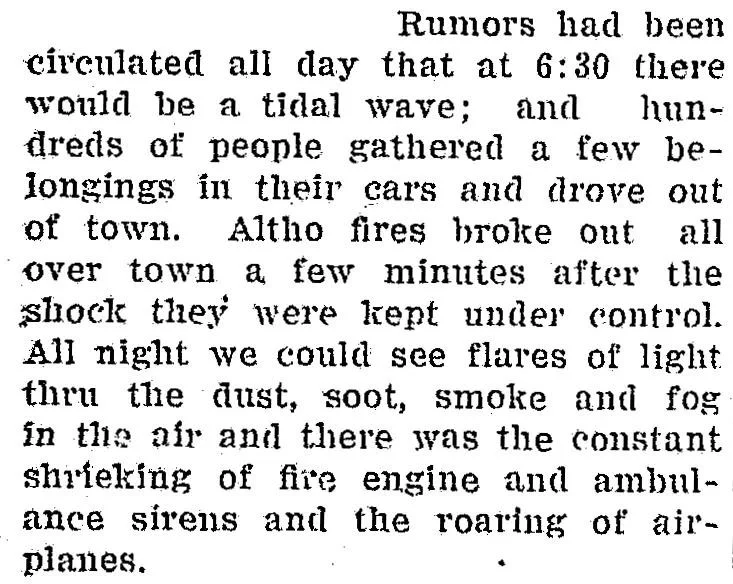
Marines and sailors patrolled the streets, helping to maintain order and assist the injured and displaced. Many families were left homeless. Aftershocks drove others from their homes, afraid the structures around them might collapse.
Near Hazel’s home, a local park filled with refugees—families sitting in their cars or huddled around fires, waiting out the night.
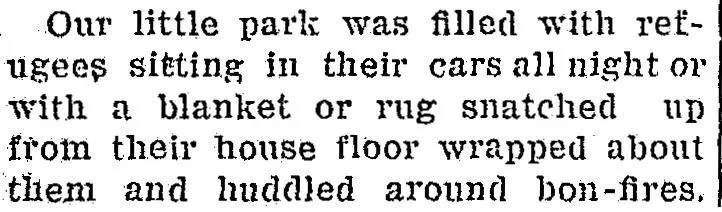
Hazel was fortunate. Her own home was left standing, though the aftermath inside told its own story.
“There was really not so much broken but the confusion and mess all over the house is rather sickening.”
Others were not as lucky.
In one of the letter’s most striking moments, Hazel describes looking into an apartment building with one entire side torn away—rooms exposed, everyday life suddenly frozen in place. Tables remained set. Personal belongings sat undisturbed.
She even compared the scene to another well-known disaster:
“I think that if the movies wanted to film the last days of Pompeii with a modern setting it would look like that.”
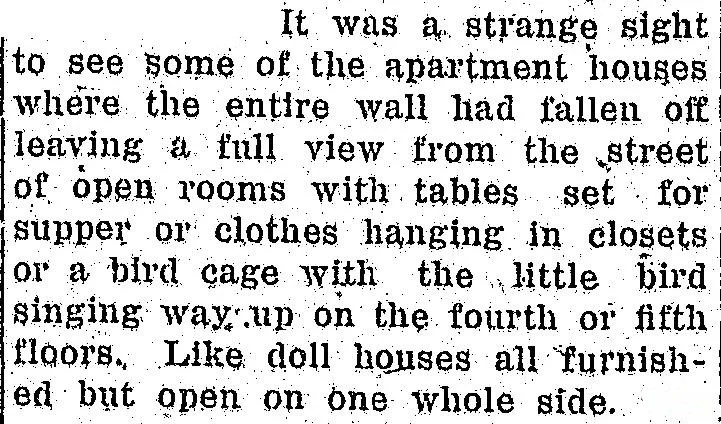
What Hazel captured in her letter was more than damage—it was the surreal experience of watching ordinary life stop in an instant.
Through her words, the earthquake becomes something more than a headline. It becomes a moment witnessed, felt, and remembered—exactly as she lived it.
A Sailor’s Story from the Long Beach Earthquake
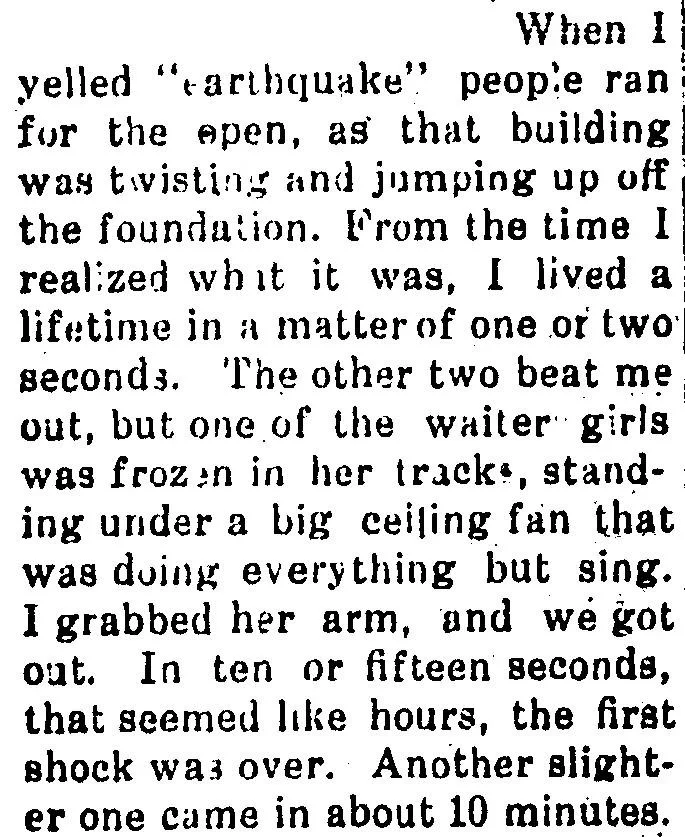
Mahlon McKelvey, a sailor stationed off the coast of California, had come ashore with several of his shipmates on March 10, 1933.
They had planned an enjoyable outing, traveling inland to visit Hollywood studios. By late afternoon, they stopped at a Long Beach diner and were just settling in for a steak dinner when the earthquake struck.
On March 16, 1933, the Clearfield Enterprise published excerpts from a letter Mahlon sent home to his mother in Iowa, describing what he experienced that day.
The scene he captured reads almost like something from a film. He described the building around him jumping and twisting off its foundation as people rushed to escape. In the chaos, he rescued a waitress who stood frozen beneath a ceiling fan, unable to move.
But for Mahlon, the experience didn’t end when he made it out of the diner.
In the hours that followed, active-duty military personnel in the area were called in to assist with relief efforts. Mahlon was assigned to Seaside Hospital, where the reality of the disaster took on a different form.
There, he witnessed the never-ending movement of stretchers—injured survivors being carried in, and those who had not survived being carried out.
In his letter, he admitted that the scenes were difficult to put into words. He also made one thing clear: anyone who claimed they were not frightened or affected by what they saw was not telling the truth.
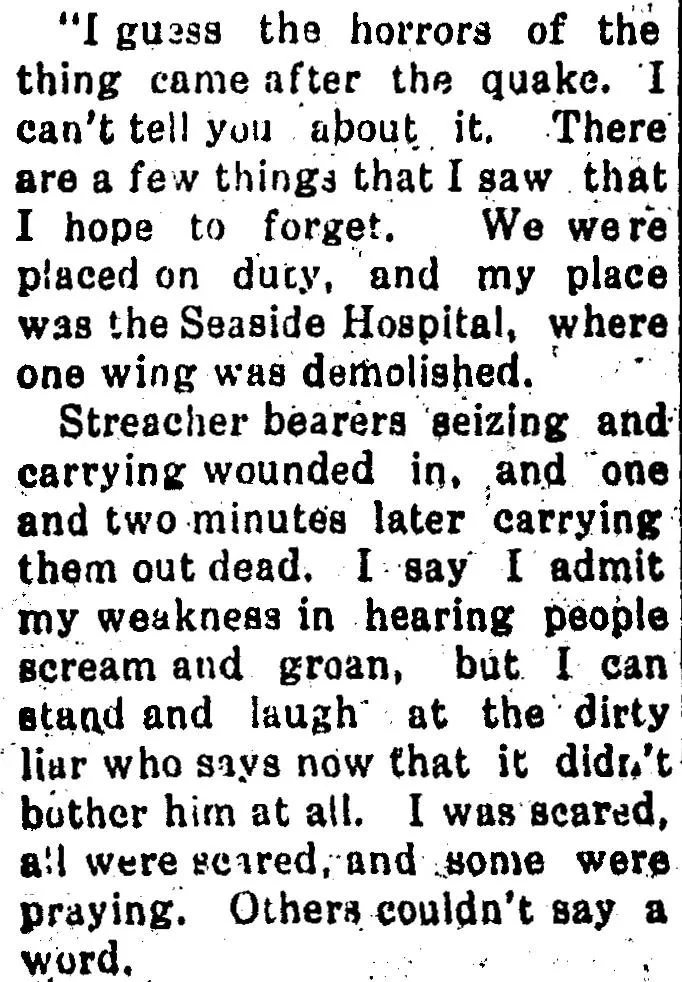
Mahlon’s account offers a perspective that few others could. He experienced the earthquake not only as a survivor, but as someone immediately pulled into the response—a victim one moment, an authority figure the next.
Through his words, we see both sides of the disaster: the shock of living through it, and the weight of helping others in its wake.
Survivor Stories in Small-Town Newspapers Across the Country
In the days and weeks following the March 10, 1933 earthquake, news of the disaster spread far beyond California. Across the country, newspapers began reporting on survivors as information slowly reached local communities.
For many readers, the connection was personal. Nearly everyone seemed to know someone—a friend, a relative, or a neighbor—with ties to the earthquake zone.
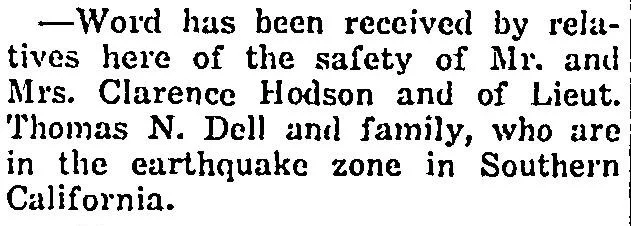
These stories often appeared not on the front page, but in social columns and local news sections.
Some were just a few lines long, like this brief mention in the March 16, 1933 issue of Maryland’s Democratic Messenger.
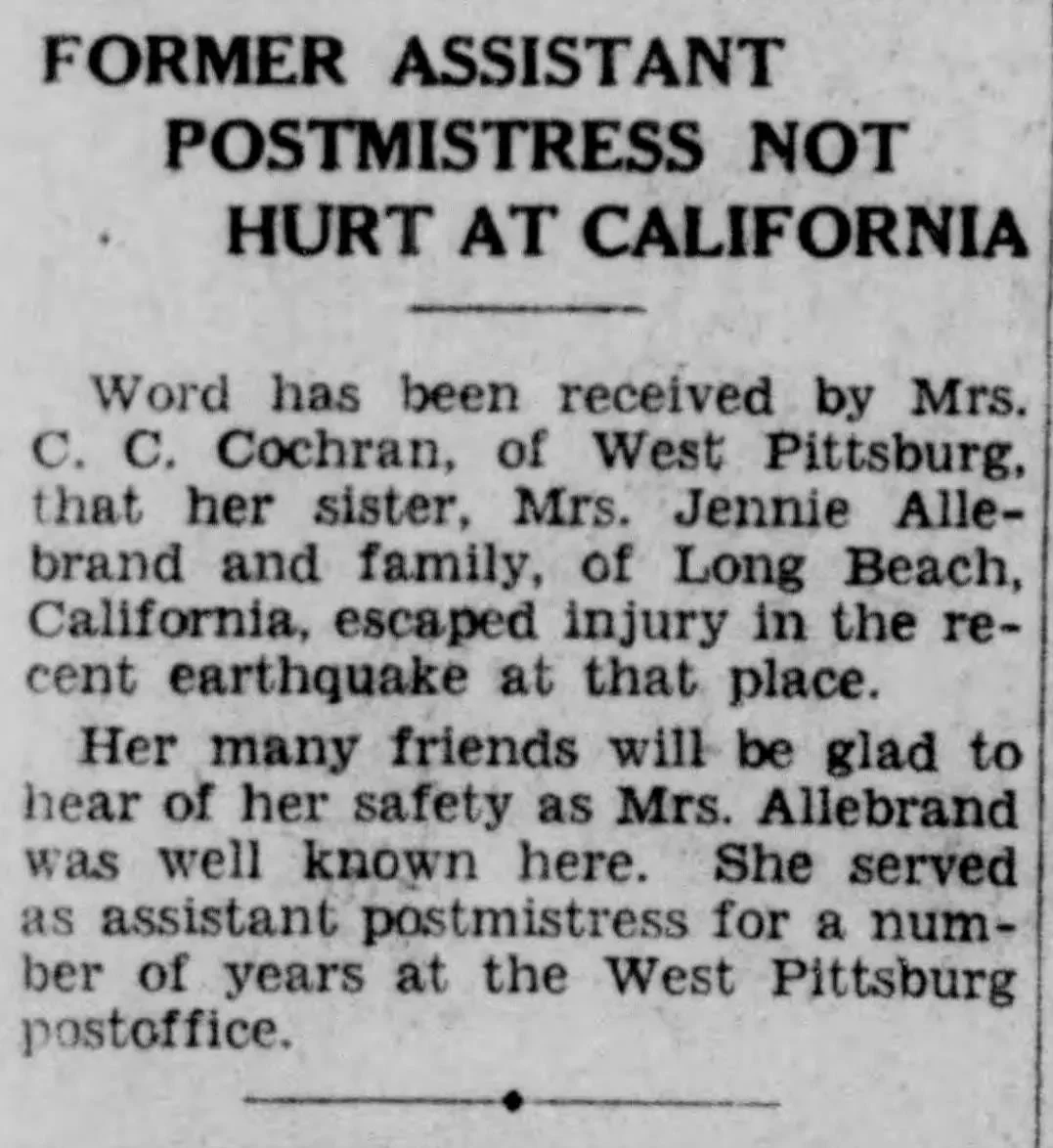
Others appeared as short standalone articles, offering a bit more detail about a survivor’s experience. This example from the New Castle News in Pennsylvania expands on what readers might otherwise have only seen summarized in a sentence or two:
In some cases, newspapers grouped multiple survivor accounts together. On March 17, 1933, the Helena Independent in Montana published three separate survivor stories in a single column—each one offering a different glimpse into how the Long Beach earthquake was experienced and remembered.
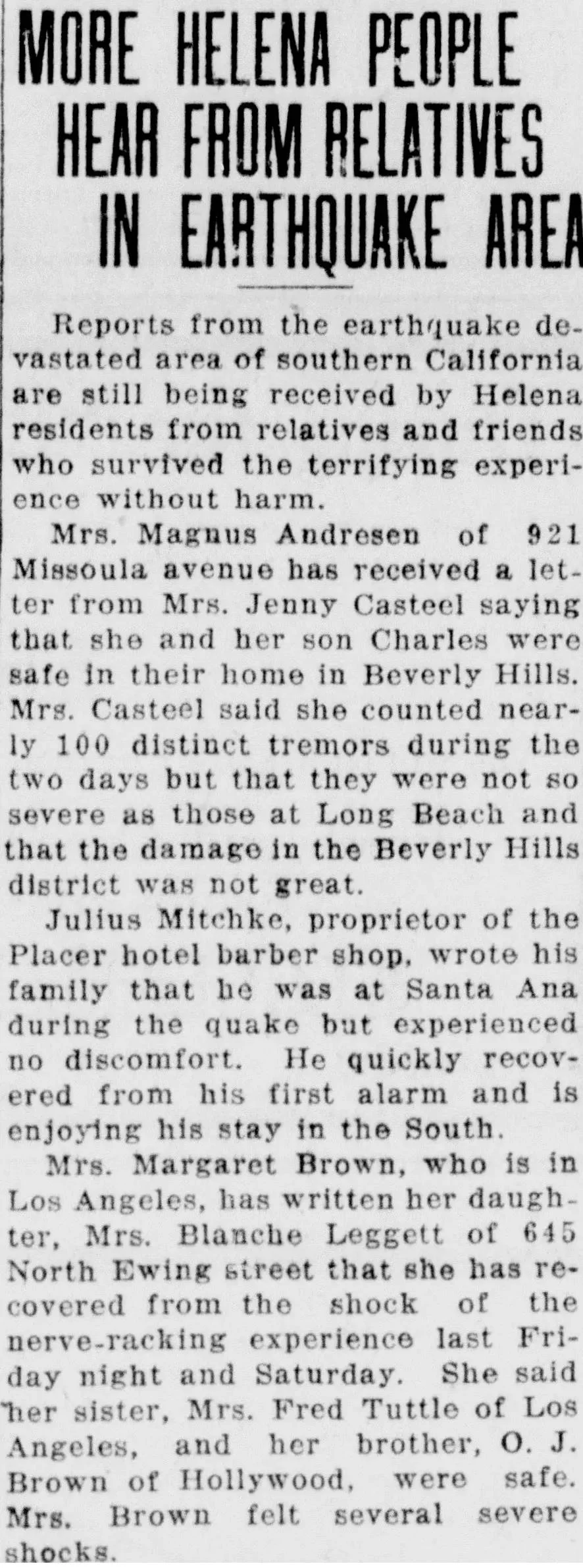
These brief mentions may seem small, but they carried real weight. For families waiting at a distance, they offered reassurance, connection, and offered hope that their own loved ones survived.
Together, they show how the story of the Long Beach earthquake didn’t stay in California—it traveled, one column at a time, across the country.
What These Stories Reveal
These stories go beyond survival.
They capture the fear, the confusion, and the uncertainty that followed the quake—moments that don’t appear in official records, but were preserved in the pages of newspapers.
Newspapers preserved these kinds of firsthand accounts across many major disasters. Read how old newspapers captured untold Titanic survivor stories in the same way.
Frequently Asked Questions About the 1933 Long Beach Earthquake
How many people died in the 1933 Long Beach earthquake?
Early newspaper reports varied, but the final death toll from the 1933 Long Beach earthquake is generally estimated at around 120 people, with thousands more injured.
How did families communicate after the 1933 Long Beach earthquake?
For many families—especially those separated by distance—letters were the primary way to share news after the earthquake. Telegrams and long-distance phone calls were also used when possible. Newspapers sometimes published these letters and messages, allowing communities to follow personal stories as they unfolded.
What was the Field Act and how was it connected to the Long Beach earthquake?
The Field Act was a California law passed in April 1933 in direct response to the damage caused by the Long Beach earthquake. Many of the most heavily damaged buildings were schools, raising concerns about student safety. The law required stricter oversight in the design and construction of public school buildings, making it one of the first major seismic safety measures in the United States.
How can I find survivor stories from the 1933 Long Beach earthquake?
Search newspapers from March and April 1933 using terms like “Long Beach earthquake survivor,” “earthquake letter,” or “California earthquake.” You can also try combining “earthquake” with relationship terms like “sister,” “son,” or “daughter,” or search smaller towns and social columns—many survivor stories appeared far from California as families shared news across the country.
Why are newspaper accounts of the Long Beach earthquake important?
Newspapers captured the 1933 Long Beach earthquake as it was happening, preserving real-time reactions, survivor experiences, and community responses. These accounts add depth to the historical record, showing not just what happened, but how people experienced it.
Stories That Traveled Beyond Long Beach
Without newspapers, these stories would be gone.
Many of those stories didn’t appear in major headlines. They were printed in small-town newspapers—shared through letters, brief mentions, and local columns.
That’s how news of the Long Beach earthquake reached communities across the country. That’s how families learned who was safe.
These stories didn’t stay in California. They moved through small-town papers, one community at a time.
And because of that, they were preserved—not just as history, but as lived experience.
About the Author
Julie Holmansky discovered her love of family history through her grandfather, who filled her childhood with stories, photos, and unforgettable characters. What began with flipping through photo albums turned into a lifelong passion for genealogy. Today, she’s driven by the same thing that first captured her imagination—bringing ancestors to life through their stories.
Connect with Julie
If you enjoyed this story, you can find more of Julie’s research and storytelling at her website, Roots and Rabbit Holes, and follow her on Storied to see what she uncovers next.