How to Use Newspaper Year-End Summaries to Find Ancestors
Newspaper year-end summaries listed births, marriages, deaths, and local events for the whole year. Here's how to find them and use them in your family history research.
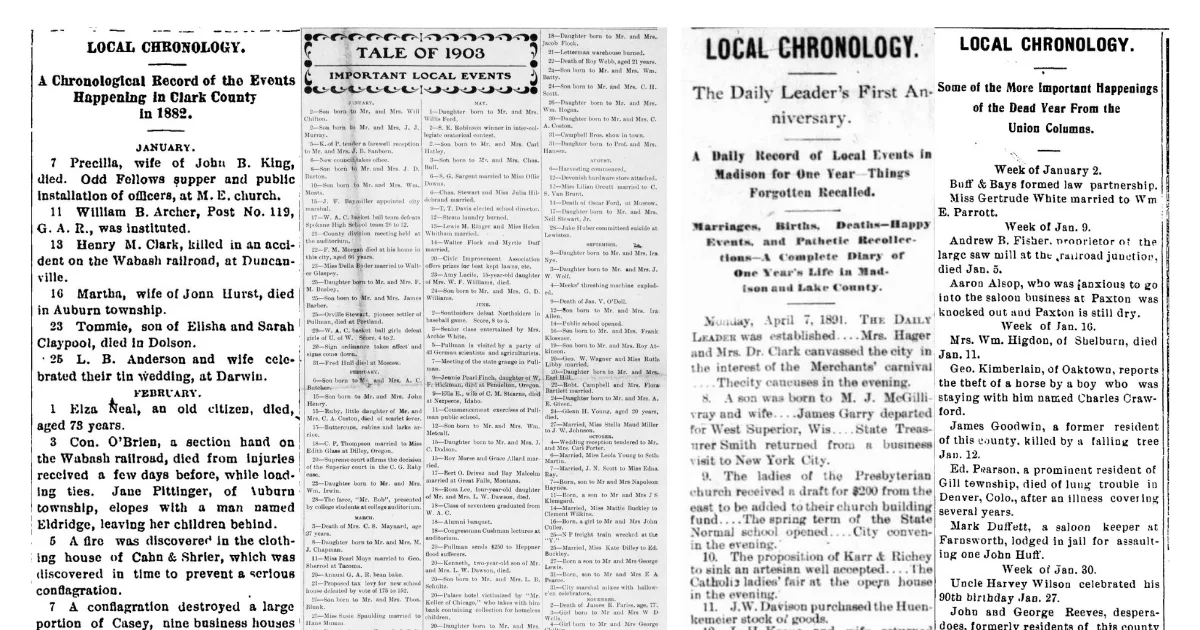
Newspaper year-end chronologies are retrospective articles published in late December or early January that compiled notable events, births, marriages, deaths, and local news from the previous year. For genealogists, these summaries can serve as standalone records when formal vital records are missing, and as finding aids pointing toward more detailed coverage in daily editions. They appeared under many names, including "Year in Review," "Local Chronology," "The Old Year's Record," and "Tale of [Year]." Small-town papers often named individual community members throughout, making them especially useful for family history research. NewspaperArchive offers searchable access to small-town and rural newspaper collections across all 50 U.S. states, many of which published detailed year-end summaries not available in other archives.
Every January, newspapers across the country did something that family historians now wish happened more often. They looked back.
Some papers ran a single column recapping notable local events. Others published sprawling special editions with separate sections for births, marriages, deaths, local business news, and community milestones. A few went month by month, day by day, naming ordinary people going about their lives: a son born to Mr. and Mrs. James Barber, a marriage at the Presbyterian church, a fire that took the warehouse on the edge of town.
These year-end summaries and chronologies were not written for future researchers. They were written for readers who lived through the year and wanted to see it all in one place. But for genealogists, that habit of looking back has turned out to be one of the most useful things old newspapers ever did.
Quick Answer
Newspaper year-end summaries are retrospective articles published in late December or early January that compiled notable events, births, marriages, deaths, and community news from the previous year. For family historians, they can serve as searchable records in their own right, sometimes naming people and events that never made it into formal vital records. Search for them in historical newspaper archives using terms like "Year in Review," "Local Chronology," or "Tale of [Year]," filtering to December and January editions.
If you have an ancestor's name, town, and a rough decade in mind, try searching NewspaperArchive for a year-end summary from a local paper. You may find your family listed where you least expected them.
What Are Newspaper Year-End Chronologies?
A newspaper year-end chronology was exactly what it sounds like: a summary of what happened during the previous year, published around the turn of the new year.
What varied was how much each paper put into it. A small-town weekly might run a single column of notable local events. A larger city paper might publish a special New Year's edition spanning sixteen pages, organized by category, covering everything from local births and marriages to war news to bank records.
The La Crosse Tribune did exactly that on January 1, 1916. Their front page announced "The Old Year's Record" and listed what the edition contained: general news, local news, local sports, building review, county marriage records, county birth records, war coverage, bank news, and a full municipal record. The editors advised readers to save the paper for reference purposes. They called it, for 1915, "a world almanac."
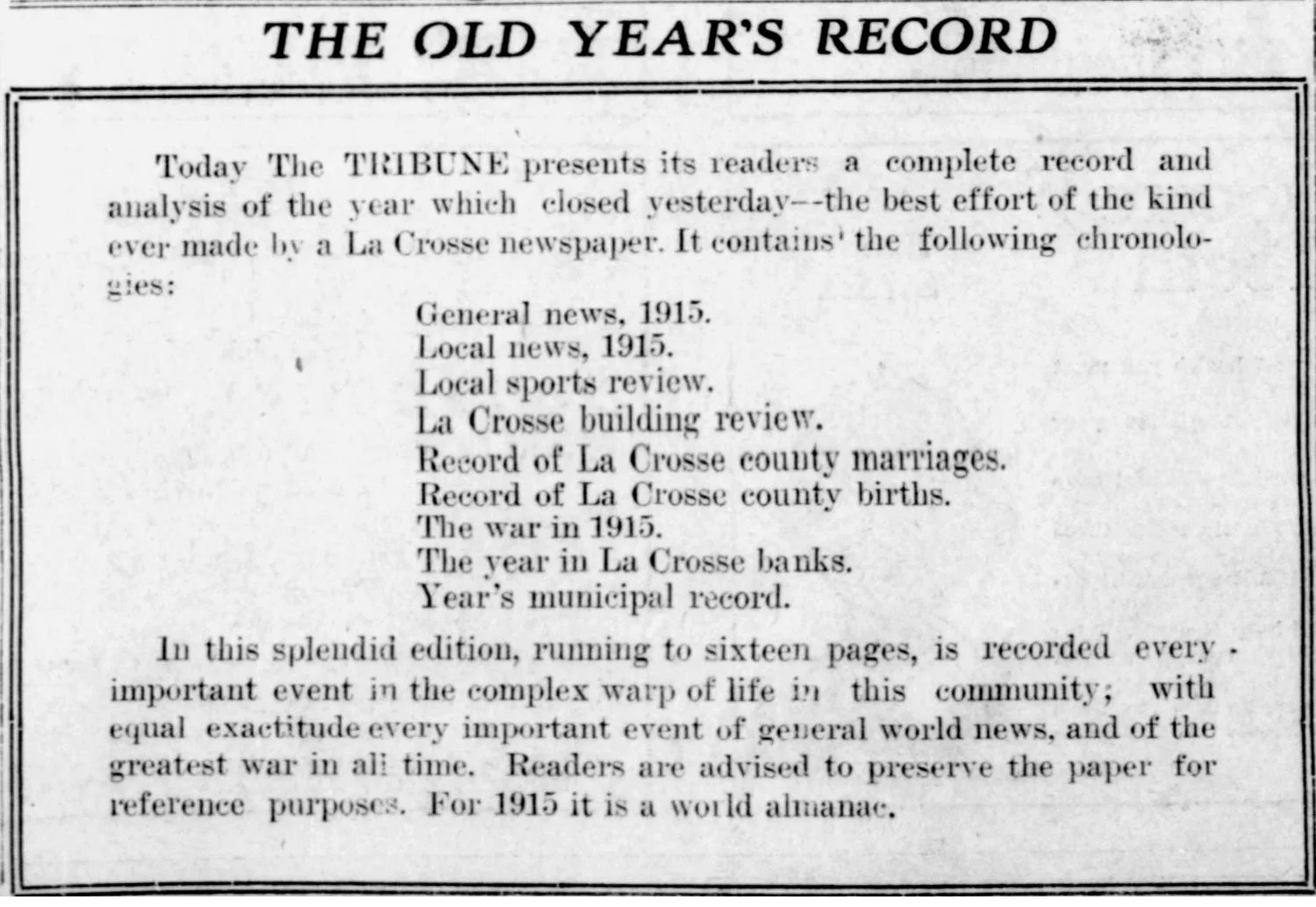
That kind of edition is a genealogical resource hiding in plain sight. If your ancestor lived in La Crosse County in 1915, there is a reasonable chance this paper named them.
Why Year-End Summaries Matter for Family History Research
They sometimes are the record
This is the part that surprises people. We tend to think of newspapers as a supplement to official records: a way to find color and context around the births, marriages, and deaths that are already documented somewhere else.
But not everything made it into formal vital records. Registration was inconsistent, especially in rural areas and in earlier decades. A birth might go unregistered with the county but still appear in the local paper's annual birth summary because the editor gathered the information directly from families, churches, and physicians.
The La Crosse Tribune's January 1916 birth record listed every child born in La Crosse County whose birth had been recorded with the register of deeds, organized alphabetically by month, with the parents' full names, street addresses, child's given name, and birth date. The header on the column read: "Pick Yours Out."
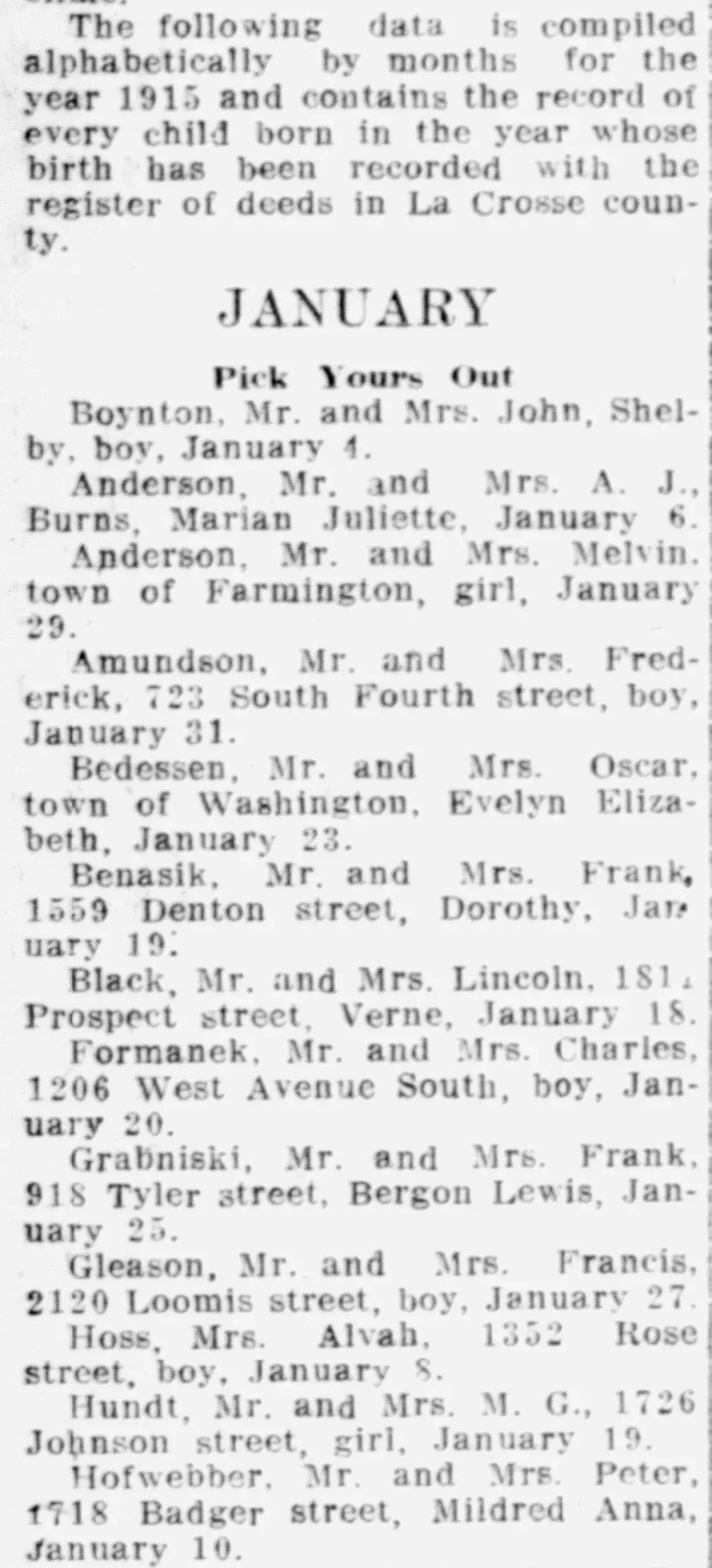
For a researcher trying to confirm a birth date, pin down a family's address, or find a parent's full name, that column is exactly what they need.
They can stand in for missing marriage records
The same logic applies to marriages. The Belleville Telescope in Republic County, Kansas, published a complete register of marriages from 1912 in their January 1913 edition: every couple's full names, ages, marriage date, and the name of the officiant who performed the ceremony.
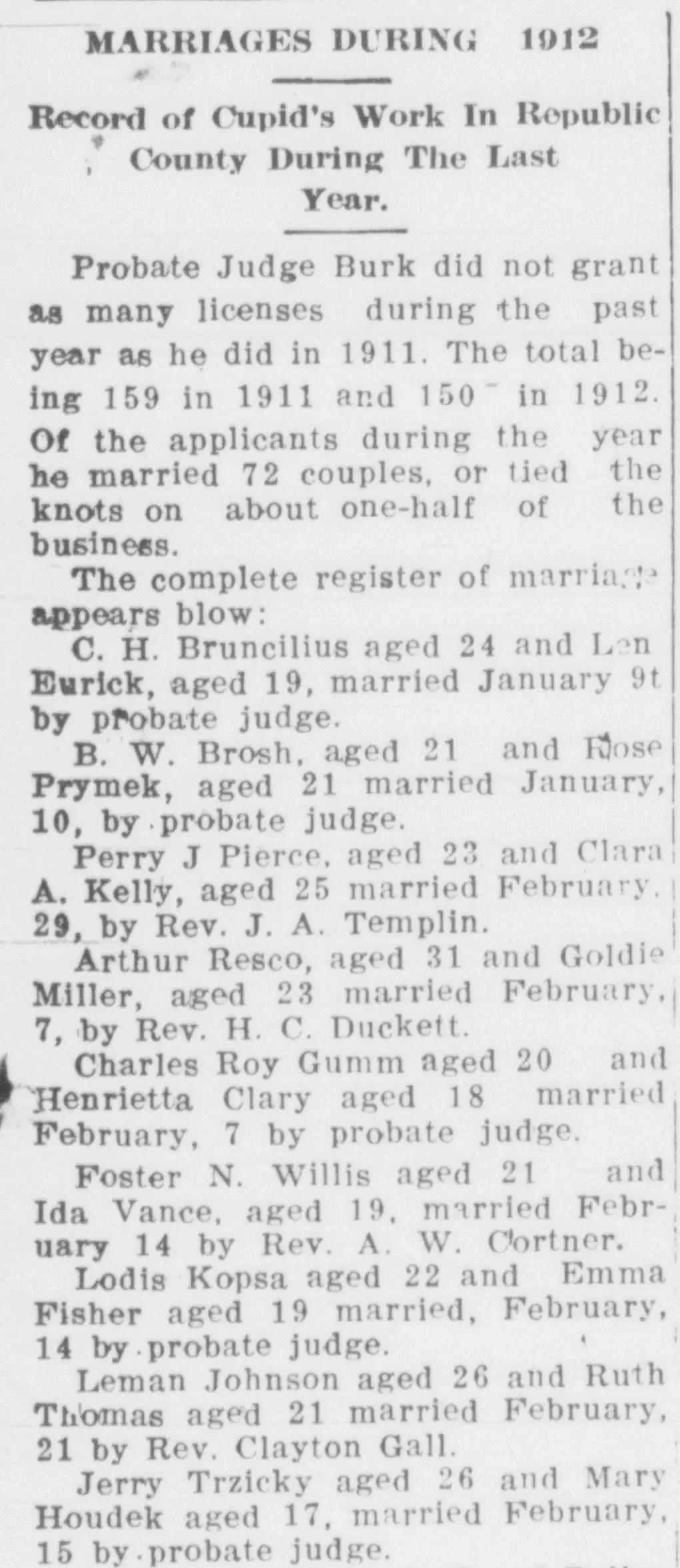
If you are trying to confirm when an ancestor married, who their spouse was, or what their age was at the time of the marriage, a county marriage summary like this one can answer multiple questions at once.
They show you the world your ancestor lived in
Even when your ancestor is not named directly, a year-end summary gives you the context around their life. What was happening in their town that year? What events would they have discussed, witnessed, worried about?
The Pullman Herald's "Tale of 1903" ran births, deaths, marriages, fires, baseball scores, business news, and civic events month by month, naming individual people throughout. It is not just a record of events. It is a portrait of a community in a single year.
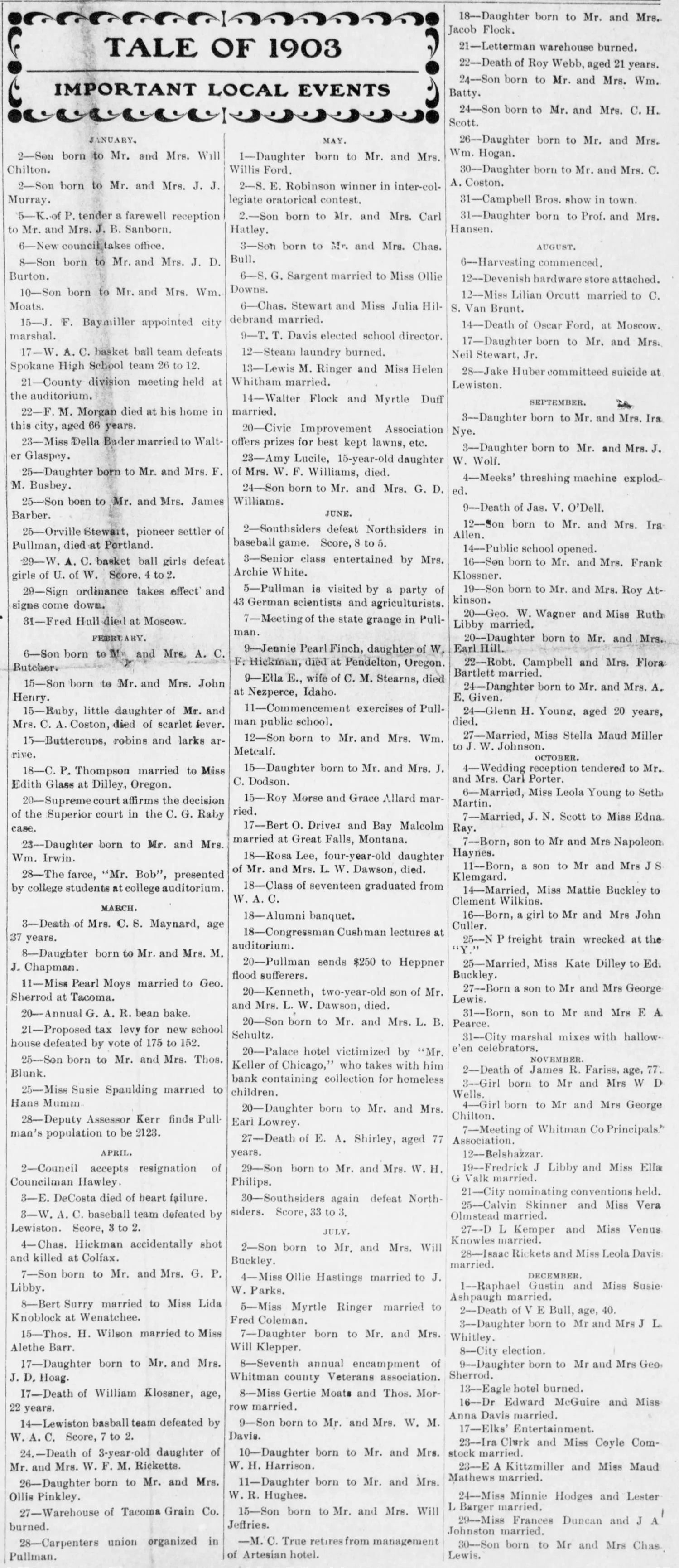
If your great-grandmother lived in Pullman in 1903, this chronology shows what her year looked like from the outside.
They can surface names you did not know to search
Year-end summaries often include names of people who appear nowhere else in the index: a neighbor, a relative who visited, a business partner, someone who witnessed a marriage or attended a funeral. Following those names can open new branches of research you would not have found otherwise.
Why Small-Town Newspapers Are Worth Checking
A big-city paper might summarize the year in broad strokes: politics, disasters, major appointments. A small-town paper named people.
The Madison Daily Leader's "Local Chronology" from 1891 ran day by day through a full year in Madison and Lake County, South Dakota. The subheading described it as "A Complete Diary of One Year's Life in Madison and Lake County" covering "Marriages, Births, Deaths, Happy Events, and Pathetic Recollections." On a single April day, it noted that a son was born to M. J. McGillivray and his wife, that James Garry departed for West Superior, and that State Treasurer Smith returned from a business trip to New York.
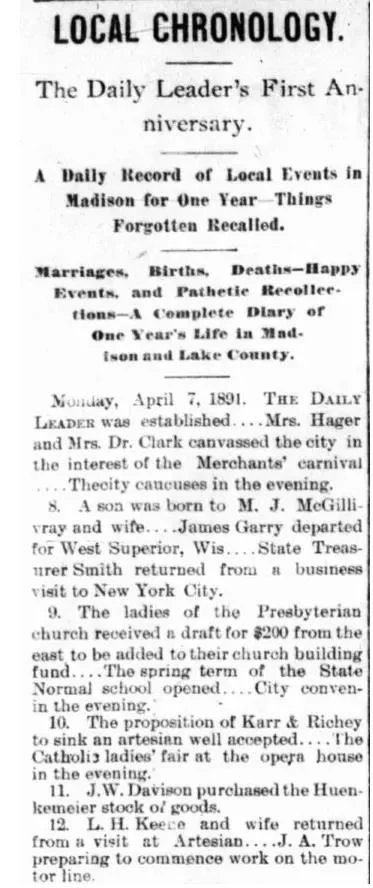
That level of detail is exactly what makes small-town papers so useful. People who never made the front page still showed up in the daily record of community life. And in a year-end summary, that record was compressed into one searchable place.
NewspaperArchive has particular depth in small-town and rural newspapers, many of which are not available anywhere else. If your ancestor lived in a county seat or a small community, the local paper's year-end edition may be one of the best places to look.
What These Summaries Were Called: A Search Term Guide
One of the biggest obstacles to finding year-end chronologies is that they had no standard name. The same type of article appeared under dozens of different titles, and what a paper called it one year might change the next.
The table below covers the most useful search terms, when each one tends to appear, and how to apply it in a search.
Search Term | When to Use It | Example Search |
|---|---|---|
Year in Review | Most common across all eras; try this first | Year in Review 1918 Greene County |
The Year That Was | Common in larger city papers, early 1900s | The Year That Was 1905 Chicago |
Local Chronology | Small-town and county papers; often very detailed | Local Chronology 1891 Madison |
Tale of [Year] | Found in smaller papers, often with "Important Local Events" as a subhead | Tale of 1903 Pullman |
Looking Back at [Year] | Appears in both city and small-town papers | Looking Back at 1922 Indianapolis |
Review of [Year] | General term; worth trying when others fail | Review of 1910 Dayton |
The Old Year's Record | Less common but produces precise results when it appears | Old Year's Record 1915 La Crosse |
Events of the Year | Often a column title rather than a headline | Events of the Year 1899 Cincinnati |
Highlights of [Year] | More common in mid-20th century papers | Highlights of 1935 Kansas City |
[Year] in Headlines | Works well for 1930s onward | 1941 in Headlines Detroit |
Milestones of [Year] | Often used for community anniversaries or significant years | Milestones of 1900 Springfield |
Annual Summary | Broader term; may pull business or civic reports too | Annual Summary 1907 Des Moines |
Chronicle of [Year] | Less common; worth trying for years with no other results | Chronicle of 1896 Louisville |
Marriages During [Year] | Specific to county marriage registers; names couples directly | Marriages During 1912 Republic County |
Retrospective [Year] | Often used by papers marking their own anniversary | Retrospective 1912 Omaha |
Search tip: Pair any of these terms with a specific county name rather than just a city. Small-town papers often covered the whole county and organized their year-end summaries that way. "Republic County marriages 1912" would find the Belleville Telescope clipping above even without knowing the paper's name.
How to Use Year-End Chronologies in Your Research
Start with a year that matters
Choose a year connected to something you already know: a marriage, a move, a birth, a death. The year-end summary will give you the community context around that event and may fill in details you were missing.
Search December and January editions specifically
Most year-end summaries appeared in late December or in the first days of January. If you are browsing rather than keyword searching, those are the editions to focus on.
Look at both the city paper and the county paper
A large city paper and a small county weekly often covered different things. The city paper might focus on political and business news. The county paper named families. Check both when you can.
Use the summary as a finding aid, not just a record
When you find a year-end chronology that mentions your ancestor, treat it as a starting point. The summary will give you dates, names, and events you can then search for in the full daily editions. A marriage listed in a year-end recap can lead you to the original wedding notice published months earlier.
Follow the names you did not expect
Year-end summaries often name neighbors, witnesses, officiants, and community members alongside your direct ancestors. Pay attention to those surrounding names. They may be relatives, in-laws, or business connections worth tracing.
Compare across years
If you find a year-end summary for one year, look for the same column in adjacent years. Tracking a family across multiple annual summaries can show you patterns: when they moved, when children arrived, when the family's circumstances shifted.
Using Chronologies to Write Your Family's Story
Year-end summaries are useful for research. They are also genuinely good material for writing.
When you find a year-end chronology that covers a significant year in your ancestor's life, try laying their personal events alongside the community events listed in the paper. A birth, a marriage, a business opening: what else was happening in town that same week? What was the local economy like? What were people worried about?
That kind of layering is what turns a list of facts into a story.
If your great-grandmother was pregnant in 1918, a year-end summary from her county paper will show you what she was living through: the Spanish flu reaching her town, the names of neighbors who died, the local men coming home from the war. That context does not just make the story richer. It helps you understand the decisions your family made.
Frequently Asked Questions
What is a newspaper year-end chronology? A newspaper year-end chronology is a retrospective article published in late December or early January that summarized notable events from the previous year. Depending on the paper, these summaries covered local news, births, marriages, deaths, business events, civic news, and more. Small-town papers often listed individual names throughout.
Where can I find old newspaper year-end summaries? Historical newspaper archives are the best place to search. NewspaperArchive includes millions of pages from small-town and rural papers across all 50 states, many of which published detailed local chronologies. Search using terms like "Year in Review," "Local Chronology," or "Tale of [Year]" filtered to December and January editions.
Can a newspaper year-end summary count as a genealogy record? Yes, in some cases. When formal vital records are missing or incomplete, a newspaper birth or marriage summary may be the only existing record. These summaries were often compiled directly from families, churches, and county offices, making them a practical substitute for documents that were never filed or that have since been lost.
What if I cannot find a year-end summary for the year I need? Try adjacent years. Papers did not always publish a year-end summary every year, or the edition may not have survived. Also try varying your search terms using the table above, and search both the county paper and any nearby city paper. If nothing surfaces, the December and January social columns from the same paper will often contain similar names and events spread across multiple issues.
Why do small-town newspaper year-end summaries have more names than city papers? Small-town papers covered a tighter community and often served as the primary record of local life. Births, marriages, business transactions, church news, and community milestones were all considered newsworthy in a way they were not in larger papers. That habit of naming ordinary people is what makes small-town papers so valuable for family history research.
Your Ancestor's Year Is Waiting
A year-end newspaper summary will not always exist for the place and time you are researching. But when one does, it can do something few other records can: show you an entire community's year in a single place, with your ancestor's name somewhere inside it.
The birth. The marriage. The business that opened or closed. The neighbor who died and the one who moved away. The town's ordinary life, compressed into a column or a special edition that was meant to be saved for reference.
Someone saved it. Now it is searchable.
When you have a name, a county, and a rough decade, try searching NewspaperArchive for a year-end summary from the local paper. Start with December and January editions and work through the search terms in the table above. You may find your family listed in a record you never knew existed.