Long Beach Earthquake of 1933: How Newspapers Reported the Disaster in Real Time
Discover how newspapers reported the 1933 Long Beach earthquake in real time, and how one Massachusetts family's story of survival traveled across the country.
This article examines how newspapers covered the 6.4 magnitude Long Beach earthquake of March 10, 1933, tracing the evolution of reporting from chaotic first-night bulletins through more complete accounts in the days that followed. Using front pages from The Bakersfield Californian and the Delphos Daily Herald, it illustrates how casualty figures and damage estimates varied widely across outlets in the immediate aftermath. The piece then narrows to a personal story: Emelie Wolf Turner of Amesbury, Massachusetts, waiting anxiously for news of her sisters Minnie and Ida, who lived in the earthquake zone. Her concern was published in the Newburyport Daily News, and weeks later, Ida's firsthand letter appeared in the same paper, describing the chaos of fleeing falling bricks and the lasting psychological toll of ongoing aftershocks. The article closes with the legislative legacy of the disaster—California's Field Act of 1933—and reflects on the unique value of small-town newspapers for preserving the human experience surrounding historical events, particularly for genealogical research.
At 5:54 PM on March 10, 1933, a 6.4 magnitude earthquake struck Long Beach, California, devastating the city and surrounding communities. Buildings were leveled. Lives were lost. Others were left injured or missing.
In the hours and days that followed, newspapers reported on the disaster as it unfolded—often with limited or conflicting information. Coverage quickly expanded to include damage reports, survivor stories, casualty lists, and recovery efforts.
As those reports spread across the country, families searched for any mention of loved ones. On the other side of the country, one Massachusetts woman waited—unsure if her sisters in California were safe.
How Newspapers First Reported the Long Beach Earthquake
In the hours immediately following the March 10, 1933 Long Beach earthquake, newspapers began reporting what little was known—often relying on early estimates, scattered reports, and urgent wire updates.
That same evening, The Bakersfield Californian rushed out a special “Quake Edition,” an eight-page extra filled with breaking news as it came in.
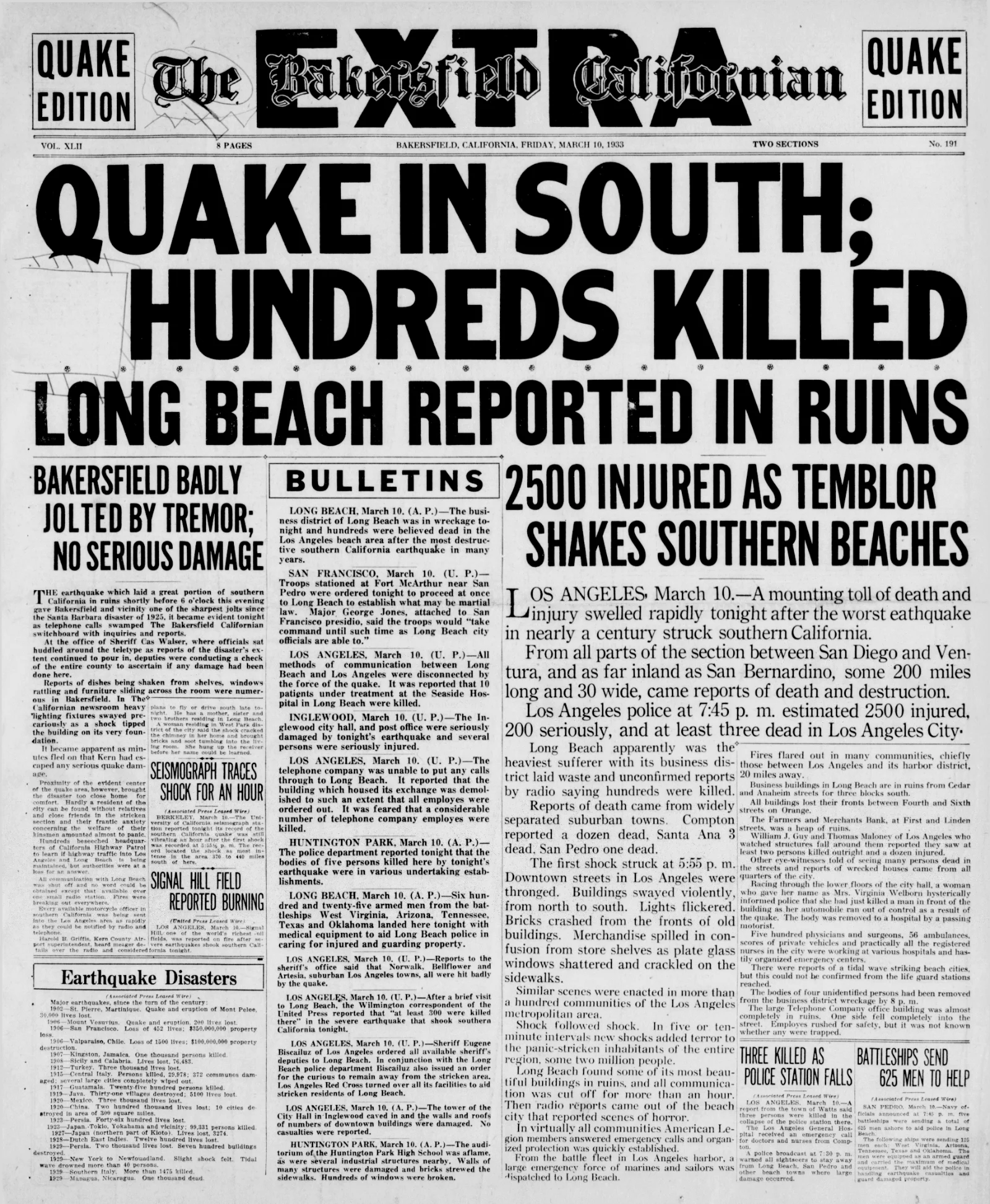
The front page alone tells the story of how the disaster was first understood. Headlines reported that “hundreds” were dead and thousands injured, while smaller articles offered fragments of information from across Southern California.
One report, based on early estimates from Los Angeles police, placed the number of injured at 2,500 as of 7:45 PM—just hours after the earthquake struck. Other updates described fires breaking out in Huntington Park, communication lines cut between Long Beach and Los Angeles, and unconfirmed reports of casualties at local hospitals.
The page is filled with urgency, yet uncertainty.
Bulletins from wire services like the Associated Press and United Press were printed alongside local reports, each adding another puzzle piece to a rapidly unfolding story. Some details would later prove inaccurate. Others were incomplete.
Taken together, they show how the earthquake was experienced in real time—through fragments, estimates, and the immediate need to make sense of what had just happened.
Across a single page, the scope of the disaster began to take shape—but not yet with clarity.
Early Confusion and Breaking Headlines
By the following morning, newspapers across the country were publishing updated reports on the March 10, 1933 Long Beach earthquake—but the details were far from consistent.
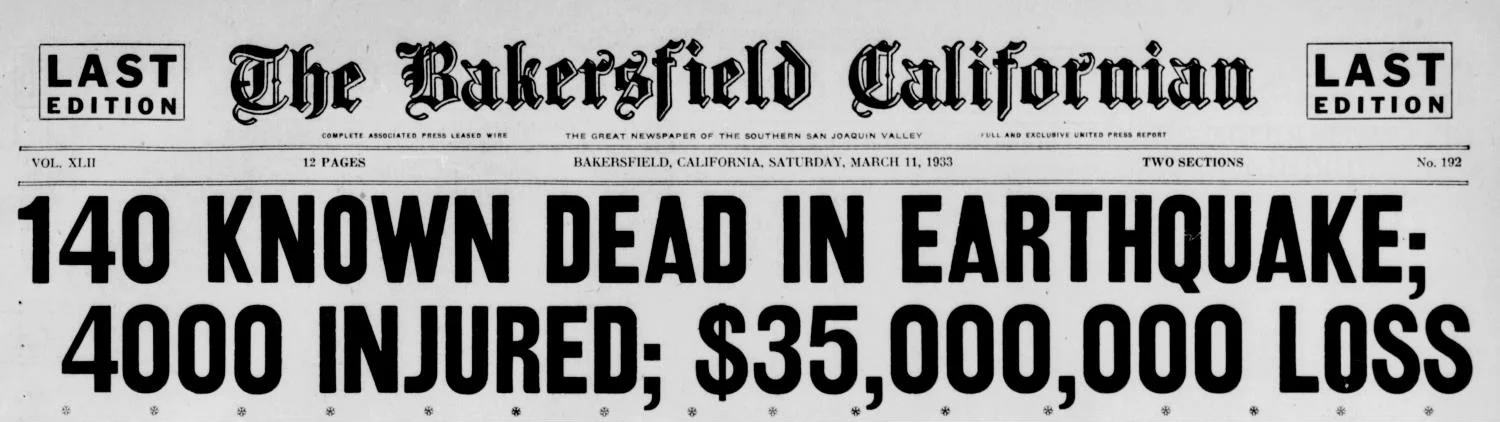
One front-page headline from The Bakersfield Californian reported 140 known dead, 4,000 injured, and $35,000,000 in damage.
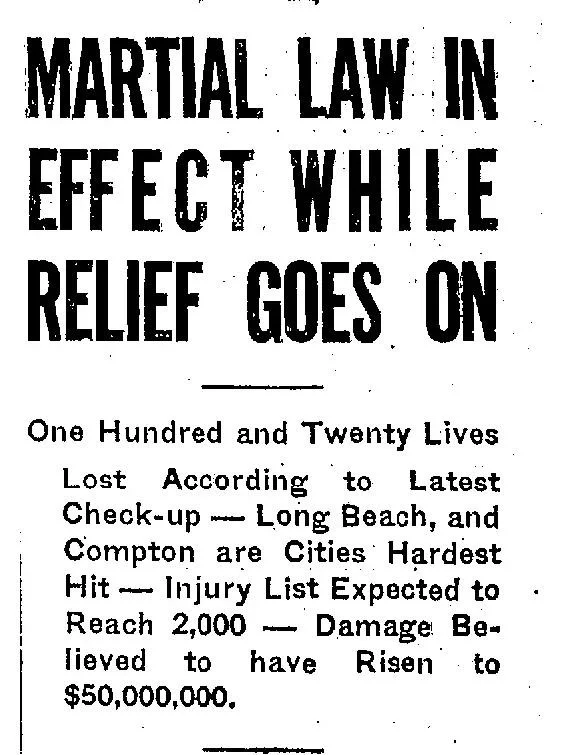
On the same day, the Delphos Daily Herald offered a different picture: 120 lives lost, injuries expected to reach 2,000, and damages estimated at $50,000,000.
Both papers were working from the same rapidly unfolding event, relying on early reports, wire services, and incomplete information.
But even within 24 hours, the numbers didn’t align.
Casualty counts shifted. Injury estimates varied widely. The full extent of the damage was still unknown—particularly during the days immediately following the disaster.
What readers saw in print evolved as new details emerged.
For families far from California, these early reports raised as many questions as they answered.
A Family Waiting for News: Emelie in Massachusetts
Across the country in Amesbury, Massachusetts, my great-grandmother Emelie Wolf Turner anxiously scanned casualty lists and rifled through her mail each day, waiting for word from her sisters, Minnie and Ida, who were both living in the earthquake zone.
A week after the earthquake, Emelie’s local paper, the Newburyport Daily News, published her concern:
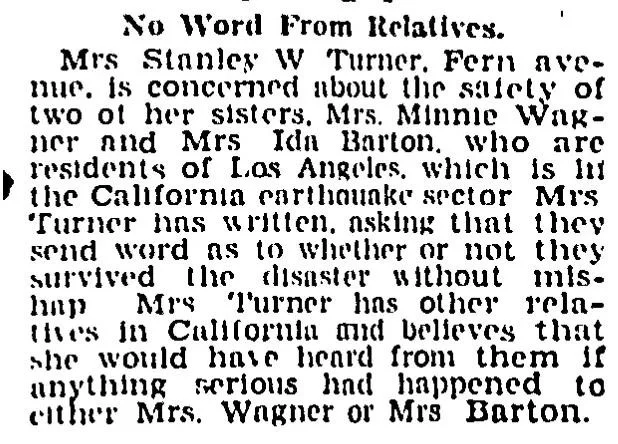
For readers in Massachusetts, this wasn’t just news from California. It was happening to someone in their own community. A distant earthquake suddenly felt immediate and personal in a way front-page headlines alone never could.
Damage and Casualties After the Long Beach Earthquake
As reports became more complete in the days following the March 10, 1933 Long Beach earthquake, the full scale of the disaster began to take shape.
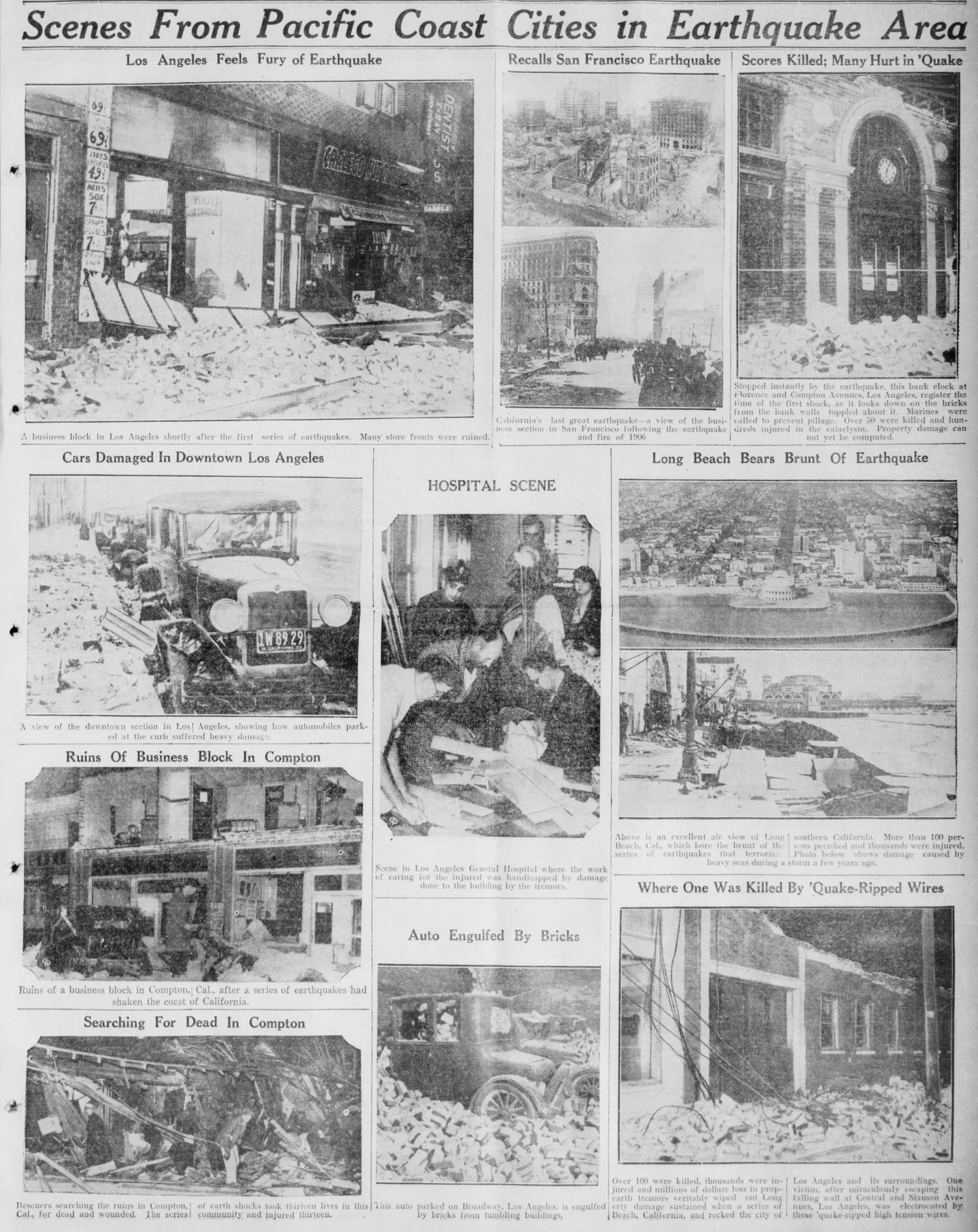
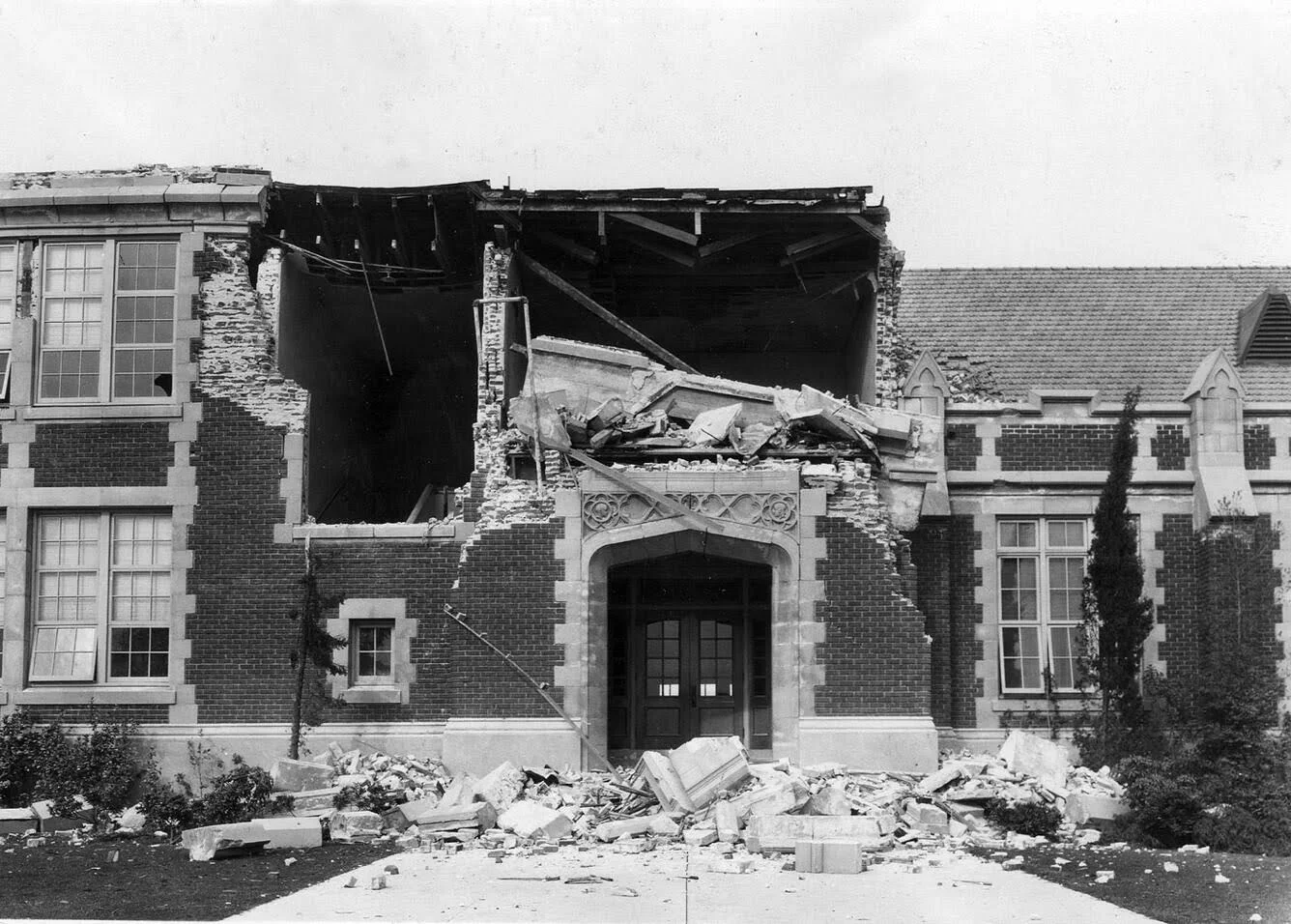
Across Long Beach and surrounding Southern California communities, buildings had collapsed, streets were filled with debris, and entire blocks showed signs of structural failure. Fires broke out in several areas, adding to the destruction.
Many of the most heavily damaged structures were schools—large brick buildings that had not been designed to withstand an earthquake of this magnitude.
Fortunately the timing of the earthquake, just before 6:00 PM, prevented an even greater tragedy. Had it struck while schools were in session, the loss of life would have been far higher than the estimated 120 to 140 deaths reported.
For many victims, the danger didn’t come from being trapped inside buildings, but from what fell around them. Bricks from chimneys and collapsing building facades rained down on those fleeing their homes.
These were the scenes readers encountered in newspapers across the country—photographs and reports that made the destruction visible in a way words alone could not.
For those waiting at a distance, like Emelie in Massachusetts, these images made the scale of the loss impossible to ignore.
But even as the damage became clearer, one question remained: whether her sisters had survived.
A Survivor’s Letter: Ida’s Account
More than two weeks after the earthquake, Emelie finally heard from her sister Ida, who shared her firsthand account of that terrifying day. It was the worst earthquake she had experienced in the twenty-six years she had lived in California.
Ida described fleeing the house with her adult daughter and baby granddaughter, dodging bricks as they fell from chimneys. The scene was chaotic—her daughter hysterical as the ground continued to shake.
On March 28, 1933, the Newburyport Daily News published the letter in its entirety:
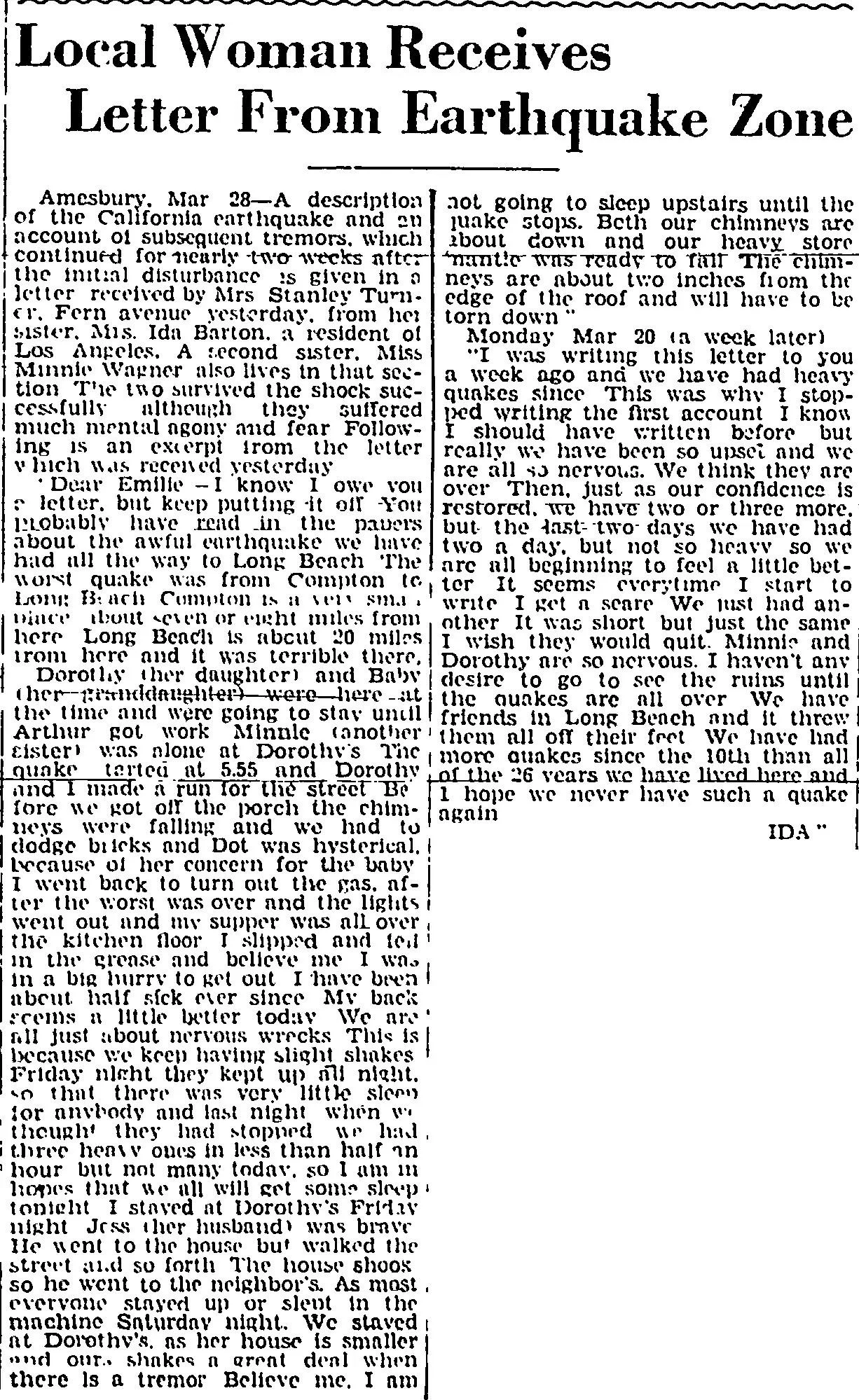
What stands out most in Ida’s account is not the damage to her home, but the loss of her sense of safety. A house can be repaired, piece by piece. It takes far longer to feel secure again.
Weeks later, Ida, her daughter Dorothy, and her sister Minnie were still on edge—reporting how nervous they felt whenever a small shockwave rattled the ground beneath their feet.
The Aftermath: Rebuilding, Reform, and the Field Act
In the weeks following the earthquake, attention turned from rescue and recovery to an urgent question: how could another disaster like this be prevented?
Among the hardest-hit structures were California schools. Many were large brick buildings that had not been designed to withstand a major earthquake. Had the quake struck earlier in the day, while classes were in session, the loss of life could have been catastrophic.
Exactly one month after the earthquake, Governor James Rolph signed new school construction legislation into law.
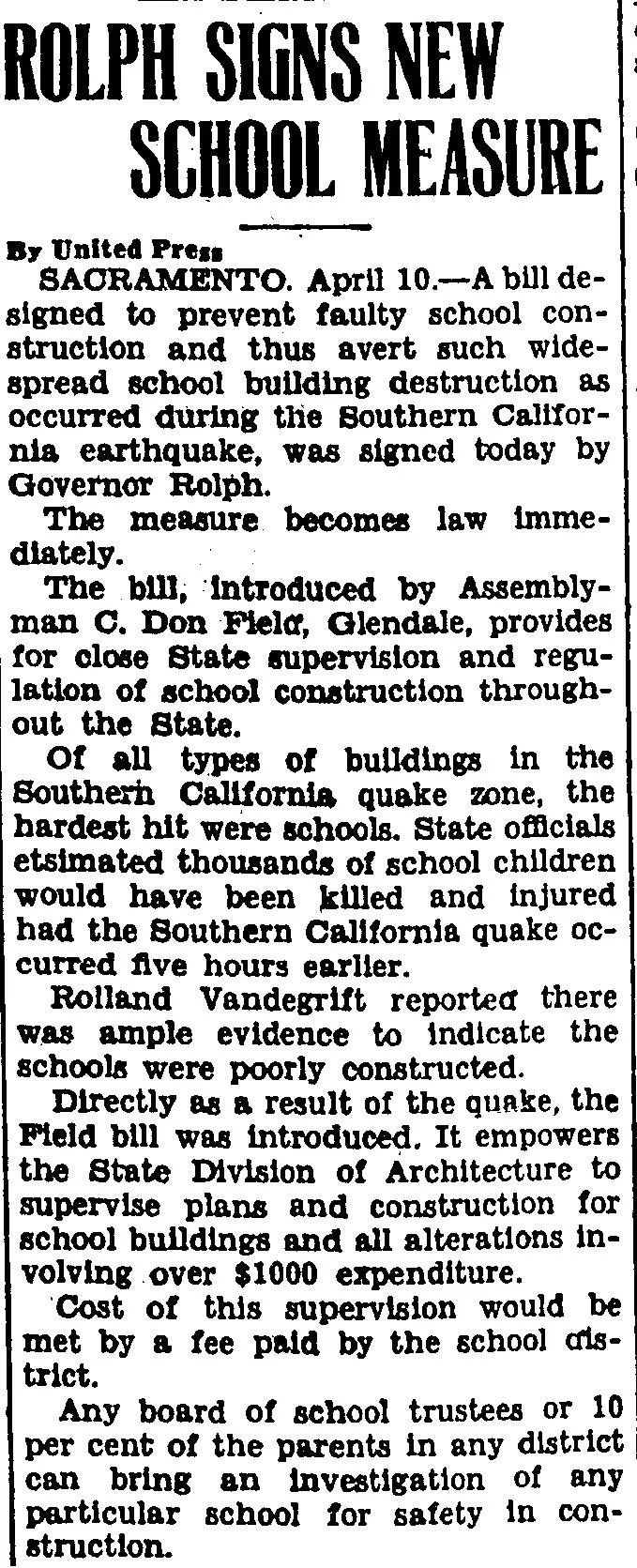
Known as the Field Act, the measure gave California’s State Division of Architecture authority to oversee the design and construction of public school buildings, as well as major renovations. The bill had been introduced by Glendale Assemblyman and building contractor C. Don Field in response to the widespread school damage.
The legislation became one of the first major seismic safety measures enacted in the United States—and one of the most effective.
The Long Beach earthquake left behind collapsed buildings, damaged communities, and over 100 casualties. But it also permanently changed how California approached school construction, creating a legacy that extended far beyond the disaster itself.
Why Small-Town Newspapers Matter in Disaster Research
Both major newspapers and small-town newspapers reported on the earthquake, but small-town papers were often more likely to publish personal stories and letters from survivors across the country.
Stories like Ida’s resonated with readers because they connected a national disaster to someone within their own community. For readers in Amesbury, Massachusetts, the earthquake no longer felt far away once Emelie’s concern—and later Ida’s firsthand account—appeared in the local paper.
These kinds of stories are part of what makes small-town newspapers so valuable in historical and family history research. They preserved not only the events themselves, but the human experience surrounding them.
Small-town newspapers connect people—not just events.
What Newspapers Reveal That Records Don’t
Official records document the facts—when the earthquake happened, where it struck, and how much damage it caused. They give us dates, locations, and numbers.
Newspapers reveal something different.
They show how people experienced the disaster as it unfolded.
More importantly, they capture the human response.
The fear of not knowing.
The waiting.
The need for connection.
Emelie’s story exists because a local newspaper recorded her concern at a moment when no answers were available. Ida’s story survives because her letter was printed, preserving her firsthand experience.
These are not details found in official records.
They are the moments in between—where history becomes personal.
How to Find Long Beach Earthquake Newspaper Articles
Search 1933 newspapers using terms like “Long Beach earthquake,” “earth shock,” “earthquake survivor,” “earthquake letter,” or “Red Cross Long Beach.”
Newspapers outside California didn’t always use “Long Beach,” so broaden your search by combining “earthquake” with nearby cities and regional terms like Los Angeles, Compton, San Pedro, Huntington Park, or even “Southland.”
You can also try searching from the perspective of families at a distance—using keywords like “letter,” “relatives,” or specific names—to uncover stories that appeared far from the disaster itself.
If your family history connects to California earthquake history, the 1906 San Francisco earthquake is another event well documented in newspaper archives. Explore how newspapers covered that disaster, including headlines, maps, and survivor stories.
A Story That Traveled Across Distance
While I have a few scattered photos of my great-grandmother, Emelie, no letters written to her remain in our family. Genealogy showed that her sisters moved to California, but it couldn’t tell me whether they stayed in touch.
Newspapers answered that question.
Through coverage of the earthquake, Emelie’s concern was recorded, Ida’s letter was shared, and the connection between the sisters becomes visible again—across distance and time.
Through her own words, Ida becomes more than a name in a record. She becomes a person with a voice.
Without newspapers, none of this would exist.
No record of Emelie waiting.
No letter from Ida.
No clear connection between them.
The story didn’t stay in California. It traveled—through newspapers—from Ida, to Emelie, and eventually, to me.
About the Author
Julie Holmansky discovered her love of family history through her grandfather, who filled her childhood with stories, photos, and unforgettable characters. What began with flipping through photo albums turned into a lifelong passion for genealogy. Today, she’s driven by the same thing that first captured her imagination—bringing ancestors to life through their stories.
Connect with Julie
If you enjoyed this story, you can find more of Julie’s research and storytelling at her website, Roots and Rabbit Holes, and follow her on Storied to see what she uncovers next.