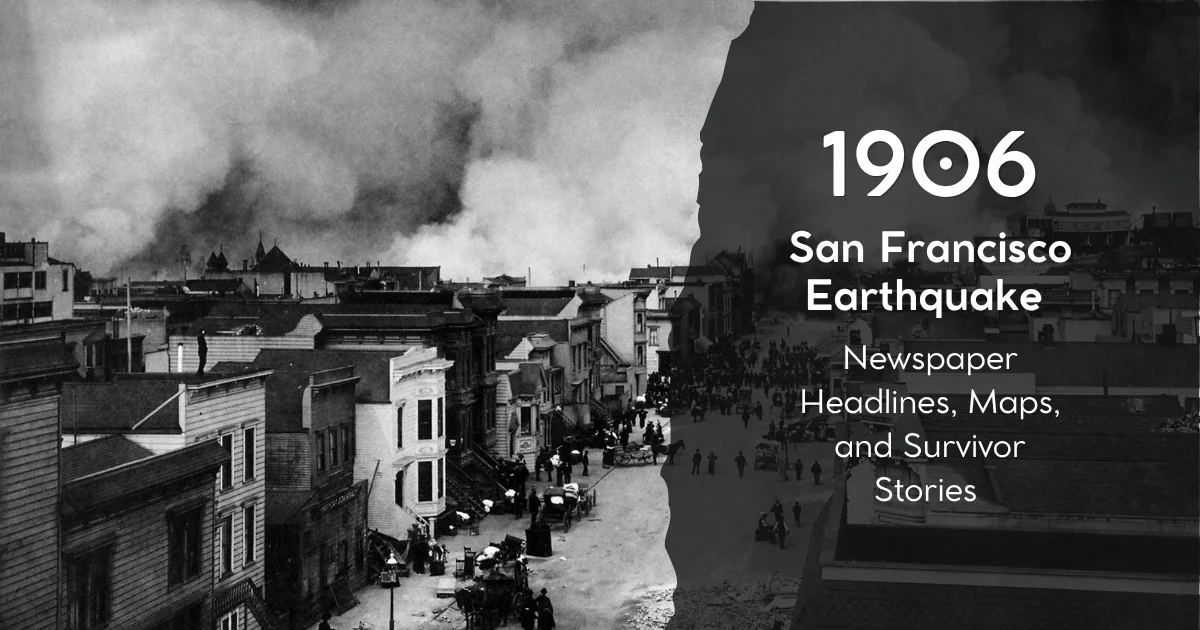
1906 San Francisco Earthquake: Newspaper Headlines, Maps, and Survivor Stories
Explore the 1906 San Francisco earthquake through historical newspapers, including headlines, maps, survivor stories, death lists, and family history clues.
The 1906 San Francisco earthquake struck on April 18, 1906, and caused widespread destruction across San Francisco and nearby California communities. Historical newspapers reported the disaster in real time through dramatic headlines, maps of burned districts, lists of destroyed buildings, survivor accounts, death lists, scientific explanations, and hometown updates about people believed to be in San Francisco. NewspaperArchive can help researchers find original newspaper coverage of the 1906 earthquake and discover family history clues such as names, addresses, occupations, relatives, hotels, churches, businesses, and survivor reports.
On the morning of April 18, 1906, San Francisco was shaken awake.
The earthquake lasted less than a minute, but the disaster did not end when the shaking stopped. Fires broke out across the city. Buildings collapsed. Telephone and telegraph lines failed. Families were separated. People across the country opened their newspapers and tried to understand what had happened.
Today, we often remember the 1906 San Francisco earthquake as one major event. But in old newspapers, it unfolds piece by piece.
A headline.
A map.
A list of destroyed buildings.
A survivor’s account.
A death list.
A notice in a hometown paper naming local people who were believed to be in San Francisco.
That is what makes newspaper coverage so powerful. It does not just tell us that history happened. It shows us how people learned about it, feared it, survived it, and searched for one another in the days that followed.
If you have family who lived in California, traveled west, worked for the railroad, served in the military, or had relatives across the country in 1906, this is the kind of event worth searching in historical newspapers. One name in one small column may be the clue that connects your family to a much larger story.
Quick Answer: What Happened During the 1906 San Francisco Earthquake?
The San Francisco earthquake struck early on April 18, 1906, along the San Andreas Fault. The shaking caused major damage throughout San Francisco and nearby communities, but the fires that followed created even more destruction. For several days, flames swept through large sections of the city, destroying homes, businesses, churches, hotels, government buildings, and entire neighborhoods.
Newspapers across the country reported the disaster as it unfolded. Their stories preserved dramatic headlines, early death estimates, maps of burned districts, lists of destroyed buildings, survivor accounts, and names of people who were dead, missing, safe, or feared to be in the city.
San Francisco Earthquake of 1906: Quick Facts
Date: April 18, 1906
Time: About 5:12 a.m. local time
Location: San Francisco Bay Area and surrounding California communities
Fault: San Andreas Fault
Estimated magnitude: About 7.9
Major secondary disaster: Fires that burned for several days
Estimated deaths: Often reported as more than 3,000
Damage: Hundreds of city blocks destroyed or heavily damaged
Why newspapers matter: They captured the disaster as people experienced it, before the story became simplified by time
A Disaster Reported Before the Full Story Was Known
One of the most striking things about reading newspaper coverage from April 1906 is how uncertain everything feels.
Reporters were trying to describe a disaster while it was still happening. Early articles included casualty estimates, damage reports, warnings about fire, and scattered details from people who had managed to escape. Some information changed from day to day. Some reports were incomplete. Some numbers were wrong or only partial.
But that uncertainty is part of what makes the coverage so valuable.
Newspapers show the confusion of the moment. They show how information traveled. They show what people knew, what they feared, and what they were still trying to confirm.
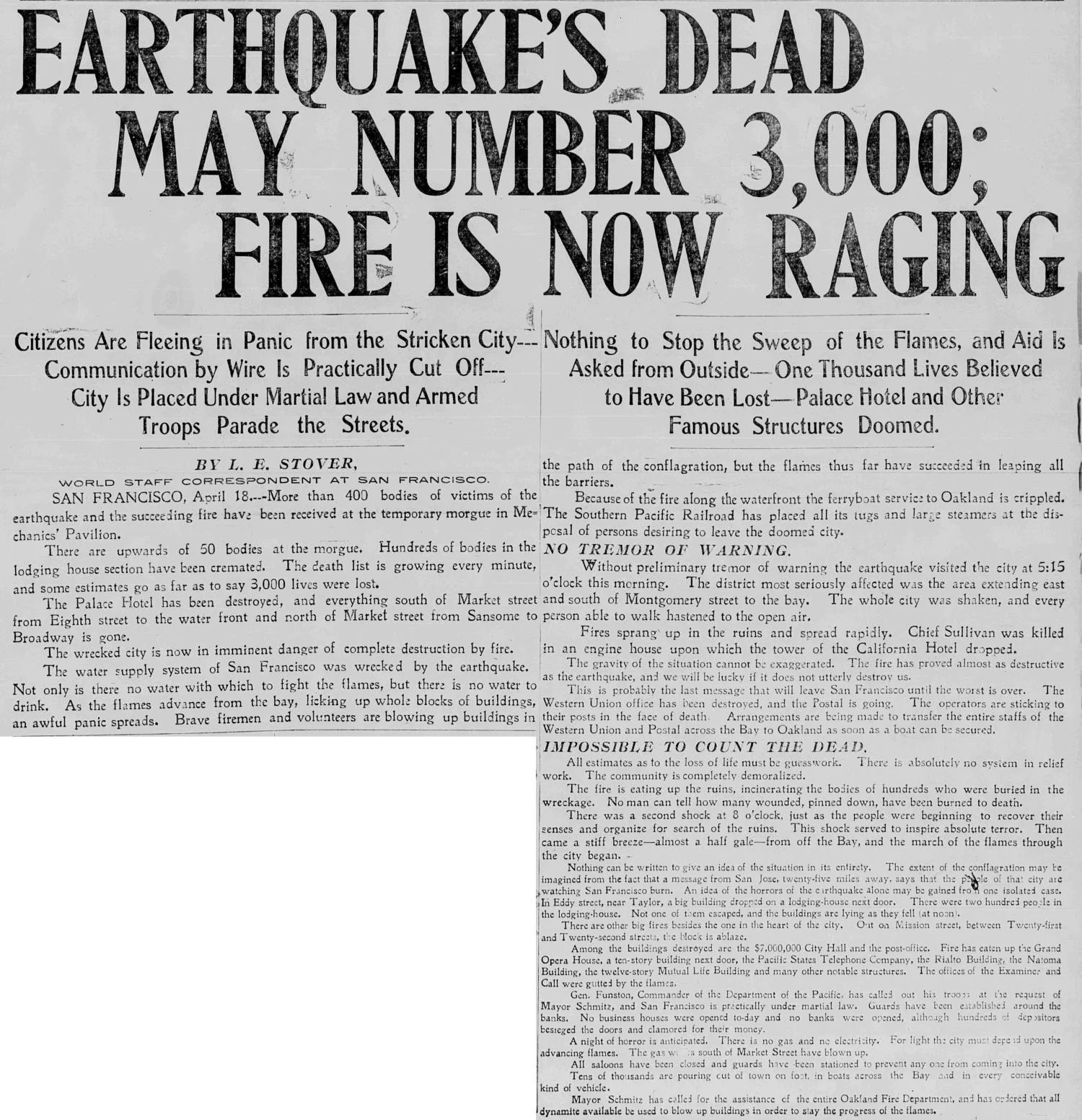
This headline alone tells you so much about the moment. The disaster was not being remembered yet. It was still unfolding.
The newspaper reported that the fire was raging, communication was cut off, and citizens were fleeing the stricken city. That kind of language helps modern readers feel the urgency people felt when the news first reached them.
The Fire Became the Story
The earthquake caused terrible damage, but the fires that followed turned the disaster into something even larger.
Broken gas lines, damaged water mains, collapsed buildings, and high winds helped the flames spread. Firefighters and volunteers worked under nearly impossible conditions. Some buildings were blown up in an effort to stop the fire, but even that did not always work.
In newspaper after newspaper, the fire became almost a character in the story. It moved. It swallowed blocks. It threatened landmarks. It pushed people from one place to another.
To understand the 1906 disaster, you have to understand the fire.
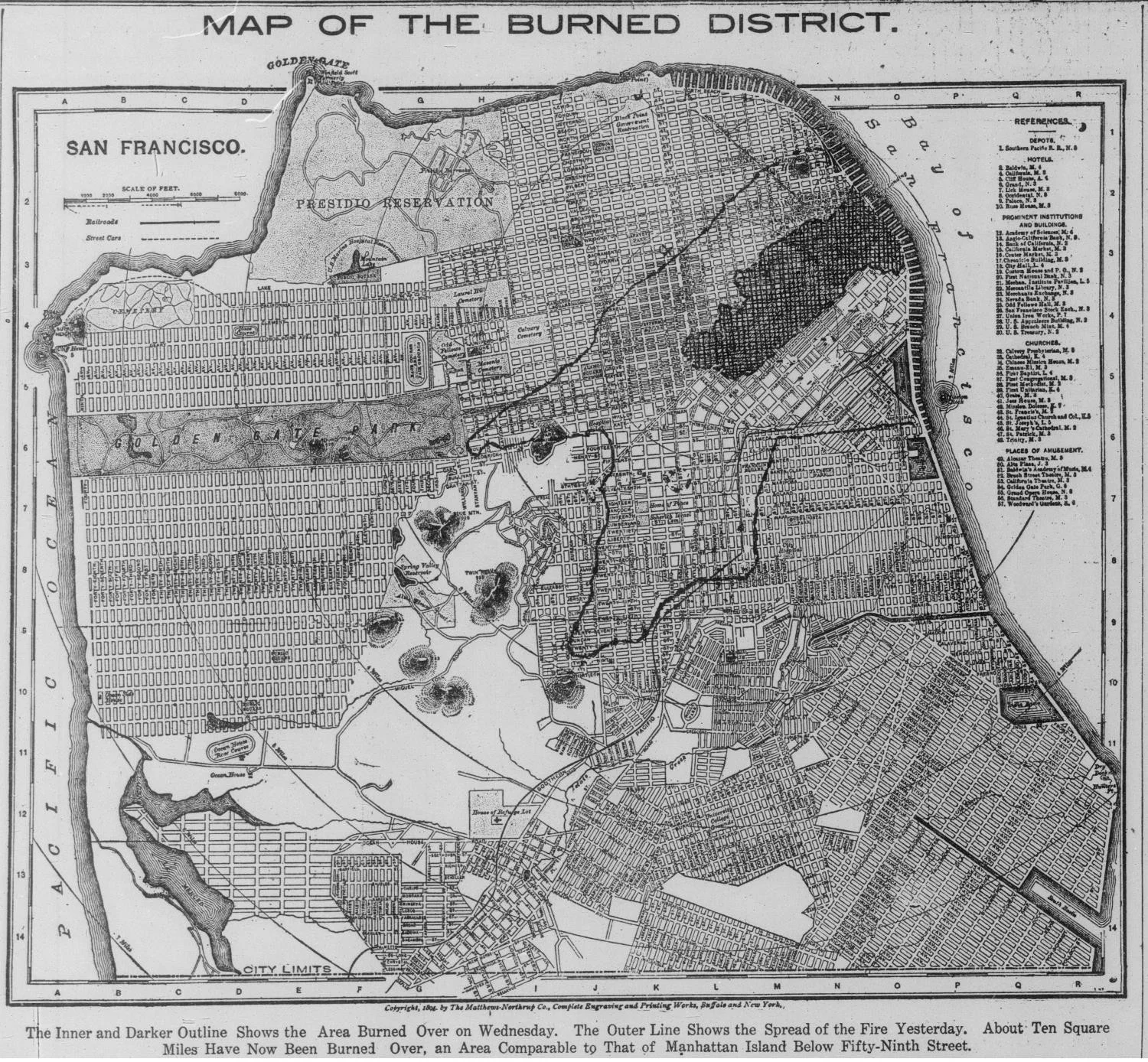
Maps like this are especially helpful because they turn a disaster into something you can see.
If your ancestor lived in San Francisco, worked there, owned a business there, attended church there, or had family nearby, a map of the burned district can help you place them in the story. A street name, hotel, church, office building, or neighborhood might show whether they were close to the fire’s path.
Lists of Damage Can Become Research Clues
Some newspaper clippings do not look emotional at first.
A list of buildings.
A list of streets.
A list of losses.
A list of churches, hotels, clubs, and businesses.
But for family historians, those lists can be incredibly useful.
They can show where people worked, worshiped, stayed, shopped, or lived. They can name buildings that no longer exist. They can help explain why a family moved, why a business disappeared, why church records were lost, or why a person suddenly appears in another city.
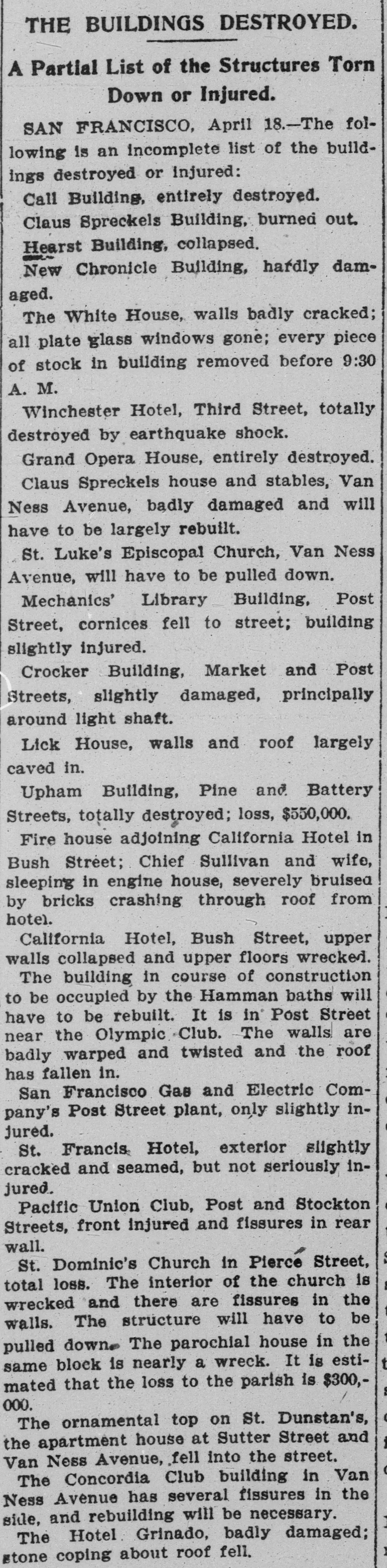
This clipping is a perfect example of why old newspapers matter.
It names places like the Call Building, Hearst Building, Winchester Hotel, Grand Opera House, St. Luke’s Episcopal Church, Mechanics’ Library Building, Crocker Building, Lick House, St. Dominic’s Church, and more.
That is not just a damage report. It is a research map.
If you were tracing someone connected to one of those places, this kind of list could help you understand what happened next. Did the business reopen? Did the church rebuild? Did employees relocate? Did hotel guests appear in survivor lists or hometown newspaper reports?
One clipping can lead to many more searches.
The Earthquake Was Not Only a San Francisco Story
The phrase “San Francisco earthquake” makes it easy to focus only on the city. But newspapers remind us that the disaster reached beyond San Francisco.
Santa Rosa, San Jose, Oakland, Berkeley, and other communities were part of the larger story. People fled across the bay. Survivors carried stories with them. Newspapers outside California picked up reports from travelers, witnesses, officials, and relatives.
That matters because your ancestor may not have lived in San Francisco and still may have been connected to the disaster.
They may have been:
visiting the city
traveling for work
staying at a hotel
serving in the military
working for a railroad, utility, or shipping company
living in a nearby town
worrying about relatives from another state
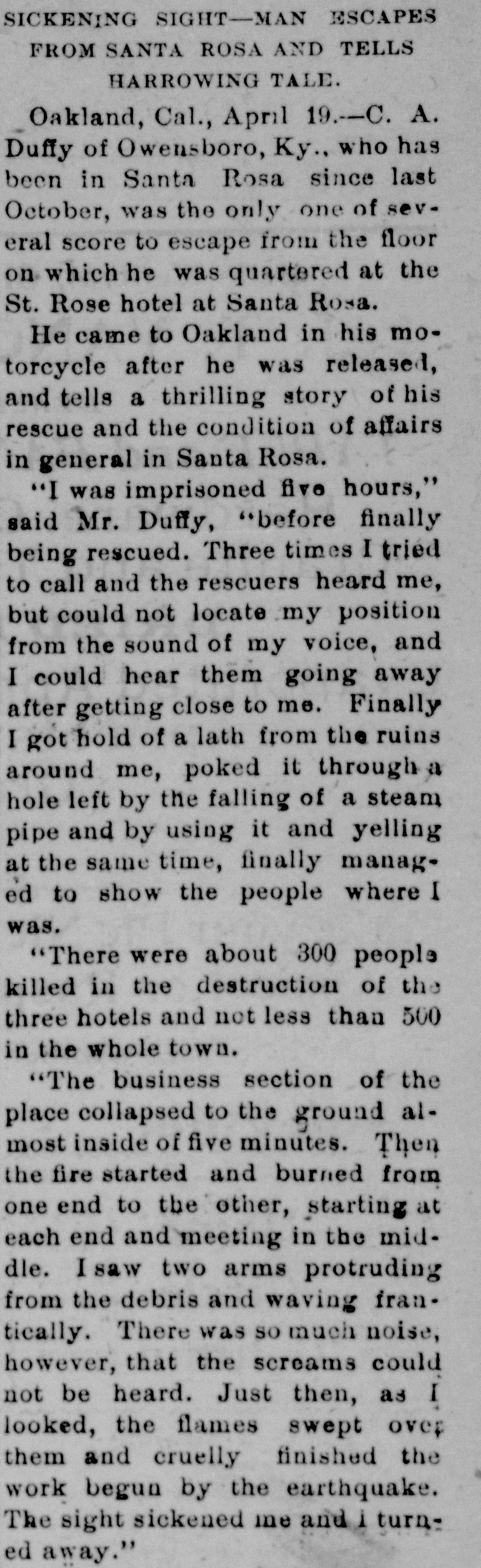
This account is difficult to read, but it is powerful.
C. A. Duffy of Owensboro, Kentucky, described being trapped for hours after the St. Rose Hotel collapsed in Santa Rosa. His story gives readers a ground-level view of the disaster. He was not speaking from a history book. He was describing what he had just lived through.
That is one reason newspaper accounts can be so gripping. They catch people close to the moment, before memory smooths out the details.
Newspapers Helped Families Search for Their People
After a disaster, people want names.
Who was safe?
Who was missing?
Who had been injured?
Who had died?
Who had been seen leaving the city?
Who had sent word home?
This is where local newspapers become especially important.
A newspaper in Indiana, Kentucky, Ohio, Missouri, New York, or anywhere else might publish a column naming local residents who were believed to be in San Francisco. These small notices can be easy to overlook, but they are some of the best family history clues.
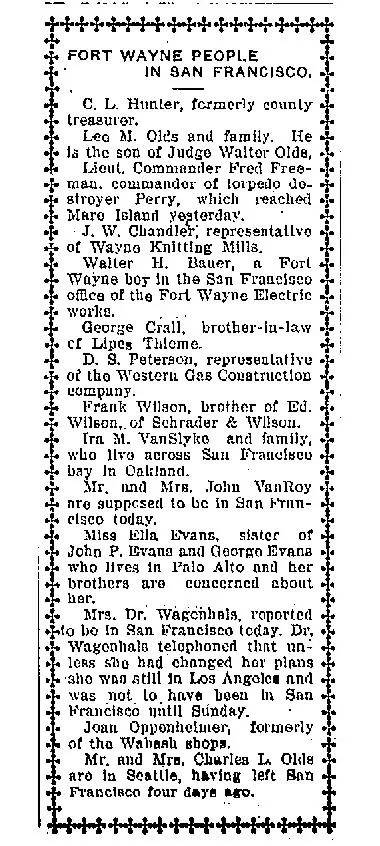
This is one of my favorite kinds of newspaper finds.
The article is not just about San Francisco. It is about Fort Wayne people in San Francisco. It names individuals, families, occupations, relatives, employers, and concerns from back home.
For family historians, this kind of clipping can do several things at once:
place a person in San Francisco at a specific moment
connect them to relatives in another city
identify an employer or occupation
show that family members were worried about them
reveal travel or relocation that may not appear in a census record
This is why searching only the city where the event happened can cause you to miss important clues. Sometimes the best mention of your ancestor appears in a hometown paper hundreds or thousands of miles away.
Death Lists Preserved Names, Addresses, Ages, and Occupations
Death lists from disasters are heartbreaking. They are also historically important.
In the days after the earthquake, newspapers printed lists of the dead, missing, injured, and unidentified. These lists could be incomplete or based on early information, but they often preserve details that may be difficult to find elsewhere.
A name might appear with:
an address
an age
an occupation
a hotel name
a street corner
a family relationship
a note about how the person died
a clue that the person was unidentified
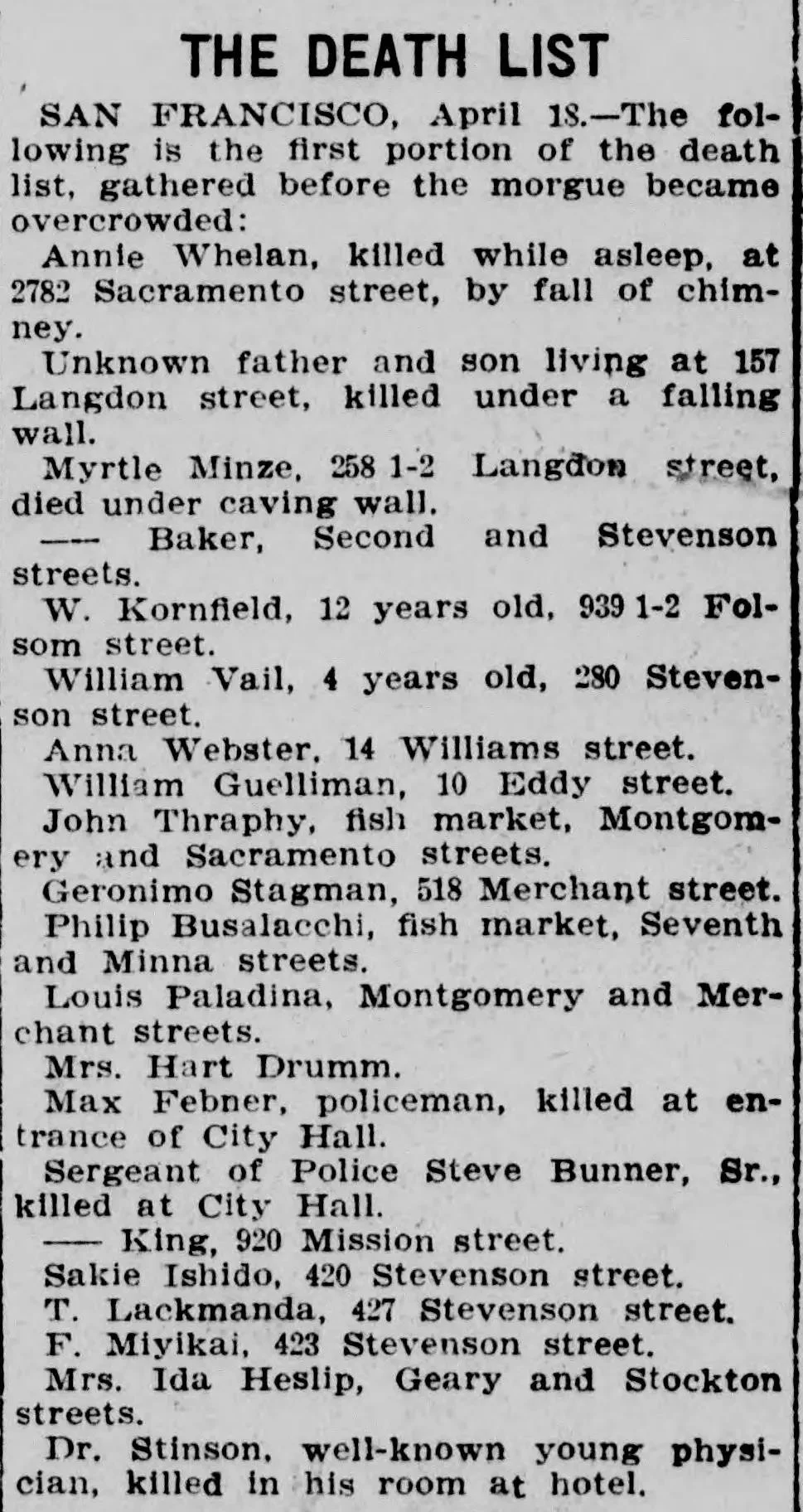
This clipping is heavy, but it shows why newspapers are so valuable for historical and family research.
The list includes names, ages, addresses, occupations, and locations. Some entries are specific. Others are painfully incomplete, such as an unknown father and son. Even those incomplete entries tell us something about the chaos of the moment.
When researching a disaster, do not only search for full articles. Look for lists. Look for columns. Look for small blocks of names. Those are often where family history clues appear.
Newspapers Also Tried to Explain the Science
Newspapers did more than report fear, loss, and damage. They also tried to explain what had happened.
Readers across the country wanted to understand how an earthquake in California could be recorded thousands of miles away. Papers printed seismograph images, diagrams, maps, and scientific explanations to help people make sense of the event.
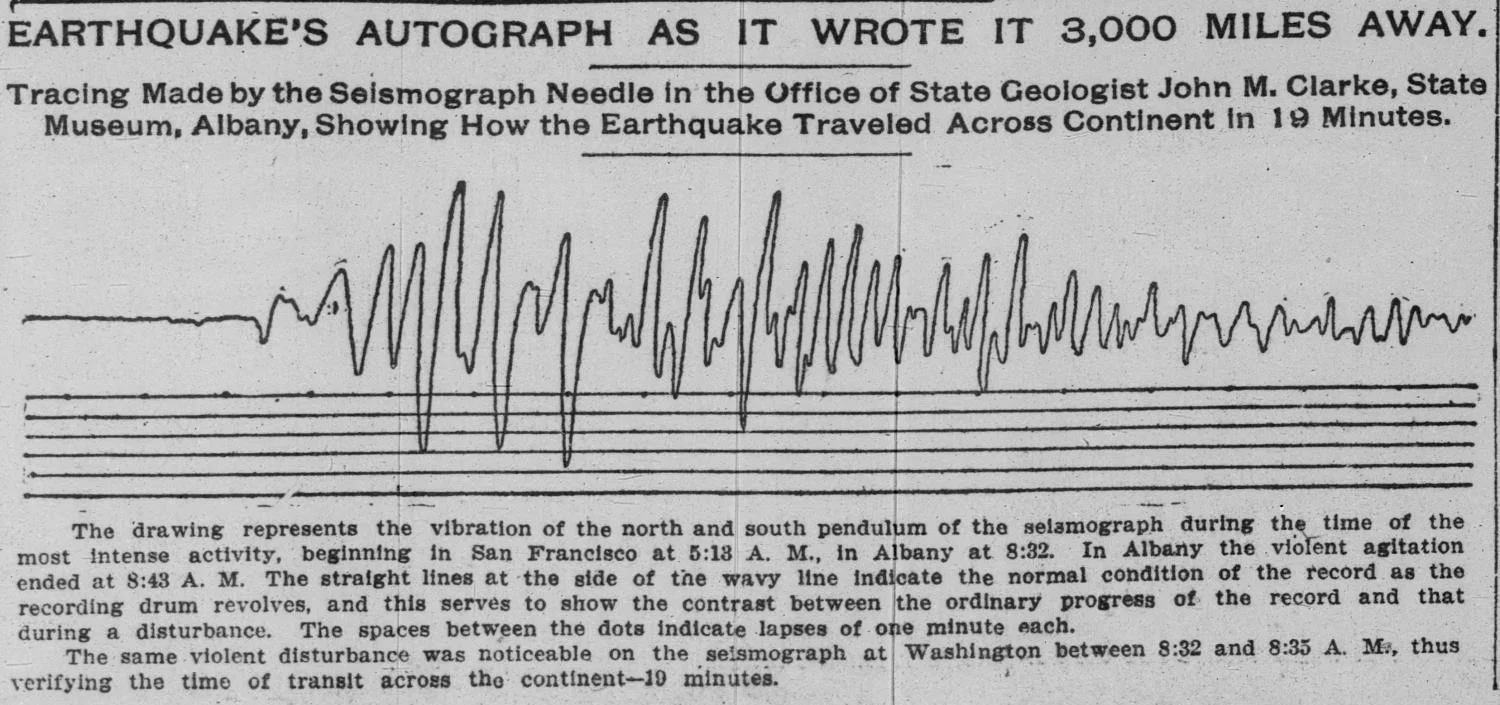
This kind of clipping adds another layer to the story.
It shows how newspapers blended breaking news with science. Readers were not just asking, “What happened?” They were also asking, “How could this happen?” and “How far away could it be felt?”
For a modern reader, these clippings help us see how people in 1906 understood natural disasters, technology, and communication.
How to Search for Ancestors Connected to the 1906 Earthquake
If you think your family may have had a connection to the 1906 San Francisco earthquake, begin with the obvious searches, but do not stop there.
Start with:
your ancestor’s full name
name variations
initials and surname
married names
workplace names
hotel names
street addresses
church names
club or organization names
hometown plus “San Francisco”
“missing” plus surname
“safe” plus surname
“earthquake” plus surname
“refugee” plus surname
Then widen the search.
Try newspapers from:
San Francisco
Oakland
Berkeley
Santa Rosa
San Jose
your ancestor’s hometown
nearby counties
cities where relatives lived
places where survivors may have traveled after the disaster
This is one of the biggest lessons newspapers teach us. A person does not have to appear in the newspaper where the event happened. They may appear in the paper where someone was waiting for news.
Try searching NewspaperArchive for a surname, hometown, or address connected to your family around April and May 1906. Even if your ancestor was not in San Francisco, a hometown newspaper may have mentioned relatives, travelers, employees, or survivors with ties to the disaster.
Search Terms to Try in Newspaper Archives
When searching for the 1906 San Francisco earthquake, try a mix of broad and specific terms.
Broad searches
San Francisco earthquake
San Francisco fire
California earthquake
earthquake and fire
disaster in San Francisco
burned district
death list
missing persons
refugees
relief committee
Location searches
Santa Rosa earthquake
Oakland refugees
San Jose earthquake
Fort Wayne people in San Francisco
[your hometown] San Francisco earthquake
Family history searches
“[surname]” San Francisco
“[surname]” earthquake
“[surname]” missing
“[surname]” safe
“[surname]” injured
“[surname]” killed
“[surname]” refugee
“[surname]” Oakland
“[surname]” Santa Rosa
Building and organization searches
St. Rose Hotel
Palace Hotel
Call Building
Hearst Building
St. Dominic’s Church
St. Luke’s Episcopal Church
Mechanics’ Library
Pacific Union Club
A search for a building, hotel, church, or employer can be just as useful as a search for a person.
Why Old Newspapers Still Matter for the 1906 Earthquake
Modern summaries can tell us the big facts.
They can tell us the date.
They can tell us the magnitude.
They can tell us the estimated death toll.
They can tell us that fires destroyed much of the city.
But newspapers show us the disaster while people were still living through it.
They show:
the first shock of the headlines
maps drawn for readers trying to picture the damage
lists of destroyed buildings
survivor stories from nearby towns
death lists and missing person notices
hometown connections across the country
scientific explanations written for everyday readers
That is the difference.
A summary tells you what happened.
A newspaper lets you watch the story unfold.
FAQ: 1906 San Francisco Earthquake Newspapers
What caused the 1906 San Francisco earthquake?
The 1906 San Francisco earthquake was caused by movement along the San Andreas Fault. The shaking damaged buildings, streets, water lines, gas lines, and other infrastructure throughout San Francisco and nearby communities.
Why were the fires after the earthquake so destructive?
The fires spread quickly because the earthquake damaged gas lines, water mains, buildings, and streets. Firefighters had limited water, and the flames burned through large sections of the city for several days.
Can newspapers help me find an ancestor connected to the 1906 earthquake?
Yes. Newspapers may mention people who were killed, injured, missing, safe, traveling, working in San Francisco, or being searched for by relatives. Hometown newspapers across the country also printed lists of local people believed to be in San Francisco.
What kinds of newspaper articles should I search for?
Search for front-page reports, death lists, missing person notices, survivor stories, relief lists, refugee reports, building damage lists, maps, and hometown columns naming local people in San Francisco.
Should I only search California newspapers?
No. California newspapers are important, but do not stop there. If your ancestor had family in another state, search newspapers from that hometown too. Local papers often reported on residents, relatives, businesspeople, and travelers connected to the disaster.
Conclusion: One Disaster, Thousands of Newspaper Clues
The San Francisco earthquake of 1906 was not preserved in newspapers as one neat story. It appeared in headlines, maps, lists, interviews, death notices, scientific explanations, and small hometown updates.
That is what makes the coverage so valuable.
For family historians, the most meaningful clue may not be the biggest headline. It may be a single name in a local column. A hotel mentioned in a survivor’s account. A street address in a death list. A building name that explains why someone moved. A report from a hometown paper that places a relative in San Francisco at exactly the right moment.
The 1906 earthquake changed San Francisco, but newspapers show how far the story reached.
Search NewspaperArchive for your family name, hometown, or a place connected to the 1906 San Francisco earthquake. You may find more than a disaster story. You may find your family standing somewhere inside it.