How to Find Enslaved Ancestors in Historical Newspapers
Searching for enslaved ancestors in old newspapers takes patience and the right keywords. Here's where to look, what record types to search, and what you might find.
Historical newspapers can help researchers trace enslaved ancestors through runaway advertisements, estate and probate notices, emancipation records, and post-Civil War community news in both mainstream and African American publications. Before 1865, records are most often found by searching the enslaver's name, county, and record-type keywords rather than the ancestor's name alone. After 1865, African American newspapers become a primary source for names, community connections, church memberships, marriages, and deaths. NewspaperArchive includes more than 2,500 publications from 1736 to 1866 and more than 500 newspapers from Southern states, along with African American newspaper titles, making it a practical starting point for this research.
Quick Answer: Historical newspapers can help you trace enslaved ancestors through runaway advertisements, estate and probate notices, emancipation records, and post-Civil War community news. These records often contain names, physical descriptions, skills, locations, and family connections that do not appear anywhere else. Searching takes patience and a willingness to work with painful language, but the clues are there.
Tracing a family line through slavery is one of the hardest things a genealogist can do. The records that document most American lives, the census entries, the vital records, the church registers, were not designed to include enslaved people as individuals. Names disappear. Paper trails go cold. And for many researchers, the line simply stops somewhere before the Civil War with no clear way forward.
Newspapers do not solve that problem completely. But they open doors that other records cannot.
This post covers the record types most likely to name enslaved individuals, the keywords that surface them, and what to do when a search gives you nothing at all.
If you have a name, a location, or even just an enslaver's surname to start with, try searching NewspaperArchive and see what surfaces in the local papers from that place and time.
Why Newspapers Matter for This Research
Most genealogical records before 1870 documented enslaved people as property, not as individuals with full names, families, or life histories. The federal census listed them by age and sex only. Wills and deeds recorded them as assets. Church records, where they existed at all, were inconsistent.
Newspapers are different, not because they treated enslaved people with dignity, they often did not, but because the notices they published were specific. A runaway advertisement had to describe a real person well enough that a stranger could recognize her. An estate sale notice had to name the individuals being sold. A community newspaper after emancipation covered the people in its community by name, with the same attention any local paper gave its readers.
Those specifics are what make newspapers useful. And it is why they are worth searching even when other records have failed you.
Record Types That Name Enslaved Individuals
Not every newspaper record will be useful for every family. But these are the types most likely to contain the names and details researchers need.
Runaway Advertisements
These ads were placed by enslavers seeking the return of people who had escaped. Because the whole point was identification, they are often the most detailed pre-war records available for any enslaved individual.
A single runaway advertisement might tell you a person's name, approximate age, physical description, clothing, skills, languages spoken, likely destination, and places they had been seen. Some ads mention family members. Some note that a person might use a different name.
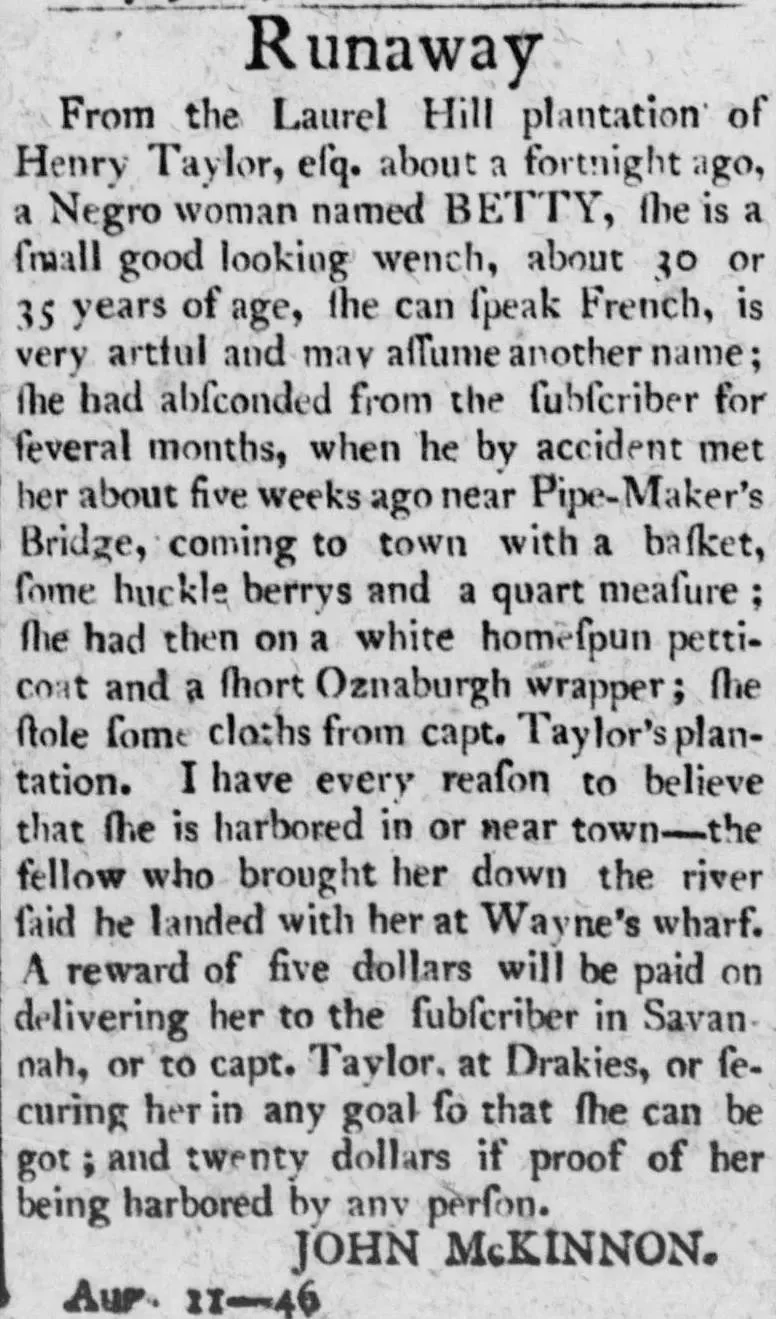
This 1814 advertisement from the Savannah Columbian Museum names a woman called Betty, notes she is approximately 30 to 35 years old, speaks French, and was last seen near Pipe-Maker's Bridge carrying a basket. The advertiser notes she is "artful" and may assume another name. That single detail, that she might call herself something else, is exactly the kind of clue that changes a search.
If your ancestor appears in a runaway ad, you have a starting point for a physical description, a location, and possibly a given name or alias. From there, you can search post-war records for the same person under multiple names in the same county.
Estate and Probate Notices
When an enslaver died, their estate went through probate. Enslaved people were listed as property and sometimes named in the legal notices that newspapers were required to publish.
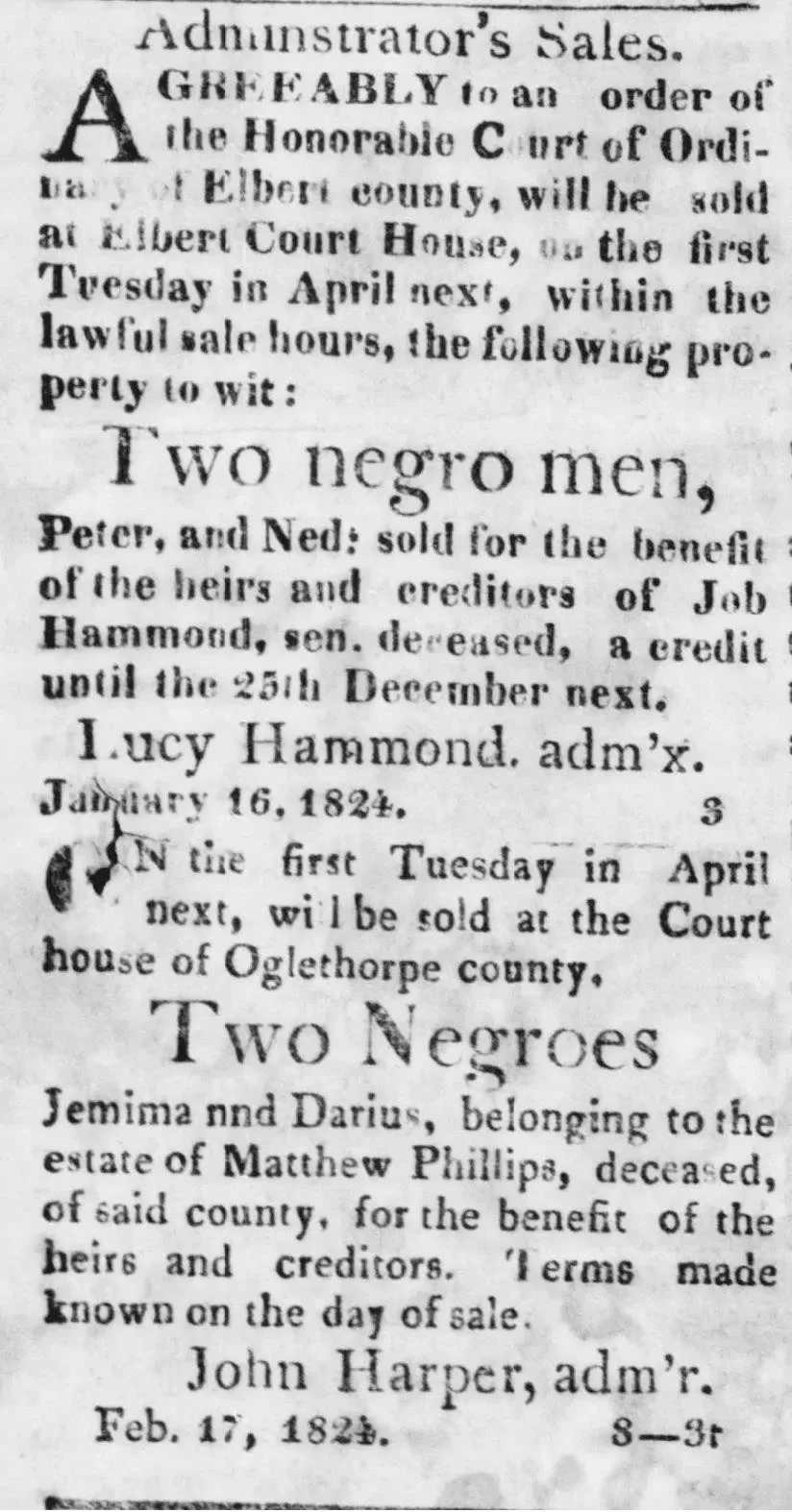
This 1824 page from the Washington News carries two separate administrator's sale notices. The first names Peter and Ned, listed among the property of Job Hammond. The second names Jemima and Darius, belonging to the estate of Matthew Phillips. Four names, two estates, one newspaper page.
For a researcher, this kind of notice matters for a specific reason. If you know your ancestor took the surname Hammond or Phillips after emancipation, a notice like this may explain why. Many freed people adopted the surnames of the enslavers who had most recently held them. Finding the estate record can help you connect a post-war name to a pre-war family.
Emancipation and Will-Based Freedom Notices
Some enslavers freed people during their lifetimes or by the terms of their wills. When those emancipations were granted, they sometimes appeared in local newspapers as legal notices or brief news items.
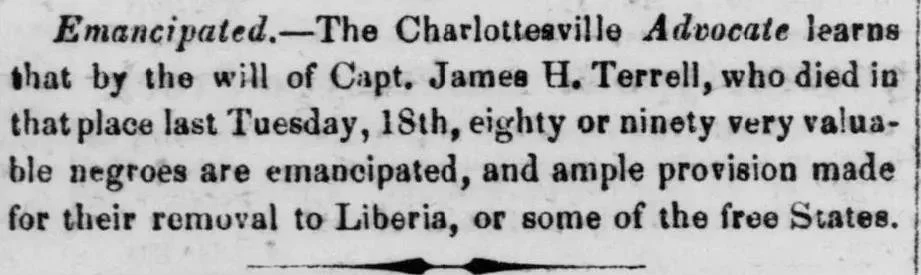
This 1856 notice from the Columbus Times and Sentinel reports that Capt. James H. Terrell of Charlottesville freed 80 to 90 people by the terms of his will. No individual names appear here, but this notice is still a research clue. If your ancestor was among those people, this is the thread to pull. From this notice, you could research Terrell's estate records, search Virginia newspapers for follow-up coverage, and look for individuals of the right age appearing in Ohio, Indiana, or other free states around that time.
Not every emancipation notice leads directly to a name. But many open a geographic or timeline path that other records cannot.
Post-War Community News and Legal Notices
After emancipation, newspapers continued to be one of the best sources for tracing individuals through a community. Mainstream local papers sometimes covered freedmen's community events, labor contracts, legal disputes, and land transactions. African American-owned papers went further, covering their communities the way any local paper would.
Marriage notices, school reports, church news, land purchases, death notices, and community gathering reports all began appearing in both types of publications after 1865. These records name people, place them in communities, and connect them to families in ways that census records alone cannot.
African American Newspapers: A Separate Research Path
One of the most important things a researcher can do is search African American newspapers directly. These publications covered their communities in detail, naming individuals who rarely appeared in mainstream papers.
After emancipation, dozens of African American newspapers began publishing across the country. Some were connected to churches or civic organizations. Others were independent community papers. All of them named people.
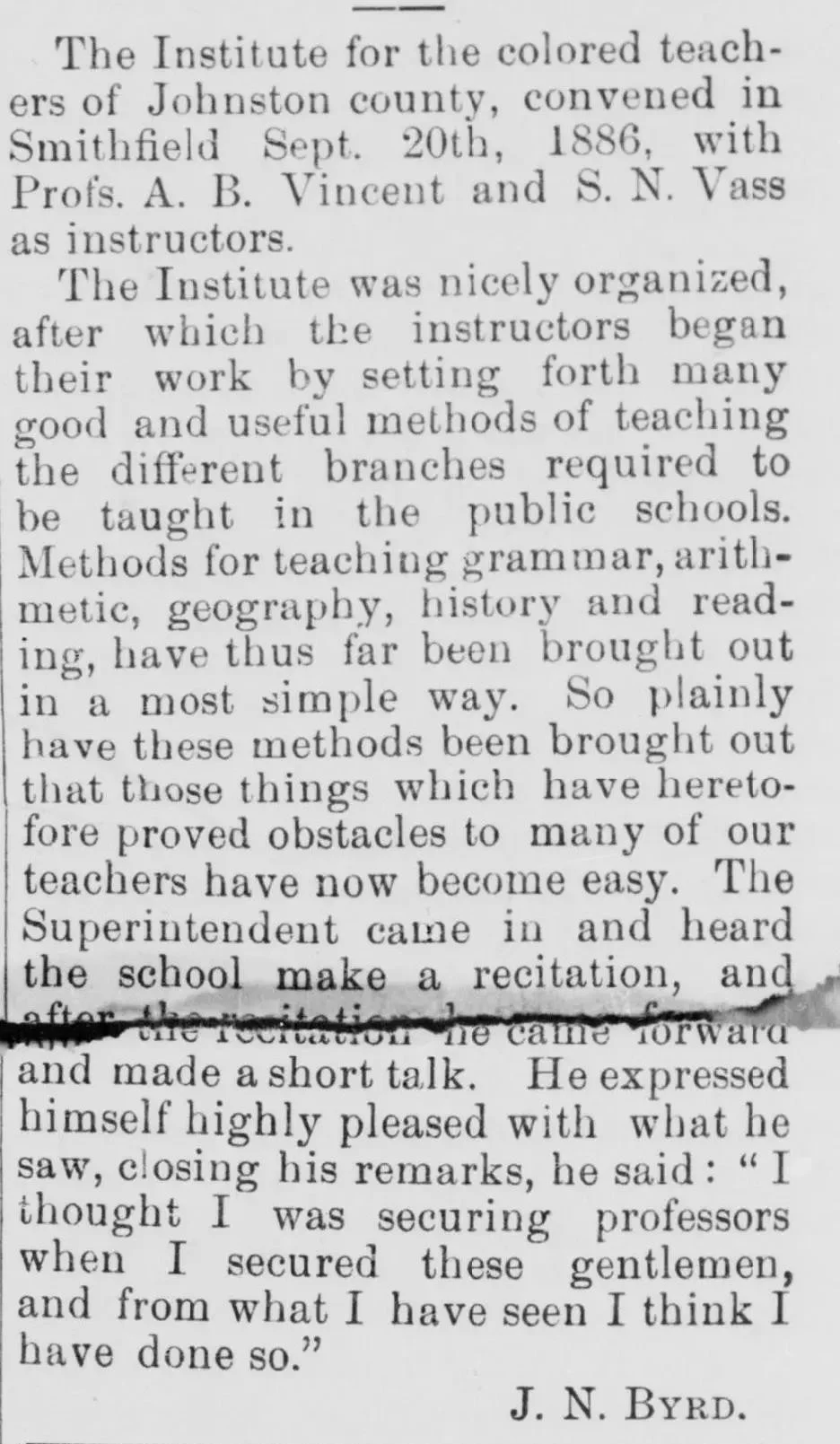
This 1886 item from the African Expositor covers a teachers' institute for Black educators in Johnston County, North Carolina. It names two instructors by full name and describes the work of the session in detail. A researcher looking for an ancestor who was an educator, or who lived near Smithfield in the 1880s, would find this kind of record nowhere else.
NewspaperArchive includes a growing collection of more than 100 African American newspaper titles. If your family history touches the post-war South, the Midwest, or any urban community with an active Black press, these papers are worth searching separately from mainstream publications.
Keywords to Use When Searching Newspaper Databases
Searching for enslaved ancestors requires flexibility with language. The terminology used in historical newspapers is often dehumanizing, but those same terms are what make the records findable. Using the right keywords, and knowing when to shift them, is a core research skill for this work.
This table organizes keywords by record type and time period to help you build more targeted searches.
Record Type | Time Period | Keywords to Try |
|---|---|---|
Runaway advertisements | 1700s to 1865 | runaway, negro, absconded, escaped, reward, plantation, slave, negro woman, negro man, likely to assume another name |
Estate and probate notices | 1800s to 1865 | administrator's sale, estate sale, negroes, property to wit, executor, heirs and creditors, court of ordinary, hire out |
Emancipation notices | 1820s to 1865 | emancipated, manumitted, free papers, freed by will, removal to Liberia, free states, freed negroes |
Freedmen-era records | 1863 to 1875 | freedmen, contrabands, colored, formerly enslaved, late slave, labor contract, Freedmen's Bureau |
Name-change notices | 1865 to 1875 | hereafter known as, will hereafter be known, assumed the name, taken the name |
Post-war community news | 1865 to 1900 | colored church, colored school, colored citizens, freedman |
African American newspapers | 1865 forward | Search publication names directly: Christian Recorder, Colored Tennessean, African Expositor, Freedom's Journal, The Elevator |
A note on this language: These terms reflect how enslaved and formerly enslaved people were described in the historical record, not how we describe them today. Using them in searches is a research strategy, not an endorsement of that language. Many researchers find it helpful to acknowledge that tension directly as part of how they document their process.
Search Tips Worth Knowing Before You Start
Start with the enslaver's name, not the ancestor's name. Before 1865, most newspaper records connect to the enslaver rather than the enslaved individual. Searching for the name of the plantation owner, estate administrator, or county where the family was held will often surface more results than searching for a first name alone.
Widen your date range past emancipation. Many researchers stop their newspaper searches at 1865. The most useful clues are often in the years just after: 1865 to 1880, when communities were reorganizing, families were reuniting, and newspapers were covering all of it.
Search the surrounding counties. Enslaved people were sometimes sold or moved across county lines. A notice published in a neighboring county paper may be the only record that names your ancestor.
Expect OCR limitations. Older newspapers were printed on fragile paper and scanned from deteriorating copies. Text recognition is imperfect, especially for pre-1870 publications. If a name search gives no results, try the enslaver's name, the county name, or a keyword like "runaway" or "estate sale" instead. NewspaperArchive completed a multi-year re-OCR project to improve searchability across its older collections, which may surface results that earlier searches missed.
Use name variants. Enslaved people were sometimes listed under nicknames, initials, or partial names. Betty might appear as Bet. A man named Archibald might appear only as Arch. Build your search around the most likely variations before assuming a record does not exist.
For more on building flexible searches, NewspaperArchive's guide to searching name variants in historical newspapers is a practical next step.
Frequently Asked Questions
Can I find enslaved ancestors by name in old newspapers? Sometimes, yes. Runaway advertisements, estate sale notices, and some emancipation records name individuals directly. The level of detail varies widely, but names appear more often in these records than in many other pre-war sources.
What if the newspaper search only returns the enslaver's name? That is still useful. The enslaver's name, location, and estate records can help you identify which individuals were held in that household and trace what happened to them after emancipation. Many formerly enslaved people took the surnames of their enslavers, which makes the connection searchable in post-war records.
Are African American newspapers available to search online? Some are, including through NewspaperArchive, Chronicling America, and university digital collections. Coverage varies by state and time period. Searching the publication name directly, rather than a general keyword search, often gives better results.
What do I do when a newspaper search gives no results at all? Shift your search. Try the county name, the enslaver's surname, or a record-type keyword like "estate sale" or "runaway" instead of a personal name. Also try neighboring counties and a wider date range. Absence of results in one search does not mean the record does not exist.
How do I handle the painful language in these records? There is no easy answer to that. Many researchers document what they find exactly as written, noting in their own words that the language reflects the historical record and not their own values. Some choose to include a brief note in their family history explaining the context. How you handle it is a personal decision, but you are not alone in wrestling with it.
Where to Start
The research path for enslaved ancestors in newspapers is rarely straight, and it is rarely easy. But it is real. The names are there, in runaway ads and estate notices and teachers' institute reports and emancipation items buried on page four of a Southern weekly. They were recorded because the law required it, or because a community paper thought it mattered, or because someone placed an ad hoping to find a person they could not catch.
Start with what you have. A county. A surname from the other side of a sale. A name that appears in a census record just after the war. Use those pieces as your search terms and see what the local papers were printing in that place and time.
Once you have a location and a rough date range, search NewspaperArchive across the full span of years around emancipation and see what the papers from that county were recording.
Key Takeaways
Runaway advertisements often contain the most detailed physical and biographical information available for any enslaved individual before 1865.
Estate and probate notices named enslaved people as property, but those names are genealogically significant, especially when connected to post-war surname research.
Emancipation notices and freedmen-era records open a research path even when they do not name individuals directly.
African American newspapers after 1865 covered their communities in detail and are worth searching as a separate source.
Searching by enslaver's name, county, and record-type keyword often yields more than searching by the ancestor's name alone.
Frequently Missed Records: A Quick Reference
If you are looking for... | Try searching... |
|---|---|
A name before 1865 | Runaway ads, estate sales, probate notices |
A connection to an enslaver's family | Estate administrator notices, will abstracts in newspapers |
Evidence of emancipation | Will-based freedom notices, emancipation items in local papers |
Post-war community placement | Freedmen's Bureau-era news, colored church and school notices |
Full biographical detail after 1870 | African American newspapers, community columns, death notices |
Conclusion
Researching enslaved ancestors is slow, sometimes painful work. The records were not built to honor these individuals, and the gaps in the historical archive are real. But newspapers, more than almost any other source, have a way of returning a person to the record. A name in a runaway ad. Four names on a probate page. A teachers' institute report in a community paper from 1886. Each one is a thread. And sometimes a single thread is enough to change everything you thought you knew about where your family came from.