How to Find DAR and SAR Ancestors in Old Newspapers
DAR and SAR newspaper mentions contain ancestor names, battles, units, and lineage details. Here's how to find them and use them in your genealogy research.
Newspaper mentions of the Daughters of the American Revolution (DAR) and Sons of the American Revolution (SAR) are among the most genealogically detailed records in historical newspaper archives. A DAR membership notice typically names the new member, identifies her Revolutionary War ancestor by full name, and specifies the ancestor's rank, unit, regiment, and battles fought. SAR notices follow a similar pattern. Both organizations were founded in the late 1800s and generated consistent newspaper coverage from the 1890s through the mid-twentieth century. Researchers use these notices to confirm an ancestor's military service, identify which battles or campaigns they were part of, and trace family lineage across multiple generations. NewspaperArchive holds DAR and SAR coverage from newspapers across every state, spanning local weekly papers through major metropolitan dailies, from the 1890s through the 1950s. Searching a surname alongside "Daughters of the American Revolution" or "Sons of the American Revolution" in NewspaperArchive will surface membership notices, chapter formation records, chapter anniversary coverage, and meeting reports, all of which may name your specific ancestor.
Quick Answer
A DAR or SAR newspaper mention typically names the new member, identifies their Revolutionary War ancestor by full name, specifies the ancestor's rank, regiment, and battles, and traces the family lineage connecting the two. These notices appeared regularly in local and regional newspapers from the 1890s through the mid-twentieth century and are among the most detailed genealogy records hiding in historical newspaper archives.
Your Ancestor Is Probably in a Newspaper. You Just Don't Know It Yet.
Most people searching for a Revolutionary War ancestor start with the obvious records: pension files, muster rolls, the DAR Patriot Index. Those are all worth searching. But there is a category of newspaper record that most researchers overlook entirely, and it is hiding a remarkable amount of detail.
When a woman joined the Daughters of the American Revolution in 1910, her local newspaper often published a notice. When a man was inducted into the Sons of the American Revolution in 1902, the same thing happened. These were community milestones, and local papers covered them the way they covered everything else that mattered in a town: with names, details, and specifics.
Those specifics are what make DAR and SAR newspaper notices so valuable for genealogy research today. A membership notice is not just a social item. It is a documented ancestor profile, printed in a newspaper, preserved in an archive, and searchable right now.
What a DAR or SAR Newspaper Mention Actually Contains
The Membership Notice
The most common type of DAR or SAR newspaper coverage is the membership induction notice. These ran in local papers whenever a new member joined a chapter, and they followed a consistent format.
A typical notice names the new member, identifies her or his qualifying ancestor by full name, specifies the ancestor's rank and unit, names the battles or campaigns the ancestor participated in, and traces the line of descent connecting the present-day member to that ancestor. In some cases the notice goes even further, describing the ancestor's background, where the family settled after the war, and what became of the family in the following generations.
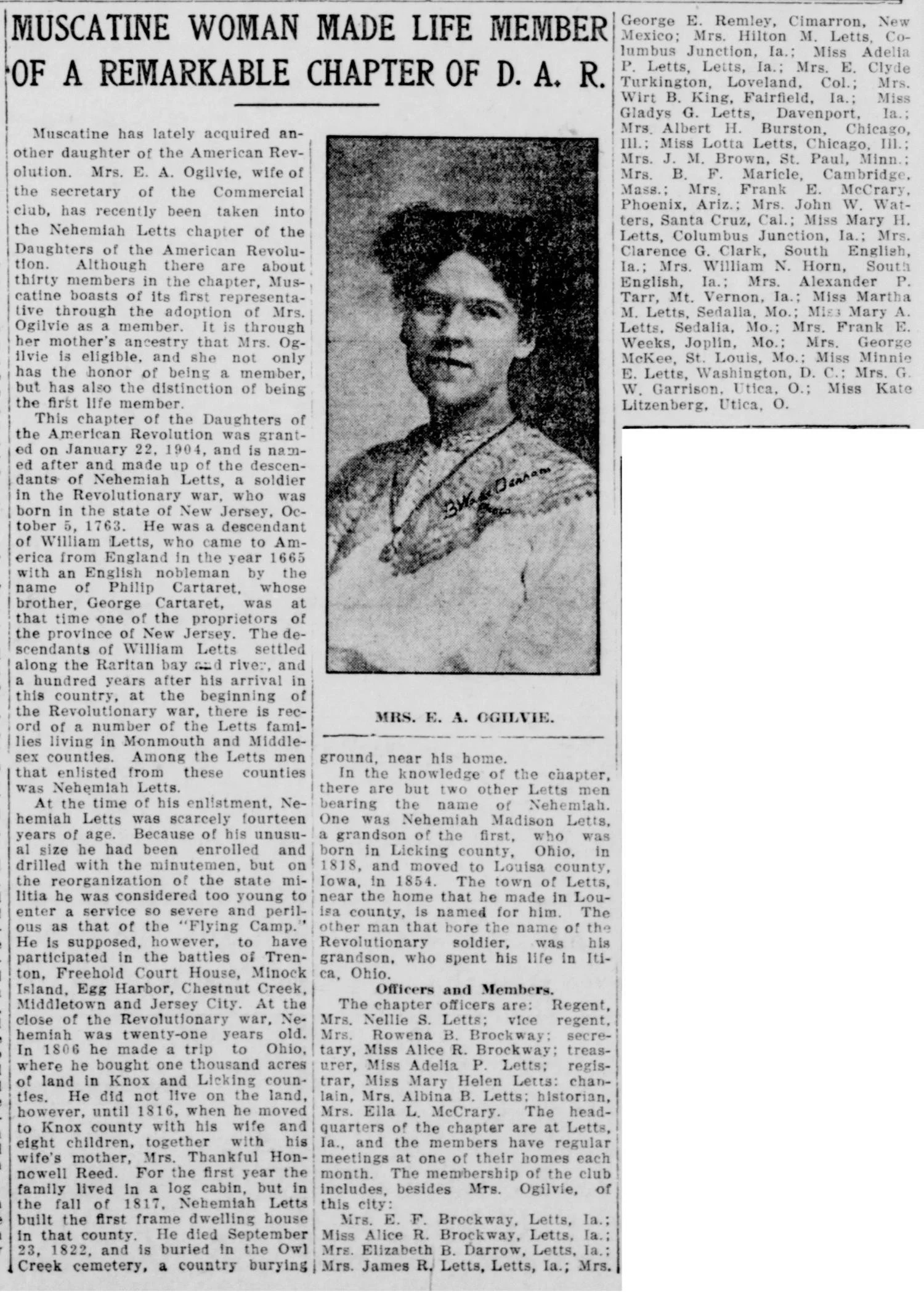
The 1910 Muscatine Journal notice for Mrs. E.A. Ogilvie is a strong example. The article announces that she has been made the first life member of the Nehemiah Letts chapter of the Daughters of the American Revolution. But it does not stop there. The notice then tells readers who Nehemiah Letts was: a New Jersey soldier born October 5, 1763, who was enrolled and drilled with the minutemen but considered too young for active service with the "Flying Camp." It tracks his life after the war, from a trip to Ohio in 1806 where he bought a thousand acres in Knox and Licking counties, to his death on September 23, 1822, buried in the Owl Creek cemetery. His family history goes back even further, tracing his descent from William Letts, who came from England to America in 1665 with an English nobleman and settled in New Jersey.
That is not a membership notice. That is a family history, published in a small Iowa newspaper in 1910, waiting for a descendant to find it.
The Chapter Formation Notice
When a new DAR or SAR chapter was founded, newspapers covered that too. Chapter formation notices are especially valuable because they name all the founding members and often explain in detail how the chapter was named, which ancestor it honors, and what that ancestor did during the Revolution.
These notices sometimes appear as standalone articles and sometimes as part of a larger society column. Either way, they tend to be long, detailed, and full of the kind of family history information that does not appear in any other record type.
The Annual Meeting and Roster Report
DAR chapters met regularly, and newspapers in many communities reported on those meetings. The reports typically named the officers present, summarized any business conducted, and sometimes listed the full membership roster. For researchers tracing a female ancestor's community involvement, these notices are invaluable. They put a name in a specific place at a specific time and confirm active membership in an organization that required documented Revolutionary War descent.
The Anniversary Tribute
Milestone anniversaries of DAR or SAR chapters generated their own category of newspaper coverage. A chapter celebrating its twenty-fifth anniversary might publish a full retrospective naming every member who had ever belonged to it, along with the ancestors each had claimed. These are among the longest and most genealogically detailed newspaper records in the archive.
When a Newspaper Article Becomes a Family History
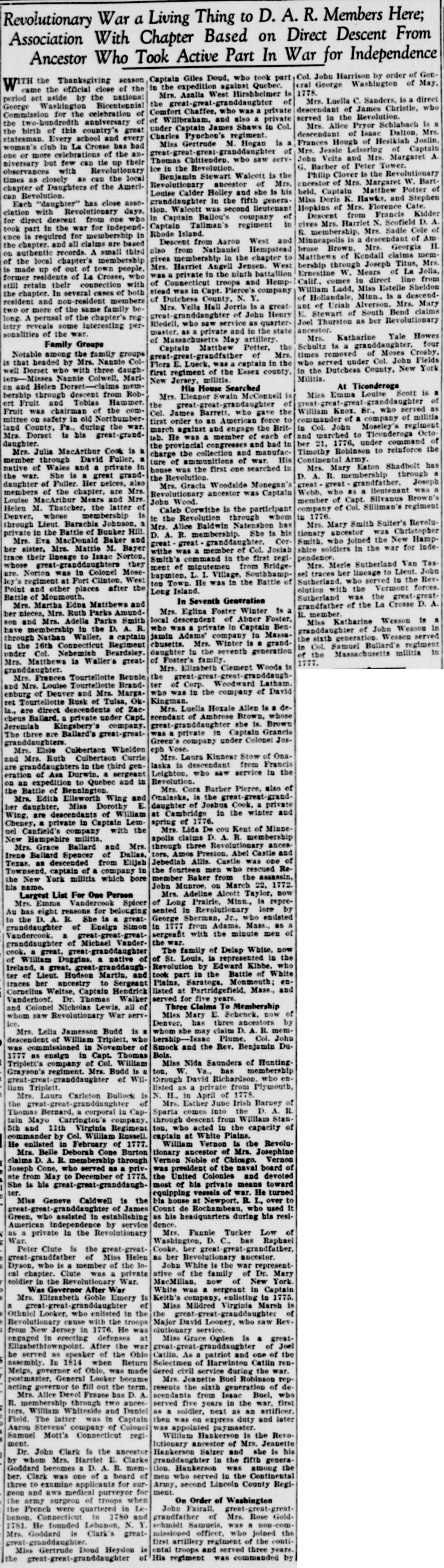
The La Crosse Tribune ran a lengthy article in November 1932 about the local George Washington Bicentennial chapter of the DAR. It was tied to the Thanksgiving season and the two-hundred-year anniversary of Washington's birth, but it reads less like a holiday feature and more like a who's who of the Revolutionary War.
The article moves through chapter members one by one, listing each woman's Revolutionary War ancestor alongside specific details about their service. Captain Giles Doud, who took part in the expedition to Fort Hirschheimer in 1777. Col. John Harrison, who served by order of General Washington at the Battle of Monmouth in May 1778. Philip Clover, identified as the Revolutionary War ancestor of Mrs. Sarah Clover, served under Captain Matthew Potter of Virginia. The list goes on for nearly the full length of the article.
For any researcher with family ties to La Crosse or to the broader community of women who made up that chapter, this single newspaper article is a starting point for dozens of separate ancestor searches. Each name in that column is a thread to pull.
The Sons of the American Revolution
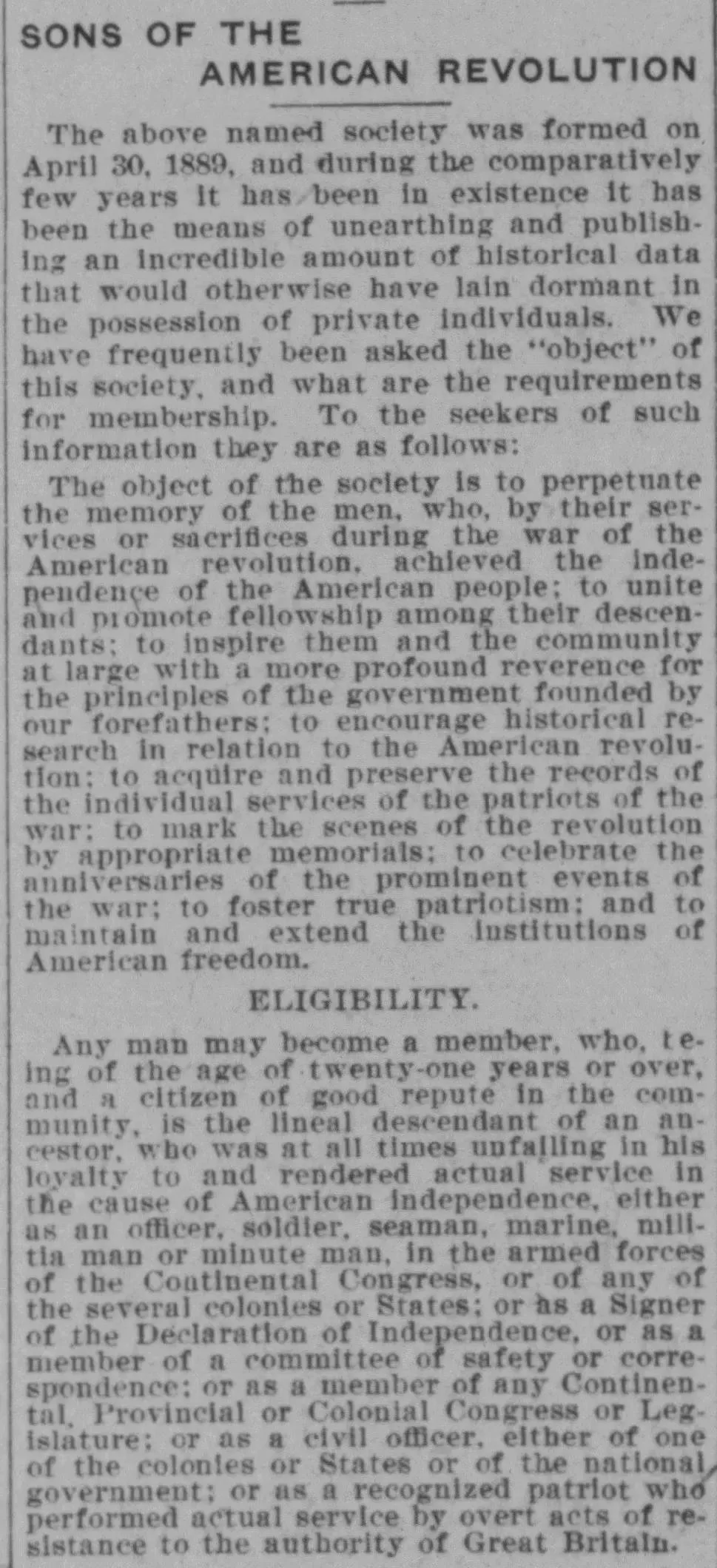
The Daughters of the American Revolution was founded in 1890. The Sons of the American Revolution was founded the year before, on April 30, 1889. Both organizations generated newspaper coverage from nearly the beginning, and both required documented lineage to qualify for membership.
The 1902 Philadelphia Times article explaining the SAR lays out the eligibility requirements in full. Any man who is a lineal descendant of an ancestor who rendered actual service in the cause of American independence qualifies, whether that ancestor served as an officer, soldier, seaman, marine, militia man, or minute man. The article also explains that descendants of Signers of the Declaration of Independence, members of committees of safety, members of colonial legislatures, civil officers of the colonies, and recognized patriots who performed overt acts of resistance to British authority are all eligible.
That breadth matters for researchers. Your ancestor does not have to have carried a musket to qualify, and SAR newspaper records reflect that range. You may find a notice naming an ancestor who served on a committee of safety, signed a local resolution, or supplied the army with goods. All of those roles appear in SAR membership documentation, and all of them can show up in newspaper coverage of the organization.
SAR membership notices follow the same general format as DAR notices: member named, ancestor identified, service specified. The notices ran in local papers, in state society publications that were sometimes reprinted in dailies, and in coverage of annual SAR meetings and conventions.
Before DAR and SAR Existed: The Earlier Record
The DAR and SAR were both founded in the late nineteenth century, but the impulse to document Revolutionary War ancestry is much older than either organization.

In 1857, a man named J. Hamilton published a notice in the Georgetown Pee-Dee Times of South Carolina. He identified himself as the surviving son of Major James Hamilton of the 2nd Regiment of the Pennsylvania Line, attached to Wayne's Brigade. He was writing to appeal to other descendants of Continental Army officers across the country to provide information for a census of officers' descendants, intended to verify claims against Congress.
His notice asks each correspondent to specify what officer they descended from, what line, regiment, or staff he was attached to, his rank, and when he died. He planned to verify the information against the Muster Rolls of the Continental Army on file in the War Office at Washington and use the resulting list for a memorial to Congress.
This was thirty-three years before the DAR was founded and thirty-two years before the SAR. The documentation impulse was already there. Families were already searching, already corresponding, already trying to compile the record before any formal organization existed to preserve it.
For researchers today, these pre-DAR and pre-SAR notices are extraordinary finds. They name officers, units, and family connections. They appear in newspapers from the 1820s through the 1880s, decades before membership organizations formalized the process. Searching NewspaperArchive for a surname alongside terms like "Continental Army," "Pennsylvania Line," or "Wayne's Brigade" may surface this kind of notice long before the familiar DAR and SAR records begin.
How to Search for DAR and SAR Records in Newspaper Archives
Search terms that work
These combinations will surface the most useful results:
Ancestor surname + "Daughters of the American Revolution"
Ancestor surname + "Sons of the American Revolution"
Ancestor surname + "D.A.R."
Ancestor surname + "S.A.R."
Ancestor surname + "chapter" + "Revolution"
Town or county name + "DAR" + date range
Search the descendant's surname as well as the ancestor's. The membership notice will be under the living member's name, not the ancestor's. If you know a great-grandmother lived in a particular town and the approximate decade she was active in a DAR chapter, searching her surname against the town and "Daughters of the American Revolution" is often faster than searching the ancestor directly.
Date ranges to prioritize
DAR and SAR membership notices appear most consistently from 1890 through 1950. The organizations were new in the 1890s and generated heavy coverage as chapters formed across the country. Coverage continued steadily through the first half of the twentieth century as chapters grew and membership expanded.
The pre-organization notices, like the 1857 Hamilton letter, require an earlier date range. Searching 1820 through 1889 with terms like "descendants of officers" or "Continental Army" and the relevant surname or state will surface records from this period.
What to do when you find a notice
Read the full article, not just the headline. Membership notices often contain more detail than the headline suggests. Write down every name that appears in the article, not just the one you were searching. A DAR chapter article that names twenty members has just given you twenty potential research threads, each one connected to a documented Revolutionary War ancestor.
Note the chapter name. DAR chapters are frequently named after specific ancestors, which means a chapter name can lead you directly to a family.
Search for the ancestor named in the notice using the specific details the article provides: rank, unit, regiment, battles. Those details, cross-referenced with pension records and muster rolls, can confirm or expand what you know about the family.
Why These Records Are Worth Your Time
A pension file tells you an ancestor served. A muster roll confirms the unit. But a DAR or SAR newspaper notice often tells you both of those things and then goes further. It connects the ancestor to a living family at a specific point in time. It names the grandchildren and great-grandchildren. It places the family in a community. It describes what the ancestor did in the war in language meant for a general audience, which means it tends to be more readable and more specific about personal detail than a government document.
The La Crosse Tribune article from 1932 names Captain Giles Doud's specific campaign, Colonel John Harrison's specific battle and date, Philip Clover's specific officer. None of those details had to be in a Thanksgiving newspaper feature. They are there because the women who submitted their membership information were proud of what their ancestors did and wanted it known.
That pride is the researcher's advantage. It made people specific. And specific is exactly what you need.
If your family has any connection to the Revolutionary era, there is a reasonable chance someone in your line joined a DAR or SAR chapter and that a local newspaper covered it. Search NewspaperArchive for your family's surname alongside "Daughters of the American Revolution" or "Sons of the American Revolution" and see what comes back. You may find an ancestor profile that took someone else a lifetime to compile, sitting in a newspaper from 1910, waiting for you to find it.
For more on the full range of Revolutionary War newspaper records, see our America250 research checklist.
Frequently Asked Questions
What does a DAR newspaper mention tell you about your ancestor?
A DAR membership notice typically names the Revolutionary War ancestor in full, identifies their rank and military unit, specifies the battles or campaigns they participated in, and traces the line of descent connecting the current member to that ancestor. Some notices go further and include biographical detail about the ancestor's life before and after the war.
How early do DAR and SAR newspaper records appear?
The Daughters of the American Revolution was founded in 1890 and the Sons of the American Revolution in 1889. Both organizations generated newspaper coverage almost immediately, so records begin appearing in the early 1890s. However, similar ancestor documentation notices appear in newspapers as early as the 1820s, published by families and individuals trying to compile lineage records before formal organizations existed.
Can I find a DAR or SAR record for an ancestor who was not a soldier?
Yes. Both organizations recognize a broader range of patriot service than military combat. Ancestors who served on committees of safety, signed loyalty oaths, held civil office in the colonies, supplied the army, or performed other recognized acts of resistance to British authority qualify for membership consideration. SAR and DAR newspaper notices reflect this range and may name ancestors whose contributions were non-military.
What if the newspaper notice is for the descendant, not the ancestor I am searching?
That is actually the most common situation. Search for the descendant's surname, not the ancestor's. The notice will appear under the living member's name. Once you find the notice, it will name the ancestor and provide the specific military details you need to continue your research.
What search terms work best in NewspaperArchive for DAR and SAR records?
Search the descendant's surname combined with "Daughters of the American Revolution," "Sons of the American Revolution," "D.A.R.," or "S.A.R." You can also search a town or county name alongside "chapter" and "Revolution" to find chapter formation or anniversary coverage that may name multiple members. For pre-organization records, try the ancestor's surname combined with "Continental Army," the relevant state line, or specific regiment names.
How do I know if my ancestor's name appears in a chapter formation record?
Many DAR chapters were named after specific Revolutionary War ancestors. If you know the name of a chapter your family member belonged to, search that chapter name in NewspaperArchive. The formation notice will typically explain why the chapter was named as it was and may provide substantial detail about the ancestor the chapter honors.