How One Newspaper Article Led to a Bigger Family Tree
See how one Thomas Moreland Hamilton obituary opened a bigger family tree through names, dates, places, relationships, and follow-up newspaper clues.
One newspaper article can lead to a bigger family tree when it includes names, relationships, dates, places, residences, churches, schools, occupations, and descendant clues. In this case study, the obituary for Thomas Moreland Hamilton, published in the Greensburg Standard on January 3, 1896, identifies his parents Robert and Polly Hamilton, his wife Lizzie McLaughlin, their marriage date, their four children, and granddaughter Helen Baker. The article also points to Greensburg, North East Street, the Presbyterian church, Hanover College, and Third National Bank as follow-up search clues. A rich newspaper clipping should be treated as a research map, not a finished answer: pull out every name, separate stated facts from clues, search each place or relationship in NewspaperArchive, and verify the details with census, marriage, cemetery, probate, church, and other records.
Sometimes one newspaper clipping is enough to make you stop.
Not because it answers every question.
It usually doesn’t.
But because it gives you enough names, places, dates, and relationships to know exactly where to go next.
That is what happened with the obituary for Thomas Moreland Hamilton, published in the Greensburg Standard on January 3, 1896. Thomas is my 3rd great-granduncle, and this article is the kind of find that reminds me why newspapers matter so much in family history.
It does not hand me a finished family tree.
But it opens the door.
Quick answer: can one newspaper article help build a family tree?
Yes. One newspaper article can help build a family tree when it includes names, relationships, dates, places, residences, churches, schools, occupations, and clues about descendants. A single obituary, wedding announcement, legal notice, or anniversary article may not prove every relationship by itself, but it can create a research plan and point you toward the next records to find.
If you already have a clipping saved, this is a good time to look at it again. Not for the main story this time, but for the smaller clues tucked inside it.
The article that started the search
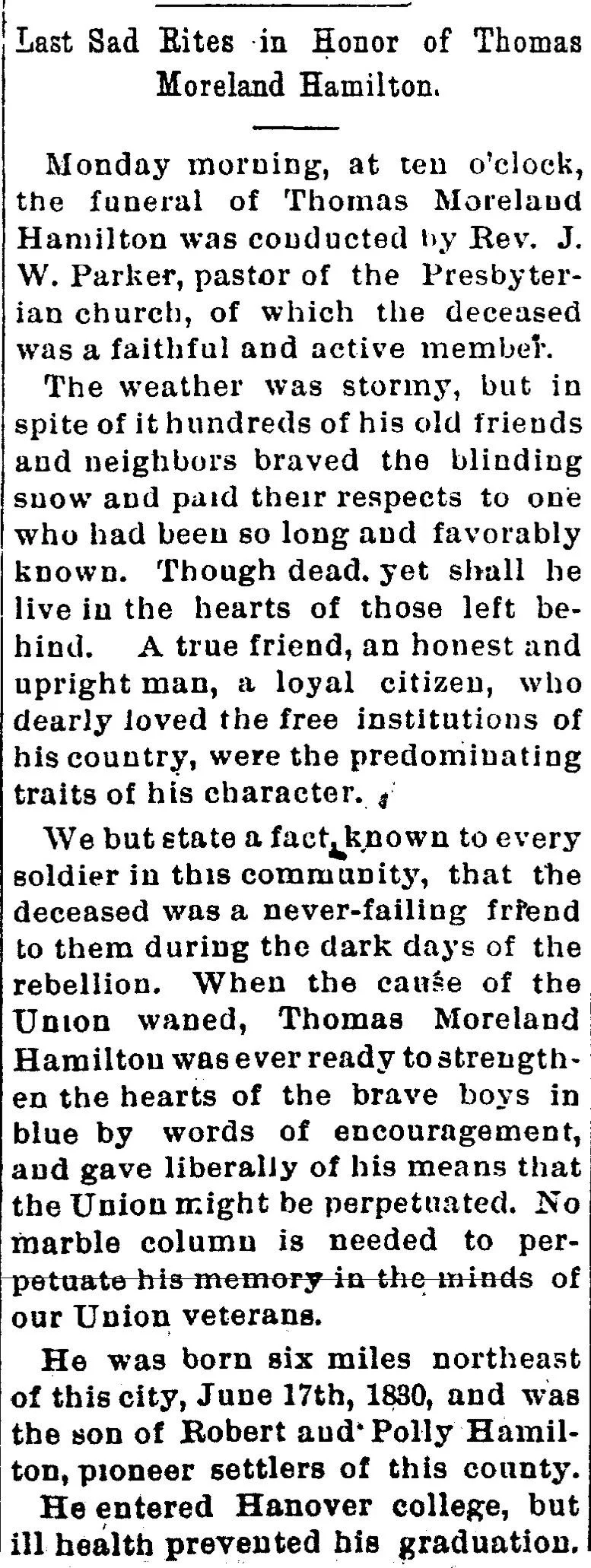
The obituary is titled “Last Sad Rites in Honor of Thomas Moreland Hamilton.”
At first glance, it reads like a funeral tribute. It describes the funeral, the stormy weather, the friends and neighbors who attended, his reputation in the community, and his support for Union soldiers during the Civil War.
But tucked inside that tribute is a lot of family history.
The article tells us Thomas Moreland Hamilton:
was born six miles northeast of Greensburg
was born on June 17, 1830
was the son of Robert and Polly Hamilton
entered Hanover College, but did not graduate because of ill health
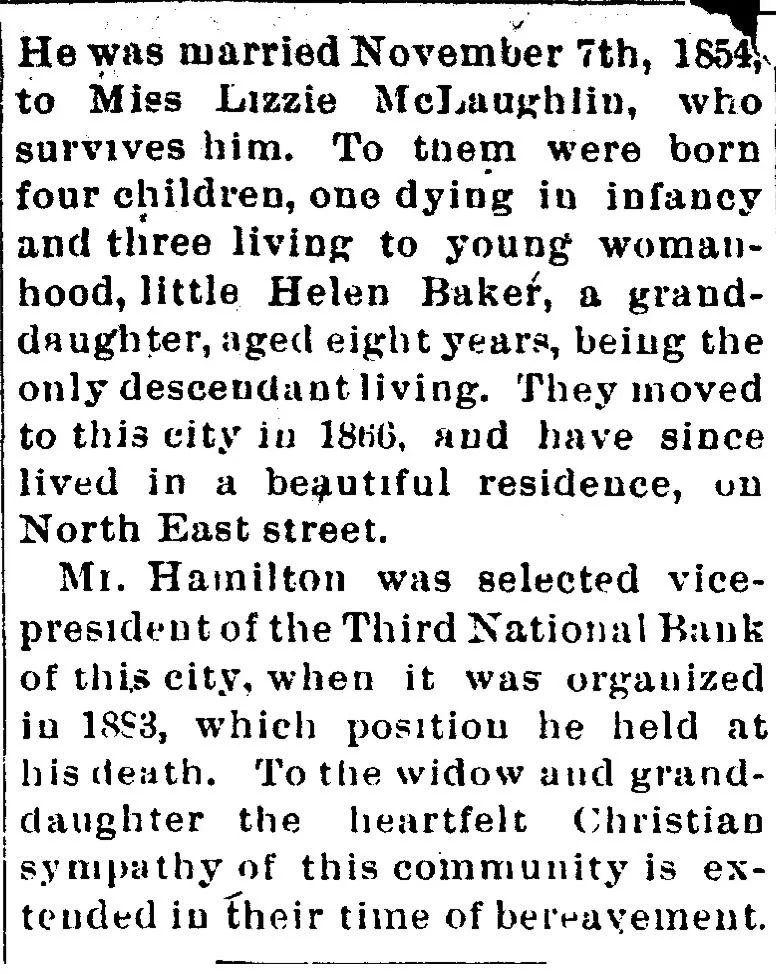
married Lizzie McLaughlin on November 7, 1854
had four children
had one child die in infancy
had three daughters live to young womanhood
had one living descendant, a granddaughter named Helen Baker
lived on North East Street
served as vice president of the Third National Bank
was connected to the Presbyterian church
died before January 3, 1896, when the obituary was published
That is a lot from one article.
And every detail gives me something to do next.
Start by pulling out every name
The first thing I do with an article like this is pull out every name.
Not just the main person.
Every name.
From this obituary, I get:
Thomas Moreland Hamilton
Rev. J. W. Parker
Robert Hamilton
Polly Hamilton
Lizzie McLaughlin
Helen Baker
That may not seem like a huge list, but it gives several directions.
Thomas is the subject.
Robert and Polly are his parents.
Lizzie McLaughlin is his wife.
Helen Baker is his granddaughter.
Rev. J. W. Parker gives a church connection.
Each one can become a new search.
This is where a newspaper article starts becoming more than a story. It becomes a map.
Build the first family group
From the obituary, I can build a basic family group.
Thomas Moreland Hamilton
Born: June 17, 1830
Parents: Robert and Polly Hamilton
Wife: Lizzie McLaughlin
Marriage date: November 7, 1854
Children: four total
Known descendant: Helen Baker, granddaughter
Residence: North East Street, Greensburg
Church: Presbyterian
Education: Hanover College
Occupation/community role: vice president of Third National Bank
That is not a complete family tree yet.
But it is a very strong starting point.
The article gives me a husband and wife, parents, a marriage date, a child count, and a living granddaughter.
Now I know what to look for next.
Pay close attention to the child count
This is one of the most important details in the obituary.
It says Thomas and Lizzie had four children.
One died in infancy.
Three lived to young womanhood.
By the time of the obituary, Helen Baker, age eight, was the only living descendant.
That one sentence tells me a lot.
It suggests that Thomas and Lizzie’s children were no longer living by 1896, or at least that none of them left living descendants besides Helen.
But I have to be careful.
The article gives me a clue, not a fully documented chart.
Now I need to find:
the names of the four children
which child died in infancy
the three daughters who lived to young womanhood
which daughter married a Baker
how Helen Baker fits into the family
whether Helen had siblings who died young
whether there are death notices, marriage notices, cemetery records, or probate records that confirm the relationships
That is why one obituary can be so powerful.
It gives answers, but it also gives better questions.
The Helen Baker clue
Helen Baker is the detail that would send me searching immediately.
The obituary says she was Thomas Moreland Hamilton’s granddaughter, age eight, and the only living descendant.
But it does not tell me which of Thomas and Lizzie’s daughters was her mother.
That becomes the next research question.
To follow Helen Baker, I would search for:
Helen Baker + Greensburg
Helen Baker + Hamilton
Baker + Hamilton
Lizzie McLaughlin + Baker
Thomas Moreland Hamilton + Baker
Helen Baker + North East Street
Helen Baker + Presbyterian church
I would also look for:
a marriage notice for a Hamilton daughter who married a Baker
an obituary for Helen Baker
a death notice for Helen’s mother
probate or guardianship records
cemetery records for Hamilton and Baker burials
census records placing Helen with relatives
This is the kind of clue I love because it does not just sit there. It asks to be followed.
Use the places as search terms
This obituary also gives several places to search.
Not all of them are obvious at first.
The article mentions:
Greensburg
six miles northeast of the city
North East Street
Presbyterian church
Hanover College
Third National Bank
Each place can become a search term.
For example:
Thomas Moreland Hamilton + Hanover College
Hamilton + Third National Bank
Hamilton + Presbyterian church
Hamilton + North East Street
Lizzie McLaughlin + Greensburg
Helen Baker + Greensburg
This is where newspapers are especially useful.
A census record might place someone in a household.
A death certificate might give dates and parents.
But a newspaper can connect a person to a church, a street, a school, a bank, a funeral, and a community.
That is the part that helps turn names into people.
Separate facts from clues
This is important.
A newspaper article can be incredibly helpful, but I do not want to treat every sentence as fully proven without checking it.
I would separate the information into two groups.
Facts the article states directly
The obituary directly states:
Thomas Moreland Hamilton was born June 17, 1830
his parents were Robert and Polly Hamilton
he married Lizzie McLaughlin on November 7, 1854
they had four children
Helen Baker was his granddaughter
he was connected to the Presbyterian church
he lived on North East Street
he was vice president of the Third National Bank
Clues that need follow-up
The article points me toward:
the identity of the four children
the name of the child who died in infancy
the three daughters who lived to young womanhood
Helen Baker’s parents
Thomas’s exact death date
his burial location
his connection to Hanover College
his role at Third National Bank
the larger Hamilton and McLaughlin family lines
This is how I keep myself from overreaching.
The article gives me a direction. Then I verify.
What I would search next in NewspaperArchive
If I were continuing this search in NewspaperArchive, I would not only search Thomas’s full name.
I would search outward.
Here are the searches I would try:
Thomas Moreland Hamilton
T. M. Hamilton
Thomas M. Hamilton
Lizzie McLaughlin Hamilton
Lizzie Hamilton
Robert Hamilton + Polly
Helen Baker + Hamilton
Helen Baker + Greensburg
Hamilton + Baker + Greensburg
Hamilton + North East Street
Hamilton + Third National Bank
Hamilton + Hanover College
Hamilton + Presbyterian church
I would also search with a wider date range.
For Thomas, I would search around:
his marriage year, 1854
his move to Greensburg in 1866
his bank role beginning in 1883
his death in late 1895 or early 1896
Helen Baker’s childhood years
If the first search did not work, I would try fewer words.
Sometimes Hamilton + Baker + Greensburg may work better than a full-name search.
Look for the records that can confirm the article
Once the newspaper gives me the path, I would look for records to support it.
For this Hamilton case, I would want:
marriage record for Thomas Moreland Hamilton and Lizzie McLaughlin
census records for Thomas and Lizzie
cemetery records
probate records
obituaries for Lizzie, Helen Baker, and any Hamilton daughters
church records, if available
Hanover College references
bank or city directory records
death notices for the children
The obituary becomes the starting point, not the only source.
That is one of the biggest lessons here.
Newspapers can open the door, but you still need to walk through it carefully.
Why this article matters
This clipping matters because it gives both a life story and a research structure.
It tells me Thomas was not just a name in a family tree.
He was remembered as:
a faithful Presbyterian
a respected citizen
a friend to Union soldiers
a man connected to the local bank
someone whose funeral drew friends and neighbors even in a blinding snowstorm
That matters.
Family trees can get flat if we only collect names and dates. Newspaper articles add shape.
They show the community around a person.
And in this case, the article gives me enough to expand the Hamilton line in several directions.
How to use one newspaper article this way
You can do this with almost any rich newspaper article.
It does not have to be an obituary.
You can use:
a wedding announcement
an anniversary article
a probate notice
a family reunion article
a death notice
a funeral notice
a legal notice
a local profile
When you find one, ask:
Who is named?
How are they related?
What places are mentioned?
What dates appear?
What organizations, churches, schools, or businesses are named?
What questions does the article create?
What records could confirm it?
Then make a list of searches.
That is how one article becomes a research plan.
FAQs About Using Newspaper Articles for Family Trees
Can one newspaper article build a family tree?
One newspaper article usually will not build a full family tree by itself, but it can provide names, relationships, dates, places, and clues that help you expand the tree and know what records to search next.
What type of newspaper article is best for family tree research?
Obituaries, wedding announcements, anniversary articles, family reunion notices, probate notices, and legal notices are especially useful because they often name relatives and explain relationships.
Should I trust every detail in an old newspaper article?
Use newspaper details as clues and evidence, but verify important facts with other records when possible. Names, ages, dates, and relationships can contain errors.
What should I do after finding a newspaper article about my ancestor?
Pull out every name, date, place, relationship, church, cemetery, occupation, school, and organization. Then search each clue separately in newspapers, census records, vital records, cemetery records, and probate records.
Why are newspapers useful for family history?
Newspapers can show details that formal records often leave out, such as community ties, funeral attendance, church involvement, residences, occupations, schools, clubs, and personal stories.
Final thoughts
This Thomas Moreland Hamilton obituary did not give me a finished family tree.
But it gave me something just as useful.
A way forward.
It named parents, a wife, a granddaughter, a marriage date, a residence, a church, a college, and a bank. It also left me with questions, especially about Helen Baker and the daughters who lived to young womanhood.
That is what a good newspaper clipping does.
It gives you answers, and then it hands you the next search.
If you have a newspaper article with more than one family name in it, try opening it in NewspaperArchive and treating it like a map instead of a finished answer. Pull out every name, place, and relationship, then search each clue one at a time.
Key takeaways
One newspaper article can lead to a bigger family tree.
A rich obituary may include parents, spouse, children, grandchildren, residences, schools, churches, and occupations.
Pull out every name, not just the main person.
Separate stated facts from clues that need follow-up.
Use places, churches, schools, cemeteries, and occupations as search terms.
Follow unclear clues, like Helen Baker’s relationship to the Hamilton daughters.
Verify newspaper details with other records when possible.
Treat a newspaper clipping as a research map, not the final answer.