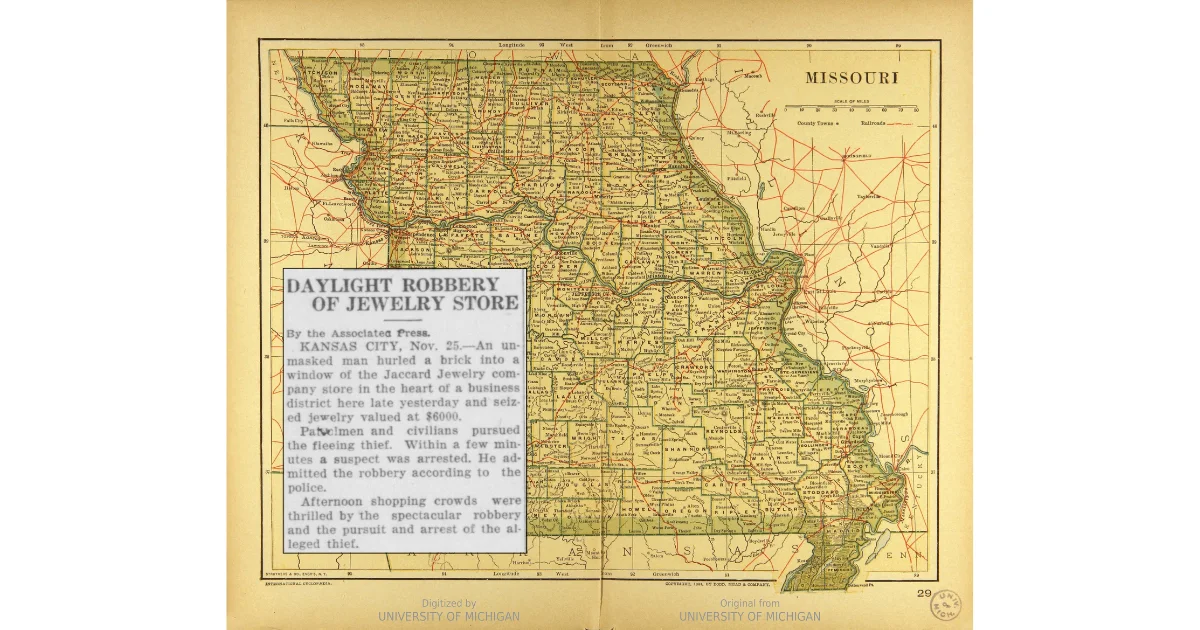
Finding Crime Reports in 1920s Missouri Newspapers: A Step-by-Step Guide
Find 1920s Missouri crime reports in newspaper archives. Learn how to search names, places, crime terms, headlines, arrests, and follow-up articles.
To find crime reports in 1920s Missouri newspapers, search local and regional newspaper archives by name, city, county, date, business name, and crime-related terms such as robbery, shot, killed, arrested, inquest, trial, verdict, or sentenced. The same crime may appear in several Missouri newspapers under different headlines, so researchers should compare multiple articles and search nearby dates for follow-up coverage. NewspaperArchive can help locate digitized Missouri newspapers that include local crime reports, court updates, arrests, and other details not found in standard search engine results.
If you are trying to find a 1920s Missouri crime report with a regular Google search, you may come up empty.
That does not mean the story was never reported. It may simply mean the newspaper that covered it is not easy to find through a standard search engine. Many crime stories from the 1920s lived in local and regional newspapers: the daily papers, county-seat papers, and small-town publications that printed the names, places, arrests, inquests, and court updates that people in the community wanted to know.
That is where newspaper archives become so useful.
Whether you are researching a family story, a local crime, a cold case, or a forgotten court case, 1920s Missouri newspapers can help you follow the story one clipping at a time.
Quick Answer: How Do You Find Crime Reports in 1920s Missouri Newspapers?
To find crime reports in 1920s Missouri newspapers, start with the local or regional newspaper closest to the crime. Search by the victim’s name, suspect’s name, city, county, business name, street name, and crime terms such as “shot,” “killed,” “robbery,” “arrested,” “inquest,” “indicted,” “trial,” or “verdict.” Once you find one article, search nearby dates and other Missouri newspapers to look for follow-up coverage, different headlines, arrest reports, court proceedings, and sentencing updates.
Why Missouri Newspapers Matter for Crime Research
In the 1920s, Missouri newspapers did more than report national headlines. They recorded everyday life in cities, county seats, and small towns.
Crime reporting could be surprisingly detailed. A single article might include:
the name of the victim
the name of the suspect
the location of the crime
the business or home involved
the value of stolen property
witness details
the arrest location
police statements
the suspect’s prior record
whether stolen property was recovered
what happened next in court
For researchers, those details matter.
A court record may confirm a charge or sentence. A death record may confirm a date and cause of death. But a newspaper article can show how the story unfolded when it was still fresh, uncertain, and local.
A 1920s Missouri Crime May Appear in More Than One Newspaper
One of the best reasons to search more than one newspaper is that the same crime may appear under completely different headlines.
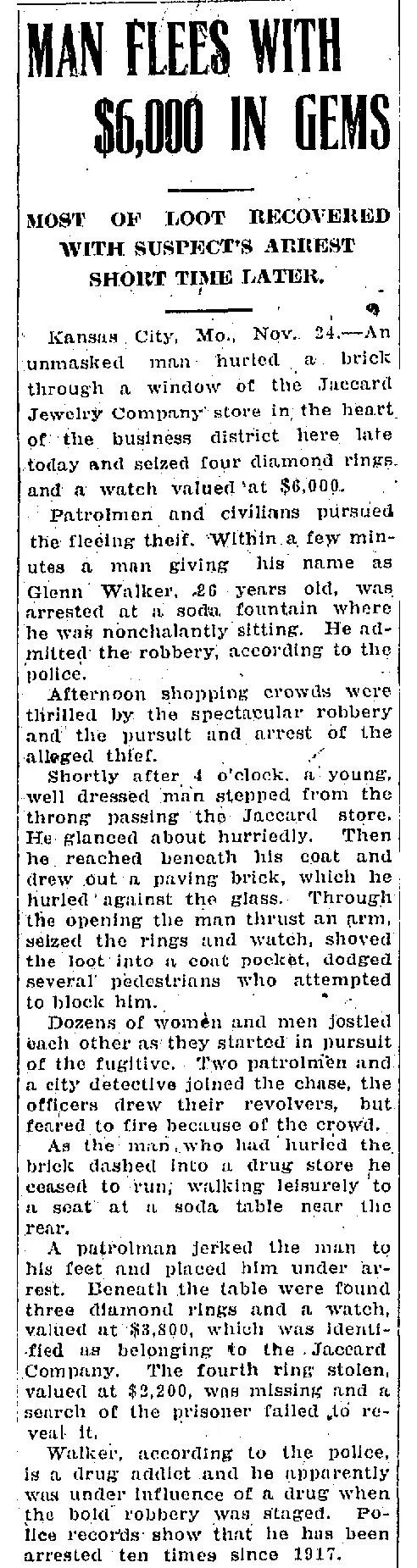
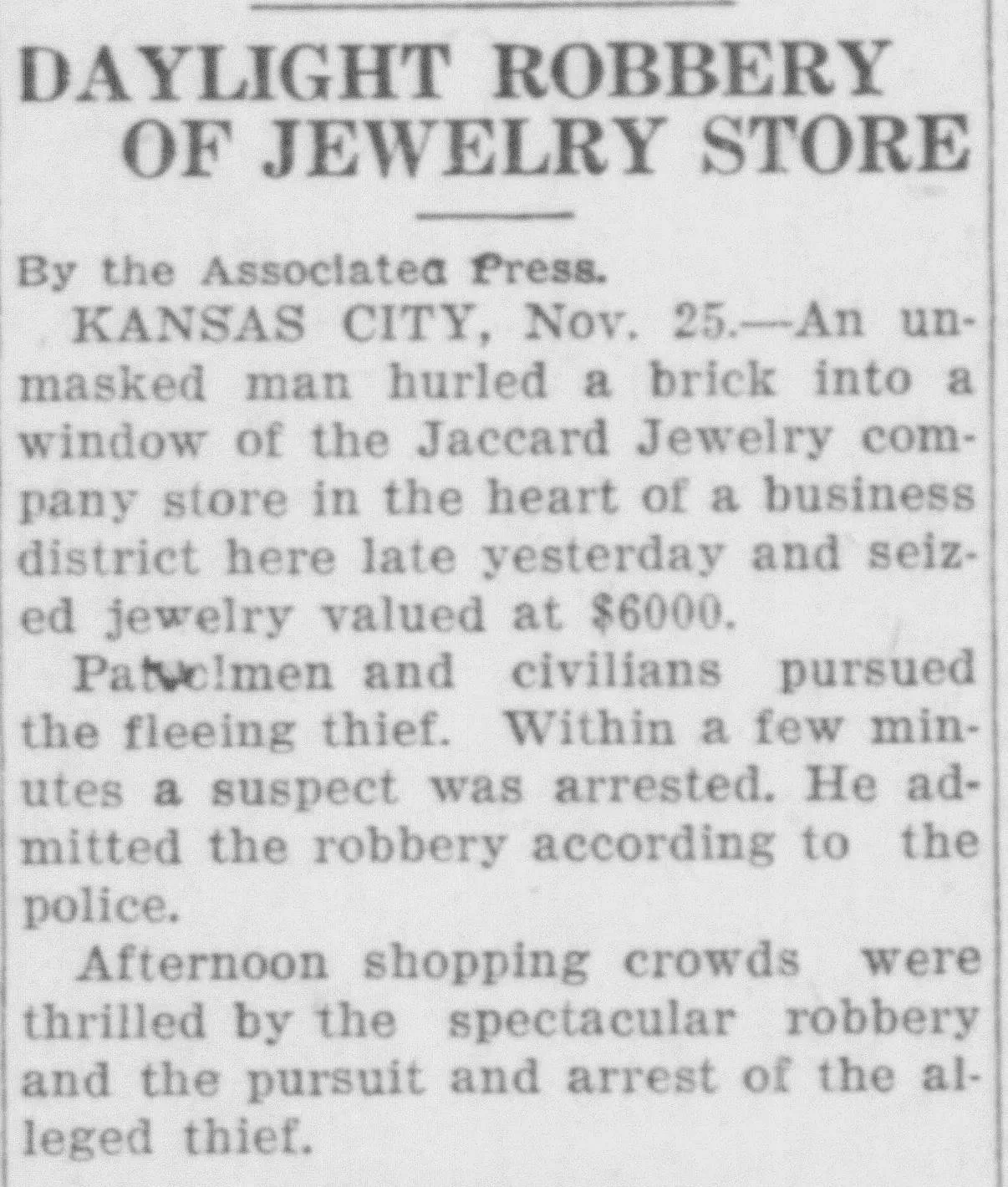
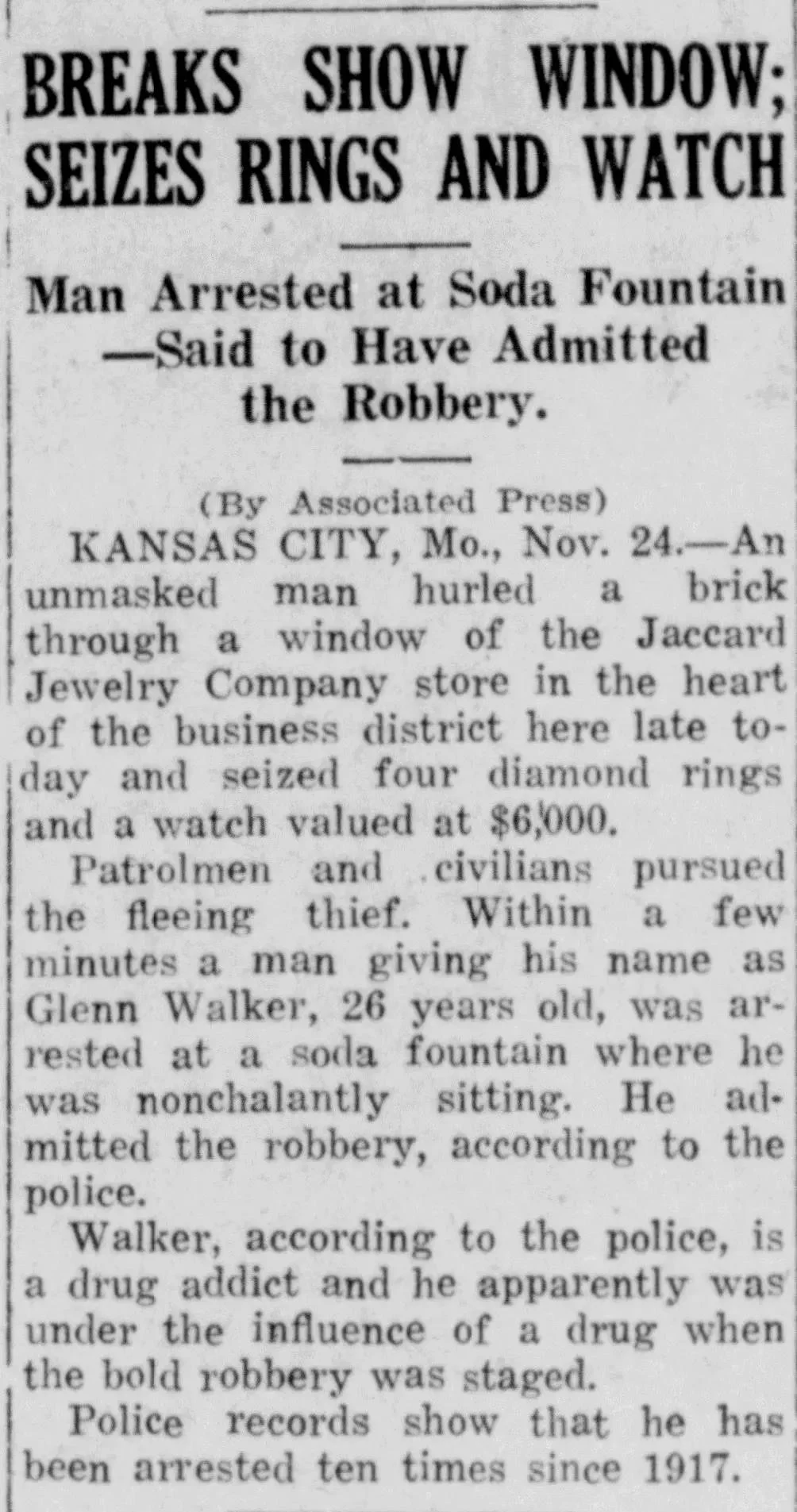
In 1922, several Missouri newspapers reported on a Kansas City jewelry store robbery involving the Jaccard Jewelry Company. The basic story was the same: a man threw a brick through a store window, grabbed diamond rings and a watch valued at $6,000, fled through the business district, and was arrested a short time later at a soda fountain.
But the articles did not all look the same.
One paper reported the story under the headline:
“Man Flees With $6,000 in Gems”
Another version used:
“Daylight Robbery of Jewelry Store”
A third focused on the action itself:
“Breaks Show Window; Seizes Rings and Watch”
That is a huge lesson for researchers. If you search only for one phrase, you may miss the story in another newspaper. But if you search several parts of the story, you increase your chances of finding more coverage.
How the Same Crime Can Look Different Across Newspapers
Here is how the three Missouri clippings compare.
Newspaper Angle | What the Headline Emphasizes | Why It Matters for Research |
|---|---|---|
“Man Flees With $6,000 in Gems” | The value of the stolen jewelry | Good for searching by dollar amount, gems, loot, or robbery |
“Daylight Robbery of Jewelry Store” | The boldness and timing of the crime | Good for searching by crime type and business |
“Breaks Show Window; Seizes Rings and Watch” | The action and stolen items | Good for searching by method, objects, and arrest details |
This is why newspaper research is not just about finding one article. Sometimes the best details appear when you compare several versions of the same event.
One clipping may give you the suspect’s name. Another may name the business. Another may include the arrest location. Another may mention police records, prior arrests, or what property was recovered.
That is how a short crime notice becomes a fuller story.
What the Jewelry Store Robbery Clippings Reveal
The Jaccard Jewelry Company robbery clippings show how much information a crime article can hold.
Detail from the Articles | Research Value |
|---|---|
Kansas City, Missouri | Location for narrowing the search |
Jaccard Jewelry Company | Business name to search in other newspapers and directories |
November 1922 | Date range for follow-up articles |
$6,000 in jewelry | Distinctive search detail |
Diamond rings and a watch | Specific stolen items |
Brick through the window | Searchable action detail |
Glenn Walker, age 26 | Suspect name and age |
Arrested at a soda fountain | Unusual detail that may appear in other reports |
Property partly recovered | Clue for follow-up coverage |
Prior arrests mentioned | Possible path to police or court records |
This is the part of crime research that can pull you in quickly. The article is not just saying a robbery happened. It gives you a scene: the business district, the brick, the broken window, the crowd, the chase, the soda fountain, and the stolen rings under the table.
Those details are what make newspaper archives so valuable. They help you see the event the way readers saw it at the time.
Have a Missouri name, town, business, or crime story you want to test? Try a NewspaperArchive search with the details you already know, then search again using the words that appear in the first clipping. One article often gives you the terms you need to find the next one.
Step 1: Start With What You Know
Before searching NewspaperArchive or any other newspaper collection, write down the details you already have.
Start with:
name of the victim
name of the suspect
city or county
approximate date
type of crime
business name or address
court date, if known
names of witnesses, officers, or family members
any unusual details, such as stolen property or location
Do not worry if you only have one or two facts. A name and a county may be enough. A business name and a year may be enough. Even a phrase like “jewelry store robbery” and “Kansas City” can help you start.
Step 2: Search by Name First
If you know the name of the victim, suspect, or business owner, begin there.
Try:
full name
surname only
initials and surname
title and surname, such as Dr., Mrs., Judge, Sheriff, or Officer
business name
family member names
witness names
In the jewelry store robbery example, you could search:
Glenn Walker
Walker robbery
Jaccard Jewelry
Jaccard robbery
Kansas City gems
jewelry store robbery
If the name is common, add a second word, such as the city, crime, business, or stolen item.
Step 3: Search by Crime Terms
Newspapers used certain words again and again in crime reporting. Searching these terms can help you find articles even when a name is misspelled or hard for OCR to read.
Type of Crime Coverage | Search Terms to Try |
|---|---|
Robbery or theft | robbery, robbed, thief, loot, stolen, recovered |
Shooting or murder | shot, shooting, killed, slain, murder, manslaughter |
Arrest | arrested, held, captured, jailed, warrant |
Court | trial, testimony, verdict, sentenced, judge, jury |
Death investigation | inquest, coroner, suspicious death, fatal |
Property crime | burglary, break-in, window, safe, watch, rings, gems |
Follow-up coverage | indicted, convicted, acquitted, appeal, prison |
For 1920s Missouri newspapers, try both plain and dramatic language. A robbery might be described as “bold,” “spectacular,” “daylight,” or “daring.” A shooting might be described as “fatal,” “tragic,” or “mysterious.”
Step 4: Search by Place
If the name search does not work, search by place.
Crime reports often mention:
city
county
township
neighborhood
street
courthouse
jail
business district
store name
road name
nearby town
This is especially useful in Missouri research because a story may appear in more than one paper. A crime in Kansas City might be reported in a Kansas City paper, but it could also show up in Joplin, Jefferson City, Sedalia, or another Missouri newspaper if the story was dramatic enough or carried by a wire service.
If you are researching a smaller Missouri community, start with the closest local paper. Then check county-seat papers and nearby cities.
Step 5: Search Local Papers and Regional Papers
For Missouri crime research, do not rely on only one newspaper.
Start with the newspaper closest to the event, but then widen your search.
Newspaper Type | What You May Find |
|---|---|
Local paper | Names, addresses, witnesses, community reaction |
County-seat paper | Court coverage, inquests, legal proceedings |
Nearby town paper | Alternate version of the story |
State capital paper | Short reports on notable crimes |
Larger city paper | Broader coverage for dramatic or unusual crimes |
This matters because newspapers often borrowed, shortened, expanded, or reframed stories. One version may be brief. Another may include the missing name, age, address, or court detail you need.
Step 6: Do Not Stop With the First Article
Finding one article is exciting, but it is usually not the end of the story.
A crime may generate several newspaper mentions, including:
first report
arrest notice
stolen property recovery
coroner’s inquest
grand jury action
indictment
preliminary hearing
trial coverage
verdict
sentencing
prison transfer
appeal or later follow-up
For the Jaccard Jewelry Company robbery, the first report gives the dramatic scene. But a researcher would still want to search forward for later coverage. Was Glenn Walker charged? Did the missing ring turn up? Was there a trial? Was he sentenced? Did another paper include a detail that the first article left out?
That is the work of newspaper research. One article opens the door. The follow-up articles help you understand what happened next.
Step 7: Compare the Details
When you find multiple articles about the same crime, compare them carefully.
Create a simple table like this:
Detail | Article 1 | Article 2 | Article 3 |
|---|---|---|---|
Date reported | |||
Newspaper | |||
Headline | |||
Location | |||
Names included | |||
Crime description | |||
Arrest details | |||
Property recovered | |||
Follow-up clues |
This helps you see what changed, what stayed the same, and what new clues appeared in each version.
Historical newspapers were not perfect. They sometimes repeated rumors, used biased language, or printed early information before the full facts were known. Comparing articles helps you separate confirmed details from first reports.
Step 8: Use the Newspaper Article to Find Other Records
A newspaper article can point you to records you may not have known to search.
After you find a crime report, look for:
Record Type | What It May Confirm |
|---|---|
Court records | charges, trial dates, verdicts, sentencing |
Coroner’s records | cause and manner of death, inquest findings |
Jail records | arrest date, confinement, release |
Prison records | sentence, transfer, physical description |
Death certificates | date, place, cause of death |
City directories | addresses, occupations, business locations |
Probate records | family impact after a death |
Census records | household, neighbors, relatives |
Cemetery records | burial location and family connections |
The newspaper does not replace these records. It gives you the clues you need to find them.
Search Strategies When the Name Is Hard to Find
Names in historical newspapers can be difficult. They may be misspelled in the original article, misread by OCR, or printed with initials instead of full names.
If your search fails, try:
surname only
first initial and surname
alternate spellings
city plus crime term
county plus crime term
business name
street name
stolen item
officer’s name
witness name
court term such as “inquest” or “trial”
For the Jaccard robbery, searching only for “Glenn Walker” might work. But you could also search “Jaccard,” “$6,000 gems,” “diamond rings,” “soda fountain,” or “Kansas City robbery.”
The more angles you try, the better your chances.
Why Small-Town Missouri Newspapers Are Worth Searching
Big-city papers covered dramatic crimes, but small-town papers often preserved the stories closest to everyday life.
In Missouri newspapers, you may find:
neighborhood disputes
farm accidents that led to inquests
courthouse updates
jail notices
domestic conflicts
robberies
suspicious deaths
local arrests
trial reports
social fallout after a public scandal
These are the kinds of stories that may never appear in a national database or a modern search result. They lived in local newspapers because local readers knew the people involved.
That is one of the strengths of NewspaperArchive. Its collection includes many local and regional newspaper titles, which can help researchers find the stories that larger papers may have ignored or summarized in only a few lines.
A Note About Sensitive Crime Research
Crime research can uncover painful stories.
Some articles include violence, addiction, domestic conflict, racial bias, public shame, or accusations that were never proven in court. Newspapers also used language that reflected the assumptions and prejudices of their time.
As you research, try to separate:
what the newspaper reported
what police claimed
what witnesses said
what the court later decided
what you can verify in other records
If you plan to write or share the story, remember that historical crime stories may still connect to living families. The goal is not to sensationalize the past. The goal is to understand it carefully.
How to Search NewspaperArchive for 1920s Missouri Crime Reports
When using NewspaperArchive, begin with a simple search.
Try this process:
Search the person’s full name.
Add Missouri as the location.
Narrow by year or date range.
Try the city or county.
Add a crime term.
Search the business name, street, or unusual detail.
Open promising results and read around the highlighted terms.
Search nearby dates for follow-up articles.
Widen to other Missouri newspapers.
Save or clip every article connected to the case.
If your first search does not work, simplify it. Try a surname, a city, or a distinctive word from the story.
A search for one exact name may fail. A search for a business name, stolen item, or court term may find the article.
Common Mistakes to Avoid
Mistake | What to Do Instead |
|---|---|
Searching only one name | Search names, places, businesses, and crime terms |
Stopping after one clipping | Search nearby dates and other papers |
Ignoring regional papers | Check nearby cities and state papers |
Trusting one article completely | Compare several versions when possible |
Using only modern terms | Try words newspapers used at the time |
Forgetting OCR issues | Use short searches, surnames, and place names |
Skipping follow-up records | Use articles to locate court, jail, and coroner records |
Frequently Asked Questions
Can I find 1920s Missouri crime reports online?
Yes, many 1920s Missouri crime reports can be found in digitized newspaper archives. Search by name, city, county, crime term, business name, and date range. If the story was reported in a local or regional paper, it may not appear in a regular Google search, but it may still be searchable in a newspaper archive.
What Missouri newspapers should I search first?
Start with the newspaper closest to where the crime happened. Then check county-seat papers, nearby city papers, and larger Missouri newspapers. For a dramatic or unusual crime, the story may appear in several newspapers across the state.
Why does the same crime have different headlines in different newspapers?
Newspapers often rewrote or shortened stories for their own readers. One paper might emphasize the value of stolen property. Another might focus on the arrest. Another might highlight the location or the victim. That is why searching multiple terms is so important.
What search terms work best for crime reports?
Useful search terms include “robbery,” “shot,” “killed,” “slain,” “arrested,” “inquest,” “coroner,” “indicted,” “trial,” “verdict,” “sentenced,” “jail,” and “prison.” Also search names, locations, businesses, roads, and unusual details.
What should I do after I find a crime article?
Search for follow-up articles. Then use the names, dates, locations, and legal details in the article to look for court records, coroner’s records, jail registers, prison records, death certificates, city directories, and cemetery records.
Start Your Missouri Crime Search
If you have a Missouri crime story, family mystery, or old court case you want to investigate, start with the simplest details you know: a name, a place, and a date.
Then try a search in NewspaperArchive. Search the name first, then the location, then words like “robbery,” “shot,” “inquest,” “arrested,” “trial,” or “verdict.” If one article appears, keep going. The next clipping may tell you what happened after the headline.
Conclusion: One Missouri Crime Story Can Have More Than One Trail
Finding crime reports in 1920s Missouri newspapers is not always about one perfect search. It is about trying different names, places, dates, and details until the story begins to surface.
The Jaccard Jewelry Company robbery is a good reminder of why this matters. The same crime appeared in different newspapers under different headlines, with different details emphasized. A researcher who found only one clipping would have part of the story. A researcher who compared several versions would have much more.
That is the real value of newspaper archives. They let you move beyond one headline and follow the trail through the newspapers that preserved the story as it happened.