Quiet World 6 Billion People Challenge Soundscape
Environmental writer Brown and natural sound recorder Gordon Hempton frame the 20th century shock of rapid population growth. They contrast Worldwatch Institute findings with Hempton’s field quests for pristine silence, showing how noise pollution and resource strain shape life quality worldwide.
MENTIONED IN THIS ARTICLE
Eater Brown
Global Watcha Dow
Msng
Ranlosest
Gordon Hempton
Phinet
Noig
Esplusiu
Boman
Earth
Brown
Worldwatch Institute
Enronmental
Washington, D.C
United States
Hempton
Wyoming
Southwest
Washington State
Iwto
Vlgbe
United Nations
U.S
Population Growth and Grain Use Debate Sparks Space-Need Warning
Brown warns that global grain use could surge past 2 billion tons yearly, impacting food for trillions of potential eaters depending on direct consumption versus livestock feed. He notes feeding 10 billion Indians or 5 billion Italians with such grain, or many Americans, would demand extra planetary resources.
MENTIONED IN THIS ARTICLE
Philadelphia
World Health Organization
Brown
Jerry Taylor
Cato Institute
Washington
Taylor
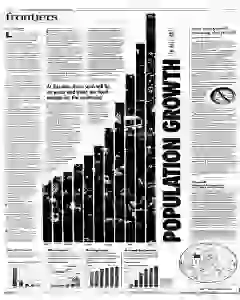
Population boom since 1950 dwarfs four million years prior
The statement notes rapid growth after 1950, surpassing the scale of population increase in the preceding four million years. It contrasts long historical population trends with accelerated modern expansion, highlighting a dramatic shift in demographic momentum.
Population Pulse: Asia Houses Most of World
The statement notes that Moore's region contains more than half of humanity, with China and India together making up about 40 percent of the global population. It emphasizes Asia as the primary demographic region and highlights the two largest countries.
MENTIONED IN THIS ARTICLE
Moore
Asia
China
India
Earth
Milky Way history and Goulds Belt notes in sky map
A sky watch discusses the Milky Way’s name origins across cultures. It explains Gould’s Belt and provides a star map usage guide marked for 11 30 p m and compiled by Joe Rao at the Hayden Planetarium.
MENTIONED IN THIS ARTICLE
Sky
Australia
Veen
Alwin
Gould
Benjamin Apthorp Gould
Joe Rao
Hayden Planetarium
Are compasses missing the point in a GPS world
Britain’s geomagnetism team warns magnetic field shifts complicate compass use while GPS grows. The Greenwich service notes fields drift and occasionally flip, but compasses still guide direction, warning airports and hikers to keep traditional methods as satellites remain fallible.
MENTIONED IN THIS ARTICLE
Britain
Edinburgh
Europe
South Africa
Vic Trekker
Toby Young
Greenwich
David Ker
Earth
Kerridge
U.S
Also Mentioned on This Page
Frontiers
David Foster
Ayko Gted Press
U.N
Everglades
Yan
Eesope
Tute
NY 7
Mes News Senace
Kate O'Connor

 This is just the beginning! Our collection holds over 300 years of history, including rare newspapers, obituaries, marriage records, birth records, and so much more—most of which you won’t find anywhere else!