Origins of the American flag and its evolving symbols
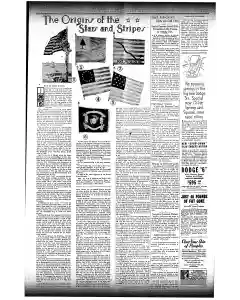
A historical account traces flag origins from St. George’s cross and Cabot’s voyage to Jamestown and Plymouth, through the Union Jack and Dutch banners, to the Stars and Stripes. It notes the gradual evolution of symbolism and the first appearance of stars in 1775 aboard the Lee, with thirteen stars on a blue canton.
MENTIONED IN THIS ARTICLE
Continental Congress
United States
North American
St. George's Cross
England
Giovanni Cabot
John Cabot
North America
John Smith
Jamestown
Plymouth
Mass
Scotland
James
United Kingdoms
St. Andrew
Jacques
Dutch West India Co
Netherlands
Rotterdam
English East India Company
America
New World
Washington
Philadelphia
Cambridge
Light Horse
Newark
N. J
Lee
Manley
Massachusetts
Hopkins
Flags of the Revolution and the Stars and Stripes
A detailed overview traces the development of American flags from the pine tree and rattlesnake banners to the grand union and the Stars and Stripes. It notes key moments including John Paul Jones hoisting the early ensign, the 1777 flag resolution, and later standardizations by the navy and Taft in 1912.
MENTIONED IN THIS ARTICLE
Henry Mosler
New York
Yorktown
Yale University Press
Vermont
Kentucky
United States Marines
John Paul Jones
Philadelphia
Washington
Cambridge
Congress
Grand Union
Marine Committee
The
Newburyport
Marion
Guides
Culpepper
Georgia Rangers
Journal of Congress
Navy
Ranger
Jones
Europe
Samuel Chester Reid
Congressional Committee
John Rogers
Navy Commissioners
Navy Department
Army
Taft
Dairymen Learn from Denmark on Herd Improvement
Ohio State University dairy professor notes Denmark’s Kontrol societies and 80 modern herd improvement associations test milk, weigh production, and record feed to cull poor cows. Denmark’s system boosted per cow output to 8,000 pounds milk and 300 pounds butterfat, while Ohio averages 6,000 pounds. Continuous yearly testing aims to improve future cattle quality.
MENTIONED IN THIS ARTICLE
Bsallabury
Ohio State University
WNU
Ohio
Denmark
Kontrol Societies of
Kontrol Society
Private Try Plants Beach Grass to Halt New York Sand
In Franklin county near Brushton, nearly 5,000 clumps of beach grass were planted on a farm to reclaim 10,000 acres of drifting sand. The project aims to stabilize shifting ground that harms crops and nearby roads, following earlier failed tree plantings and proven success in France and at Jones Beach. The grass spreads via stolons to form a thick mat, enabling trees to be planted within two to three years.
MENTIONED IN THIS ARTICLE
New York State
Brushton
Franklin County
Adirondacks
France
Long Island Park Commission
Jones Beach
Erosion Wipes Out Large Piedmont Farmland
Five million of fifty million acres in Piedmont country from New York to Alabama are essentially ruined by soil erosion, with another 56 million damaged and 13 million stripped of surface soil. Despite cultivation, many families live on meager incomes, around $300 yearly in 1924. The Department of Agriculture urges terraces, tree planting, strip cropping, brush, and dams to curb erosion.
MENTIONED IN THIS ARTICLE
Piedmont
New York City
Alabama
Appalachian Mountains
United States Department of Agriculture
Control of stomach worms in pasture rotation
Rotating pastures to avoid lambs grazing on previously used land is a top control method. When permanent pastures are needed, drenching with a bluestone or copper sulfate solution offers effective, inexpensive control and is easy to administer.
Agricultural Squibs and Regional Crop Notes
The report notes Town has the largest share of arable land. Cherry trees respond better to nitrogen than apple or plum trees. Ozark Arkansas canners expect tomatoes on 45 000 acres. Tennessee hay corn and tobacco production fell 10 to 20 percent in 1932 from the prior year. North Dakota stands alone with milk per capita at 90 gallons or more in every county. Dairy products lead gross farm income, overtaking cattle hogs and other items.
MENTIONED IN THIS ARTICLE
Ozark Hills
Arkansas
Tennessee
North Dakota
Prominent Motor Firm Advances to Large Scale Scrap
A major motor company conceived dismantling cars on a large scale and remelting the steel. After success, it expanded operations about a year ago with a 1000 ton hydraulic press to bale scrap and a 400 ton furnace to remelt and compact large bales. One car can be compressed into a bale 80 inches long, claimed the record.
MENTIONED IN THIS ARTICLE
Motor Company
Kraschen Salts Claim Big Weight Loss and Health Boost
Seattle reader Mrs Walter reports dropping from 156 to 110 pounds after using Kraschen Salts, taking half a teaspoon in hot water each morning. Ad touts safety for fat loss, fewer digestive woes, and improved energy with a money back guarantee.
MENTIONED IN THIS ARTICLE
Pines
Ale Walter
Seattle
Washington
Also Mentioned on This Page
Elmo Scott Watson
United States Marine Corps
Federal Building
A Century of Progress
Chicago
Hack Miller
Dodge
Detroit
Cuticura
Malden

 This is just the beginning! Our collection holds over 300 years of history, including rare newspapers, obituaries, marriage records, birth records, and so much more—most of which you won’t find anywhere else!