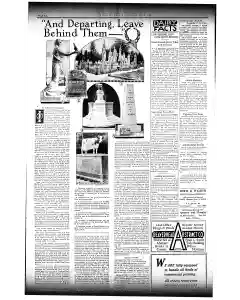
Memorials Earn Fame for Unlikely Things and Animals
A survey of unusual monuments from France to Alaska honors Camembert cheese, famous dairy cows, carrier pigeons, dogs of poets, and even a skull for Soapy Smith. The piece catalogs memorials in Vimoutiers, Mayfield, Berlin, Salt Lake City, and Douglas, recounting motives and local pride behind these lasting tributes.
MENTIONED IN THIS ARTICLE
Mayfield
Vimoutiers
France
Beau Moncel
Marcel
New York
Joseph Karim
San Jose
Calif
Louis Pellier
America
Pellier
California
Bordeaux
West
Fair Play
Cole
Alaska
Ladies of the
Golden North
Alaska-Yukon
White Pass
Klondike
George A. Parks
George Black
Yukon Territory
Inspiration Point
Dead Horse Gulch
Lexington
Winchester
Pike
Hamburg
Camembert District
Normandy
Alaskan
Smith
Arctic Brotherhood
Douglas
Wyo
New York Dairymen Cut Losses With Herd Test Programs
Despite low milk prices New York state dairymen can still secure prewar prices for high testing milk. Some farmers use dairy record clubs or mail order testing to identify low testing cows and reduce butterfat notches, paying per cow rather than per herd. Samples are collected at home, mailed to a central lab, with records kept locally. information is available from the Farm Bureau or the State College of Agriculture at Ithaca.
MENTIONED IN THIS ARTICLE
C. G
BRAT
New York
Satate College of Agriculture
WIY Service
New York State
Dairy Record Club
Farm Bureau
Department of Animal Husbandry
State College of Agriculture
Ithaca
Good Cows Prove Their Value in Dairy Economy
A Prairie Marmet column notes top Holstein Friesian cows boost dairy profits. Modesto owned heifer yields 811 pounds butterfat, an Adohr cow 609 pounds, Monrovia cow 584.1 pounds, and a Los Angeles county cow 474.1 pounds. These four averaged over 600 pounds per lactation, equaling about fourteen ordinary cows. The piece argues high producers cost less than three times ordinary cows via efficiency gains.
MENTIONED IN THIS ARTICLE
Holstein Fresian Association of America
If. Freeman
Modesto
Feeding Experiments With Pea Vine Silage For Fattening Stock
The Wisconsin Agriculturist reports feeding tests using pea vine silage in fattening rations. Three steer lots, ten each, received basal shelled corn and cottonseed meal with either alfalfa hay, alfalfa plus corn silage, or alfalfa plus pea silage. The corn silage group grew most, pea silage slightly less, while hogs moved in after December with adjusted pork credits of 3.25 per hundred.
MENTIONED IN THIS ARTICLE
Wisconsin Agriculturist
Soybean products span flour to oils in new collection
A department has assembled a 400 item soybean collection from the Orient and America, showing extensive US use from flour and bean products to meal and oil derivatives. The four groups include flour with bread and pasta items, bean products like soy milk and substitutes, meal for animal feed and fertilizer, and oil derivatives such as soaps, paints, and lecithin.
MENTIONED IN THIS ARTICLE
America
Alfalfa Seed Production Slips in 1951 Crop
Alfalfa seed production in 1951 reached 61,200,000 pounds, about 26 percent below 1930 levels. The 1951 crop was the largest since 1926 but still 15 percent under 190. Northern districts suffered the steepest declines due to drought. Spring and fall sales lagged 1930, exports fell sharply, and imports were unusually small with no seed entering the U.S. in the second half of 1981. Stocks remain ample to meet normal needs.
MENTIONED IN THIS ARTICLE
United States
Fighting Corn Borer Control Through Low Cutting
Sections with European corn borer should cut corn as low as possible to expose borers in the stalk stubs. Low cutting moves borers out of the field and into the silo, aiding wintering avoidance. After cutting, plow under stubs to kill remaining borers or break up remnants and burn them.
Agricultural squibs and crop notes from the era
The text discusses weed control to prevent seed spread, snow’s use in banking houses, manure drawbacks to siding, copper sulfate for sheep worming, and county agents explaining treatment. It notes improved grain feed imports abroad and reports OSU tests where Golden Bantam hybrids outyield standard Golden Bantam by up to 800 percent.
Also Mentioned on This Page
Elmo Scott Watson
Llere
Mankind Legis Pleterije Prospect
Carnation Milk, Farms
Brussels
Belgium
Duke of Brabant
George W. Pike
Berlin
Germany
Segis Pietertje
Seattle
Wash
Newstead Abbey
Nottingham
England
Lord Byron
Boatswain
Salt Lake City
Utah
Salt Lake Valley
Eternal Rest
Wayward West
George
Camenbert
Alfalfa Statistics
Ohio State University
Columbus
Lewis & Walker
P. O
North
Wyoming
Butte, Mont
Richard McCarthy
East Granite
Butte, Montana
Land Office
Estract CO
Pearl I. Smith
Dillon
Montana

 This is just the beginning! Our collection holds over 300 years of history, including rare newspapers, obituaries, marriage records, birth records, and so much more—most of which you won’t find anywhere else!