Where Did the Spanish Flu Really Come From? And What Did Local Newspapers Know?
Why was the 1918 influenza pandemic called the Spanish flu? Learn what old newspapers reveal about its uncertain origins, local outbreaks, public-health orders, and family history.
The 1918 influenza pandemic became known as the Spanish flu because Spain’s neutral press reported the disease more openly during World War I, not because the virus was proven to have originated there. Its exact origin remains uncertain, although early outbreaks in Kansas are central to one widely discussed theory. Local newspapers documented how influenza affected individual communities through illness reports, school and church closures, public-health advice, death notices, and state statistics. These reports can help family historians understand what their ancestors experienced during the pandemic, even when an ancestor is not named directly.
If your family was in the United States in 1918, their local newspaper may have recorded the influenza crisis in unusually personal detail. Newspapers reported who was sick, which schools and churches were closed, what health officials advised, and how entire communities were being affected.
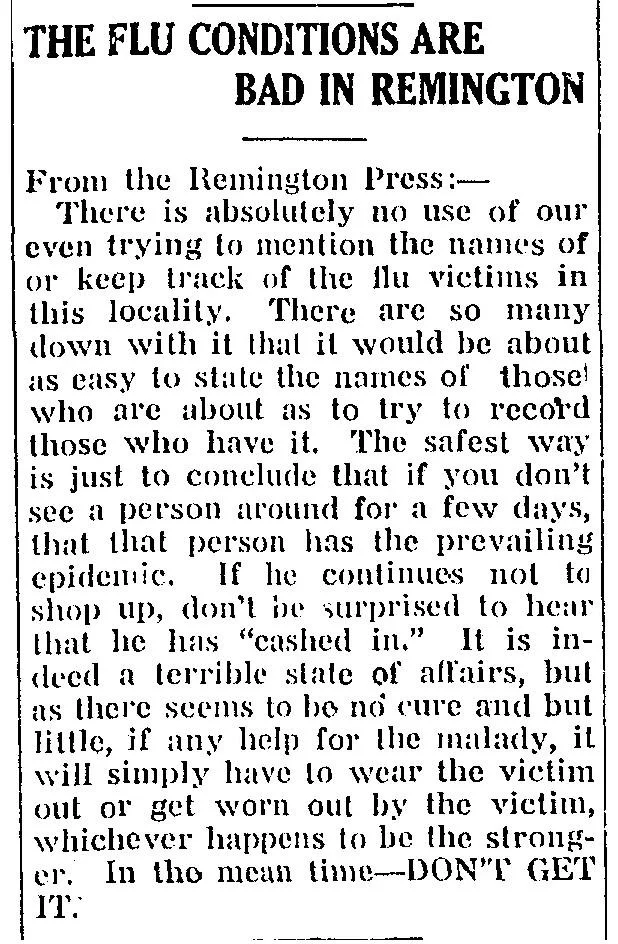
One striking example appeared in the Monticello White County Democrat in Indiana on January 10, 1918, months before the deadly fall wave most people associate with the pandemic.
Reprinting an account from the Remington Press, the newspaper described a serious local influenza outbreak. There were so many sick people in Remington that the editor wrote it would have been nearly as easy to list those who were well as to record everyone who had the flu.
“DON’T GET IT,” the report concluded.
The newspaper cannot tell us whether the illness in Remington was caused by the exact strain that later spread around the world. What it does show is that a severe influenza outbreak was already disrupting an Indiana community remarkably early in 1918.
Quick Answer
Despite its name, the Spanish flu almost certainly did not begin in Spain. The precise origin of the 1918 influenza pandemic remains uncertain.
One widely discussed theory points to an early severe outbreak in Haskell County, Kansas, followed by a large, well-documented outbreak at Camp Funston in March 1918. Other researchers have proposed possible origins in Europe or China.
Spain became associated with the pandemic because it was neutral during World War I, and its newspapers reported the illness more openly than the censored or self-censoring press in many combatant countries. Reports that King Alfonso XIII had become ill drew international attention and helped attach Spain’s name to the disease.
As the crisis grew, local American newspapers documented influenza deaths, school closures, public-health orders, family illnesses, and practical advice. Those reports now offer family historians a detailed look at what individual communities experienced.
The Name Was Always Wrong
The influenza pandemic of 1918 and 1919 became known as the Spanish flu, not because researchers proved that it began in Spain, but because Spain reported it openly.
World War I was still being fought in 1918. The United States, Britain, France, Germany, and other combatant nations had strong reasons to protect military morale. Wartime censorship, patriotic pressure, and concern about alarming the public limited how openly newspapers in many countries discussed the growing health crisis.
Spain was neutral. Its press faced fewer wartime restrictions and reported widely on the outbreak that swept through the country in the spring of 1918. That coverage included news that King Alfonso XIII had become ill.
Readers in other countries saw extensive reporting from Spain and incorrectly connected the disease with the place where it was being discussed most openly.
The illness acquired other geographic nicknames as well. It was sometimes called the German flu in Brazil and the Brazilian flu in Senegal. In Spain, one popular nickname was the “Naples Soldier,” taken from a song in a successful musical revue.
None of those names reliably identified where the pandemic began.
Where It Might Have Started
The exact birthplace of the 1918 influenza pandemic remains debated.
One influential theory points to Haskell County, Kansas, where a physician reported an unusually severe influenza outbreak in January and February 1918. In March, a large and well-documented outbreak occurred at Camp Funston, part of the Fort Riley military complex in Kansas.
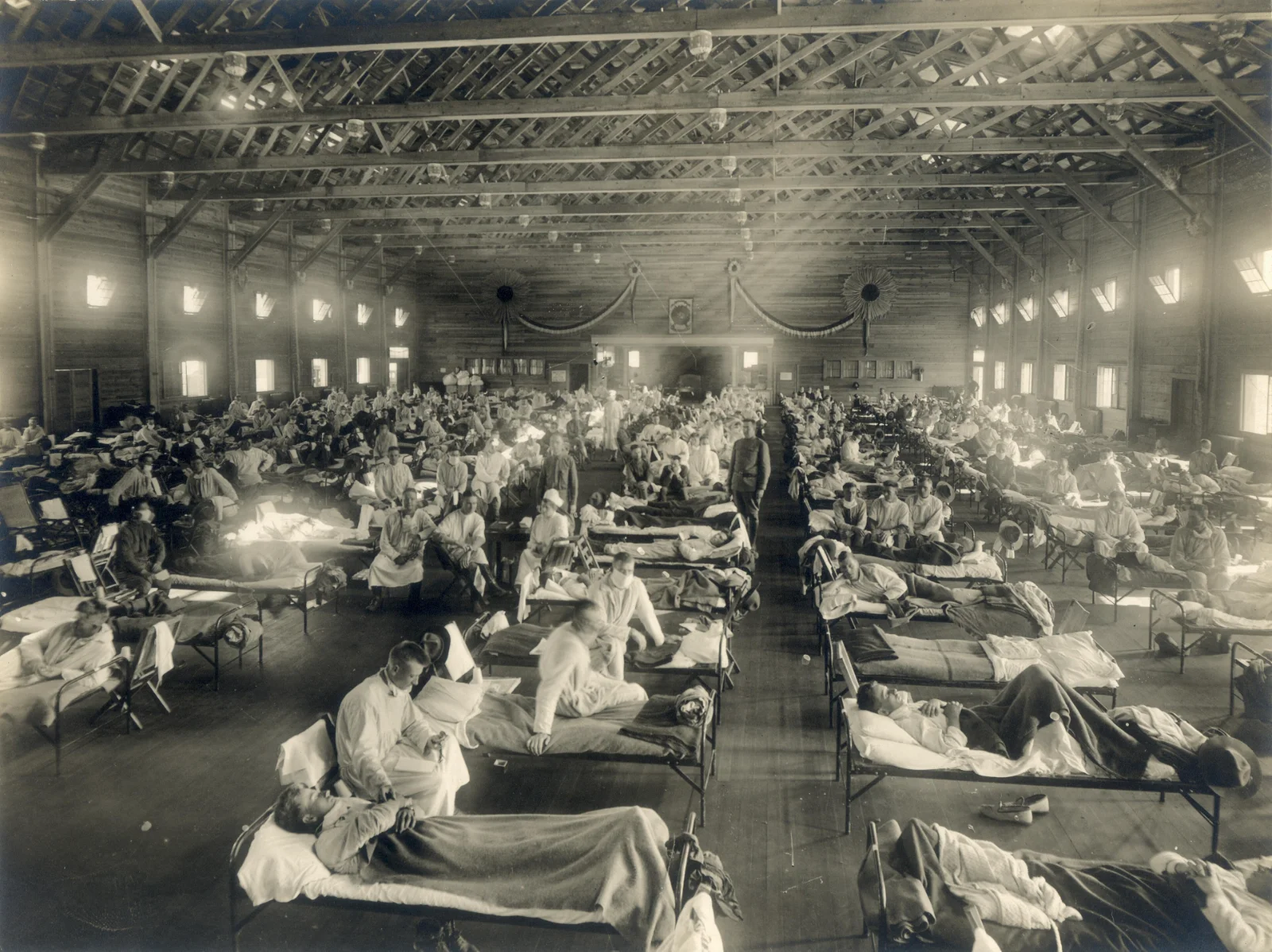
Crowded military camps provided ideal conditions for respiratory illness to spread. Once influenza appeared in those camps, the movement of large numbers of soldiers helped carry the disease within the United States and overseas.
Some historians and scientists have proposed other possible starting points, including France, Britain, and China. The available evidence does not allow researchers to identify one origin with complete certainty.
What historians generally agree on is that there is no strong evidence that Spain was the source. The name reflected wartime politics and newspaper coverage more than geography.
What Local Papers Were Reporting During the Crisis
For family researchers, the value of these newspapers is not limited to the debate over where the pandemic began.
Local papers often recorded how influenza affected individual towns, neighborhoods, schools, churches, workplaces, and families.
Local editors were affected by wartime pressure and official messaging, just as larger newspapers were. Some papers repeated reassuring statements or medical advice that later proved questionable. Others published candid descriptions of the illness unfolding among their own readers and neighbors.
The Remington report is a good example. The editor was no longer able to keep track of everyone who was sick. That short article captures the feeling of a community overwhelmed by illness in a way that statewide totals cannot.
The Influenza Ban Returned to Kalamazoo
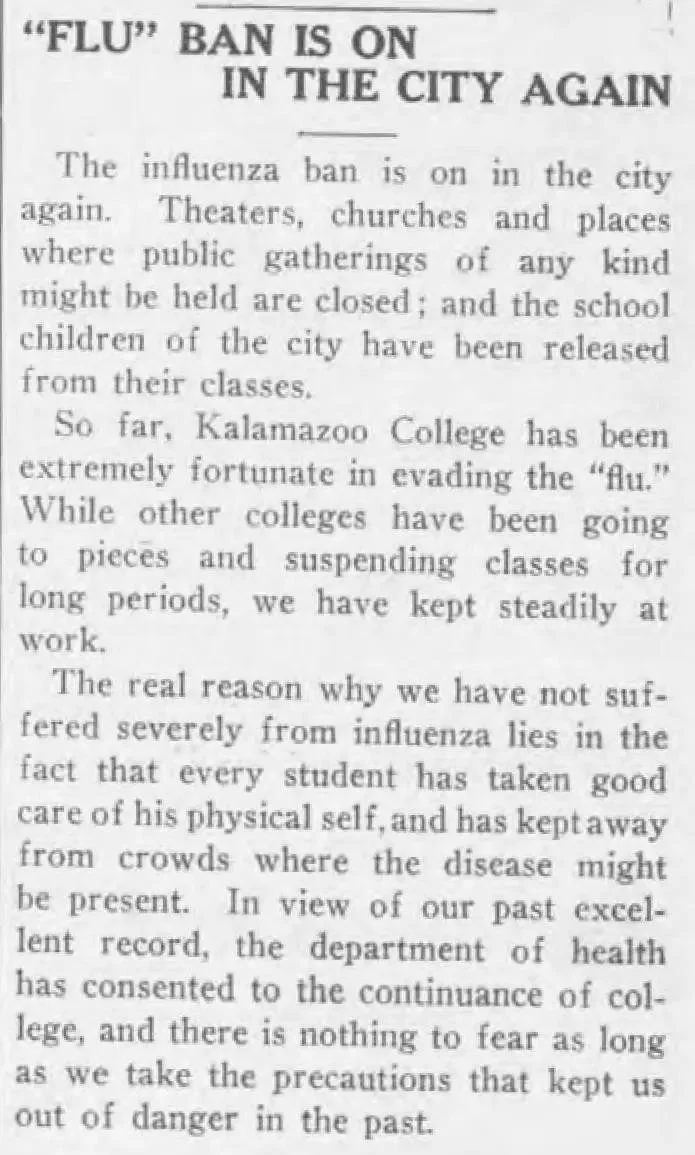
On December 12, 1918, the Kalamazoo College Index in Michigan reported that the influenza ban was back in the city.
Theaters, churches, and other places where public gatherings might be held were closed. Schoolchildren had been released from their classes.
The word “again” is important. It shows that officials were reinstating restrictions after an earlier period of closures and disruption.
The article also reported that Kalamazoo College had been allowed to continue operating because it had avoided severe influenza among its students. College leaders credited students with taking care of themselves and staying away from crowds where the disease might be present.
The clipping offers a snapshot of the difficult choices communities faced. City gathering places were closed, but the college remained open under an agreement with the health department.
For more about how communities responded with mask rules, public-health proclamations, closures, and other measures, see How the Spanish Flu Ended: What Old Newspapers Reveal About the Fight Against It.
Newspapers Shared Public Health Advise
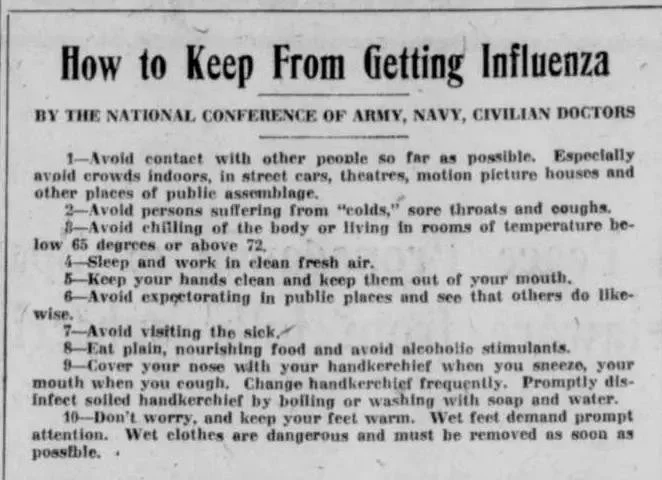
On October 17, 1918, the Wilmington Evening Journal published a ten-point list titled “How to Keep From Getting Influenza.”
The advice was attributed to the National Conference of Army, Navy, and Civilian Doctors.
Readers were told to avoid crowds and people suffering from colds, sore throats, and coughs. The list also advised people to keep their hands clean, sleep and work in fresh air, cover the nose and mouth when sneezing or coughing, eat nourishing food, avoid alcohol, and keep their feet warm.
Some of the advice sounds familiar today. Other parts reflect the medical understanding and popular health beliefs of the period.
The clipping also shows that newspapers were an important channel for public-health information. Army, Navy, and civilian doctors were using the press to circulate detailed guidance at the same time that other leaders and officials sometimes continued to offer overly reassuring messages.
Even Famous Names Appeared in Flu Reports
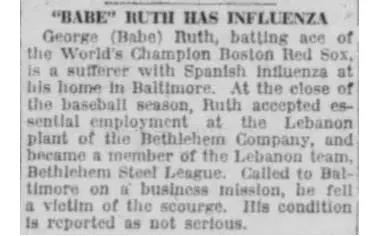
The same October 17 issue of the Wilmington Evening Journal carried a short article under the headline “‘Babe’ Ruth Has Influenza.”
The newspaper reported that George “Babe” Ruth, the batting star of the World Champion Boston Red Sox, was suffering from Spanish influenza at his home in Baltimore.
After the baseball season ended, Ruth had accepted what the newspaper described as “essential employment” at Bethlehem Steel’s Lebanon plant. He also became a member of the Lebanon team in the Bethlehem Steel League.
According to the article, Ruth had been called to Baltimore on business when he became ill. His condition was reported as not serious.
The item appeared alongside other influenza coverage from the same issue.
It is a useful reminder that local newspapers recorded illnesses involving both famous people and ordinary residents. The same pages that mentioned a baseball star might also include a sick child, a factory worker, a farmer, a teacher, or an entire family recovering at home.
If your ancestor lived through the fall of 1918, their newspaper may have mentioned them, a relative, their workplace, or the conditions affecting their community.
The Numbers Behind the Names
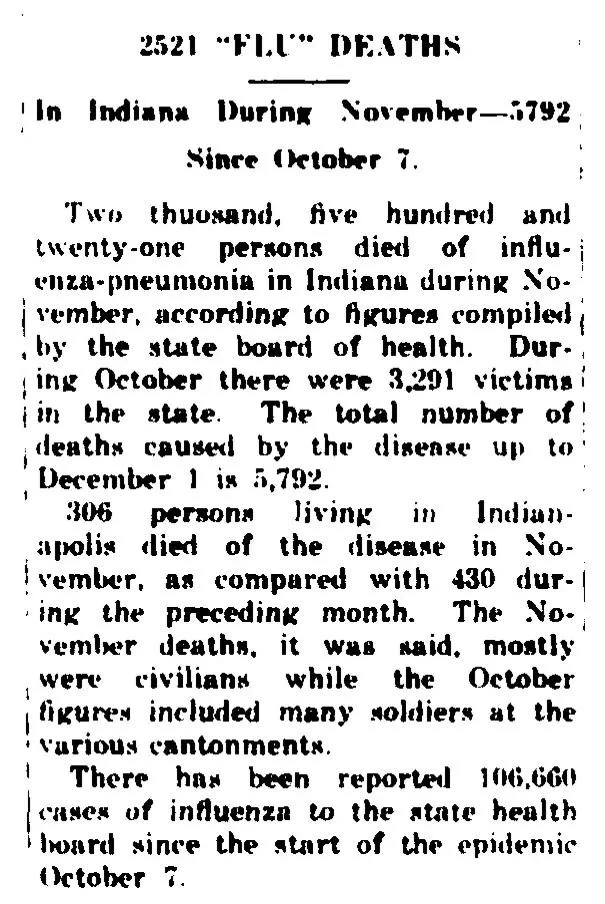
On December 13, 1918, the Lafayette Tippecanoe County Democrat reported figures compiled by the Indiana State Board of Health.
According to the report, 2,521 people died of influenza-pneumonia in Indiana during November. The reported death total through December 1 had reached 5,792.
The state health board had also received reports of 106,660 influenza cases since October 7.
The article noted that Indiana had recorded 3,291 deaths during October. It explained that the October total included many soldiers at military cantonments, while the November deaths were mostly civilians.
These figures were estimates reported at the time, not necessarily the final historical totals for the pandemic. Recordkeeping was incomplete, medical terminology varied, and not every case was reported.
Still, the numbers show the scale of the crisis.
State totals tell us how many people were affected, but they rarely provide the names, relationships, and personal details family researchers need. Local newspapers can help fill that gap.
Some victims can be found in death notices, obituaries, funeral reports, church announcements, community columns, and updates about families affected by influenza.
That is the genealogy record the pandemic created without anyone intending to create it.
How to Search for Your Ancestor's Experience
If your family lived in the United States during the pandemic, begin with a name and a place.
Search by Name and Location
Look for your ancestor’s full name along with their town, county, or state in newspapers from 1918 and 1919.
Flu-era papers sometimes mentioned people who were sick, recovering, visiting an ill relative, caring for family members, or returning to work after an illness.
Search for Influenza Terms
Do not search only for your ancestor’s name. Try terms such as:
influenza
flu
epidemic
pneumonia
quarantine
health board
school closed
church closed
ban on gatherings
Combine those terms with the name of your ancestor’s town or county.
Look for Statewide Health Reports
Newspapers sometimes published figures from state or local health boards. These reports may show how severely a county or city was affected, even when they do not name individual residents.
Read Community Columns
Small-town social columns can be especially helpful. A short note might say that a family was ill, a relative had arrived to help, someone was recovering, or a funeral had been held.
These notices may not use the word influenza, so it is worth reading the surrounding column rather than relying only on keyword results.
Do Not Stop With 1918
The pandemic came in multiple waves. Illness, deaths, closures, and health notices continued into 1919, and some communities experienced renewed outbreaks after restrictions had been lifted.
Widen your date range when necessary.
Check Nearby Newspapers
Rural residents may have been covered by a county-seat newspaper or a weekly paper from a neighboring town.
If your ancestor’s community did not have its own newspaper, search the closest towns and county papers.
NewspaperArchive includes many small-town and rural newspapers from this period. These papers may contain death notices, family updates, closure announcements, and community reports that are difficult to find in broader histories of the pandemic.
Frequently Asked Questions
Did the Spanish Flu Really Start in Spain?
There is no strong evidence that it did. The exact origin remains uncertain.
Spain became associated with the disease because its newspapers reported the outbreak more openly than the press in many countries fighting in World War I.
Why Was It Called the Spanish Flu?
The name came from visibility, not proven geography.
Spanish newspapers reported the illness widely, including the sickness of King Alfonso XIII. Because wartime restrictions limited reporting elsewhere, many readers incorrectly assumed the outbreak had begun in Spain.
Did the Pandemic Begin in Kansas?
Kansas is one important theory, but it is not a settled fact.
An early severe outbreak was reported in Haskell County, Kansas. A large, well-documented outbreak followed at Camp Funston in March 1918. Researchers have also proposed possible origins in Europe and China.
Can Newspapers Document My Ancestor’s Experience?
They may.
Local newspapers from 1918 and 1919 reported illnesses, deaths, funeral services, quarantines, school and church closures, health orders, and family updates.
Even when an ancestor is not named directly, the newspaper can help you understand what was happening in their town.
What Should I Do if My Ancestor Does Not Appear in the Search Results?
Search for relatives, neighbors, churches, schools, employers, and local health reports.
You can also search for influenza terms combined with the town or county name. Once you find a relevant issue, read the surrounding pages and community columns carefully.
Why Are Small-Town Newspapers Especially Useful?
Major city newspapers often documented the pandemic across large populations, hospitals, and institutions.
Small-town papers were more likely to include brief personal notices about local residents, families, schools, churches, and businesses. That community-level reporting can be especially valuable for family history.
What the Local Papers Got Right
The influenza pandemic was a global catastrophe, but every death, closure, and quarantine happened in a particular community.
In Remington, Indiana, the number of sick residents had become almost impossible for the editor to track. In Kalamazoo, gathering places closed again as officials responded to renewed concerns. Across Indiana, a state health report placed the influenza-pneumonia death total at 5,792 through December 1, 1918.
The public response was uneven. Some officials and newspapers minimized the danger. Medical authorities and local papers also published warnings, closure notices, statistics, and practical advice.
Week after week, newspapers recorded names, illnesses, public-health rules, community disruptions, and accounts of loss.
Those newspapers are still searchable.
If your family was there, part of their experience may be waiting in the pages.