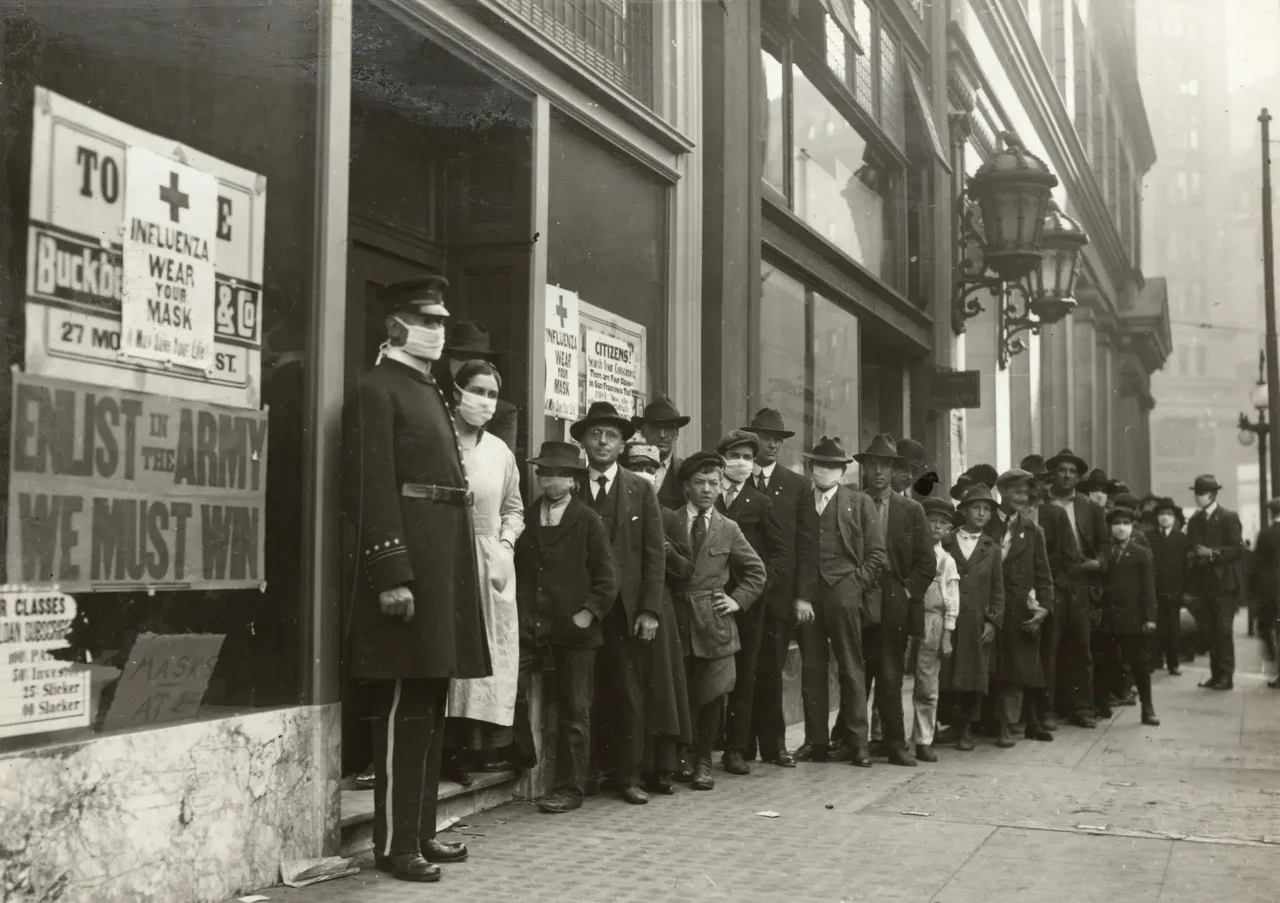
How Communities Fought the 1918 Flu: What Old Newspapers Reveal
See how communities fought the 1918 flu through closures, masks, emergency hospitals, and public-health orders, and learn what newspapers can reveal about your family.
Communities responded to the 1918 influenza pandemic with public gathering bans, mask instructions, ventilation requirements, emergency hospitals, hygiene advice, and local relief efforts. No single measure or cure ended the pandemic, and the effectiveness of these responses varied. Local newspapers documented both the public-health response and the individual people affected, making them valuable sources for family historians researching ancestors who lived through the crisis.
The fall of 1918 was unlike anything most Americans had experienced.
Schools closed. Churches suspended services. Public gatherings were prohibited. Nurses were in short supply, and local newspapers carried death notices for families across entire communities.
In Gettysburg, Pennsylvania, the Gettysburg Compiler devoted a long column in its November 16, 1918, issue to the people who had died during a single week. Several of those deaths were directly attributed to influenza.
Among them were Hazel M. Sanders Spangler, a young wife and mother who died after several weeks of illness; Annie Lentz Nelson, who died at age 24; Margaret Topper Dick, whose family had already lost two other members to influenza that month; Lorena Trone, who died at age 17; Clayton Edward Gitt, who died at age 37; and 9-year-old Jacob Blair Fissel.
Other people in the column died from unrelated illnesses or causes. Together, the notices show how influenza deaths appeared alongside the other losses a community was already experiencing.
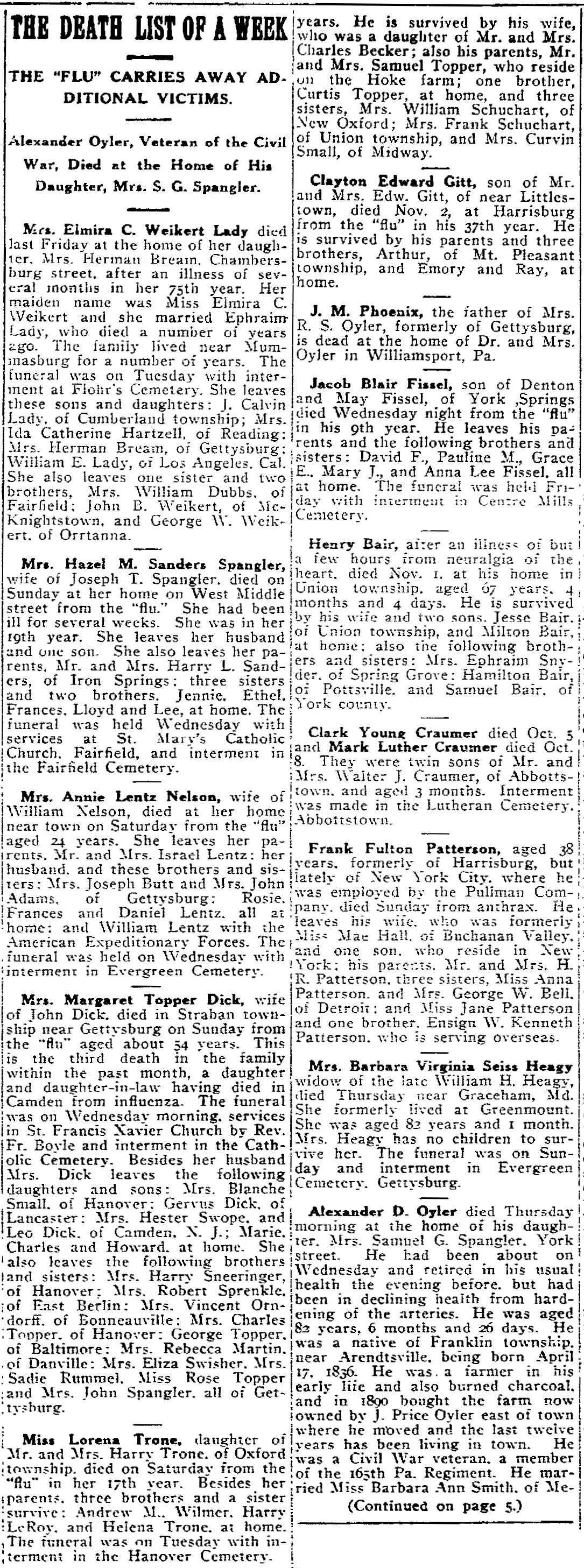
That clipping is more than a list of names. It is a collection of family history records.
The notices identify spouses, parents, children, siblings, churches, burial places, military service, and former communities. Somewhere in those details may be a researcher’s great-grandmother, cousin, neighbor, or Civil War ancestor.
If your family lived in the United States during the pandemic, their community was likely affected by illness, closures, shortages, or public-health restrictions, even when no one in the household died.
Old newspapers can help you understand what that experience looked like where your family lived.
NewspaperArchive includes many small-town and rural newspapers from this period. Search by location and date to see which titles are available for your ancestor’s community.
For more about why the pandemic became known as the Spanish flu, read Where Did the Spanish Flu Really Come From? And What Did Local Newspapers Know?
Quick Answer
The 1918 influenza pandemic did not end because of one cure, vaccine, or public health order.
Communities used school and business closures, limits on public gatherings, isolation, masks, ventilation, hygiene advice, and emergency medical care to slow transmission and manage outbreaks.
These measures could reduce immediate pressure on a community, especially when introduced early, but cases often returned after restrictions were relaxed.
Over time, increasing population immunity, seasonal conditions, changing behavior, continued viral evolution, and other factors contributed to the pandemic’s decline. Researchers cannot assign its end to one single cause.
What Made the 1918 Flu So Dangerous?
The 1918 influenza pandemic was unusually deadly.
Unlike the mortality pattern usually associated with seasonal influenza, the pandemic caused an unusually high number of deaths among healthy young adults. Children younger than five and older adults were also at serious risk.
The disease spread quickly and arrived in multiple waves. Some patients recovered after several days of illness. Others developed pneumonia and declined rapidly.
By the time the pandemic had passed, estimates place the worldwide death toll at about 50 million people. Approximately 675,000 people died in the United States.
Communities faced shortages of nurses, hospital beds, undertakers, and coffins. Entire households could become sick at the same time, leaving no healthy family member available to provide care.
For family historians, that means influenza is worth considering when someone died unexpectedly in 1918 or 1919. Newspapers from the period may also document illness, quarantine, emergency relief, or community disruption, even when an ancestor survived.
How Communities Tried to Slow the Spread
There was no vaccine against the influenza virus in 1918, and doctors had no antiviral medication that could cure the disease.
Communities relied on measures intended to reduce contact, improve care, and slow the spread of respiratory illness.
The responses varied from place to place. Some were introduced quickly. Others came only after cases had risen sharply. Enforcement also differed, and not everyone followed the rules.
Local newspapers recorded those efforts as they happened.
Masks Became Part of the Public Response
Cloth masks became one of the most visible symbols of the pandemic.
On October 18, 1918, the Quincy Whig in Illinois published instructions for making a flu mask at home.
Readers were told to cut a strip of gauze eight inches wide and 23 inches long, fold it twice, stitch the edges, and attach ties. The article said masks should be worn by patients and the people attending them.
The masks were to be sterilized after each use and changed several times a day.
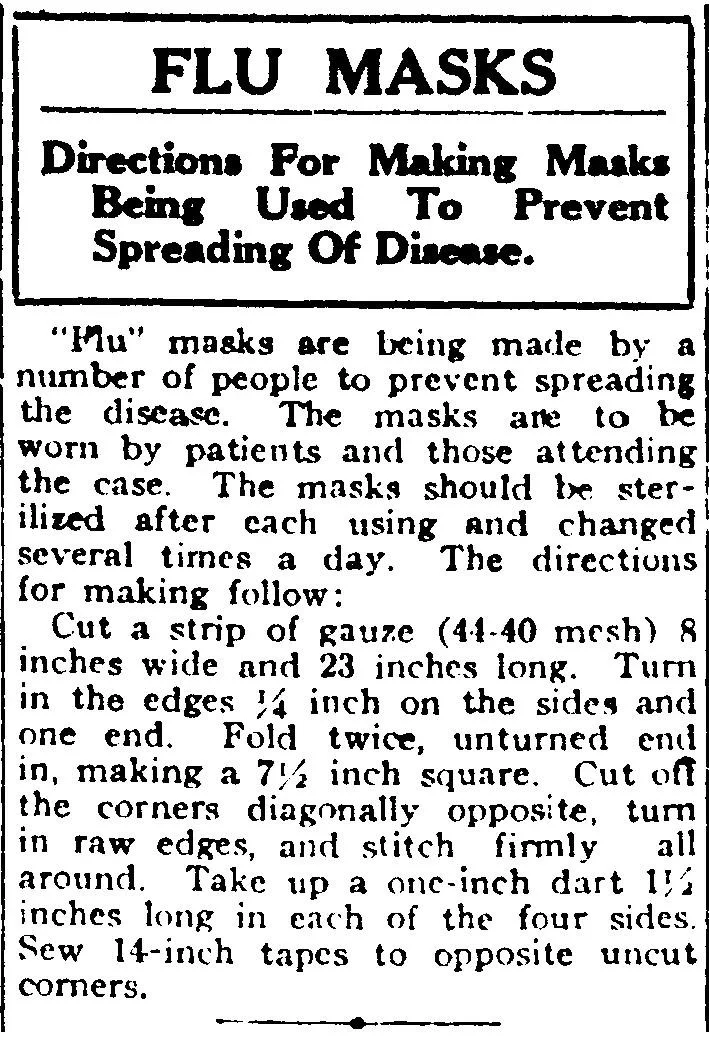
The clipping gives us a practical look at what residents were being asked to do.
It does not tell us how many people made the masks, how consistently they wore them, or how effective these particular gauze masks were. The materials, fit, number of layers, and way masks were used varied widely.
Still, the instructions show how ordinary families were drawn into the public health response. Protective equipment was not always supplied by a hospital or government agency. People were sometimes expected to make it themselves from directions printed in the newspaper.
For a family historian, that adds texture to the story. An ancestor living in Quincy may have seen these instructions, made a mask, cared for a sick relative, or watched masked residents move through town.
Cities Issued Public-Health Orders
Some cities responded with strict public health proclamations.
On October 28, 1918, the Seattle Star printed a large “Flu Proclamation” addressed to the people of Seattle.
The proclamation said new cases had increased from about 300 per day to nearly 500. Officials blamed the increase in part on residents continuing to gather in crowds and acting as though they were personally immune.
The city ordered streetcar companies to place every available car into service during crowded parts of the day. One-third of all streetcar windows had to remain open, and overcrowding would not be tolerated.
People who were not performing essential work were told to stay home. Those who had to go downtown were required to wear influenza masks in crowds, stores, streetcars, and jitneys.
Soft drink establishments and ice cream parlors were ordered closed. Restaurants and other places serving food had to remain well ventilated, keep doors open, and scald glasses after each use.
The proclamation warned that stores permitting crowding could be closed and that people caught spitting or coughing in public could be taken to jail or the hospital.
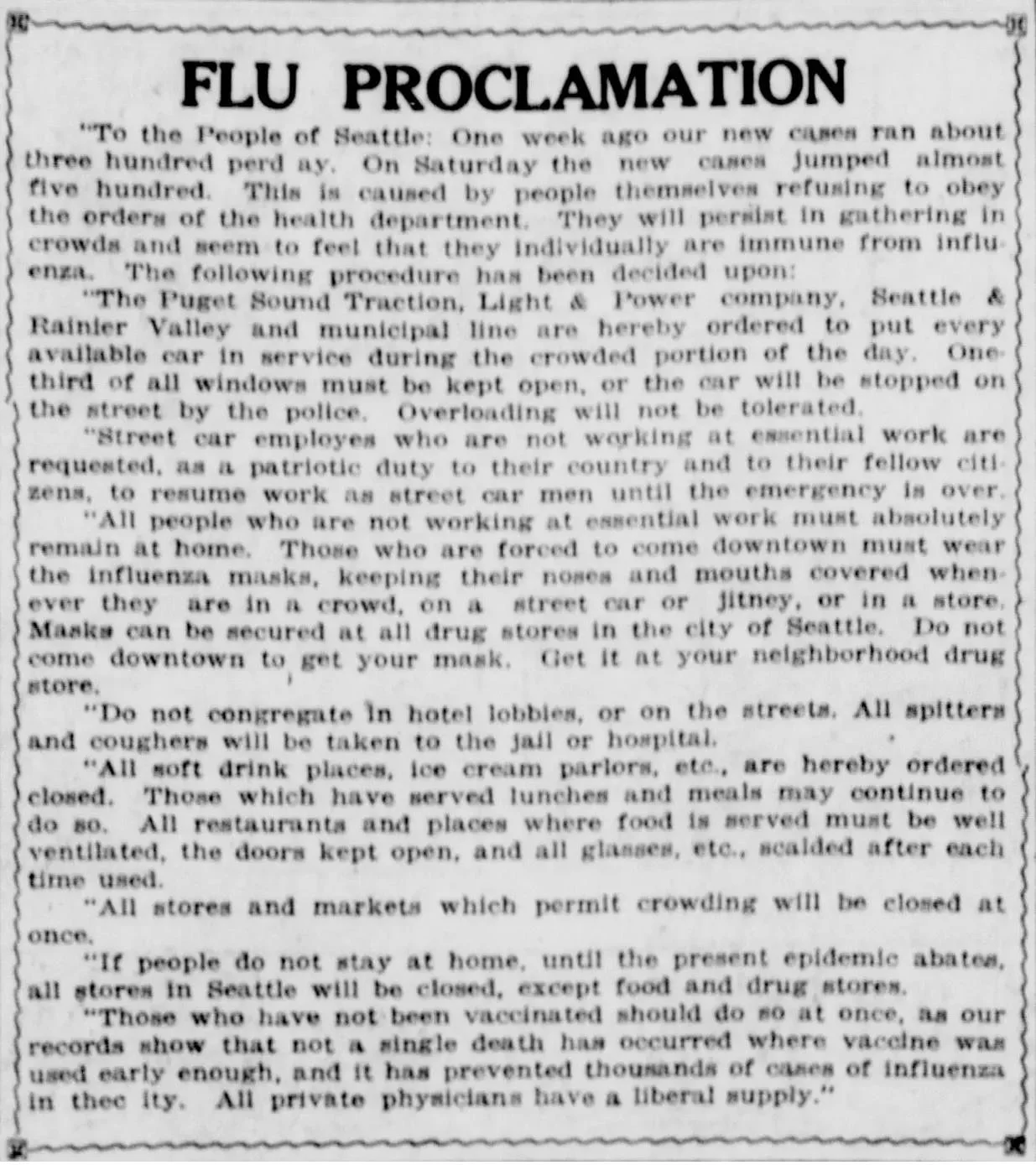
These were presented as enforceable city orders, not simply voluntary recommendations.
The proclamation also urged residents to be vaccinated and claimed that vaccination had prevented thousands of cases and that no deaths had occurred when it was used early enough.
That claim requires historical context.
There was no vaccine against the influenza virus in 1918. The virus had not yet been identified. Products promoted as influenza vaccines were generally bacterial preparations based on incomplete or mistaken ideas about what caused the disease, or they were intended to prevent bacterial complications.
The Seattle proclamation is therefore valuable for two reasons. It records practical measures such as reducing crowding and improving ventilation, but it also preserves medical claims that later proved unreliable.
Newspapers can document both.
Hygiene and Ventilation Were Widely Promoted
Health authorities frequently advised people to wash their hands, cover coughs and sneezes, avoid sharing drinking cups, keep rooms ventilated, and stay away from crowds.
Doctors did not understand the influenza virus as they do today, and many believed bacteria caused the illness. Even so, some of the advice was aimed at reducing the spread of respiratory disease and preventing secondary infections.
Fresh air became an important part of public health messaging.
Cities ordered streetcar windows opened. Homes and hospitals were encouraged to improve ventilation. Some emergency facilities treated patients in tents or open-air wards when weather and space allowed.
Historical accounts sometimes described positive outcomes from open-air care. Those reports were not controlled medical studies, however, and they cannot tell us exactly how much outdoor treatment affected survival.
The clearest conclusion is that ventilation, distance, hygiene, and limits on gatherings were all part of the response communities attempted.
Emergency Hospitals and Nursing Shortages
Even when case numbers began to decline, local officials could not assume the danger had passed.
On October 12, 1918, the New Castle News in Pennsylvania published the headline “Decrease in Number of Flu Cases.”
The article reported 17 new cases that day, bringing the city’s reported total to 98. Six cases had been followed by pneumonia, and one death from that cause had been reported to the health department.
The lower daily number offered some hope, but the rest of the article showed that New Castle was still in an active emergency.
Nurses were in short supply. Health officer Dr. William L. Steen had received repeated calls from homes affected by the disease and had struggled to find nurses for two patients.
Officials and local medical leaders began planning an emergency hospital for people who could not receive proper care at home. Churches, schools, amusement venues, and public meetings remained closed.
Nearby West Pittsburgh was described as especially hard hit.
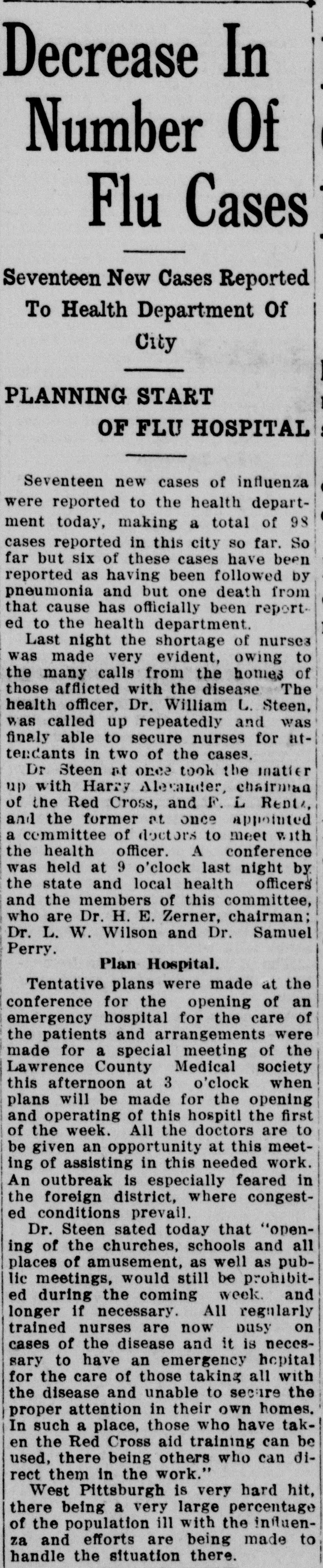
The clipping captures the uncertain middle of an outbreak.
Cases appeared to be decreasing, but officials were still preparing for conditions to worsen. Relief and danger existed at the same time.
The article also preserves names that may matter to family researchers. It identifies Dr. William L. Steen, Red Cross chairman Harry McAlexander, Dr. H. E. Zerner, Dr. L. W. Wilson, Dr. Samuel Perry, and other people involved in the response.
Those names can lead to additional searches involving medical work, volunteer service, civic organizations, or family connections.
The Pandemic Did Not End Everywhere at Once
There was no single day when the pandemic ended.
Cases rose and fell at different times in different communities. One city might reopen schools while another was preparing an emergency hospital. Restrictions could be removed when cases dropped and reinstated when illness returned.
Public health measures could temporarily suppress transmission, especially when communities acted early and used several measures together. Cases often increased again once restrictions were relaxed.
Increasing population immunity likely played an important role over time. Seasonal conditions, changes in human behavior, demographic patterns, and continued changes in the virus also probably influenced the decline.
The relative importance of those factors is difficult to determine.
It is more accurate to say that communities endured a series of outbreaks and gradually moved beyond the emergency than to say that one measure defeated the pandemic.
Why Local Newspapers Matter for Flu Research
Some of the most personal records of the pandemic appear in small-town weeklies and county newspapers.
Large city papers documented hospitals, government actions, death totals, and the broader scale of the emergency.
Local papers were more likely to include brief notices about individual residents and families.
The Gettysburg Compiler notice for Hazel M. Sanders Spangler identified her husband, infant son, parents, sisters, brothers, church, and cemetery. Similar notices could name married daughters, siblings living in other states, military relatives, employers, and former hometowns.
A large city newspaper might reduce a death to a short line or omit it. A community weekly sometimes had room to record relationships and burial details.
That information can help a family historian:
Confirm a death date or approximate date
Identify relatives
Find a married surname
Locate a church or cemetery
Learn where someone lived
Connect a family to another town or county
Discover military, workplace, or community service
NewspaperArchive includes many small-town and rural newspapers from the pandemic period. Search by location and date to see which titles are available for the community you are researching.
How to Search for Your Ancestor’s Flu Experience
You do not need proof that your ancestor had influenza before beginning.
Start with a name, a place, and a broad date range.
Search a Name With a Location
Search for your ancestor’s full name with their town, county, or state in newspapers from 1918 and 1919.
Try initials, nicknames, maiden names, alternate spellings, and married names.
Newspapers may mention that someone was sick, recovering, caring for relatives, returning to work, or visiting a household affected by influenza.
Search for Relatives and Neighbors
A person may appear in someone else’s notice.
A death report might name your ancestor as a surviving sister, brother, parent, pallbearer, nurse, minister, or neighbor.
Search close relatives and people who lived nearby.
Search Influenza Terms
Combine a town or county with terms such as:
influenza
flu
epidemic
pneumonia
quarantine
mask
health board
emergency hospital
school closed
church closed
public gathering
death list
This can help you locate issues worth reading even when your ancestor’s name does not appear in the search result.
Read More Than Obituaries
Useful records may appear in:
Community columns
Church announcements
School news
Hospital reports
Red Cross updates
Public proclamations
Business closure notices
Funeral reports
Lists of the sick
Notices of recovery
A short social item may be the only record showing that an ancestor experienced the illness.
Search Nearby Towns
Rural communities were often covered by a county-seat newspaper or a weekly paper from a nearby town.
Do not limit your search to the exact place where your ancestor lived.
Continue Into 1919 and 1920
The deadliest wave struck during the fall of 1918, but influenza did not disappear when the year ended.
Later waves and local outbreaks continued into 1919 and, in some places, 1920.
Widening the date range may reveal renewed closures, delayed funerals, continuing illness, or later deaths.
Frequently Asked Questions
Did masks end the 1918 flu pandemic?
No single measure ended the pandemic.
Masks were widely promoted and required in some communities, but their materials, construction, fit, use, and enforcement varied. Masks were one part of a much broader response that also included gathering bans, closures, isolation, ventilation, and emergency care.
Was there an influenza vaccine in 1918?
There was no vaccine against the influenza virus.
The virus had not yet been identified. Some products called influenza vaccines were based on bacteria that doctors incorrectly suspected of causing the disease, or were intended to prevent bacterial complications.
Did closing schools and public gathering places work?
Closures and gathering restrictions could reduce contact and slow transmission, particularly when introduced early and combined with other measures.
They did not permanently eliminate the virus. Cases sometimes increased again after restrictions were relaxed.
Can I find influenza deaths in newspapers?
You may find them.
Newspapers frequently published death notices, obituaries, funeral reports, and community death lists. Coverage varies by location, and not every death was identified specifically as influenza.
What other flu-related records appeared in newspapers?
Newspapers printed mask instructions, public health orders, hospital updates, school and church closures, business restrictions, nursing appeals, case totals, and reports of people who were ill or recovering.
Will my ancestor appear even if they survived?
Possibly.
Community columns often reported that residents were sick, improving, caring for family members, or returning to work. An ancestor might also be named as a volunteer, nurse, physician, minister, official, or surviving relative.
Why are small-town newspapers helpful?
Some small-town papers included detailed personal information about residents, relatives, churches, cemeteries, and neighboring communities.
Those details can make them especially useful for reconstructing a family’s experience.
What the Newspapers Preserved
People responded to the pandemic in different ways.
Many made masks, opened windows, cared for sick relatives and neighbors, volunteered through the Red Cross, worked as nurses, and followed public-health orders.
Others resisted restrictions, continued gathering, or ignored warnings. Seattle officials complained that residents behaved as though they were personally immune. That frustration was part of the historical record, too.
Local newspapers documented the fear, effort, confusion, loss, and cooperation.
In Quincy, readers received directions for sewing masks at home.
In Seattle, city officials ordered windows opened, crowds reduced, and masks worn in public.
In New Castle, doctors and Red Cross leaders planned an emergency hospital even as the number of newly reported cases appeared to decline.
In Gettysburg, a single column preserved the names and family relationships of people who died during one terrible week.
Those pages do not offer a simple explanation for how the pandemic ended.
They offer something just as important for family historians: a record of how communities lived through it.
Search for the names you know. Then read what the newspapers from their town were reporting around them.