What Happened in Between: A Story Told Through Newspaper Clues
Guest post by Julie Holmansky showing how newspapers reveal missing years between census records and help trace ancestors’ movements and life events.
In this guest post, Julie Holmansky demonstrates how newspapers can fill the gaps between census records by capturing everyday life events, movements, and relationships. Using real examples, she shows how social columns, local news, and legal notices help trace where ancestors lived and how their lives changed over time, even when traditional records are missing.
Finding Your Ancestors Between Census Years With Newspapers
Newspapers can help you track your ancestors between census years by revealing where they lived, traveled, and appeared in everyday life. Social columns, local news, and legal notices often document movements and life events that don’t appear in traditional genealogical records.
The Problem: A Missing Timeline
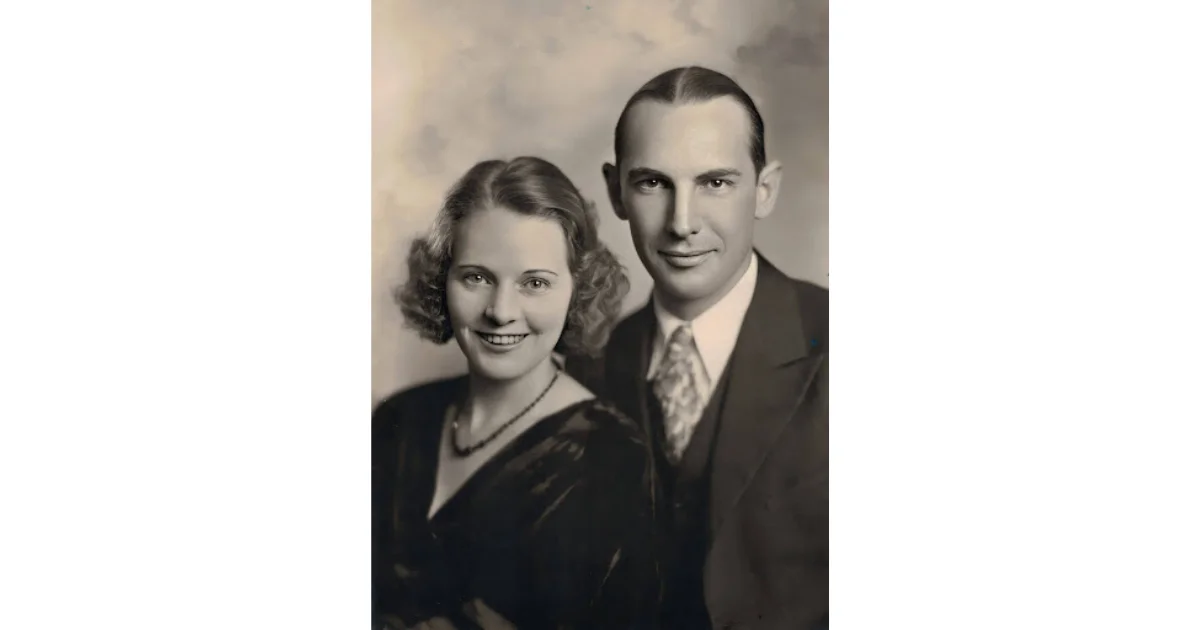
On the first day of winter in 1929, twenty-three-year-old Frederick Wagner Turner married nineteen-year-old Edith Elaine Kierstead in a small ceremony at her parents’ home in Amesbury, Massachusetts.
They divorced in Maine in 1938.
Aside from their appearance on the 1930 census in Merrimac, Massachusetts, they leave almost no conventional records behind.
No city directories.
No clear place of residence.
No obvious path from beginning to end.
Without children to generate additional records, there was a nine-year gap—and no clear way to fill it.
And yet, they didn’t disappear.
How Newspapers Fill the Gaps
Censuses, vital records, and city directories show where your ancestors were at fixed points in time.
Newspapers do something different.
They fill in the gaps between those records, revealing movement, relationships, and everyday life as it happened.
Social columns, local news articles, and legal notices can show where people lived, what they were doing, and sometimes even explain why they were there.
That’s where Fred and Elaine’s story begins to take shape – in the pages of the newspaper.
Following the Trail in Social Columns
After their marriage, Fred and Edith begin to appear in newspapers across both Massachusetts and Maine -- most often in the social columns, where everyday movements were noted in passing.
On April 19, 1933, the Newburyport Daily News reported that the couple had been living in Maine but were returning to Amesbury.
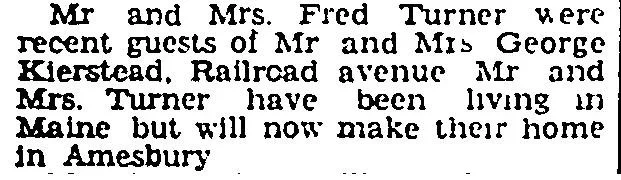
It’s a small notice, easy to overlook…but it establishes something important:
They had already left Massachusetts -- and were now coming back.
They didn’t remain there long.
A year later, another social column placed them in Farmington, New Hampshire -- a location that doesn’t appear in any other record.
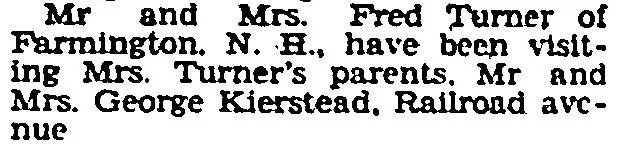
Without this brief mention, their time in New Hampshire would be completely unknown.
When Local News Tells a Bigger Story
The Turners’ time in New Hampshire was also short-lived.
On February 12, 1935, the Newburyport Daily News reported that the couple had been involved in a car accident in Maine while traveling to visit family in Massachusetts.
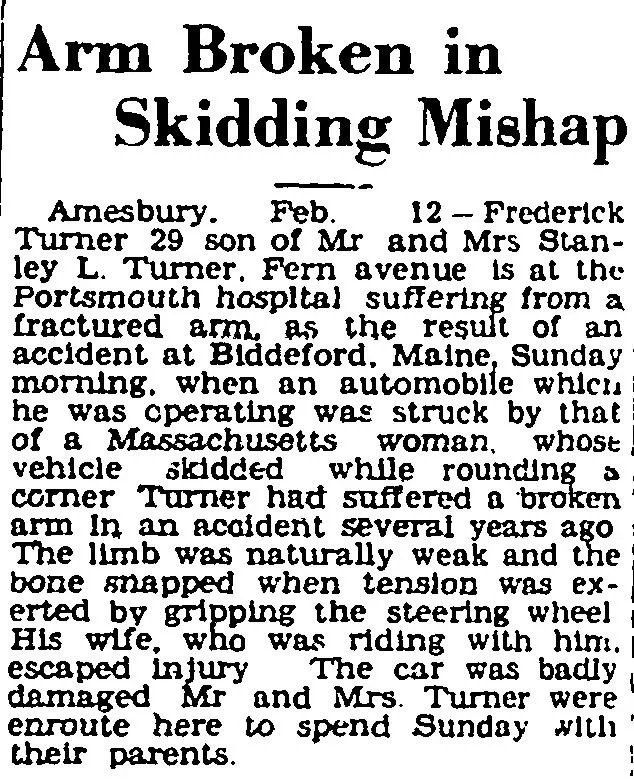
Because the story was longer and more detailed, it appeared as a standalone article rather than a brief social mention.
This article does more than report an accident.
It places Fred and Edith on the road -- moving between states and maintaining family connections.
What Legal Notices Reveal About Relationships
Beginning in 1936, social columns mention Edith—but no longer Fred.
She appears visiting her parents several times. He is notably absent.
The reason becomes clear in the legal notices published in Maine’s Kennebec Journal. They separated in the autumn of 1937.
By the time their divorce was finalized in February 1938, Fred and Edith were living in entirely different places.
Edith had moved to Portland, Maine.
Fred was living more than an hour away in rural Mount Vernon.

What began as scattered newspaper mentions now forms a clear picture:
A young couple who moved frequently during the Great Depression, grew apart, and ultimately separated -- leaving behind a paper trail not in traditional records, but in the pages of local newspapers.
Why Small-Town Newspapers Matter
Many of the details in Fred and Elaine’s story survive because they appeared in local and regional newspapers -- not major city publications.
Small-town newspapers often recorded everyday movements: visits, travel, short stays, and returns home. These small mentions, while easy to overlook, can reveal patterns that never appear in official records. They not only show where your ancestors were, but who they were with.
In larger cities, a move from one place to another might go unrecorded, but in smaller communities, those same movements were often noted, creating a trail researchers can still follow today.
How to Trace Ancestors Between Records Using Newspapers
If you’re researching ancestors between census years, try these strategies:
Search for names in social columns, not just headlines
Look for movement words like visiting, returning, traveling, or staying
Check legal notices for major life events such as divorce or relocation
Search the same individuals across multiple towns and states
Look for associated names—parents, siblings, or friends
A Clearer Picture Emerges
What began as a nine-year gap becomes something more when viewed through newspapers.
Not a complete timeline, but a clear pattern.
Movements between towns. Returns home. Short stays that didn’t last. Distance growing between two people who started out in the same place.
These moments don’t appear in the records we usually rely on, but they were written down in brief mentions, scattered across local papers.
And when they’re brought together, they do something the records alone can’t.
They show a life in motion.
They show change as it was happening.
They show how the story unfolded—one small piece at a time.
About the Author
Julie Holmansky discovered her love of family history through her grandfather, who filled her childhood with stories, photos, and unforgettable characters. What began with flipping through photo albums turned into a lifelong passion for genealogy. Today, she’s driven by the same thing that first captured her imagination—bringing ancestors to life through their stories.
Connect with Julie
If you enjoyed this story, you can find more of Julie’s research and storytelling at her website, Roots and Rabbit Holes, and follow her on Storied to see what she uncovers next.
Newspaper Clippings In Order As They Appear:
Newburyport Daily News, 19 Apr 1933, page 2
Newburyport Daily News, 31 Jul 1934, page 2
Newburyport Daily News, 12 Feb 1935, page 3
Daily Kennebec Journal, 16 Feb 1938, page 3