Same Name, Wrong Man: How to Know You've Found the Right Ancestor in Old Newspapers
Finding a name in old newspapers is only the first step. Use this ancestor identity checklist to confirm you have the right person before you build your research on a stranger.
When searching historical newspapers for genealogy research, finding a name is only the first step. Confirming that a newspaper record belongs to the right ancestor requires checking multiple identifying details including spouse's name, parents' names, children's names, location, occupation, and approximate birth year. NewspaperArchive offers searchable access to millions of pages from small-town and regional newspapers, making it possible to find multiple records for the same individual and cross-reference details across sources. Using a structured identity checklist helps researchers avoid building family history research around the wrong person when two individuals share the same name.
You find the name. It matches. The date looks right, the state looks right, and for a moment you feel that particular rush that keeps genealogists searching at midnight.
Then something feels off.
That is exactly where I found myself when I started tracing Henry Schortemeyer through Indiana and Ohio newspapers. A marriage license from 1891. A name I recognized. But was it my Henry?
Turns out there were at least two Henry Schortemeyers in Indiana and Ohio newspaper records. One of them was mine. One of them was not. And without a way to check my work, I could have spent weeks building a family story around the wrong man.
This checklist exists so that does not happen to you.
Quick Answer
To confirm you have the right ancestor in a newspaper record, check at least three of the following: full name including middle name or initial, spouse's name, parents' names, location, occupation, approximate birth year, and names of children or siblings. The more details that match across multiple records, the more confident you can be.
If you are already searching in NewspaperArchive, try pulling several records for the same name and comparing them side by side before you decide which one belongs to your family.
Why Duplicate Names Are a Real Research Problem
Common surnames are an obvious challenge. But even less common names appear more than once in historical records, especially when you're searching across decades, counties, and states.
In small communities, naming patterns made things harder. Families named sons after fathers and grandfathers. Cousins shared given names. Neighbors with the same surname sometimes gave children identical first names across generations.
When you add in the fact that newspaper records are often brief, sometimes cut off by OCR problems, and rarely include a birth date, you can see why confirming identity takes more than a name match.
A name match is a starting point. It is not a conclusion.
The Henry Schortemeyer Problem
When I searched for Henry Schortemeyer in Indiana and Ohio newspapers, I found what looked like a promising clipping right away.
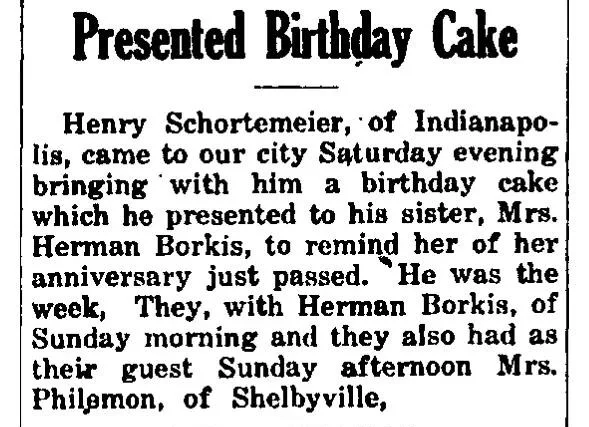
The 1922 Batesville Tribune mentioned a Henry Schortemeyer of Indianapolis who came to town to bring his sister a birthday cake. He visited Mrs. Herman Borkis and spent the week. Nice detail. Real person. Right location. Wrong Henry.
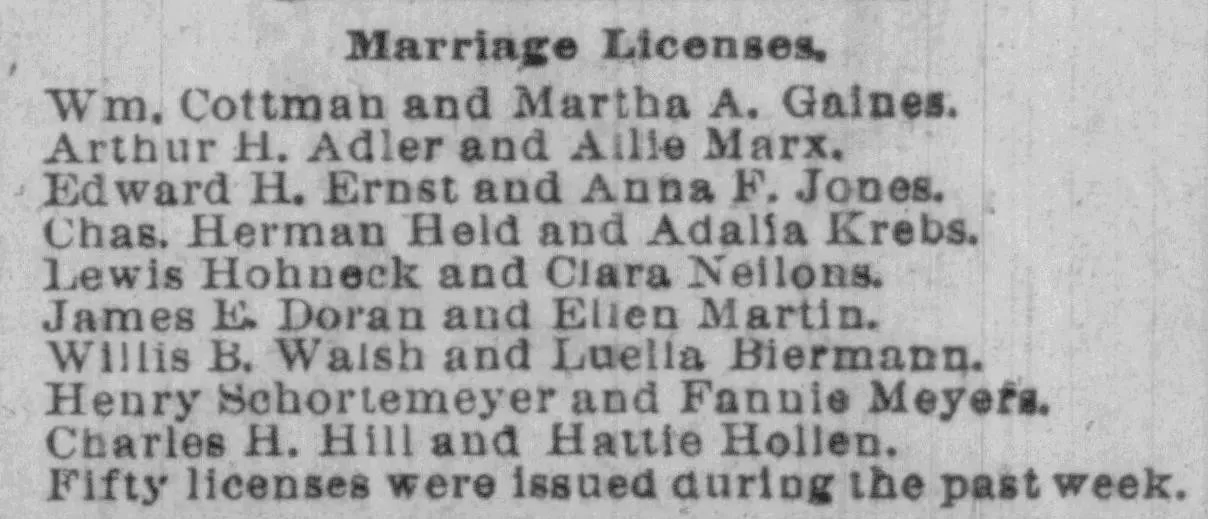
My Henry Schortemeyer appeared in an 1891 marriage license list in the Cincinnati Commercial Gazette. Henry Schortemeyer and Fannie Meyers. One line. No location beyond the license list, no age, no parents. Just a name and a bride.
Same name. Same era. One of these was my ancestor. One was not.
What settled it was William.
William Schortemeyer's 1968 obituary in the Greensburg Daily News named his parents as Henry and Louise Rohlfing Schortemeyer. It listed his birthplace as Cincinnati, Ohio. It placed him in Sunman, Indiana, then Greensburg. It named his wife, his children, his church, and his address.
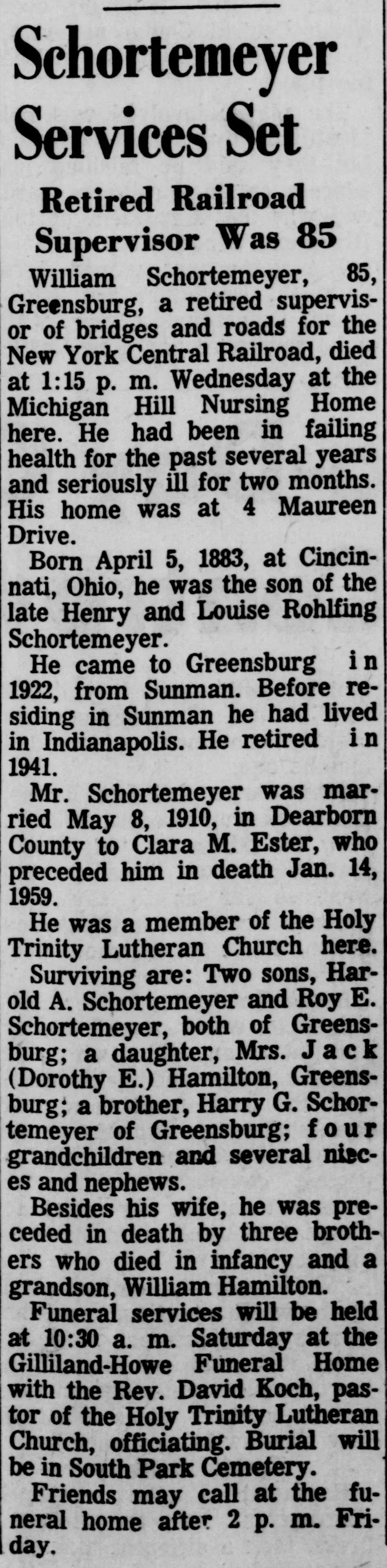
That obituary gave me enough to work backward. Henry and Louise Rohlfing Schortemeyer. Cincinnati origins. Ripley County connections. That is a completely different family from the Indianapolis Henry visiting the Borkis household in Batesville.
The checklist I use now would have caught that difference in about five minutes.
The Ancestor Identity Checklist for Newspaper Research
Use this checklist when you find a name in a newspaper record and want to confirm it belongs to your ancestor before you add it to your research.
You do not need every box checked. You need enough details that match consistently across more than one source.
Checklist Item | What to Look For | Where to Find It in Newspapers |
|---|---|---|
Full name including middle name or initial | Does the middle initial match other records? | Obituaries, legal notices, formal announcements |
Spouse's name | Does the husband or wife named match what you already know? | Marriage notices, obituaries, anniversary announcements |
Parents' names | Are the parents named, and do they match? | Obituaries, birth announcements, family notices |
Children's names | Are any children named, and do they match your tree? | Obituaries, school mentions, social columns |
Siblings' names | Are brothers or sisters mentioned? | Social columns, visiting items, obituaries |
Location | Is the town or county consistent with other records? | Nearly every newspaper item |
Approximate birth year or age | Does the age given match what you expect? | Obituaries, anniversary notices |
Occupation | Does the job or trade match other records? | Business ads, work notices, obituaries |
Church or organization | Is a church, lodge, or club named that matches? | Community notices, obituaries |
Death or burial details | Does the date, location, or funeral home match? | Death notices, obituaries |
How to use this table: When you find a clipping, work through the checklist and mark which items you can confirm. If three or more match records you already trust, you are likely looking at the right person. If one or more items directly contradict what you know, stop and look for a second candidate before you go further.
How This Looks in Practice
Here is how the checklist applied to the two Henry Schortemeyers.
Checklist Item | Indianapolis Henry (Batesville Tribune, 1922) | My Henry (Cincinnati Commercial Gazette, 1891 + William's obituary) |
|---|---|---|
Location | Indianapolis / Batesville area | Cincinnati origins, Ripley County Indiana |
Siblings | Sister is Mrs. Herman Borkis | Son William names parents as Henry and Louise Rohlfing Schortemeyer |
Spouses | Not mentioned in this clipping | Fannie Meyers (1891 marriage license) Louise Rohlfing Schortemeyer (confirmed via William's obituary) |
Parents | Not mentioned | Not mentioned |
Children | Not mentioned | William Schortemeyer, Greensburg |
Match confidence | No overlap with my family details | Strong match across multiple records |
Two men. Same name. The checklist makes the difference visible.
What to Do When the Details Don't Line Up
If something in a clipping contradicts what you already know, do not discard the clipping right away. Consider these possibilities first.
The clipping may be for a different person with the same name. This is the most common explanation. Search again with additional terms like a spouse's name, a county, or an occupation.
The newspaper may have printed an error. Names were misspelled, ages were estimated, and relationships were sometimes described loosely. A sister-in-law sometimes appeared as a sister. A stepfather sometimes appeared as a father.
Your existing records may be the ones with the error. Newspaper records are sometimes more accurate than family memory or earlier research. If a clipping consistently contradicts your tree, it may be worth checking the tree rather than dismissing the clipping.
OCR may have changed a name. If a surname looks close but not exact, the original print may have been clearer. NewspaperArchive's ongoing re-OCR project has improved search accuracy on many older pages, and searching a name variation may surface a cleaner version of the same article.
When details don't line up cleanly, look for one more record before you decide. One corroborating source can settle most questions.
Search Tips for Using This Checklist in NewspaperArchive
Once you have a name to verify, these search approaches can help you build out the checklist faster.
Start with what you already know with confidence. If you know a spouse's name, search the spouse's name alongside the ancestor's name. If you know a town, filter by state or search the town name alongside the surname.
Obituaries are the most checklist-friendly record type in historical newspapers. A well-written obituary can fill in six or seven checklist items at once. Search for your ancestor's name, but also search for a spouse, parent, or child if the ancestor's obituary is hard to find. William Schortemeyer's obituary told me more about his father Henry than a direct Henry search returned on its own.
Social columns are useful for sibling and location confirmation. Visiting items and community notices often name a person alongside relatives and neighbors, which gives you relationship details in a casual context. The Batesville Tribune clipping about the Indianapolis Henry was wrong for my research, but it was exactly the kind of item that helps a researcher confirm or rule out a candidate quickly.
If you are searching NewspaperArchive and not finding results, try the name with one less detail. Search the surname alone with a county or state, then narrow from there. Small-town papers especially named ordinary people in brief items that a full-name search might miss.
Frequently Asked Questions
How many checklist items do I need to confirm an identity? There is no fixed number, but three or more matching details across at least two separate records is a reasonable threshold for most researchers. The more specific the matching details (a spouse's unusual surname, a middle initial, a specific town), the more confidence each match carries.
What if I can only find one newspaper record for my ancestor? One record is a starting point, not a conclusion. Use what the record gives you (a location, a spouse's name, a parent's name) to search for additional records in newspapers and in other genealogical sources. The goal is to build a pattern, not to rely on a single clipping.
Can I use this checklist for ancestors with very common names? Yes, and it matters even more when names are common. For surnames like Smith, Miller, or Johnson, focus on the location and spouse columns first. Those two details together narrow the field significantly even when the given name and surname are both common.
What should I do if two clippings seem to be about the same person but the details conflict slightly? Look for a third record that might settle the question. Slight conflicts (an age off by a year, a middle initial missing) are often explainable. Direct conflicts (different spouse, different parents, different location) usually mean two different people.
Why does NewspaperArchive sometimes return results for the wrong person? Keyword search returns every record that contains the name you searched, regardless of which individual it refers to. That is not a flaw; it is how search works. The checklist is your tool for sorting the results once they appear. NewspaperArchive also includes millions of pages from small-town papers, which means the same name may appear in many different communities across decades. Filtering by state or date range can help narrow results before you apply the checklist.
Conclusion: Confirm Before You Commit
Finding a name in an old newspaper feels like progress, and it is. But a name alone is not confirmation.
Henry Schortemeyer appeared in Indiana and Ohio newspaper records more than once. The Henry in Indianapolis visiting his sister had nothing to do with my research. The Henry who married Fannie Meyers in 1891 and raised a son named William in Ripley County did.
The difference between those two men came down to details: a spouse's name, a location, a son's obituary that traced back a generation. Those details are almost always somewhere in the newspaper record if you know what to look for.
Work through the checklist before you add a clipping to your research file. It takes a few extra minutes, and it can save you from building a whole branch of your family tree around a stranger.