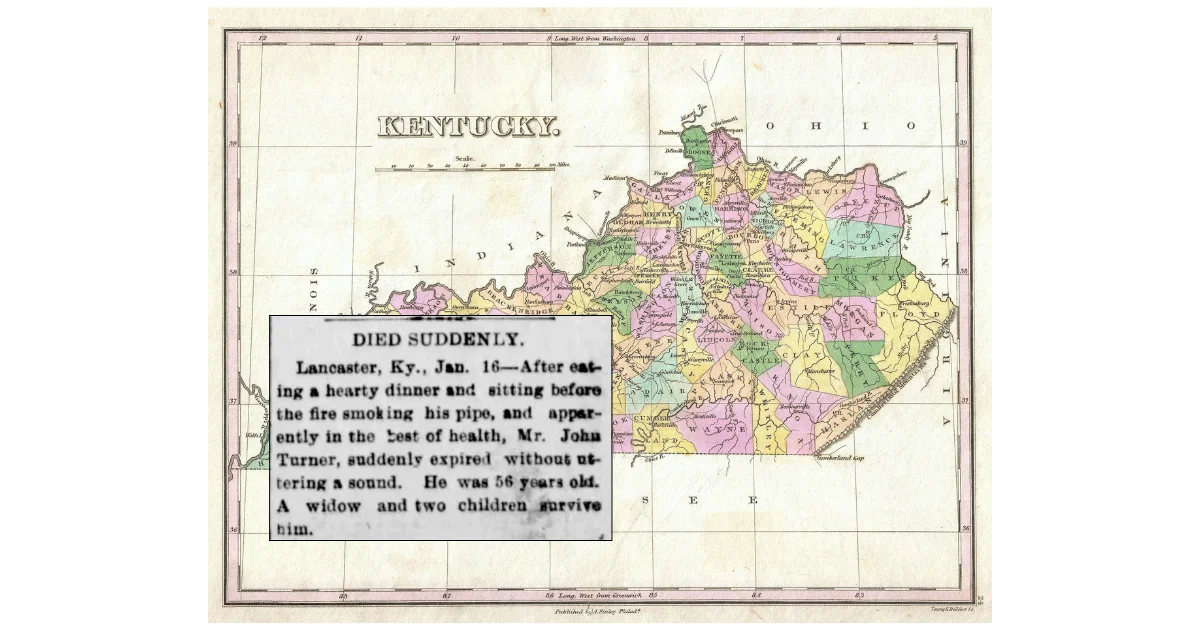
How to Find Obituaries in Small-Town Kentucky Newspapers
Learn how to find obituaries in small-town Kentucky newspapers using name variants, nearby counties, death notices, and NewspaperArchive searches.
To find obituaries in small-town Kentucky newspapers, search by name, location, and date range, then expand to nearby counties, name variants, maiden names, initials, and short death notices. Kentucky newspapers can include valuable family history clues such as parents, spouses, children, siblings, church membership, cemetery, funeral details, and out-of-town relatives. NewspaperArchive is useful for Kentucky obituary research because it includes small-town newspaper titles that may help researchers find family details not easily found in larger city papers or official records.
Kentucky obituary research can feel personal fast. One minute you are looking for a death date, and the next you are wondering where the family worshiped, who stood beside the grave, or why a daughter suddenly disappeared from the records.
Small-town Kentucky newspapers can help fill in those spaces. In communities across the state, local papers often printed more than formal obituaries. They published death notices, funeral details, church connections, cemetery information, visiting relatives, and the small clues that can help bring a family story back into focus.
Quick Answer: How Do You Find Obituaries in Small-Town Kentucky Newspapers?
To find obituaries in small-town Kentucky newspapers, start with the person’s full name, then narrow by county, city, and date range. Search nearby counties, try name variations, and look for both long obituaries and short death notices. NewspaperArchive can be especially useful for Kentucky research because its collection includes small-town titles that may not appear in every major newspaper database.
Why Small-Town Kentucky Newspapers Matter for Obituary Research
If your ancestor lived in Louisville or Lexington, you may already know which major newspapers to check. But many Kentucky families lived in smaller towns, rural counties, and mountain communities where the local newspaper was the center of community life.
Those papers covered the details that larger newspapers usually missed, including:
deaths and funerals
church services
cemetery burials
visiting relatives
married daughters’ names
out-of-town siblings
local illnesses and accidents
neighborhood and county-line news
That matters because Kentucky families often moved between nearby counties, married into neighboring communities, or had relatives spread across small towns. An obituary for someone in Whitley County might mention family in Knox County. A Laurel County notice might name relatives in Pulaski, Rockcastle, or Clay County. Those small details can help you keep moving when official records leave gaps.
Why Small-Town Kentucky Papers Can Be Hard to Find Online
Some Kentucky newspapers are easy to find. Others are not.
Many small-town papers were not published by large regional chains. They served local communities, and their back issues did not always end up in the same large preservation programs as major city newspapers. That can make obituary research frustrating, especially if you are looking for a person from southeastern Kentucky or another rural part of the state.
Here are a few common challenges:
Some newspapers were preserved on microfilm but not fully digitized.
Some county libraries have local newspaper collections, but they may require an in-person visit or a research request.
Some titles only exist online for certain years.
OCR errors can make names hard to find, especially in older or faded pages.
A death may have been printed as a short notice instead of a full obituary.
The obituary may have appeared in a neighboring county newspaper instead of the person’s exact hometown paper.
This is why a flexible search matters. You may need to search by name, county, nearby city, spouse, child, sibling, or even cemetery.
Which Kentucky Newspaper Titles Are on NewspaperArchive?
NewspaperArchive’s strength is especially useful when you are researching small towns and local communities. Instead of relying only on major city papers, you can search through smaller titles that may have printed the everyday family details you are looking for.
For southeastern Kentucky research, two useful examples include:
Corbin Times Tribune in Corbin, Kentucky
London Sentinel Echo in London, Kentucky
These titles are especially helpful for families connected to Whitley County, Knox County, Laurel County, and nearby communities.
NewspaperArchive also includes many other Kentucky titles from towns and cities across the state. Since newspaper availability can vary by title and year, it is always smart to search by state, city, and date range to see what is currently available for your ancestor’s location.
If you are not sure where to begin, try one focused search on NewspaperArchive with your ancestor’s name, Kentucky as the state, and a decade-wide date range. Once you see what appears, you can narrow by city or expand into nearby counties.
What a Kentucky Obituary Can Tell You About Your Family
If you have only worked with modern funeral home obituaries, older newspaper obituaries may surprise you. Many small-town Kentucky obituaries included several paragraphs of personal and family information.
A Kentucky obituary might name:
the deceased person’s full name
age or birth date
place of death
parents
spouse
children
married daughters
siblings
out-of-town relatives
church membership
funeral location
minister
cemetery
pallbearers
cause or circumstances of death
That is a lot of information from one clipping.
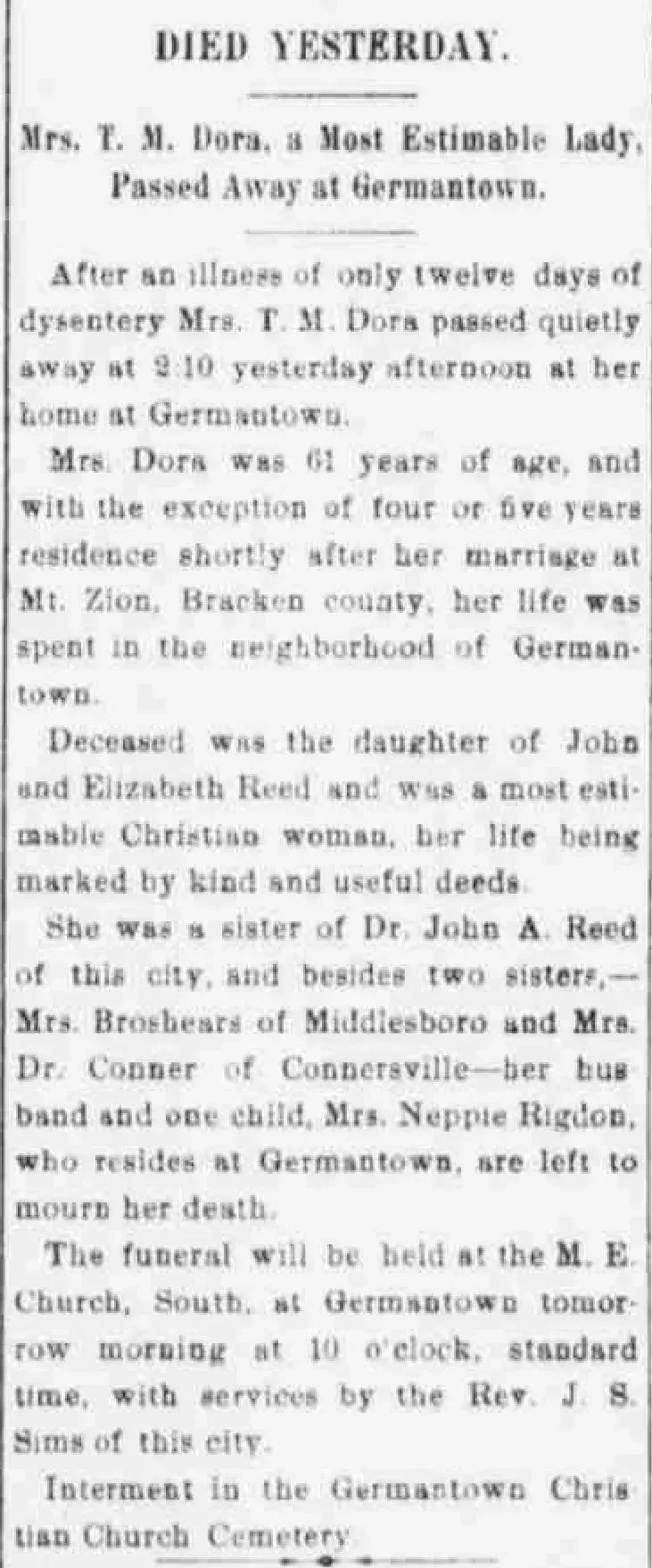
Example: What One Kentucky Obituary Reveals
Detail in the obituary | Why it matters for family history |
|---|---|
Mrs. F. M. Dora died at Germantown | Places her in a specific Kentucky community |
She was 61 years old | Helps estimate a birth year |
She was the daughter of John and Elizabeth Reed | Gives parents’ names and opens another generation |
She was a sister of Dr. John A. Reed | Adds a sibling and possible research path |
Sisters are mentioned in Muddiesboro and Connersville | Points to married sisters and possible migration clues |
Her husband and one child, Mrs. Noppie Rigdon, survived her | Confirms immediate family |
Funeral was held at the M. E. Church South | Gives church and community context |
Burial was in Germantown Christian Church Cemetery | Gives a cemetery location to search next |
This is the kind of obituary that can move your research in several directions at once. You are not just learning when someone died. You are finding parents, siblings, married names, church connections, and burial details.
If your Kentucky obituary search comes up empty, don’t stop there. Our guide to how to find an old obituary online, even when Google comes up empty walks you through what to try next, from name variations to newspaper archives and date-based searches.
Step-by-Step: How to Search for Kentucky Obituaries on NewspaperArchive
Here is a simple way to begin your search.
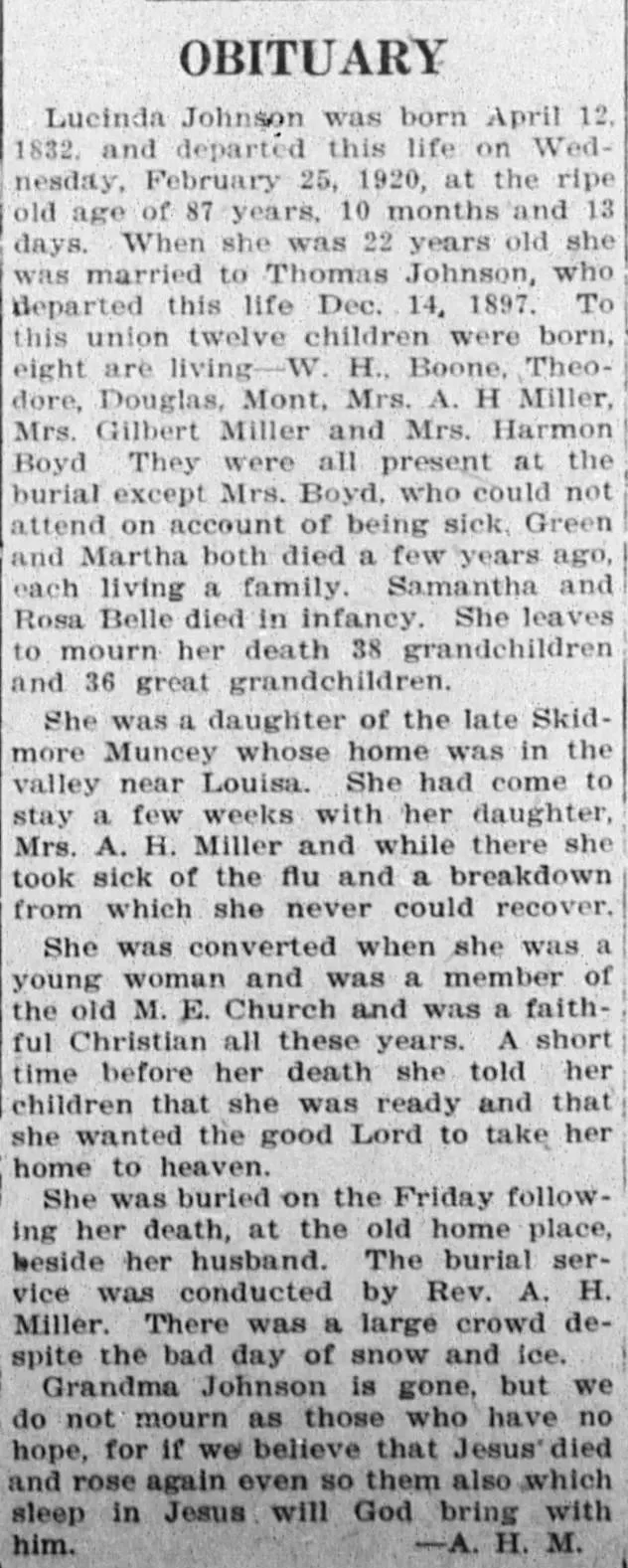
Step 1: Start with the person’s name
Begin with the full name of the person you are searching for. In the obituary example above, the name is Lucinda Johnson, so that would be the first search to try.
If nothing appears, do not stop there. Older newspapers did not always use names the same way we do now, especially for women. Lucinda Johnson’s obituary gives us several other names and relationships we could use in a search.
Try searching:
Lucinda Johnson
Grandma Johnson
Mrs. Thomas Johnson
Thomas Johnson
Skidmore Muncey
Mrs. A. H. Miller
Mrs. Gilbert Miller
Mrs. Harmon Boyd
You can also try the surname only, especially if the first name was misspelled or the OCR had trouble reading the text.
One obituary can give you a whole list of search clues. Lucinda Johnson’s obituary names her husband, father, married daughters, burial place, minister, church connection, and several family relationships. If one name does not bring up the obituary, another name from the same family circle might help you find it.
Step 2: Add Kentucky as the location
Set the state filter to Kentucky. This keeps your results focused without making the search too narrow too quickly.
If you know the city or county, you can narrow further. But if the first search does not work, remove the city filter and search more broadly across Kentucky.
Step 3: Use a date range
If you know your ancestor died in the 1940s, search 1940 to 1949 first. If that does not work, widen the range by a few years.
This is especially important because obituaries were not always printed immediately. A death late in the week might appear in the next issue. A funeral notice might appear before or after the obituary. A memorial mention could appear days or weeks later.
Step 4: Search nearby counties
Kentucky families often lived close to county lines. If your ancestor lived near Corbin, for example, do not limit yourself to only one county. Search nearby areas as well.
Try expanding into:
neighboring counties
the closest market town
the county where the church was located
the county where the cemetery was located
the county where adult children lived
Sometimes the obituary appeared where the person died. Sometimes it appeared where the family was known.
Step 5: Open the full page
Do not stop at the search result preview. Open the full newspaper page.
Why? Because the obituary may be near related notices, funeral announcements, church news, or social columns that mention the same family. The surrounding page can give you context that the clipping alone does not.
Step 6: Save the clipping and record the citation
When you find the obituary, save the clipping and write down:
newspaper title
city and state
date
page number
column, if visible
person’s name
any alternate spellings
This makes it much easier to add the source to your family tree or return to the record later.
Search Tips for Kentucky Names and Obituaries
Kentucky obituary searches often require a little creativity. If your first search does not work, try these approaches.
Search initials instead of full names
Many men appeared in newspapers by initials, especially in older notices.
Try:
J. W. Turner
J.W. Turner
John W. Turner
Mr. Turner
Jno. Turner
Try nicknames
A person’s legal name may not be the name printed in the newspaper.
Search for common nickname forms, such as:
Bessie for Elizabeth
Nannie for Nancy
Mollie for Mary
Mattie for Martha
Sallie for Sarah
Retta for Loretta
Bill for William
Search married and maiden names
For women, search both the married name and maiden name. Some obituaries list a woman under her husband’s name, while others include her maiden name or parents’ surname.
Try combinations like:
Mary Combs
Mrs. Earl Combs
Mary Napier
Mrs. Earl Combs Napier
Napier obituary Kentucky
Search relatives instead of the person
If you cannot find your ancestor’s obituary, search for a spouse, child, sibling, or parent. Their obituary may mention the person you are looking for.
This is especially helpful for women, children, and people whose names were misspelled in print.
Try spelling variations
Newspapers often printed names the way they heard them, and OCR can add another layer of errors.
Try alternate spellings, partial names, and common variations.
For example:
Philpot and Philpott
Stivers and Stevers
Benge and Benji
Combs and Coombs
Sizemore and Sizimore
Need more help with tricky names? Read The Name Game: 15 Smart Ways to Search Name Variants in Historical Newspapers for simple ways to search spelling variations, nicknames, initials, married names, and maiden names.
Do Not Overlook Short Death Notices
Not every newspaper mention will be a long obituary. Sometimes the only notice you find is short.
That does not mean it is useless.
A brief death notice may still give you:
name
place
approximate date of death
age
surviving family
circumstances of death
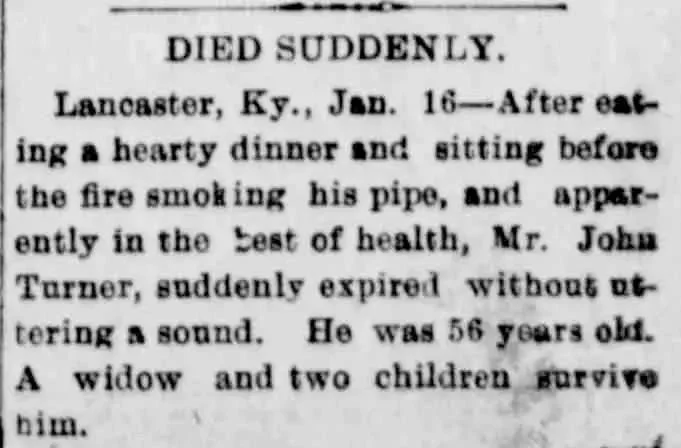
Example: What a Short Kentucky Death Notice Can Still Tell You
Detail in the notice | Why it matters |
|---|---|
Lancaster, Kentucky | Places the death in a specific community |
John Turner | Names the deceased |
Age 56 | Helps estimate a birth year |
A widow survived him | Confirms marital status |
Two children survived him | Points to immediate family |
Sudden death after dinner | Adds personal and historical context |
This type of notice may not give parents, burial place, or a long family list. But it still gives you clues worth saving. It may also help you find a death certificate, cemetery record, probate file, or longer obituary in another paper.
Where Else to Search for Kentucky Obituaries
NewspaperArchive is a strong place to begin, especially for small-town newspapers, but it should not be the only place you look.
Other useful places to check include:
Kentucky county libraries
local historical societies
cemetery databases
funeral home archives
county genealogy societies
state library newspaper collections
church records
probate records
death certificates
family files and vertical files at local libraries
If the newspaper title you need has not been digitized, a county library may still have it on microfilm. Some libraries will search or scan an obituary for a small fee if you can provide the name and approximate date.
What to Do When You Cannot Find the Kentucky Obituary
If your search comes up empty, do not assume the obituary does not exist. Try these steps before you stop.
1. Widen the date range
Search several days or weeks after the death date. Weekly papers may not have printed the notice right away.
2. Remove the city filter
If you searched only one city, search all of Kentucky next. The obituary may have appeared in another town’s paper.
3. Search nearby counties
This is especially important in rural Kentucky. Families often lived, worshiped, worked, and buried relatives across county lines.
4. Search for a spouse or child
A family member’s obituary may mention your ancestor, even if your ancestor’s own obituary is hard to find.
5. Search for the cemetery or church
If you know the burial place or church name, search those terms with the surname.
6. Look for death notices, funeral notices, and memorials
The word “obituary” may not appear on the page. Search by name, not just by obituary category.
7. Try alternate spellings and initials
Name variations are one of the most common reasons a newspaper search fails.
Why Small-Town Kentucky Newspapers Are Worth the Search
Small-town newspapers often preserved the kind of details that official records leave out.
A death certificate may tell you when someone died. A cemetery record may tell you where they were buried. But a newspaper obituary may tell you who they were connected to, where they worshiped, who traveled for the funeral, and which relatives remained in the community.
For family historians, those details matter.
They help you move from a name and date to a fuller family story.
If your Kentucky research has stalled, try one focused search today. Start with one person, one Kentucky county, and one decade. Then widen the search to nearby counties or related family names. NewspaperArchive’s small-town Kentucky newspapers may help you find the clue that connects the next piece of your family story.
Frequently Asked Questions About Finding Kentucky Obituaries
How do I find an obituary in a small-town Kentucky newspaper?
Start with the person’s full name and narrow by Kentucky, city, county, and date range. If that does not work, search nearby counties, try name variations, and look for short death notices or funeral notices instead of only full obituaries.
Why can’t I find my Kentucky ancestor’s obituary online?
The obituary may not be digitized, the name may have been misspelled, the notice may have appeared in a neighboring county paper, or the newspaper page may have OCR errors. Try searching relatives, initials, nicknames, maiden names, and a broader date range.
What details can Kentucky obituaries include?
Kentucky obituaries may include parents, spouse, children, siblings, married daughters, church membership, funeral location, minister, cemetery, pallbearers, and out-of-town relatives. Even short notices can provide useful family clues.
Should I search nearby counties for Kentucky obituaries?
Yes. Many Kentucky families lived near county lines or had relatives in nearby towns. If you cannot find the obituary in one county, search surrounding counties and larger nearby towns.
What is the difference between an obituary and a death notice?
An obituary is usually a longer notice with family details and biographical information. A death notice may be much shorter, but it can still confirm a name, place, age, death timing, and surviving relatives.
Key Takeaways
Small-town Kentucky newspapers can be one of the best places to find family details that do not always appear in official records.
When searching for Kentucky obituaries:
Start with a name, location, and date range.
Search both full obituaries and short death notices.
Try initials, nicknames, maiden names, and spelling variations.
Search nearby counties, not just the exact town.
Save every useful clipping, even if it is brief.
Use obituary details to follow parents, siblings, children, churches, cemeteries, and neighbors.
A Kentucky obituary may not answer every question, but it can give you the next clue. Sometimes that clue is a parent’s name. Sometimes it is a married daughter. Sometimes it is a church, a cemetery, or one short sentence that proves you are finally looking at the right person.