
 This is just the beginning! Our collection holds over 300 years of history, including rare newspapers, obituaries, marriage records, birth records, and so much more—most of which you won’t find anywhere else!
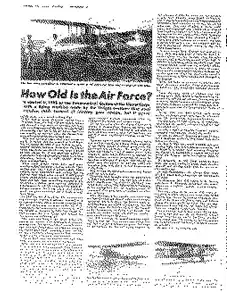
Early U S Army aviation from Wrights to world reach
A chronicle of U S Army aviation from the 1908 Army plane at Fort Myer to 1998 expansion. It covers early experiments, the Signal Corps Aeronautical Section, first pilots, 1917 wartime shortages, the 1919 to 1920 testing era, Billy Mitchells bold claims, and postwar growth leading to global reach. Notable milestones include Wright aircraft, tubular landing gear, Liberty engine, and pioneering flights from Mineola to Toronto and Hawaii. It notes altitude records, instrument flight, and stratosphere balloon feats. The piece ends with a broad view of today’s global reach of U S air power.
MENTIONED IN THIS ARTICLE
Orville Wright
U. S. Army
Fort Myer
Signal Corps
Army
Wright
Air Arm
War Department
F. E. Humphreys
Dayton
Wilbur Wright
F. P. Lahm
Niuchiitie
Germany
America
France
U. S
Eddie Rickenbacker
General Pershing
Frank Luke
U.S. Army Air Service
Guadalcanal
Morocco
Mem Bs
Army Air Service
Mineola
Long Island
Toronto
Civil Airways
Post Office Department
Billy Mitchell
U.S
AEF
Alabama
Martin
Congress
R. W. Schroeder
Albert F. Hegenberger
Lester J. Maitland
California
Hawaii
Latin-America
H. A. Dargue
Charles A. Lindbergh
Army Air Reserve
Paris
James H. Doolittle
Japan
Hegenberger
Army Air Forces
Africa
South Sea Islands
Europe
Atlantic