Genius Shown in Begging in Italy Story
A street beggar in Italy mimes a carriage scene to pressure a nobleman for coins. He claims the girl has two colored eyes and two coppers are due, arguing the nobleman should pity the pair. the narrator pays two coins to end the disruptive scene.
MENTIONED IN THIS ARTICLE
Italy
Kort
Nature's Use for Flowers Explains Plant Roles
Dr Andrew Wilton argues flowers serve purposeful ends beyond human pleasure. He notes seed production propagates species, colors attract pollinators, perfumes lure insects, and bloom structure aids fertilization and cross pollination for stronger offspring.
MENTIONED IN THIS ARTICLE
Andrew Wilton
Honey Bay
Parrot Pranks and a City Lady’s Grim Wish
A New Guatemalan tale unsettles a city with a parrot's crude refrain about the old woman being dead. The bird’s phrases trigger a minister’s intervention as a taste of a moral fable surfaces alongside fragmented, florid verse lines.
MENTIONED IN THIS ARTICLE
Guatemala
Fently
Infant terrible and scandal mark a social visit
An observed scene shows a mother and her child visiting a friend in a row of houses. The hostess notes the difficulty of living amid gossip and dimly lit rooms. A child adds a quip about identifying a house by dirty windows, echoing social judgment.
Curious Ring Found Near Whitman Lake in Porter Mass
Local resident Frank Munroe reported discovering a wooden ring near Whitman lake shaped like a signet with a silver shield at the seal. Diamond shaped silver pieces flank the ring sides, prompting inquiries into its origin and purpose.
MENTIONED IN THIS ARTICLE
Frank Munroe
Porter
Mass
Whitman Lake
Quite the Reverse Singleton
A terse exchange contrasts two speakers, with Wederly denying trouble caused by time at the club and claiming a counteraction by St koopa, while the unnamed young man questions the consequences. The dialog hints at conflict over social expectations and personal liberties within a club setting.
MENTIONED IN THIS ARTICLE
Singleton
Wederly
Prophecy That Went Wrong At Astoria School
The New York Times recounts a joke about R Ki Munkittrich editor of Judge who teased a pupil McFadden about future banking success. A friend recalls a Coney Island tale where Munkittrich is linked to a waiter who served beer.
MENTIONED IN THIS ARTICLE
R. Ki Munkittrich
Judge
McFadden
Munittrick
Land
New York Times
Refusal of Sentry and Laughter in Washington
A Russian ambassador’s coachman was barred from passing a roadway. The coachman insisted his master was Count Cassini, ambassador of the czar, but the sentry replied he would not let through even for a free born American citizen. The piece mocks wealth and official privilege.
MENTIONED IN THIS ARTICLE
Washington
Count Cassini
Zo Czar
Frenchy
Senator Depew Story About a Humorous Moment
Senator Depew recalls a White House tale involving a Midwest colleague and a bright young woman. The exchange centers on humor at a Washington social event and a remark about ice in countries lacking it, as reported by the New York Times.
MENTIONED IN THIS ARTICLE
Depew
New York
Middle West
White House
Senator Blank
Washington Sociery
New York Times
Advertising program pun about hippopotamus joke
An advertising discussion turns into a pun about referencing a hippopotamus. The agent suggests using the word Rippo to cover for a missing animal and avoid misreading the copy as the hippopotamus arriving. The dialogue highlights quick marketing improvisation and wordplay in a promotional program.
It Stopped the Argument William You Must Remember
Comic Cuts presents a dialogue between William and his wife about taste and marriage. The wife notes their mutual choices, and William remains silent, ending the witty exchange with a comic beat.
MENTIONED IN THIS ARTICLE
William
Natural Deduction, Little Mae and the Hunt Inference
A fragmentary dialogue depicts Little Mae debating gender roles through a chain of logical inferences. Fate is invoked as a ratter while a hunting man is linked to motherhood via analogy. The exchange probes assumptions about who pursues and bears responsibilities.
MENTIONED IN THIS ARTICLE
Mae
The Limit Palette Joke About DeAuber Painter
A quip from Palette sketches DeAuber as the most mystical chap ever met. Brosher asks how, and the reply says every landscape he paints seems to flatter nature.
MENTIONED IN THIS ARTICLE
DeAuber
Greek Meets Greek Dealer Says I Recommend Cigar
Customer objects and cites past busts while trying another brand. The exchange unfolds in a humorous wordplay moment as two Greeks discuss tobacco choices and propriety.
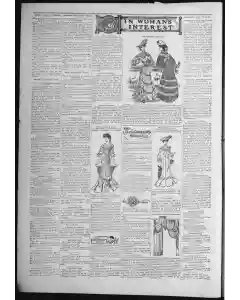
Tallor Costumes And The Short Skirt Suit In Fashion
The era’s clothing blends dressmaker and tailor roles as garments adapt for spring and summer. Transparent or lace accents appear, indoors and out, with etamine, voile, and crêpe de chine fabrics. A short skirt suit features a heavy tolle pattern, side tab detailing, point finishes, a bolero with a pointed collar, a front stole, and a red inner vest paired with a white linen skirt and leather belt.
MENTIONED IN THIS ARTICLE
Tallor
Decorated Larkspur and Tea Frocks in Modern Style
The article discusses Larkspur as a popular floral decoration with newer varieties showing brighter tones and larger blooms. It also describes the Evening Gown with pale lemon organdie and empire wreaths, plus the tea frock as a practical, corset-free indoor dress favored by young English women, featuring light fabrics and minimal fastenings.
Ripeness tips and kitchen hacks from an old notebook
To tell if a cantaloupe is ripe, press the stem with a finger nail and sense a melon odor. Recipes blur with plaster of parts and vine gar as preservatives. A baby's bath height tip uses a box, and chocolate lemonade is praised as a town drink. An ordinary lemonade with grated chocolate adds flavor.
Two Green Gowns Described in Chic Parisien Fashion
A detailed Parisian fashion note describes two women’s gowns. The first is white foulard with green and black figures, white lace insertions, green velvet ribbon, a large cape collar with English embroidery disks, a green satin girdle. The second gown features green silk gauze with white dots, a plaited blouse, Valenciennes lace inserts, velvet-trimmed cuffs, puffed skirt with insertion and velvet frills, and a silk girdle.
Fashion Notes on Evening Gowns and Accessories
A write up on black mousseline with Cluny medal lions forming matronly gowns. Suggestions include matching pocket flaps and collar lapels to a hat, pale gray and white tones, crocheted fringe pendants, white leather wrist bags for all white outfits. Also mentions a black straw hat trimmed with forget me nots and French ideas for tailor made gowns and lace dominated inserts.
MENTIONED IN THIS ARTICLE
Jase
Refrigerator tips and laundry notes from old guide
A historical guide offers kitchen wisdom on keeping the ice compartment full, avoiding heat from hot foods, and not overusing water short on ice. It covers safe storage, damp rooms for appliances, cleaning with warm water and soda, plus a method to restore shrunken flannel garments using cheesecloth and hot iron.
Pale Blue Lavender Costume Description
A costume description notes pale blue fabric trimmed with lavender and blue lace leaves. Lavender floss is used to applique the leaves onto the blue foundation. The bale blue parasol is barred with hello trope.
MENTIONED IN THIS ARTICLE
Laven
Artistic Drapery: Graceful Curves in Irregular Drapes
The piece notes minimal artistic drapery on doors and windows, observing that most people settle for trivial designs. It argues true beauty lies in graceful curves and irregular arrangements that suit a room’s mood and form.
MENTIONED IN THIS ARTICLE
Someason
Drapery design offers color and arrangement tips
The article discusses altering visual size with proper drapery arrangement and color schemes. It describes a 50-inch double-faced velour fabric in solid color, with an over drape in old rose and fringe detailing in a contrasting color.
MENTIONED IN THIS ARTICLE
Nile
Delmonico Cocktail Motive Shapes Bronx Artist Career
A New York Times tale notes how a young artist rose from garment work to church windows and theater ceilings by borrowing a quarter nightly to drink at Delmonico's. He later explains he cares not for the cocktail but for the sight of drinking it there, a boastful symbol of status.
MENTIONED IN THIS ARTICLE
Belmonten’s
Munkittrick
Delmonico's
Delmonico’s
Boticelli
The
Bronx
Delmonica’s
New York Times
Briton praises American sobriety over England
Visiting former British parliament member Hugh Ashford notes the United States shows far less intoxication than Great Britain. He says American workers are sober and industrious, while British workers spend much on strong drink, predicting long term advantage for the Yankee workingman. Washington Post
MENTIONED IN THIS ARTICLE
Albion
Hugh Ashford
Barton
United States
England
Great Britain
America
Washington Post
Japanese Acrobats Toes Highlight Circus Skill
The Philadelphia Record notes a Japanese acrobat sliding along a wire in a black robe with gold dragons. An older circus man praises the trick as uniquely Japanese, claiming Europeans lack the toe mobility to imitate the feat.
MENTIONED IN THIS ARTICLE
Japan
Philadelphia
Jewels Strangely Recovered At Coronation Bazaar Theft
At King Edward's coronation the duchess of Buccleuch misplaced a bracelet that attached to Indy's dress and hid in the garment until a holiday. A New Zealand bazaar, run by a relative of the owner, saw an heirloom stolen from an English clergyman secreted in the glove worn by the wearer.
MENTIONED IN THIS ARTICLE
Edward
Buccleuch
Indy
Finder
New Zealand
Fragmentary verse fragment and garbled names
A distorted text fragment lists names like Phyllis Knows Porathh and Baylis with unclear references. The lines include nonstandard spellings and stray letters, rendering a coherent event or subject indiscernible. No clear action or date emerges.
MENTIONED IN THIS ARTICLE
Phyllis
Modest Estimate of Fire Losses on Fourth
The estimate says about $2,000,000 worth of powder was burnt up on the Fourth. Given the casualties and injuries, the figure does not seem extravagant.
Silent Verdict Spoken Between Two Partners
A terse exchange ends an argument about equality and voice in a private confrontation. The man asserts he is silenced, while the woman contends she is not. The dialogue underscores a dispute over authority and agency within a relationship.
Paper Use For Tickets On New York Elevates Rail
One thousand tons of paper are needed annually to print tickets for the New York elevated railways. A man with a wooden leg was fined $20 for thrashing a constable in Berlin. England first divided into shires in the seventh century.
MENTIONED IN THIS ARTICLE
New York
Berlin
England
Also Mentioned on This Page
Wowann
California
Pacific Coast
Harlem
Pronesr
Manhattan
Los Angeles
France
ELITE

 This is just the beginning! Our collection holds over 300 years of history, including rare newspapers, obituaries, marriage records, birth records, and so much more—most of which you won’t find anywhere else!