Straits for Prussianism in War Survival
Yet the line hints at strategic stakes in a broader conflict. The phrase suggests a view on civilian resilience and political direction during wartime pressures.

 This is just the beginning! Our collection holds over 300 years of history, including rare newspapers, obituaries, marriage records, birth records, and so much more—most of which you won’t find anywhere else!
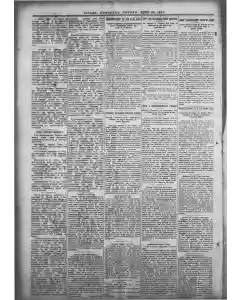
This newspaper page contains 22 articles. Subscribers can read the full text of each article.
Newspaper
The Diller Record
Location
Diller, Nebraska, United States of America
Date
Sep 28, 1917
Page
8
Yet the line hints at strategic stakes in a broader conflict. The phrase suggests a view on civilian resilience and political direction during wartime pressures.
A brief notice from Hele Holden of the Burh ton Railroad warns shippers about current conditions. The communication notes cars available and good weather, stating supply lines, including tea, are solid and rail traffic should proceed smoothly today.
A garbled note describes export grain needs and supply constraints for allies. It warns of price loss and deterioration if wheat is not moved, implying urgency for port handling and liquidity.
Fragmentary wartime verse recounts democracy as stake and duty. Aimed at soldiers, it asserts resolve and unity, urging sustained effort and national spirit as Nebraska stands at the front.
Fragmentary text discusses Liberty Loan Bonds and a war bill linking life and indemnity insurance for soldiers and sailors. It mentions Congress and drafting a wage career, tying the draft to family patriotic duty and a hedge against risk.
The readable text is fragmented and nonsensical, lacking identifiable people places organizations or events to form a coherent summary. It references unspecified citizens and a vague patriotism theme without concrete facts or context.
The article argues potatoes offer starch comparable to bread and can replace bread or cereals in a mixed diet. It notes potatoes have higher water content but a medium potato yields similar starch to two medium bread slices, suggesting five parts potato equal one part cereal. It urges using potatoes when locally plentiful.
The Washington Star notes ongoing war related legislation moving through Congress. Key bills include the first Liberty Bond act enacted May 18 after earlier passage of the April 24 bond bill and embargo and shipping measures. The fourteen to eleven billion dollar figure appears in context of wartime funding.
A fragmented, archaic reflection extols the moral worth of a tugsman over appearances. It argues true honor comes from service in times of need, dismissing polish and social polish as secondary to deeds.
A historical sketch tracing advertising from ancient Egypt and Greece to Rome and the middle ages. It notes papyrus loss notices in Egypt, town criers and musical bands in Greece, wall postings in Roman homes, and public bath postings in Rome before revival of advertising with medieval town criers.
A 1920s report notes how the Bureau of Plant Industry investigated paprika pepper. After studying soil climate and cultivation in the United States, they found suitable conditions in Florence County South Carolina. Farmers agreed to grow it under expert guidance to raise a properly standardized product.
The Fort Worth Star quotes a reader’s view on universal indifference and the melancholy pleasure some find in believing the world is against them. The piece explores existential mood and personal reflection in a concise, darkly humorous tone.
A brief, rough OCR fragment shows a shopper asking someone to buy a toy and a child crying when a pet or item is pulled. The text appears as casual speech with missing context and garbled phrases.
In southern Missouri Uncle Ike Ross runs a mountain post office and refuses to sell more stamps until after dinner. Two city men plead their urgent letters must go to catch the stage, while a sign on the door advertises a fried chicken dinner for fifty cents at the Ike Ross restaurant next door.
In 1198 Saladin died in Damascus leaving a reputation for magnanimity and martial prowess. Six years earlier he defeated Guy de Lusignan and seized Jerusalem as the city endured its desecration. He spared the queen and shed tears at her misery while later avenging Christians with executions. Overall he stood above many rulers of his era.
A quoted scientist notes that a live fish encased in ice may suspend life and revive when thawed slowly. He cites frogs and turtles as examples of cold blooded animals enduring long freezes and reviving after thawing.
A writer notes that across centuries people chase fame money power and other prizes yet the enduring consensus is the desire for something timeless and essential. The passage hints at a universal aim that transcends eras and cultures.
London Tit-Bits explains how early single bottom steamers foundered level due to no subdivisions. Modern vessels with bulkheads sink unevenly with bow or stern up or list to one side, as water cannot find its level. This uneven flooding makes lowering lifeboats difficult and increases loss of life in shipwrecks.
The latest fusion of film and music uses screen projections of a conductor to guide an orchestra. Experiments in Chicago show overtures and songs conducted by baton via moving pictures, with motor driven projectors keeping tempo precise and uninterrupted.
Scientific American notes British and French designers developed folding wing hydroplanes for entente naval forces. Hinged wings allow compact storage on warships, while pilots and crew can ready the aircraft for sustained service in minutes.
Fragment mentions Hedjaz as a kingdom and the notion of separation, with a newly made king ruling over a desolate land and an ark shereef obstructing progress. The text is garbled and lacks concrete events or dates to confirm details.
The passage contrasts thrift with parsimony, arguing no admiration for misers and stating that food clothing and shelter are civilization basics. Once needs are met, people may pursue healthier amusements and productive work, including farm life, though the text is fragmented and unclear in parts.
We want people to find what they are looking for at NewspaperArchive. We are confident that we have the newspapers that will increase the value of your family history or other historical research. With our 7-day free trial, you can view the documents you find for free.
People find the most success using advanced search. Try plugging in keywords, names, dates, and locations, and get matched with results from the entire collection of newspapers at NewspaperArchive!
You can also successfully find newspapers by these browse options. Explore our archives on your own!
Browse by location and discover newspapers from all across the world.
Browse by date and find publications for a specific day or era.
Browse old newspaper publications to find specific newspapers.