Entry at the phen at Diller for through the mails
The notice records an entry at Diller Nebraska indicating mail through the postal system as second class matter. It notes the location and status of the submission within the postal classification.
MENTIONED IN THIS ARTICLE
Diller
Nebr
U. S. Well Fortified Offshore Fortifications Critique
A Lincoln man with naval service says U S coast defenses are highly fortified with mines and disappearing guns. He notes strong coastal fortifications protect major harbors like San Francisco Bay making it hard for warships to damage them. He warns hidden guns and mines could devastate hostile ships entering the bay.
MENTIONED IN THIS ARTICLE
Lincoln
United States Navy
United States
Golden Gate
San Francisco Bay
Naval Service
War boosts drug prices in Lincoln display
A local Lincoln druggist shows a window exhibit on how the European war pushes medicine costs. Items like Digitalis and gum camphor rise sharply with percentages listed from 85 to 350 percent reflecting war effects.
MENTIONED IN THIS ARTICLE
Lincoln
Europe
Persia
England
Italy
Asia
India
Japan
China
Sage
Parisa
Spain
War in Europe Echoes a Fabled Cat Fight Tale
The description likens Europe’s conflict to a fierce cat fight that leaves nothing but tails, suggesting a brutal clash with potential silence on casualties and a grim, mythical ending. The remark frames the war as an exhausting, nearly exhausting struggle with uncertain narrative to follow.
MENTIONED IN THIS ARTICLE
Europe
Kilkenny
Faultfinding drains mood. talk kindly instead
The text urges speaking well of others for better health, noting that dwelling on faults makes you grouchy and suggesting you focus on people you can praise rather than criticize.
Judge Allows Wife to Name Husband’s Punishment
In Los Angeles a judge permits a wife to decide her husband’s penalty and she sentences him to one year on the rockpile. The remark suggests future judges should perform the task themselves when their turn comes.
MENTIONED IN THIS ARTICLE
Los Angeles
Battle reporting clash as Allies and Germans disagree
Eyewitness accounts from both sides create conflicting narratives of a recent battle. Allied reporters describe maneuvers and outcomes while German sources contest the details, leaving readers to weigh competing perspectives.
Battle lines loom large as rivers name modern wars
The piece notes that today’s warfare creates long battle lines and that rivers increasingly serve as labels for conflicts, illustrating how geography dominates naming of battles in contemporary combat.
Removalists seek to abandon Lincoln campus building
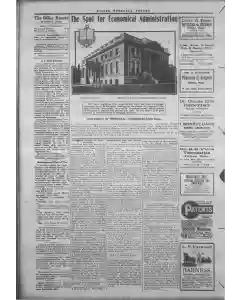
The engraving shows one of 15 University structures on Lincoln's city campus. The removalists urge Nebraskans to abandon these buildings and convert them into junk, arguing against wasteful preservation and urging a business view of the campus assets.
MENTIONED IN THIS ARTICLE
Lincoln
Nebraska
University of Nebraska Administration Hall Built 1905 06
The University of Nebraska Administration Hall is described as built in 1905 06 of common brick with terra cotta trim and a temporary metal roof. It cost 35000 and is praised as an efficient office building near Lincoln's commercial center. The note adds the city campus could be expanded with a 300000 investment to about 40 acres.
MENTIONED IN THIS ARTICLE
Lincoln
Distinct Schools of Agriculture Urged by Bushnell
H M Bushnell argues in Trade Review that the college of agriculture and the school of agriculture are separate. He says most farm youth seek practical instruction at the school level, not university study, and warns that moving the university to the farm would favor the 5 percent who pursue higher education over the 95 percent who need practical farming training.
MENTIONED IN THIS ARTICLE
School OF Agriculture
College of Agriculture
State Farm
H. M. Bushnell
Trade Review
Vote for Home Campus Extension on University Ballot
A brief voting note instructs marking an X in the second square on the ballot labeled Little ballot University Location. The fragment urges participation in a campus extension vote and reminds voters to follow the second-square mark.
MENTIONED IN THIS ARTICLE
Mark X
Washington and the University face removal debate
The piece argues that moving the national capital is impractical and unwise, noting Washington's advantages and the high costs of relocation. It extends the point to the University of Nebraska, stating the university should not be moved due to disruption, loss of efficiency, and lasting negative impact on students and programs.
MENTIONED IN THIS ARTICLE
Washington
Farmers’ Congress Special Commission
National
White House
Capitol
Cross Roads
Tenn
Kanapolis
Kans
Woodrow Wilson
Washington, D. C
Jawn
America
School of Agriculture
Nebraska
Move Supreme Court and Library from Capitol to a university building
Mesers Haller and Coupland propose abandoning part of fifteen state university buildings and moving the Supreme Court and State Library there. The question is what to do with the remaining fourteen buildings and whether removing the Supreme Court and Library a mile and a quarter from the Governor and Attorney General offices is wise.
MENTIONED IN THIS ARTICLE
Haller
Coupland
Supreme Court
State Library
State Capitol
Supreme Court and Library
Governor's Office
Attorney General's Office
The Doctrine of Selfishness in University Debate
A University Home Campus Extension Committee reply argues that removal arguments hinge on selfish motives. It compares critics to Clay Clement’s old philosophy and contends some selfishness drives progress and the push for a top ranked, improved campus.
MENTIONED IN THIS ARTICLE
Edward Martin
Omaha
Clay Clement
State Farm
University of Nebraska
University Home Campus Extension Committee
The Folly of Removal Debate at Lincoln Campus
In a 19th century college editorial the campus faces crowding with fifteen brick buildings valued at a million and a half. It argues adding forty acres nearby for up to 300 000 would relieve congestion without disturbing current facilities and would speed new buildings. It contrasts removal and abandonment with a plan to expand on site and notes long time and cost implications.
MENTIONED IN THIS ARTICLE
City of Lincoln
Oe An University
O — Jook
D. Eager
Ily Star
Also Mentioned on This Page
The
Diller Record
Frank T. Pearce
U. S
Cornell
University OF Nebraska—Administration Hall
Washington and the
Univer
Sity
O. C. Diehl
Guy H. Bezler
D. C
Nature Cures
Neuman Bldg
Wymore
DR. H. Bauguess
Diller, Nebr
Claude Ellis
Diller, Nebraska
J. Monroe Davis
First National Bank
Fairbury
Neb
Viers
Diller, Neb
Waggoner Bros
HABA
Maracanna
Washington, D
L. P. Raymond

 This is just the beginning! Our collection holds over 300 years of history, including rare newspapers, obituaries, marriage records, birth records, and so much more—most of which you won’t find anywhere else!