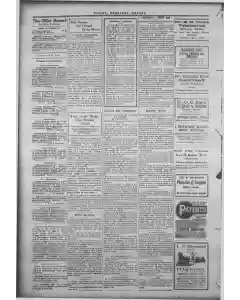
Diller Nebraska Postal Notice from June 12 1914
Notice indicates a mail transmission at the Diller post office as second class matter with a 5 cent per line insertion rate. Dated Friday June 12 1914.
MENTIONED IN THIS ARTICLE
Diller
Nebr
County Commissioner Candidates Announce Candidacies
Notices show Geo F Riddle pledging to serve if elected and promising the best effort. Rohrbaugh and Peter Gill announce county commissioner candidacies in Jefferson county Nebraska for the First Commissioner District, subject to Republican and Democrat primary voters in August 1914.
MENTIONED IN THIS ARTICLE
Geo. F. Riddle
Commission
Jefferson County
Peeter Gill
Fehrman Declares Candidacy for Jefferson County Clerk
A. Fehrman announces candidacy for the office of Jefferson County Clerk in Nebraska. He runs as a Republican and states the campaign is subject to the will of the electors at the primary on August 18, 1914.
MENTIONED IN THIS ARTICLE
Jefferson County
Nebraska
Bell
A. Fehlman
Jefferson County Non-partisan Judicial Ticket Candidate
Candidate announces run for County Judge in Jefferson County on the Non-partisan Judicial ticket. Primary election date August 18 noted.
MENTIONED IN THIS ARTICLE
Jefferson County
Lambert seeks Jefferson county nomination under Democratic party
L R Lambert announces candidacy for Representative from Jefferson county. He lists Rock Creek as support base and seeks voters approval in progressive primaries. Blauser names L E Blauser as party rival in the campaign context.
MENTIONED IN THIS ARTICLE
Jefferee
Rock Creek
L. R. Lambert
Election primary for county officials set for August 18 1914
Candidate Sosa pledges to support Banari and to continue as superintendent at Siocie Hastanes. The Republican auditors decide on August 18 1914 as the primary date to determine county officials. Ousome L Shaffer notes the event.
MENTIONED IN THIS ARTICLE
Sosa
Siocie
Hastanes
Ousome L. Shaffer
Flies Reproduce Rapidly Warns Against Swatting
A historical note explains the fly life cycle from egg to generations, counting 120 eggs per female and rapid maturation. It highlights that one fly can produce millions of descendants within two months, urging decisive action to reduce numbers.
No title available in readable text
A political commentary notes that every man has a right to work but many do not exercise it and that loyalty to party can prevent accepting votes from opposition. It also remarks that rising living costs do not affect the potato bug.
Moving pictures and theatre in New York debate
A commentator argues New York has too many theatres and that consolidating would help the industry. He cites Berlin as a recent example where half of the venues closed in two years, improving the field for survivors. He says movies neither harm nor replace real theater, though he enjoys them.
MENTIONED IN THIS ARTICLE
New York
Rlin
Opinion on capital punishment and prevention measures
A speaker argues against capital punishment and media sensationalism, claiming newspapers romanticize the electric chair and that weak minded individuals and children show potential criminal tendencies. Proposes institutions or a board to detect mental deficiency and keep offenders under observation or rehabilitation.
Notes on Bees and Honey Production
This article discusses using a honey extractor to save time, expanding from strong colonies, and rearing queens to boost honey yields. It compares East Indian and Cyprian bees, noting Cyprians can yield about 1000 pounds per season, endure winter, and defend hives against robbers.
Portrait debate on Carlyle life size authenticity
The fragment notes a discussion about a Carlyle portrait and its scale, with the artist replying that the work was not life size. The remark suggests a deliberate departure from conventional proportion and raises questions about intent.
MENTIONED IN THIS ARTICLE
Carlyle
Tween furrows and the call for child friendly work
A Country Gentleman essay argues against forced farm tasks for children. It promotes directed play with freedom to nurture enthusiasm in youth. It notes child labor under harsh masters harms upbringing and rural poverty remains limited to poorer lands with potential for better farming.
Alfalfa Soil Treatment Inoculation Advice
J G Hutton explains alfalfa requires nitrogen fixing bacteria and nodules. Inoculate with soil from established fields, using 200 to 500 pounds per acre, avoiding pest-infested or unhealthy fields, and lime sour soils to improve growth.
MENTIONED IN THIS ARTICLE
South Dakota
Nebraska Experiment Station
Agronomy Department
State Agricultural College
An Extraordinary Man
A Chicago Record-Herald note quotes a speaker praising her husband as extraordinary for finding items in closets. The exchange highlights light humor about marital admiration and memory.
MENTIONED IN THIS ARTICLE
Chicago Record-Herald
Beth Cautious M D Opposes Operation Price Question
A fragment shows Beth Cautious M D discussing whether asking for price implies the need for an operation and if one should reveal cost. The exchange centers on medical pricing and ethical implications.
MENTIONED IN THIS ARTICLE
Beth
M. D
Manning
Fluorine the Rabid Gas Shocks the Chemical World
The article describes fluorine as a volatile powerful element that resists isolation and reacts violently with many substances. It notes its discovery by Moissan and its tendency to tear apart compounds, releasing heat and forming hydrofluoric acid that can dissolve glass and water, while sparing only platinum and lead.
MENTIONED IN THIS ARTICLE
Moissan
Burning Water: Wet Coal Produces More Heat Than Dry
The Philadelphia North American notes that damp coal yields significantly more heat than dry coal. Wet coal burns hotter in furnaces and stoves, with large chunks soaking for minutes boosting heat by about half. Wet coal also aids air tight furnaces and mine conditions, though dampness complicates extinguishing portions of a fire.
MENTIONED IN THIS ARTICLE
Philadelphia
Allah and the Cotton Worm in The Banks of the Nile
An English cotton worm inspector asks an Egyptian sheik about the pest. The sheik says there are no cotton worms, and explains that punishment or coercion cannot force picking. The sheik attributes the lack of worms to Allah and remains resolute about future work being by divine will.
MENTIONED IN THIS ARTICLE
Allah
John A. Todds
The
Nile
The Annual Rainfall Global Estimate Summary
Sir John Murray estimates total global land rainfall at 29 347 4 cubic miles with 6 524 cubic miles draining via rivers. River water weighs about 4 205 650 000 tons per cubic mile and dissolves around 420 000 tons of foreign matter. About 2 735 000 000 tons of solids reach the ocean each year United States Geological Survey.
MENTIONED IN THIS ARTICLE
Sir John Murray
Globe
United States Geological Survey
Two Wise Ones In A Quiet Household
A young man removes cigars from his vest, places them on a piano, and opens his arms. The girl meets the moment with cool retort, accusing him of past loves as tension rises in a private moment.
MENTIONED IN THIS ARTICLE
Chicago _Record-Herald
Never Did
A courtroom dialogue features a judge and parties in a terse exchange about lingering after a goodnight farewell with a witty remark implied by the judge. The exchange highlights restraint and implied propriety without graphic detail.
Also Mentioned on This Page
the Diller
Frank T. Pearce
Ublican
Rohrbaugh
Democratic Co
L. E. Blauser
Katherine B. Davis
Commissioner of Correction
New York City
Board of Parole
Board of Rehabilitation
J. G. Hutton
State College
Miller
Ncme
Waggoner Bros
Claude Ellis
Deintist
Diller, Nebraska
Odell
J.monroe Davis
First National Bank
Fairbury
Neb
Guy H. Bezler
D. C
Ridays
Akeoe
DR. H. Bauguess
Diller, Nebr
Sei
Washington
L. P. Raymond
Comaa

 This is just the beginning! Our collection holds over 300 years of history, including rare newspapers, obituaries, marriage records, birth records, and so much more—most of which you won’t find anywhere else!